Hello,
I found the IBM schools computer in the IBM Hursley museum. That is the machine you see in those pictures. Next to it was a single sheet quick reference card. That had the full instruction set on it and some operating instructions. That got me interested as there seemed to be enough information on that sheet to have a go at making a replica. After some research I found a few documents and even photos of it being used in a school. There was enough to create a replica using a RP Pico, some buttons and a small OLED display.
That is shown here:
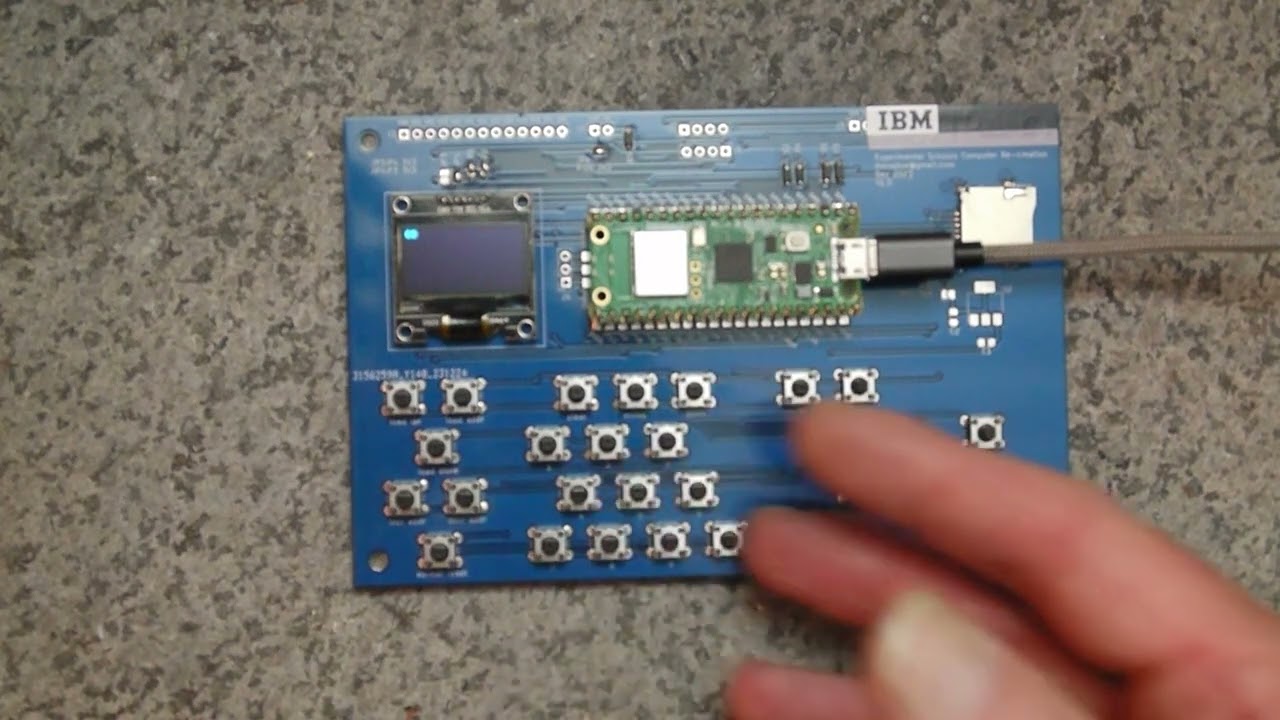
The original was designed and built in Hursley in the UK and was, I think, based on the IBM360 type of SLT circuitry. I asked the museum curators if they would open the museum machine with a view to maybe getting it running again or replicating at the hardware level. They did open the machine and found it was actually just case. There was no functioning hardware inside at all, even the keyboard is a non functional panel. It seems that this machine was just a mechanical prototype of some sort.
The architecture of the computer is odd by todays standards, and very much aimed at mathematics. It runs in BCD, so decimal, has 32 bit registers, apart from some double length registers of 64 bits and 200 words of core store. The floating point instructions are actually coded in the machine language of the ‘processor’ and stored in one half of core store. they are run as normal instructions but a branch to core is made to run the actual code (extracodes). This does allow custom instructions to be created to replace the standard floating point instructions, or add to them. There is an example of this in one of the documents I found.
i did manage to collect documents about the machine, there was the original quick reference sheet, and a paper about the unit that describes it’s architecture in detail was fairly easy to find. I actually managed to buy a paper copy of that document on ebay. There are some patents that describe aspects of the machine, and some other references on the internet. After I had found all this information I was still in the position of having no original programs to run on the replica. I did find a reference to a 'First course on the schools computer" which I thought might have useful information. I managed to track one copy down at Oxford University and managed to get permission to go there and scan it. This I did and that document does have some programs for the machine. What I still don’t have is the extracode implementation of the floating point instructions, unfortunately. I have written the replica version in a form that should be codable in the machine language of the schools computer, but I haven’t done that yet.
The replica can run any of the programs that the original could, but it doesn’t have the floating point code in the ‘extracodes’.
After i made the small PCB replica, I gave one to the Hursley museum, and I mentioned that I was thinking of making a half size replica of the machine. The museum were interested and so I did. The replica is a fairly faithful half scale, made in powder coated aluminium sheet. The electronics and code is a version of the small replica, but altered to run with a largeer display and a touch keyboard, as the original had. The screen is housed in a replica TV to match the way the original was used. The electronics is also in the TV, so the metal case is just for the keyboard, (it’s also a dummy, like the museum version, I suppose).
I think this is the first machine that used a domestic TV as output, and a tape player for storage, I can’t find anything earlier. The replica uses an SD card.
The machine never made it into full production, but about ten were made and sent to schools around the country. There’s a photograph of it being used in one school, I have managed to work out where some of the units went, but not all of them. There’s some mention on the internet of mathematical investigations that some school pupils undertook using the machine, so it did move from being a teaching aid into being a useful tool, well, to a small extent.
I have a github with all the documents, and they are also on the Hursley museum website.
I think to call this a rare computer is understating it a bit, as no fully complete example exists, as far as I’m aware. I’d really like to know if one does still exist, that would be amazing, but unlikely. Similarly if there are any programs that were written for it somewhere, I’d really like to see them.
I have no idea what happened to the machines at the end of testing.
It did have some impact though, I believe one of the designers of Haskell used it, and some other pupils went on to work with computers, from bits of information I found on the internet.