Was this written by AI?
It seems like the question on people’s minds these days. It was asked of Haitian-Canadian author Thélyson Orélien’s debut novel, It Was Either That Or Die, which gained rave reviews until questions arose about whether it had been written with the help of AI; he denied it, but critics using AI detectors like Pangram said otherwise. The book was yanked from consideration from a major literary prize.
In contrast, when billionaire Stanley Druckenmiller came clean about getting AI help to write an opinion piece in The Wall Street Journal critiquing Treasury Secretary Scott Bessent’s interventions in the bond markets, the paper just shrugged. My own shop, Semafor, joined the fray, doing an analysis of various op-ed pieces and flagging one, by Dartmouth provost Santiago Schnell as AI-written.
It feels like open season on hunting down AI use — on being able to answer the question, was this written by AI?
But should we care? And why? And, critically, when should we care?
And more importantly (for this Substack, at least), why does it matter for journalists and journalism?
Warning: Long post ahead. But all human-generated!
There’s lots of good reasons to dislike the growing encroachment of AI into writing, including fears that it will erode critical thinking skills, that the process of writing is thinking, that it feels inauthentic, that it’s theft of other people’s words and ideas, that it’s burning up the planet, and more. I’m sympathetic to many of those arguments, and have some of the same fears as well.
But it’s a debate that could probably use some more nuance as well. Perhaps I’m tilting at straw men — look! a mixed metaphor that proves this wasn’t AI-generated! — but many of the arguments I see compress the issues into a binary did-you-or-didn’t-you test, followed by the should-you-or-shouldn’t-you question. And there ought to be a lot more to it than that.
And just to get it out of the way: My two cents is that there are lots of good reasons to not want AI-generated text in some situations, and lots of good reasons to embrace it in others; but we too often conflate the two.
I’m going to assume this will generate a lot of hate mail; lots of people have very strong feelings about AI and writing, including any number of my friends. This may well be the next let’s-not-talk-about-it topic at Thanksgiving this year. I never really liked turkey anyway.
Let’s start with the question of whether anyone can really tell if something is AI-generated or assisted. If we’re going to call out AI, let’s make sure we know it when we see it. Sure, we can all identify the quickly generated uncanny valley copy that plagues LinkedIn, but there’s a ton of grey area where there aren’t definitive answers. Orélien denied he used AI, but it’s functionally impossible to prove a negative, short of him offering up handwritten notes from pre-2022. Pangram, the leading tool for AI detection, claims a minuscule false positive rate — and, to be sure, a number of researchers have concluded it’s pretty accurate — but then again, you can drive a false positive rate down by increasing the amount of unmistakably human-generated text in the denominator, so I’m not sure what that number really tells us.
Complicating this is the existence of anti-AI detection “humanizing” technology, which uses AI to make AI-generated work read more like human-written text.
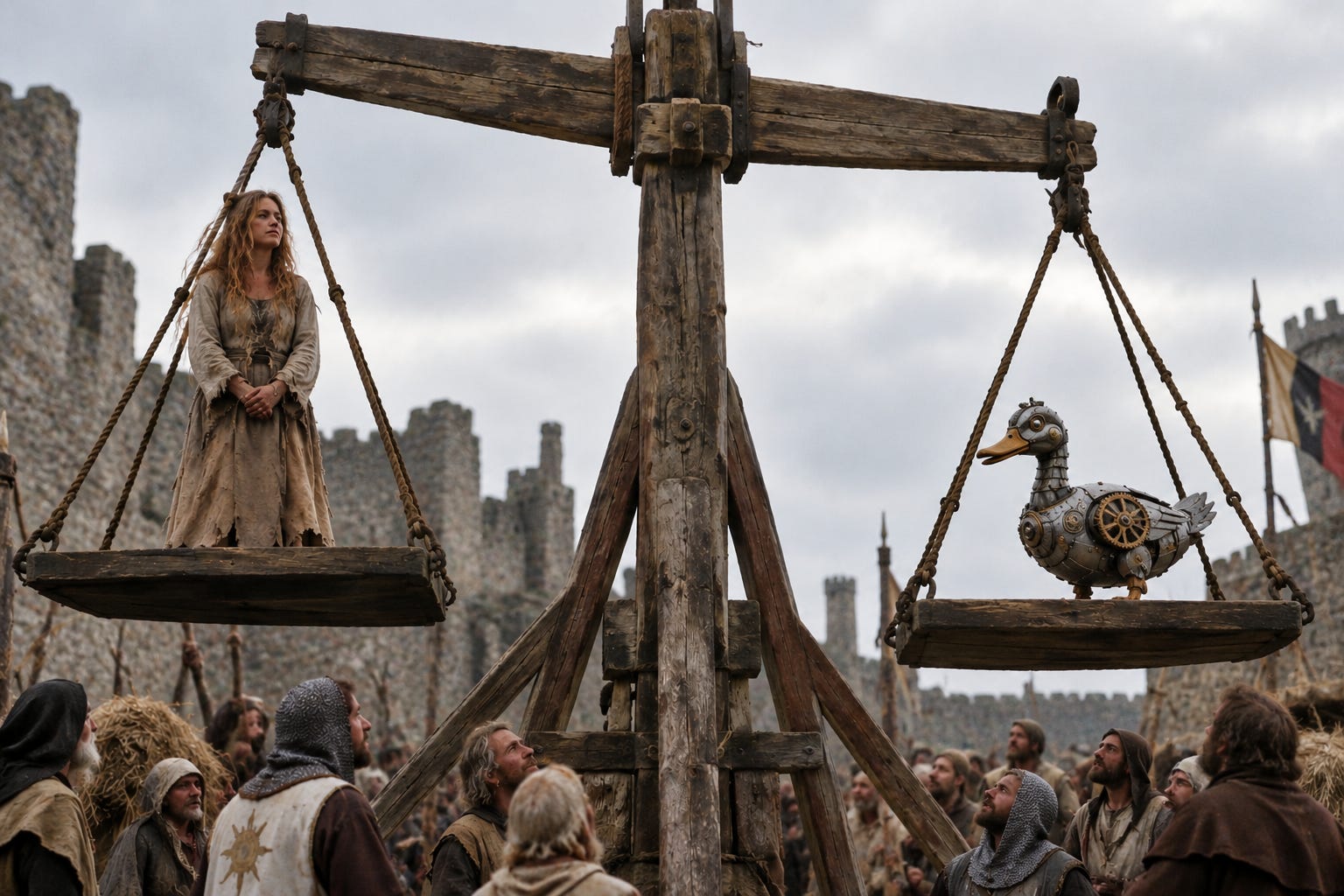
Which is to say, we’re basing accusations — that can’t really be rebutted — off a tool whose inner workings we don’t fully understand. It recalls the hilarious Monty Python scene where a medieval village tries to determine if a woman is a witch; the conclusion after some tortured and incoherent — but very funny — logic is that, if she weighs the same as a duck, she’s a witch. Which she does. “It’s a fair cop,” she concedes.
But let’s say we could tell, with some degree of confidence, how much AI had contributed to a piece of text. (The watermarking that Anthropic and others have promised seems to be a good step in that direction; the explanation is technical, but the workings are ingenious.)
When does it matter? Authenticity is a good measure. If we’re judging a work that’s ostensibly the product of a particular person, then we don’t want it to be ghost-written, whether by a machine or a human. We feel cheated if the live performance we’re watching is actually lip-synced. (Milli Vanilli comes to mind.) When we reward the form of words as much as the ideas — fiction, features and the like — we want to know the person we’re rewarding actually assembled those words themselves.
But what if it’s ideas we want, not words or authenticity? Lots of op-eds are ghost-written, and we don’t care — no one seriously thinks the President of Wakanda (or whoever) is slaving over a 1,200-word piece for The Wall Street Journal; he has people for that. And loads of news stories are the collective effort of reporters, writers, bureau chiefs, copy editors and so on; all of them are humans, but how different would it be if some of them were machines? In the pre-AI days, Reuters — and the AP and Bloomberg — had systems that searched for patterns in financial data and added machine-generated text to stories that went out under a reporter’s byline.
And then there’s the work that I think everyone agrees — but I could be wrong — we’re fine to use AI for: FOIA requests, stock replies, bullet-point summaries, headline suggestions.
The point is, there’s a spectrum of use cases.
And also a spectrum of uses.
Should AI be used for research? To summarize documents? To brainstorm? To copy edit? To offer suggestions on structural fixes? To look for logical flaws? To strawman or steelman an argument? To suggest alternative phrasing? Where should we draw the line?
I’m not making an argument for one side of the debate or the other (well, OK, I am), I’m really making the case that we need to be much more specific about what we’re fighting about — and for.
I had dinner with the daughter of a friend the other day; she’s just graduating from a master’s program in Dublin, and she talked about how the school she attended had a useful system of defining different “levels” of AI use that were allowed in class work. Level 1 (I’m making it up) might be that it’s OK for research; Level 2 for brainstorming, and so on. So one exercise might be a Level 1 project, and another a Level 3 exam. Having some agreed-on language wouldn’t hurt for cleaner and more specific disclosure — and debate.
It’s true, certainly, that surrendering cognitive processes to a machine that appears to think as well as we do is probably not a great long-term species survival strategy. Unthinking delegation is a bad idea. But that’s an argument against lazy working more than it is against a particular technology, and we should be specific about what we think people shouldn’t delegate, and when. When I was in the army, I needed to learn map reading skills; letting me use Apple Maps then would have defeated the purpose. But it makes no sense now to require me to juggle a huge map book while I’m driving; the ban is situational. I’m sure I’ve lost some spatial reasoning capability because of my dependence on mapping software, but it’s also possible that I’ve gained something with the extra brain space that has opened up (beyond listening to Taylor Swift on the open road.)
But there’s a broader point, and it’s really about what we prize. We’re a communicative species, by and large, and we’ve tended to reward those who communicate well, even if they’re not the sharpest stick in the barrel (see: more mixed metaphors!) We have a machine that can level some of those disparities now; is that a good thing or a bad thing? I don’t disagree that writing is thinking, and good thinking requires some level of writing; but we can also conflate great writing with great thinking, and inarticulate writing with inarticulate thinking.
Wire services are full of smart local reporters who aren’t fluent in English, and whose work was historically rewritten by an expat sent out from home base to collect their reporting and turn it into usable English prose. The expat usually got the house, the fat salary, the car and the kudos. Could AI systems level that playing field and center the locals’ reporting work instead of the expats’ writing work?
It’s one thing to argue that everyone should write their own words if you’re a fluent writer, and it’s a skill that has carried you well through the world; it’s another if writing has been the handicap that has prevented your other talents from shining through.
And more importantly for journalism: Readers of this Substack know that I’m a proponent of the idea that AI systems will allow us to create much more personalized news to bring in more useful information and perspectives for readers, and especially historically underserved readers. We can’t do that without some AI writing, and we should be debating the pros and cons of when AI should or shouldn’t be used to create such stories.
Which is to say, we’ve put a ton of effort into detecting AI use; perhaps we should be spending as much effort digging into what we gain and lose from using it.
And now I’ll brace for the hate mail.
A note: This post was human-crafted, albeit with electrons on a screen. I bantered back and forth with Claude about the ideas behind it, and got some genuinely good feedback, some of which I incorporated and some which I ignored (and which Claude then kept badgering me about.) It also copy edited the final draft, flagging mixed metaphors — which, for the record, are intentional — bad grammar and spelling mistakes. It also usually tells me I write too long, and I often tell it it writes terribly, which it (apparently) accepts as criticism before telling me to go back to work. The image that accompanies this post was generated by ChatGPT, as are the vast majority of the images on this Substack.
Also, all my posts are reviewed by my partner in crime, Adiel Kaplan, the Tow-Knight Center’s Program Director, who I am reliably informed — but have not confirmed — is human.