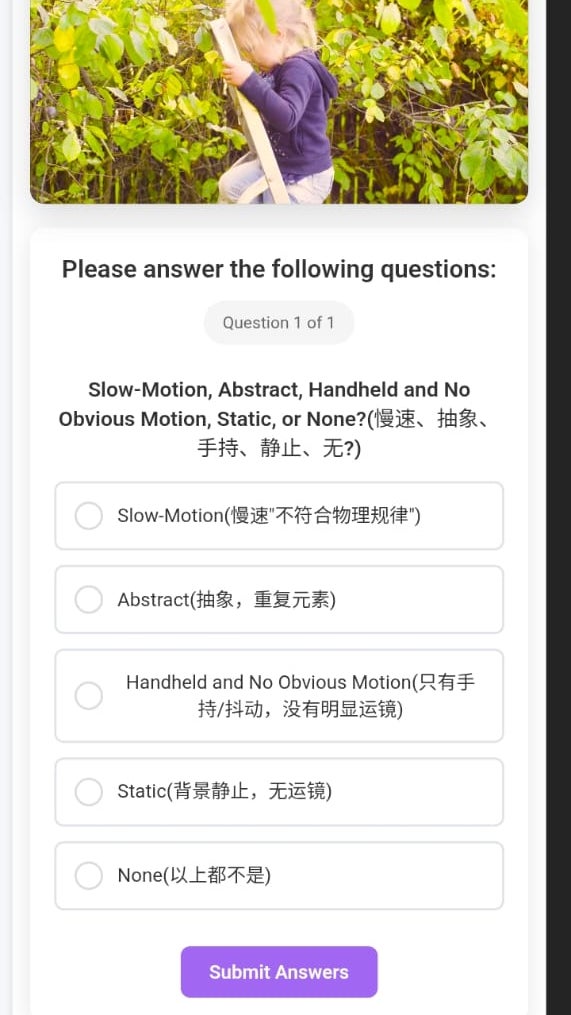
It’s 3 a.m. in Nairobi, and Ken’s laptop and phone glow in the dark. On one screen, waves crash against a beach in a video, and on the other, a woman stretches into a yoga pose. He has watched each clip several times, trying to decide whether or not it’s in slow motion.
His phone buzzes. In a WhatsApp message, a teammate informs him that she has already labelled 2,200 video clips that day, 200 short of her daily goal. “Are you close to the target? I am so sleepy, I think I will continue tomorrow,” she says.
Ken, who asked to be identified by a pseudonym, fearing loss of work, is among the young Kenyans quietly fueling China’s artificial intelligence ambitions from Nairobi. For as little as 700 Kenyan shillings ($5.42), the workers — mostly university students and recent graduates — spend around 12 hours a day labeling thousands of short videos for China-based companies.
Kenya has long been a data labor hub for U.S. tech giants like Meta and OpenAI. Rest of World’s reporting shows that in recent months, Chinese AI firms have been moving in, but with less transparency.
“Chinese AI firms have quietly become some of the world’s largest buyers of human-labeled data. What distinguishes their expansion isn’t just scale, but opacity — a low-visibility supply chain stitched across East Africa, Southeast Asia, and the Middle East,” Payal Arora, professor of inclusive AI culture, media, and culture studies at Utrecht University in the Netherlands, told Rest of World. “Unlike the U.S. firms that are increasingly scrutinized, the Chinese operations often operate through layers of subcontractors, making accountability far harder to trace. … The lack of transparency means we know far less about labor conditions, wage structures, or worker protections than we should.”
Rest of World reached out to some of China’s largest AI companies to inquire if they outsource data labeling work to Kenya and how they connect with workers in the country, but did not receive responses.
Over the past decade, U.S. tech companies have relied on Kenyan workers for back-end tech work such as data labeling. Companies including Meta, Google, and OpenAI work with outsourcing firms like Sama, CloudFactory, and Turing in Kenya. These arrangements have led to a series of complaints about low pay, toxic office culture, and the traumatic nature of work without mental health support. In recent years, companies have faced public protests and several court cases in Kenya as local workers challenge how Silicon Valley employers treat them.
China, which is challenging the U.S.’ dominance in global AI, is tapping Kenyan workers for similar assignments. Unlike American companies, however, Chinese firms tend to outsource work more informally.
Rest of World spoke to 10 annotators who said they work for Chinese companies, based on the nature of the content they annotate. A few team leaders said they have met their Chinese managers over calls. None of the annotators knew the names of the companies behind the projects. They only knew the middlemen: third-party companies or agents.
The workers were onboarded via a simple Google Form, managed through WhatsApp groups of up to 30 members, and paid through the local fintech app M-Pesa. There is no formal contract, and work is executed through short-term projects of around two weeks, during which the annotators are expected to work seven days a week.
“We just get on the platform where some Chinese [managers] organize the work. We have no idea what they are doing with this annotation work,” David, who has been doing this work for three months, told Rest of World. He asked to be identified by a pseudonym, as he feared losing his income.
The workers said they do not have access to any formal email IDs, contracts, human resources systems, or offices. They handle the annotation work on portals with no publicly available information, such as Vranno.ai, which opens to a login page and cannot be accessed without approval. Work-related instructions and feedback reach the workers through automated reports on WhatsApp groups.
The annotators who spoke to Rest of World said they had found this work via recommendations from existing workers.
David said his classmate had recommended him. After filling out a recruitment form, David was added to a WhatsApp group with around 10 other members, including a supervisor. This would be his team, and they started with a “simulation phase” where they all needed to annotate 20,000 clips per day with 90% accuracy. Each clip was up to 10 seconds long. Low accuracy could lead to the entire team being fired from the project. After the trial period, the team was responsible for annotating up to 260,000 videos a day or 26,000 videos per person, which could take up to 12 hours for beginners, David said.
Experienced annotators can manage the work in as few as eight hours by splitting their screens, using both phone and computer, and recognizing patterns, Ken told Rest of World. “You get into the zone and zone out. You become a zombie,” he said. “If I stop, I lag. If I think, I fail. You need to sit and have time with it because if you’re doing something else, you won’t make it.”
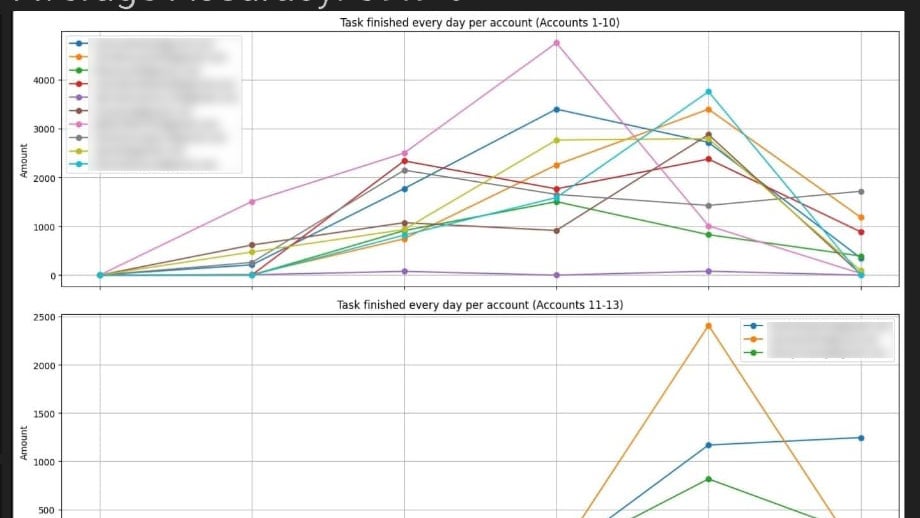
Screenshots and chat logs reviewed by Rest of World show that the WhatsApp groups work like digital factory floors: daily rankings, production charts, motivational messages, and reminders to push harder.
Every day, administrators share reports ranking output and accuracy. They also hold stand-up calls several times a week to review reports, fix accuracy issues, and push the team to work faster. When one worker lags, others are ordered to pick up the slack. To get paid, workers must maintain at least 85% accuracy.
“The bigger the project, the more people we hire and the lower the rates [we offer],” a Kenyan supervisor, who ran a team of 30, told Rest of World. “We cannot have people full-time [staff with employment benefits], so we set that expectation.”
It’s a model built for distance and deniability, Joan Kinyua, president of the Data Labelers Association, a Nairobi-based AI workers’ union, told Rest of World.
“It’s capitalism and the height of digital colonialism. Oftentimes, supervisors don’t even mention who you are working for, but you’d be able to tell from the faces in the content,” she said.
AI may feel futuristic, but it is built on profoundly old-world economics.”
Chinese companies have been accused of exploiting student interns back home. In 2023, Rest of World reported how Chinese companies employed vast armies of low-wage data annotators, often recruited from vocational schools or routed through “inland-sourced” labeling centers in poorer provinces like Gansu, Guizhou, and Henan to keep costs low and scale quickly.
“AI may feel futuristic, but it is built on profoundly old-world economics. Models look automated, but behind the scenes, they are propped up by armies of low-paid workers doing psychologically draining tasks for just a few dollars a day,” Arora said. “Companies rely on cheap annotation not because it’s optional, but because the current AI business model depends on absorbing massive training costs while still competing on speed. Cheap labor is the silent subsidy keeping the AI boom afloat. … Without fair labor practices, the future of AI will be fast — but fundamentally unjust.”
Young Kenyans have flocked to such work due to chronic unemployment in the country, which stood at 67% as of July 2025, according to data from the Federation of Kenya Employers.
“Kenya is attractive for global outsourcing because if you look into the global BPO [business process outsourcing] index, Kenya hits all the top spots: language, literacy, power stability, and a tech-savvy population familiar with Western culture,” Shikoh Gitau, founder and CEO of Qhala, a Nairobi-based IT provider, told Rest of World. “Our time zone works magic. We can work with the West Coast of the U.S. and the east coast of Asia without much adjustment.”
Gitau said such work could be a way for young Kenyans to earn, but the country “must proactively build policies and frameworks that guide the industry and ensure our people are protected.”
“They [companies] are all here simply because of cheap labor,” said Kinyua, from the Data Labelers Association. “Companies know Kenyans will give them quality work done at very minimal or zero cost. At times, these workers don’t get paid because they don’t have a direct link with the organization they’ve been working for or what their work is helping to build. No contracts, even so, it’s your words against theirs.”
Kenyan authorities are aware of local workers taking up data annotation tasks with Chinese companies, but the country’s current labor laws do not protect them, Florence Kimata, a member of the Kenya National Innovation Technical Committee, a board responsible for planning and executing national innovation activities, told Rest of World. The Kenyan government is in the process of formulating regulations for this outsourcing industry, which will prioritize protecting vulnerable workers, she said.
“A lot of work is going on around firmly identifying who should be held accountable as the employers of these workers, between the outsourcing firms and the companies contracting them,” said Kimata. “The framework should have been finalized by July of this year, but there is more consulting work still ongoing between the labor body and the labor ministry, and the ICT [information and communication technology] ministry.”