Lately I’ve been reading Ron Chernow’s lively and well-written biography of Mark Twain, one of my personal heroes. “Travel is fatal to prejudice, bigotry, and narrow-mindedness, and many of our people need it sorely on these accounts,” Twain wrote in 1869. “Broad, wholesome, charitable views of men and things cannot be acquired by vegetating in one little corner of the earth all one’s lifetime.”
With that spirit in mind, and of course with current events in mind as well, I thought I’d share some photographs I took during my visit to Iran in September of 2017. I was there to attend the wedding of my sister-in-law. Afterwards, we took the opportunity to travel with my wife’s family in a big loop down from Tehran to the historical capital of Isfahan, then southeast to Shiraz (Iran’s wine country), and then back up to Tehran via the Great Salt Desert and the amazingly well-preserved Silk Road city of Yazd.
I am not one of those historians who thinks that learning the history of the world automatically makes you a better person. But I do agree with Twain that there is something fundamentally good not just about traveling but about exposing yourself to the cultural productions of societies outside your childhood experience — via words, via speech, and via images.
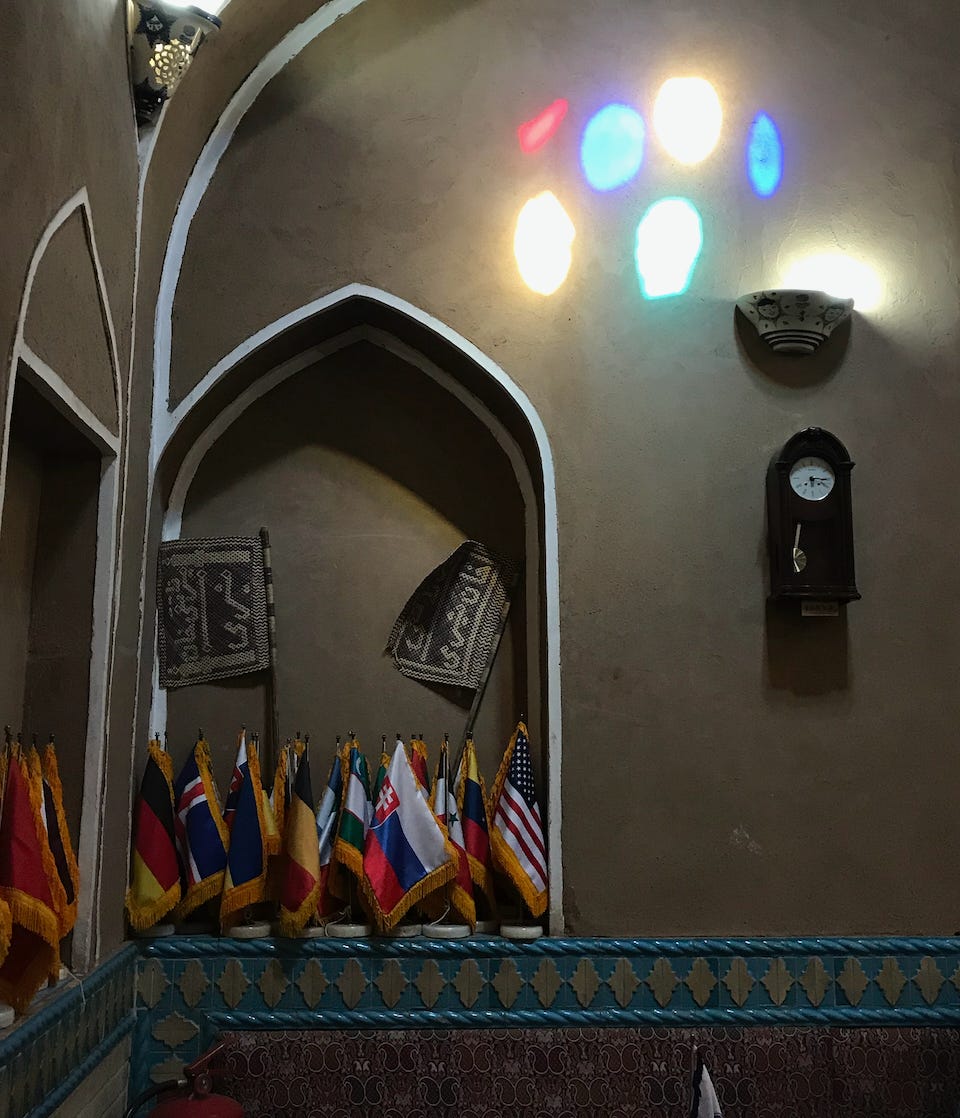
I return to these photos with feelings of sadness at the thought that some of these places are or may soon be destroyed by a hideously counter-productive bombing campaign which further punishes a proud people already brutalized by the Iranian regime. But also with hopefulness, as I am reminded of the tiny details like the American flag displayed alongside the other flags of the world in a Yazd hotel, or the fact that Orwell’s 1984 was one of most popular books being sold on Tehran’s street corners. I think about the warmth of the complete strangers and extended family I met in Iran and the fundamental goodness of humans, which, despite all the darkness in history, is a fact of life that I consider immutable.
Note: I am releasing these photos into the public domain under a non-commercial license. Feel free to use them in any non-commercial use cases, such as Wikipedia.

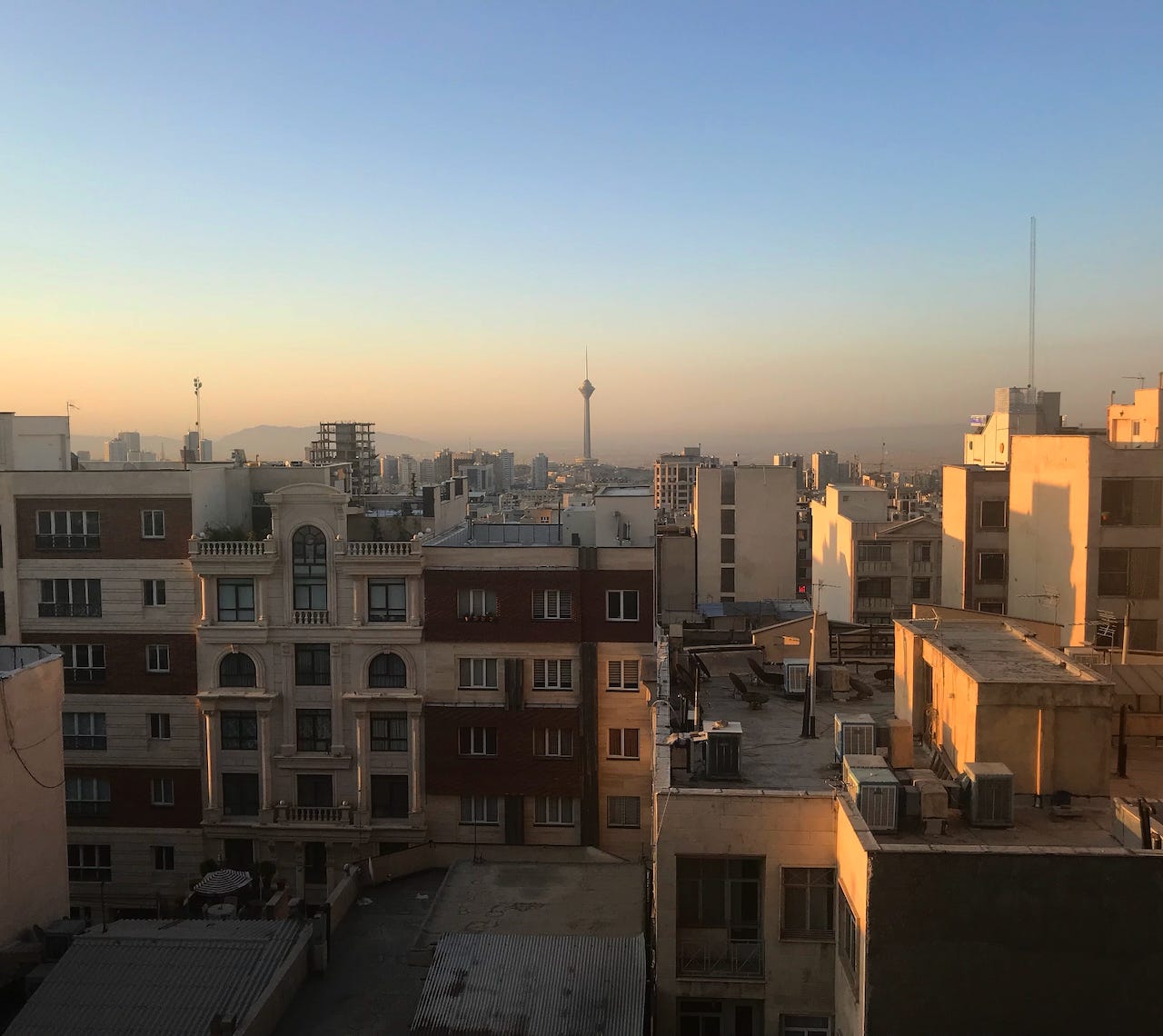
The view from my mother-in-law’s apartment in northwest Tehran, with Milad Tower, a focal point of the city’s urban core, visible in the distance.
Tehran’s architecture reminded me a bit of Athens or Istanbul with an interesting mix of traditional and modern forms. What surprised me was how leafy and pleasant the streets were.
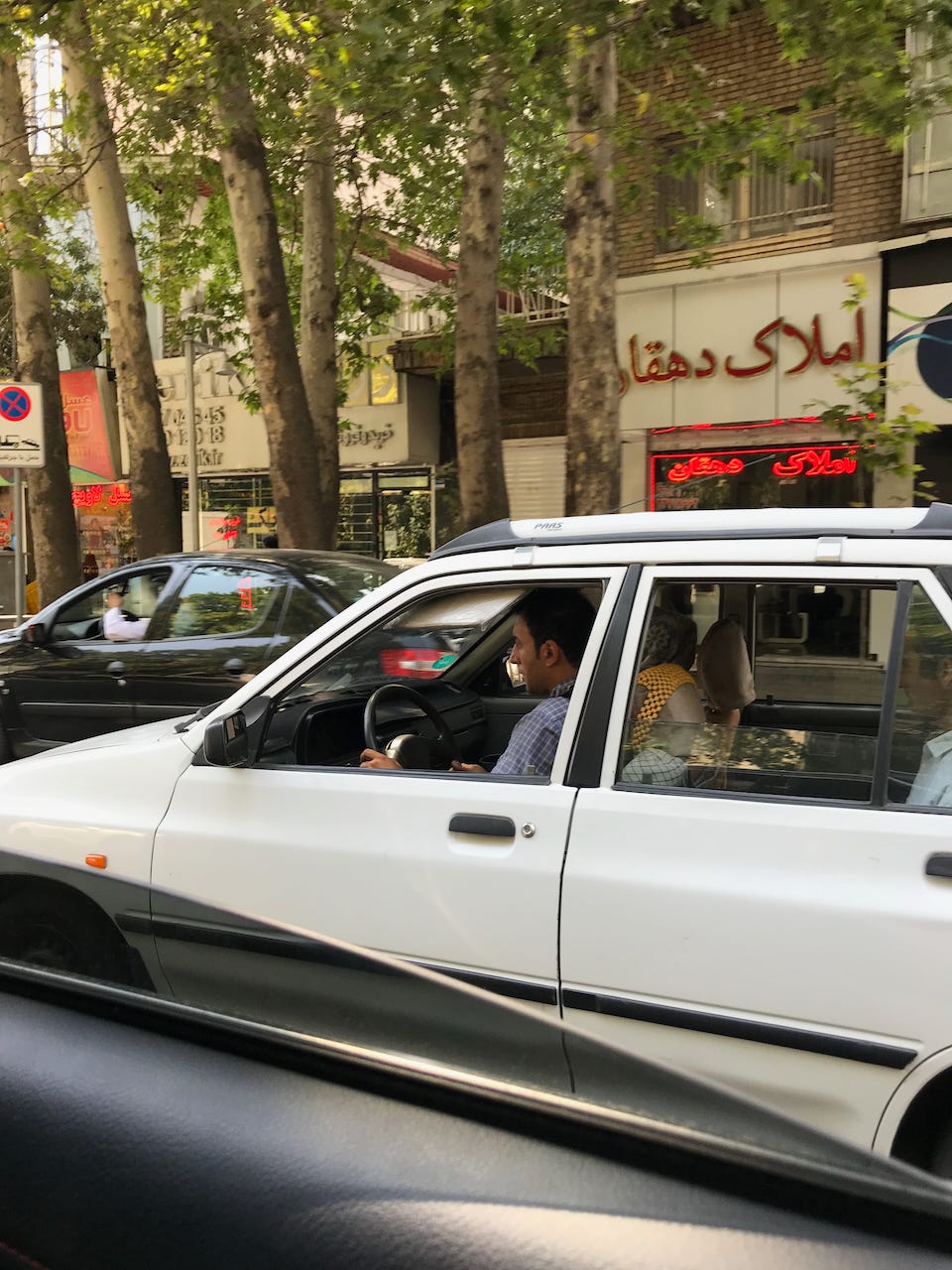
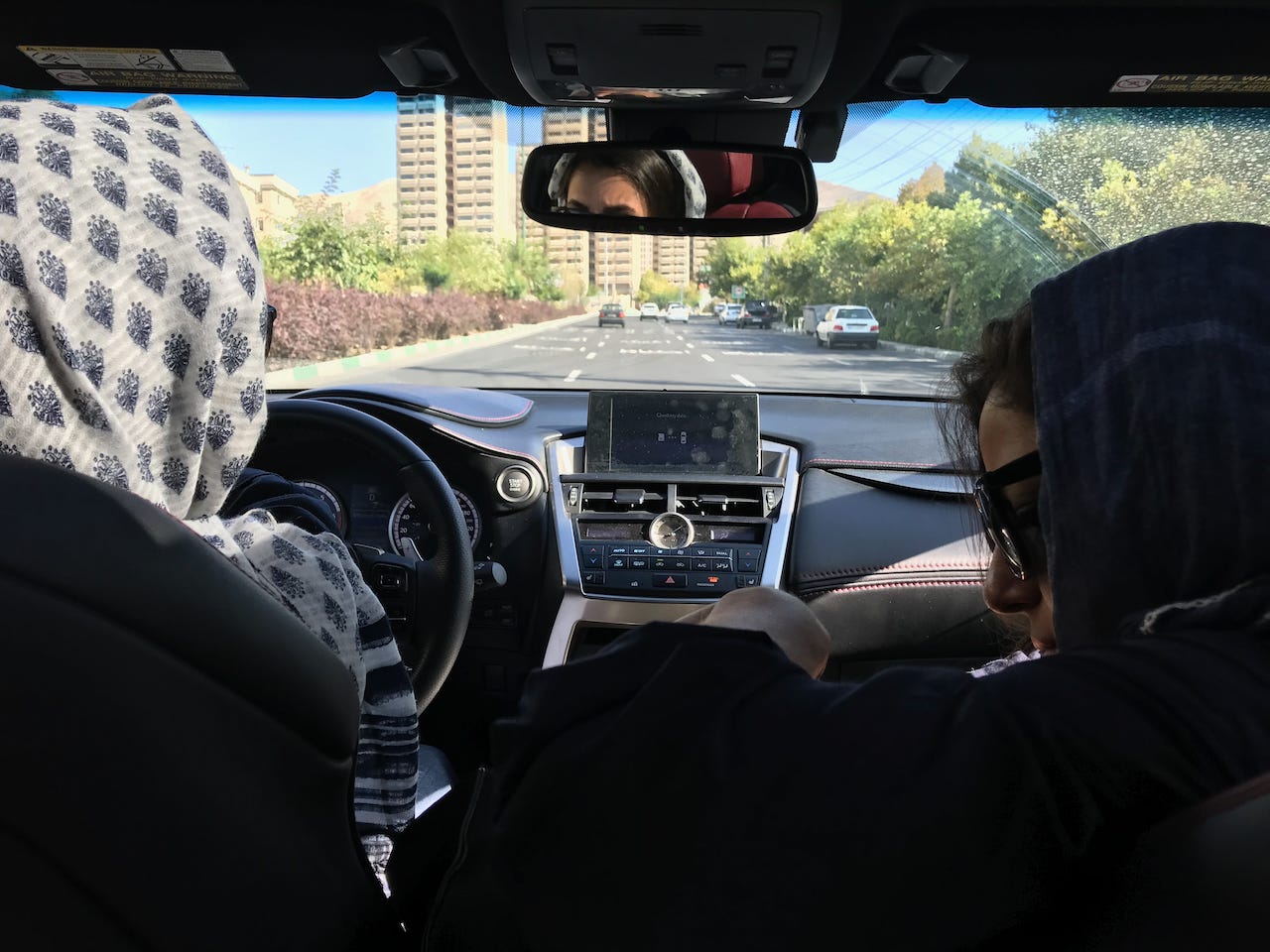
Driving in Tehran is an experience. With its high rises and urban sprawl bisected by freeways, that aspect of the city reminded me a bit of Los Angeles or São Paulo.
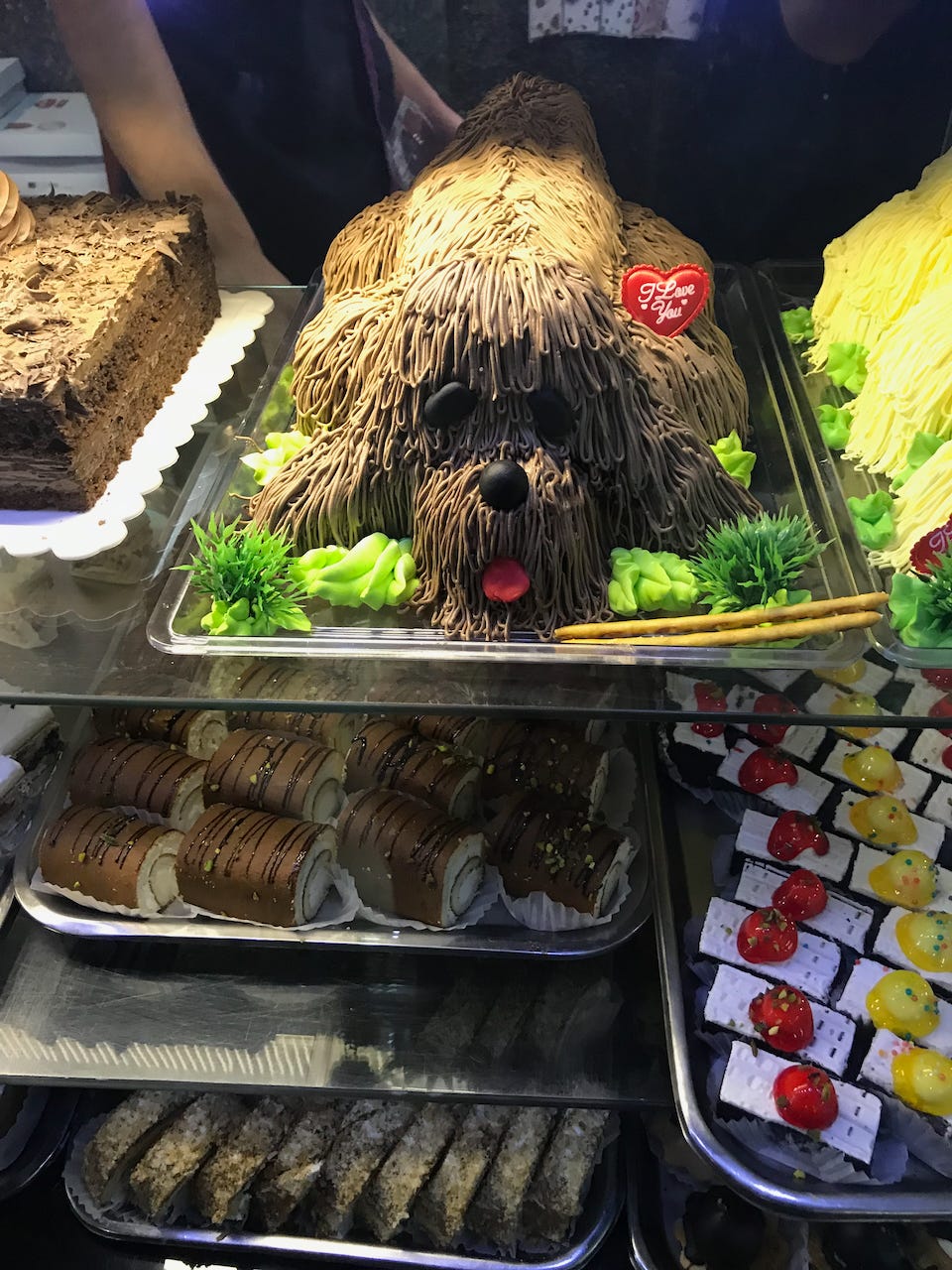
I was deeply charmed by Tehran’s bakeries, which are abundant, much beloved by the populace, and home to lots of original creations like this poodle cake.
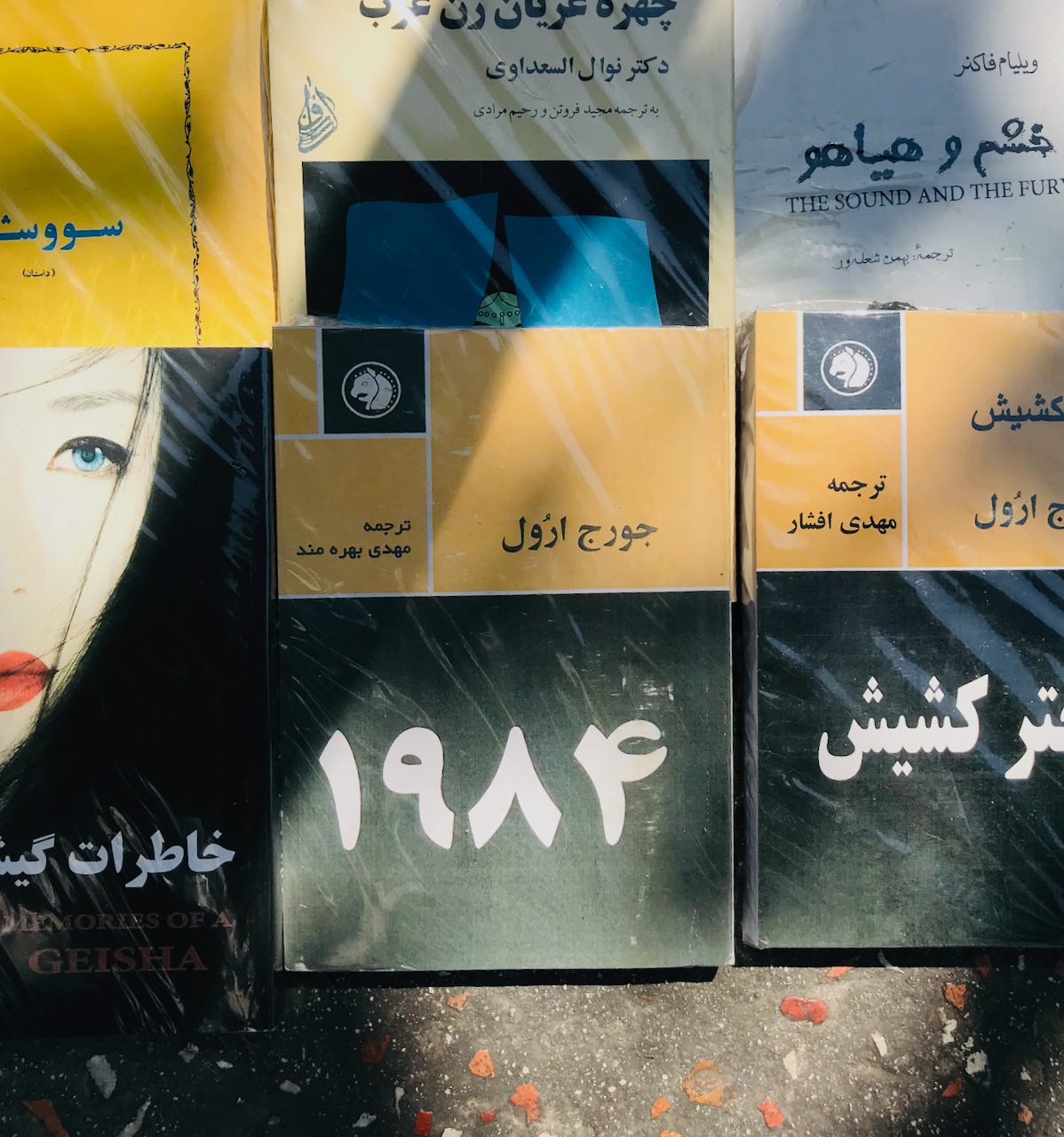
The streets around the University of Tehran were fascinating to walk through because nearly every corner had vendors selling books, including banned ones. I noticed a lot of works of the great Russian novelists (especially Doestoevsky) as well as a lot of 20th century British and American fiction in translation — think Hemingway, Fitzgerald, and Orwell.
Here we see The Sound and the Fury, Memoirs of a Geisha, and 1984. The latter was probably the most frequently-sold book that I spotted in the entire neighborhood. The title at top is a Farsi translation of a book by the Egyptian feminist writer Nawal El Saadawi about female genital mutilation and the oppression of women called The Hidden Face of Eve.
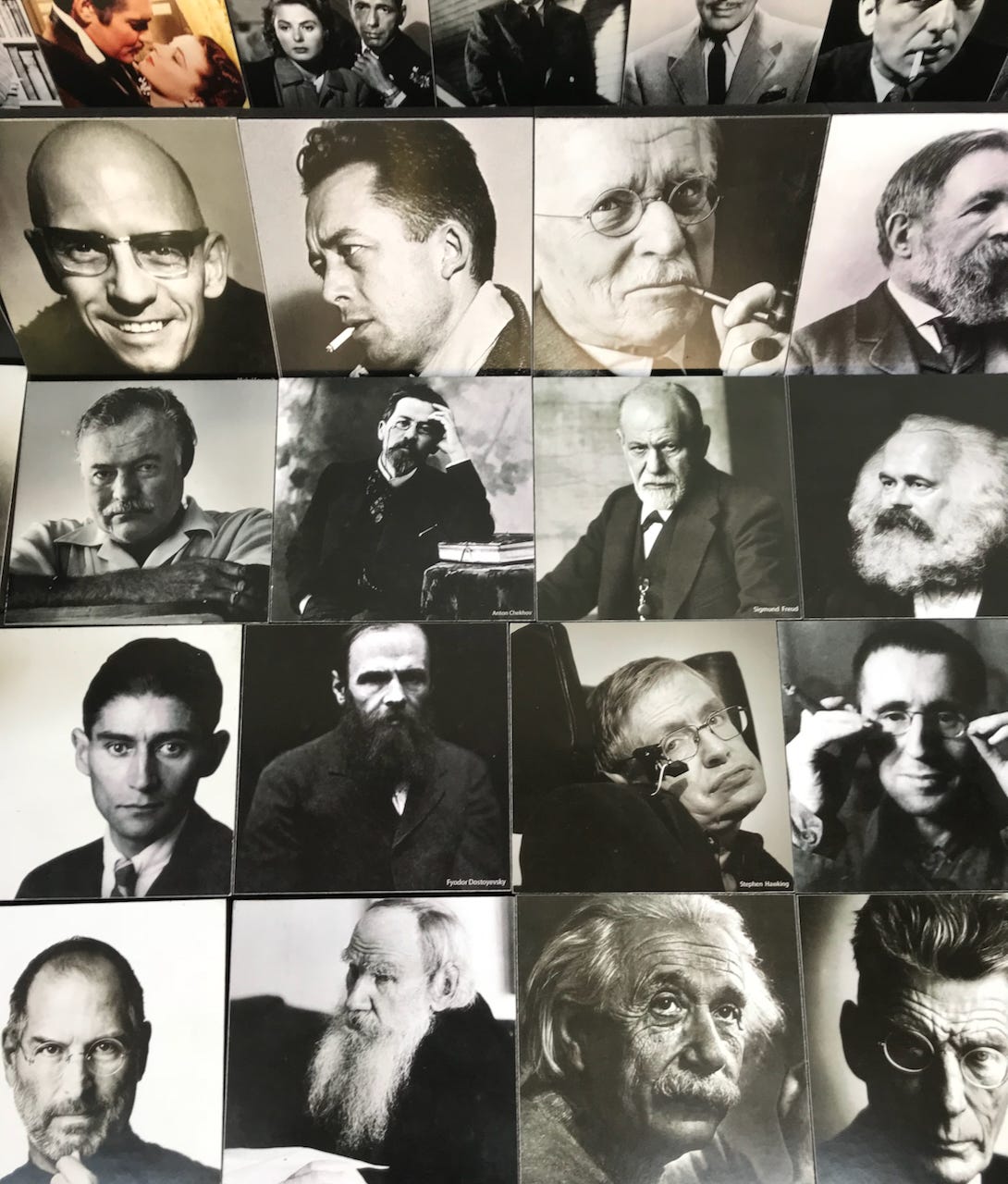
The samizdat booksellers around the University of Tehran also sold posters and magnets, including more than a few which I remembered from dorm room walls when I was a student.
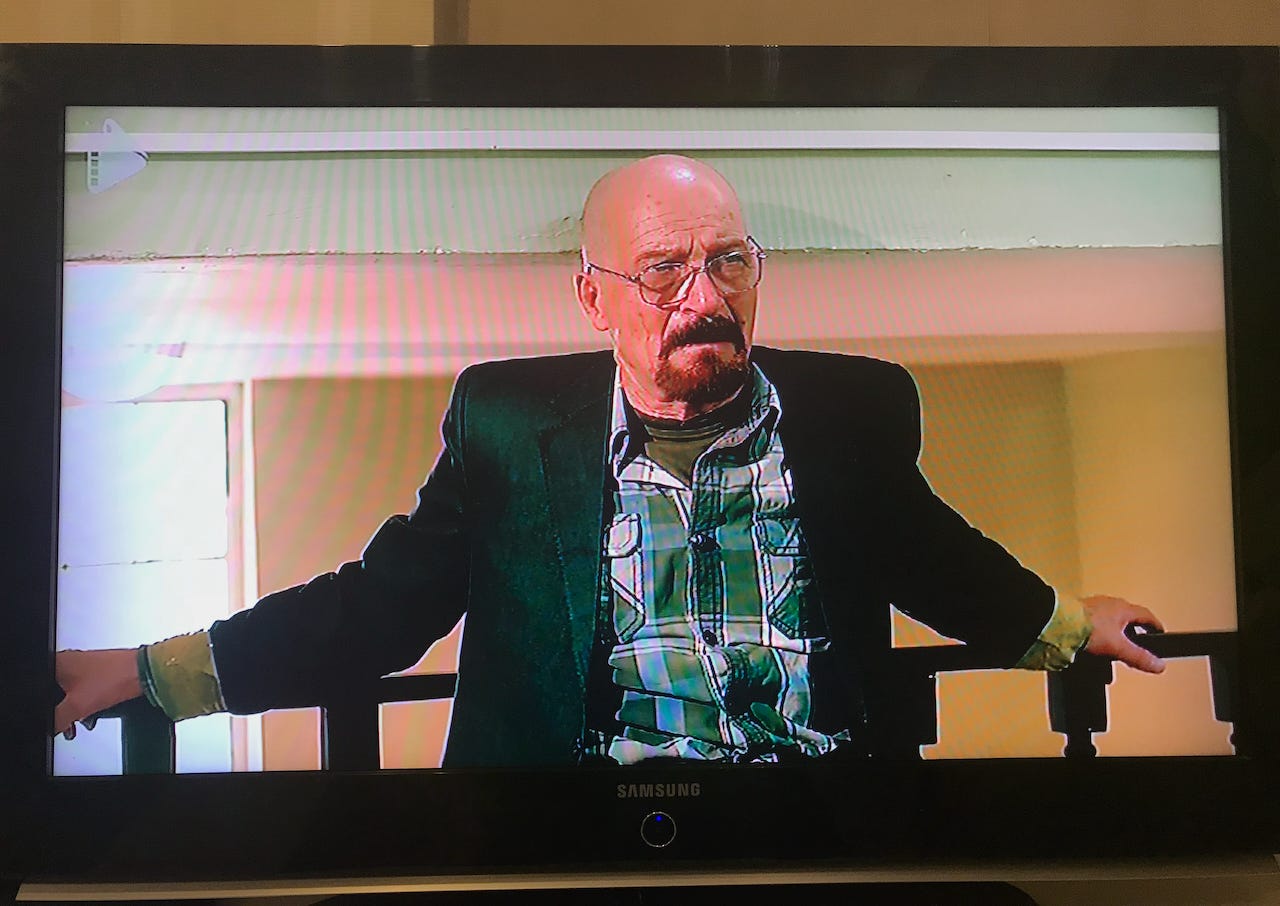
The following day, I caught some Iranian state TV with my mother-in-law and realized that we were in fact watching a rather well-done recreation of Breaking Bad. It was the famous “Fly” episode. Here’s the Iranian version of Walter White, gazing scornfully at the Iranian version of Jesse as they struggle to make sufficiently pure crystal meth:
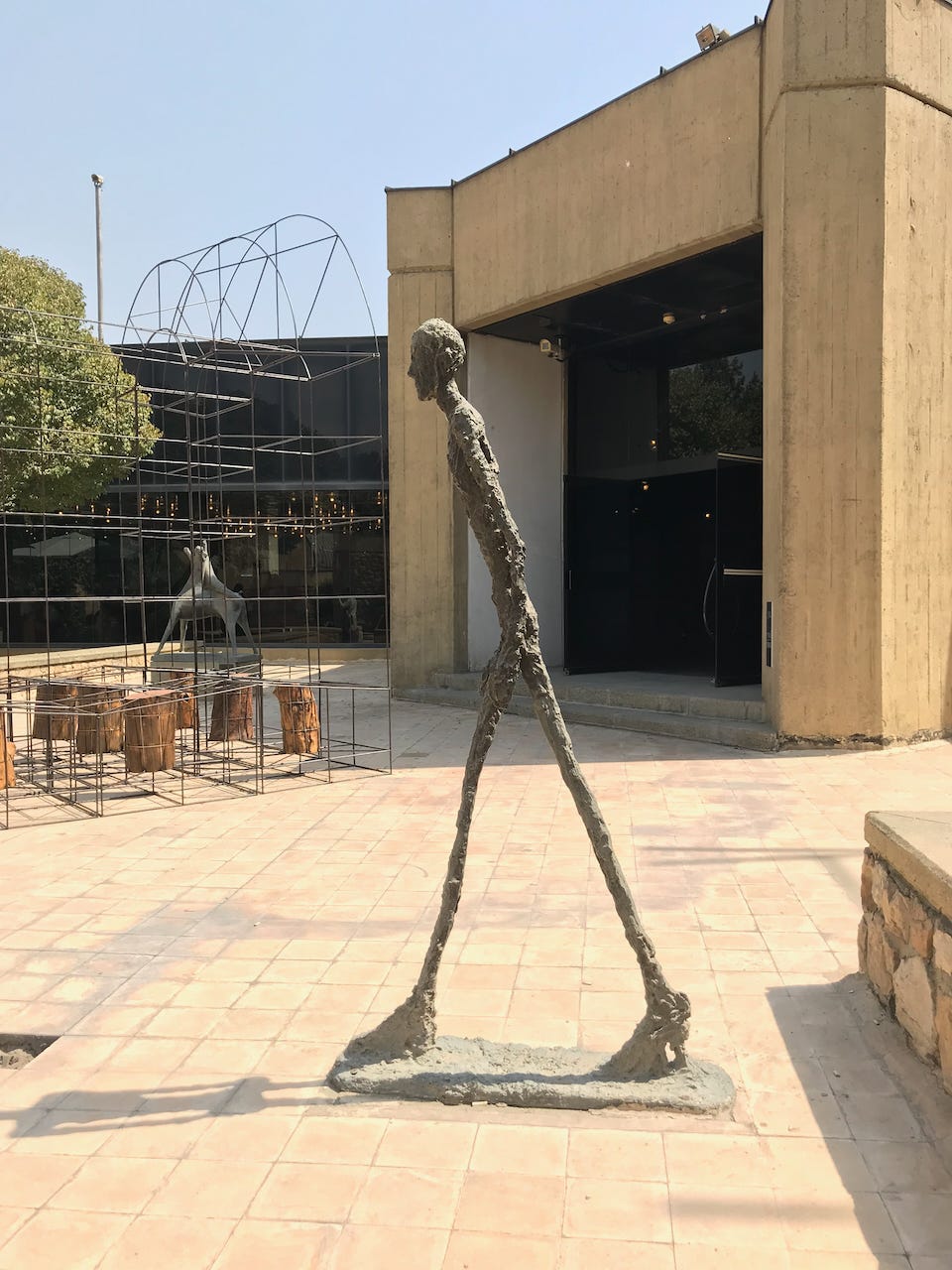
Tehran’s Museum of Contemporary Art, built under the Shah just two years before the 1979 Revolution, is famous for having one of the world’s best collections of 20th century modernism, though it’s rarely displayed. There was however a Giacometti sculpture casually striding by outside the cafe.
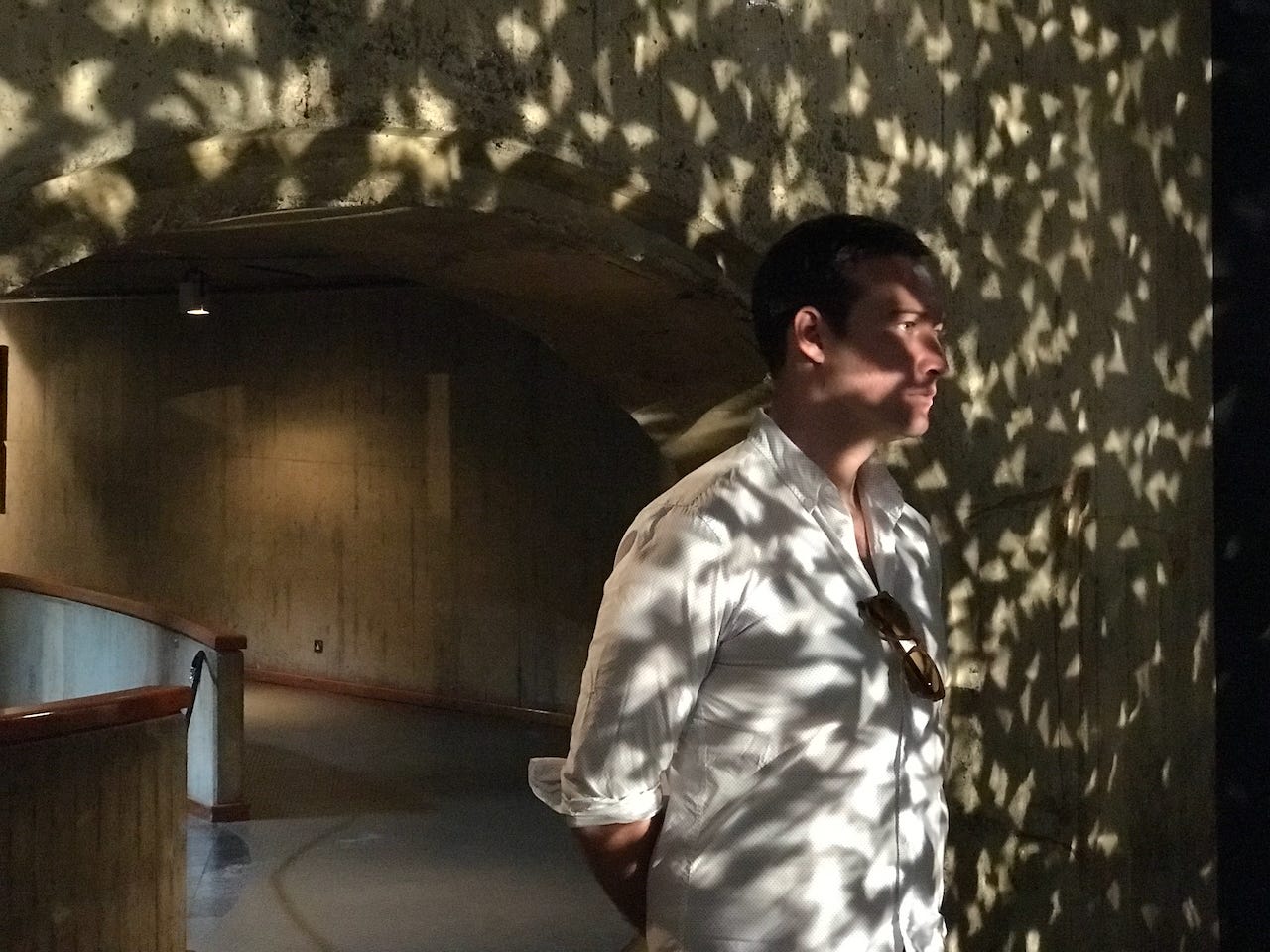
The building itself is a wonderful example of 1970s Brutalism adapted to traditional Iranian motifs like high banks of windows that evoke Windcatcher towers. When I was there, the exhibited art included this system of mirrors that cast geometric patterns of light. It is a really extraordinary place.
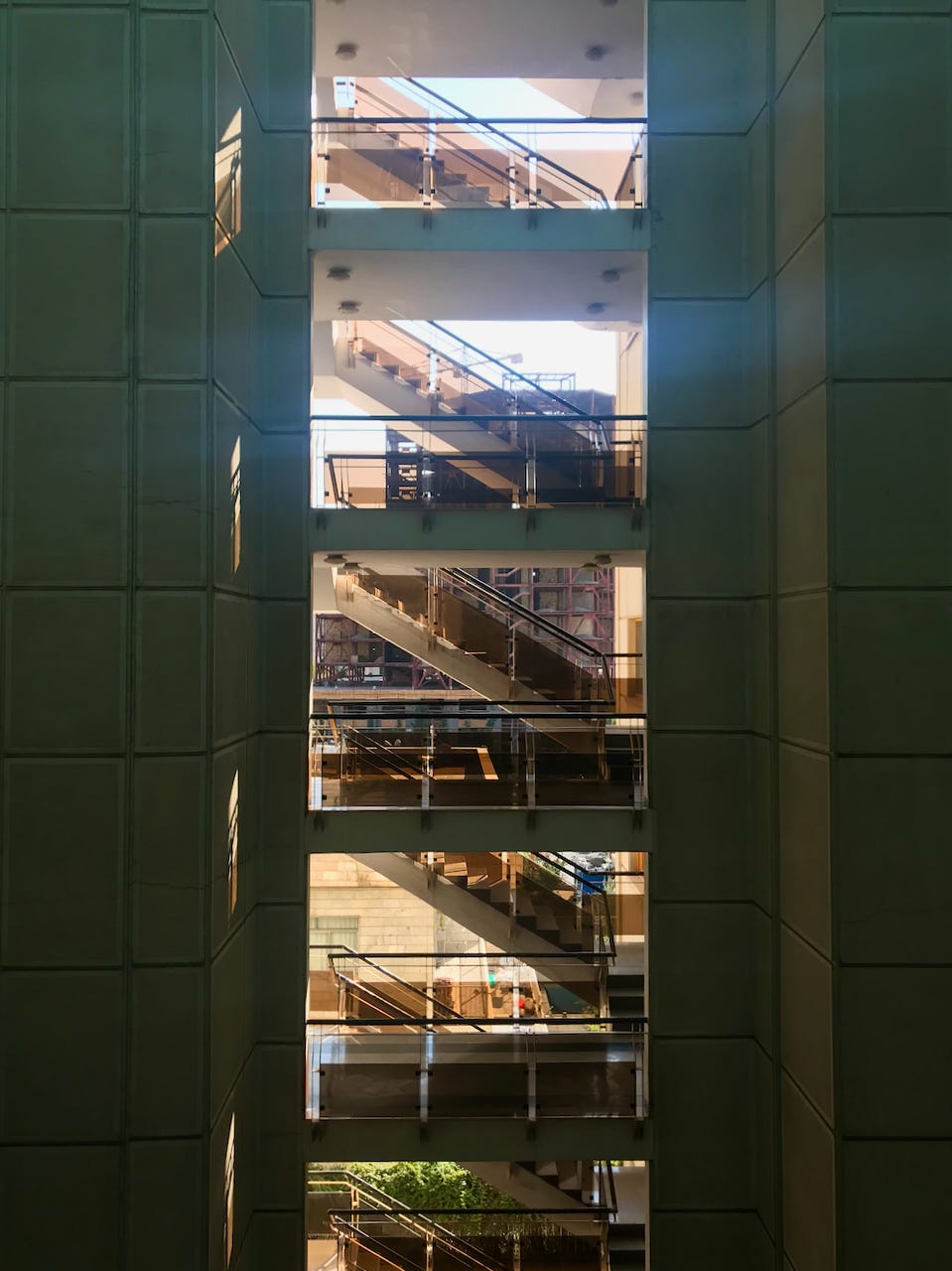
Tehran’s vernacular residential architecture is quite interesting. Here is a set of outdoor staircases in a fairly typical mid-rise building.
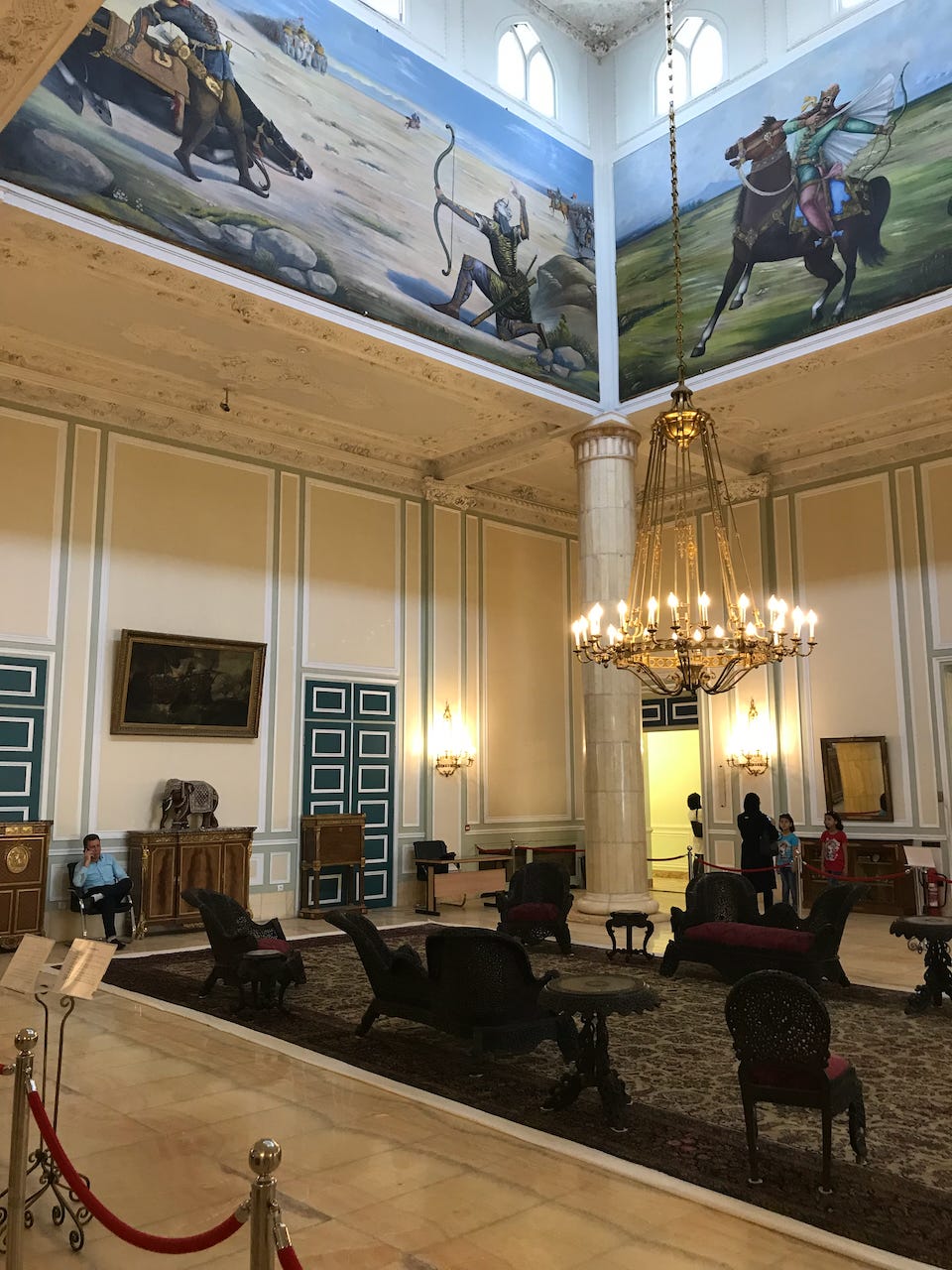
The Shah’s palace in Tehran was one of the more moody and haunted-feeling places I’ve been. It preserves, seemingly more or less intact, the artifacts of the Iranian royal family on the eve of the 1979 Revolution, complete with faded 1970s-era recliners, fluorescent lighting, and other accoutrements of an aging couple. The grander, more public-facing halls and ballrooms feature paintings from Iran’s national epic, Shahnahmeh.

Traveling south from Tehran for about five hours, you reach Isfahan, which was the capital of the Persian empire under the Safavids and a major destination on the western edge of the Silk Road. Indeed, to a striking degree, it still feels like a city on the Silk Road, only now with lots of LED lights.
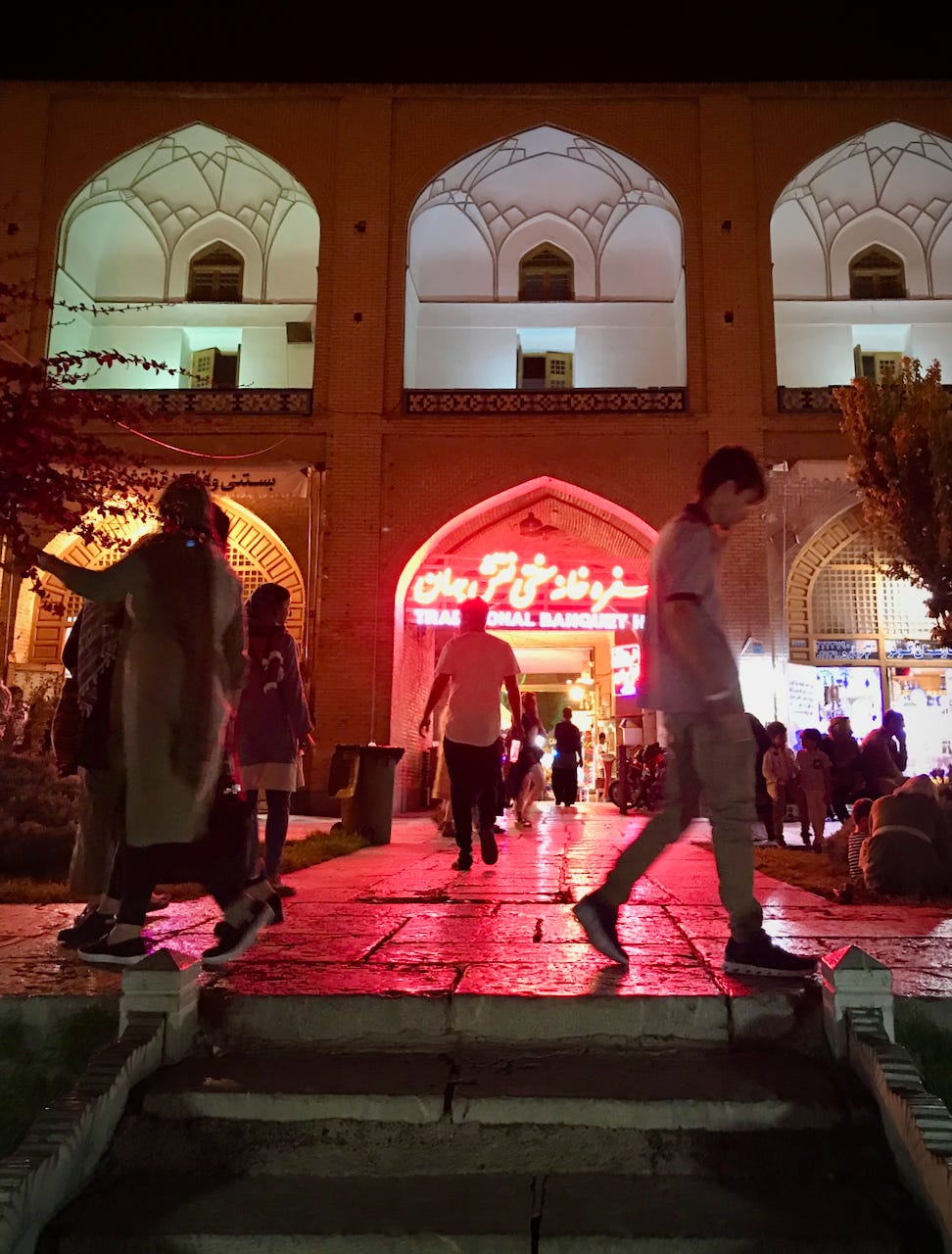
Walking through the vast central square (a UNESCO World Heritage Site) is hugely evocative because it has barely changed since the 17th century. I noticed a group of Chinese businessmen walking through the stalls while French tourists haggled nearby, and it occurred to me that this demographic mix, too, was unchanged since the 17th century!
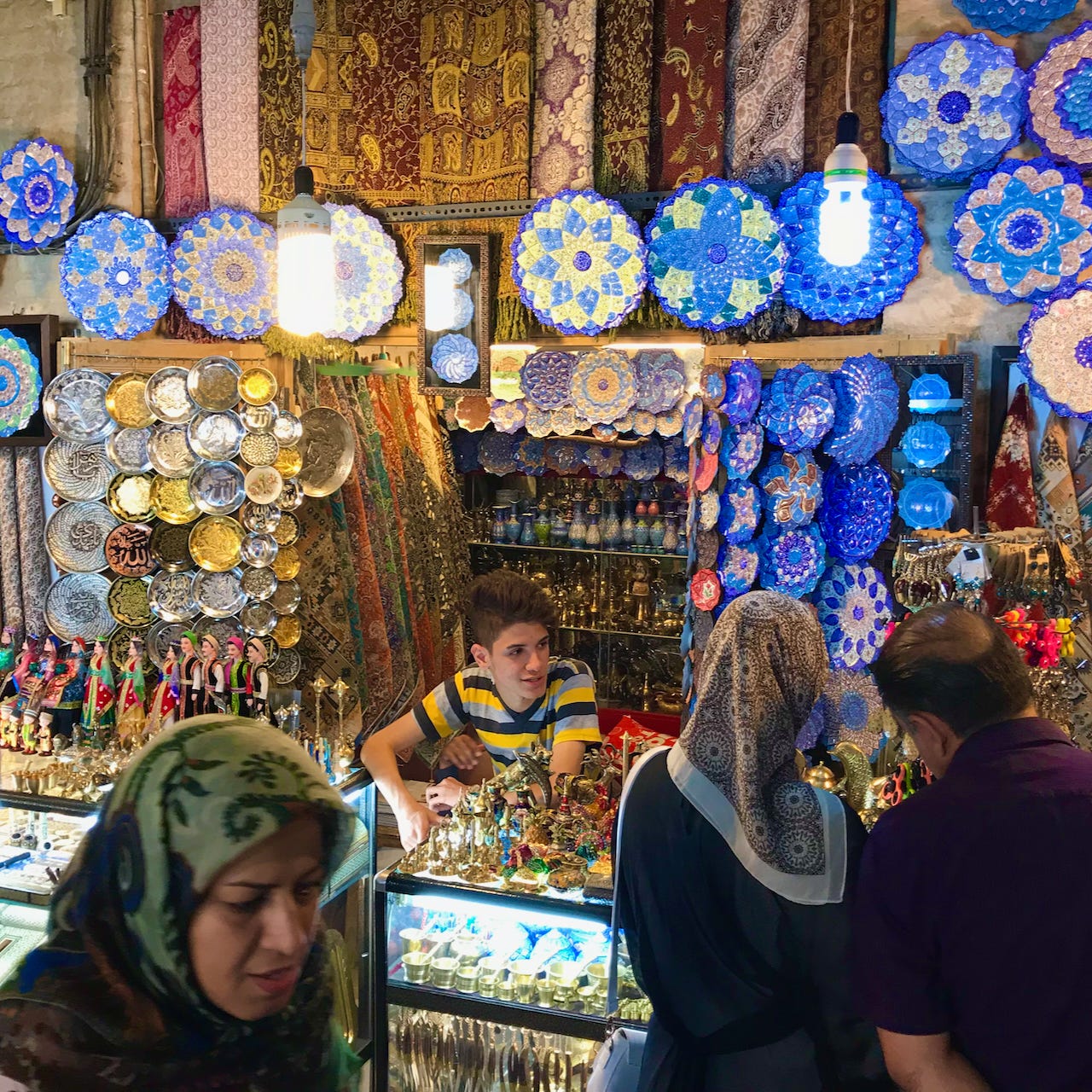
The image below is maybe my favorite photograph I’ve ever taken — it was 10 pm, a hot September night, and the girl on rollerblades skated past the boy eating an ice cream, gliding onwards to the central square.
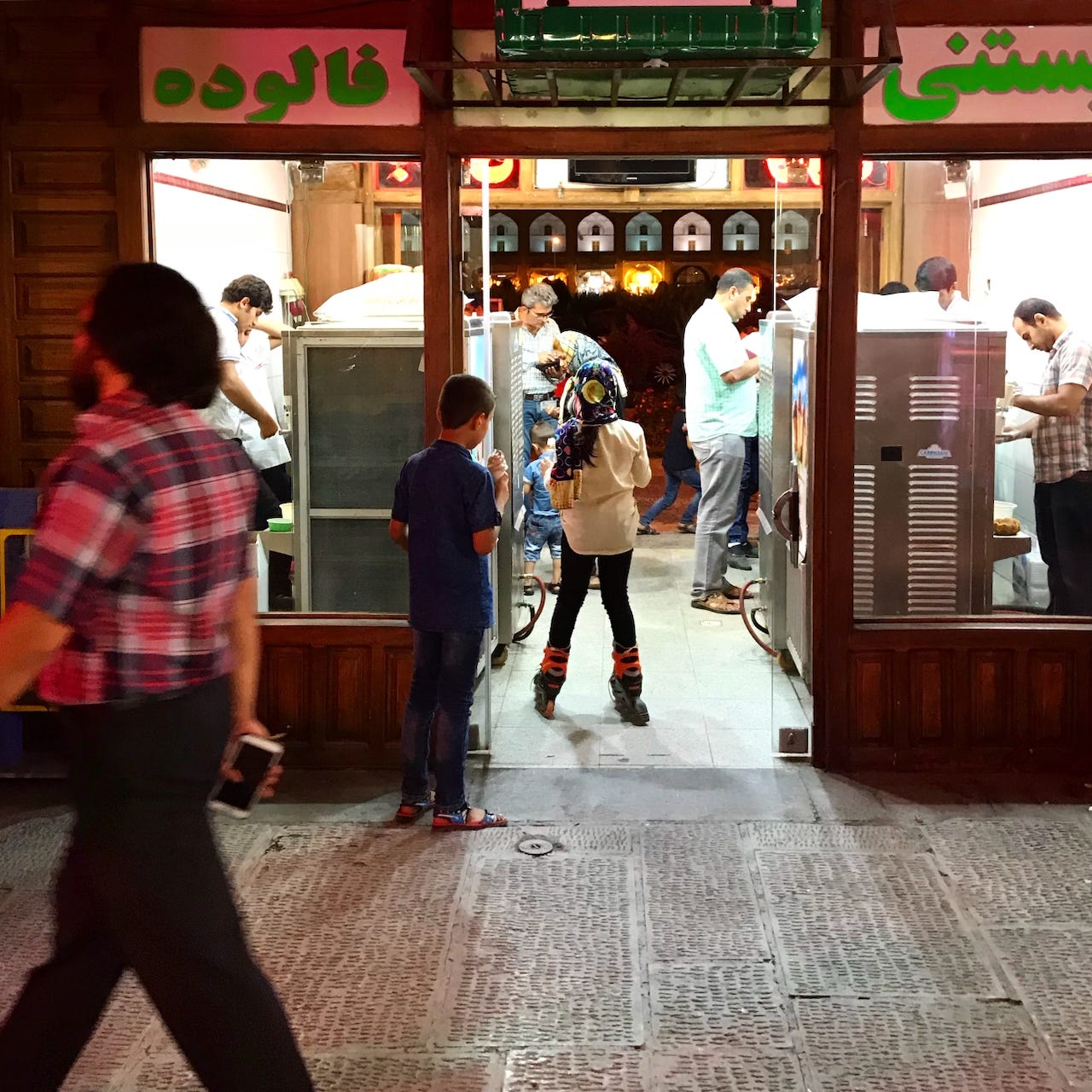
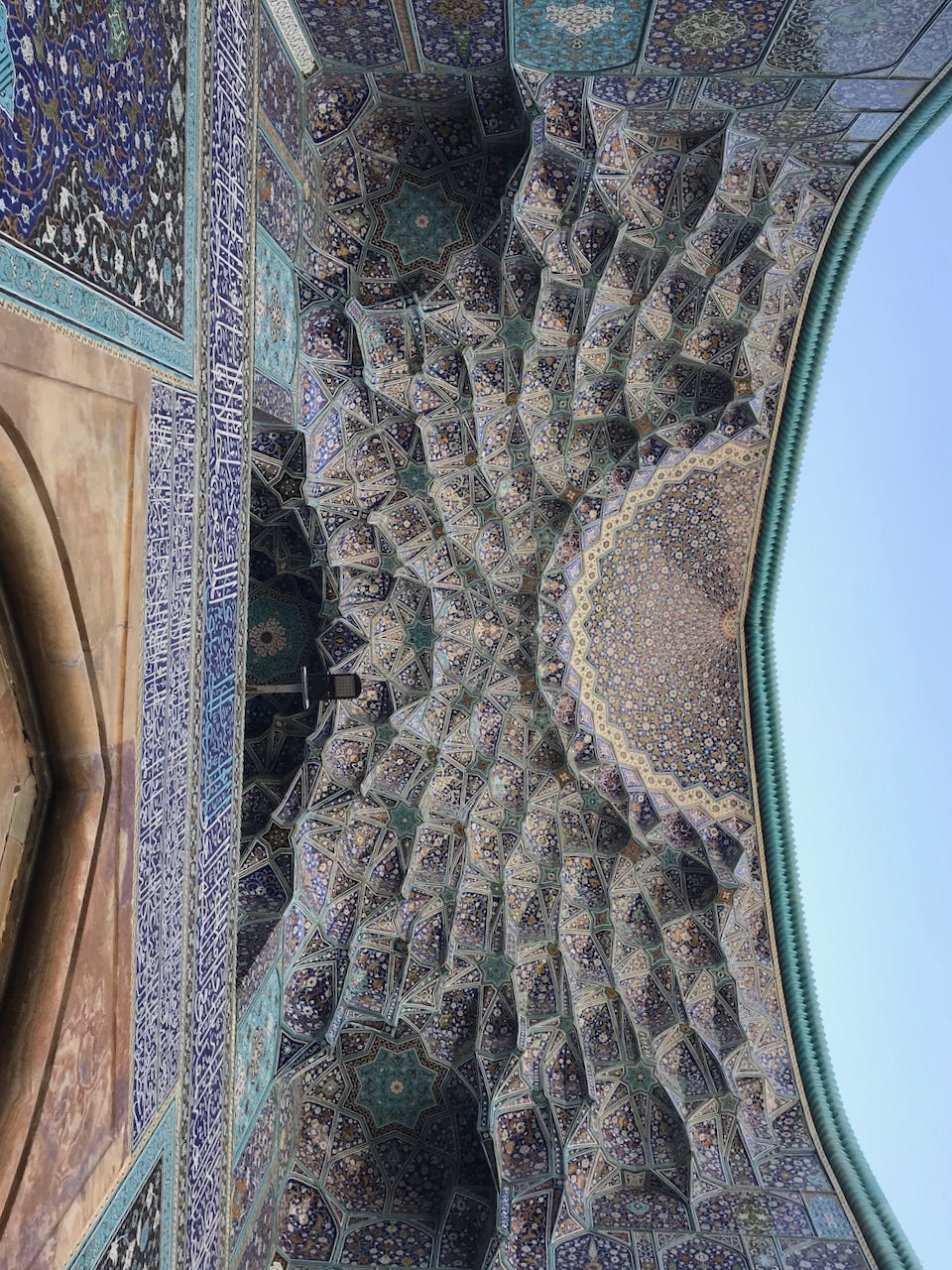
Jameh Mosque, which adjoins the square, is the most extraordinary example of Islamic geometric tiling I’ve ever seen. It is literally jaw-dropping, and photos like this don’t really do it justice:
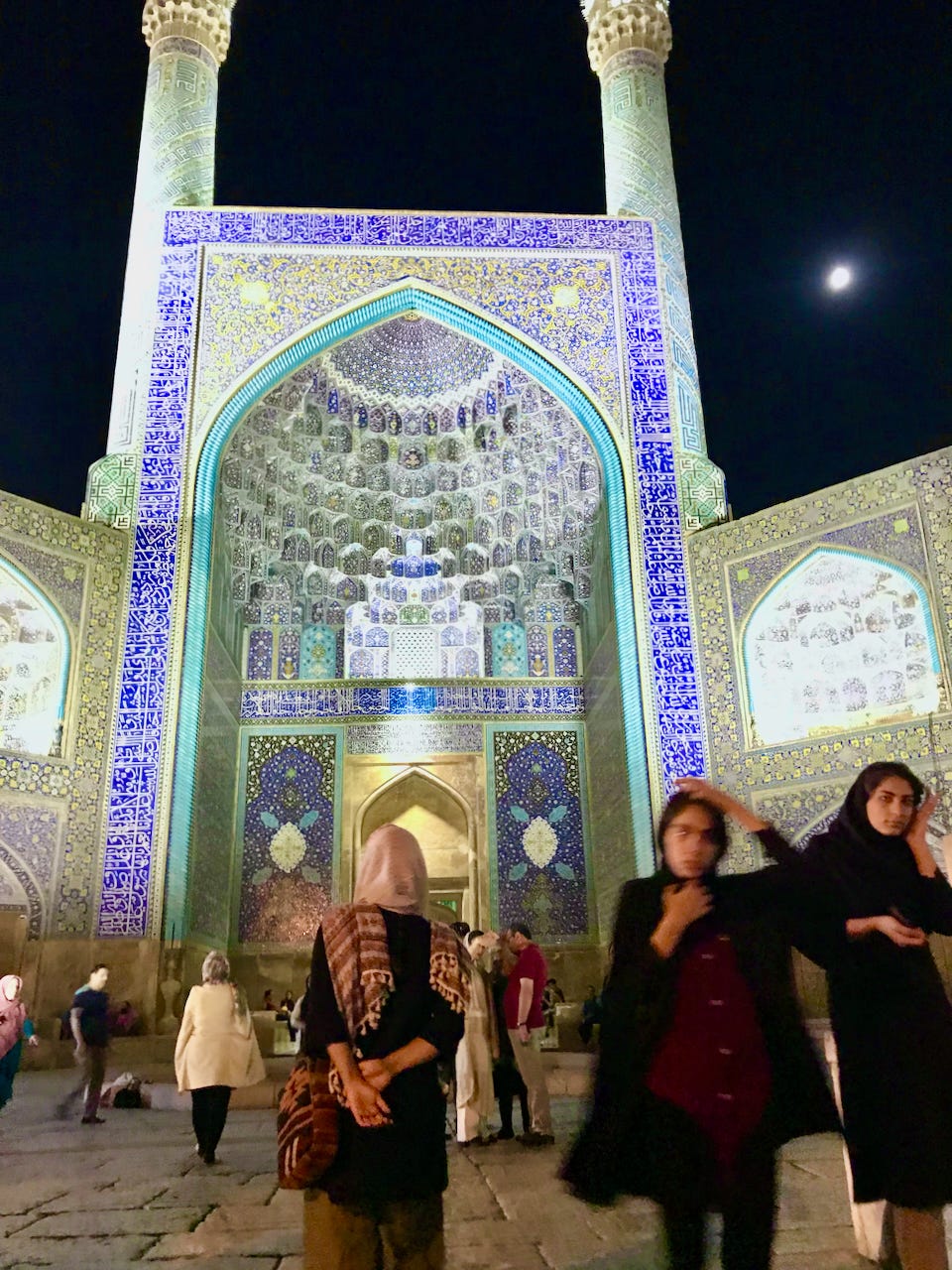
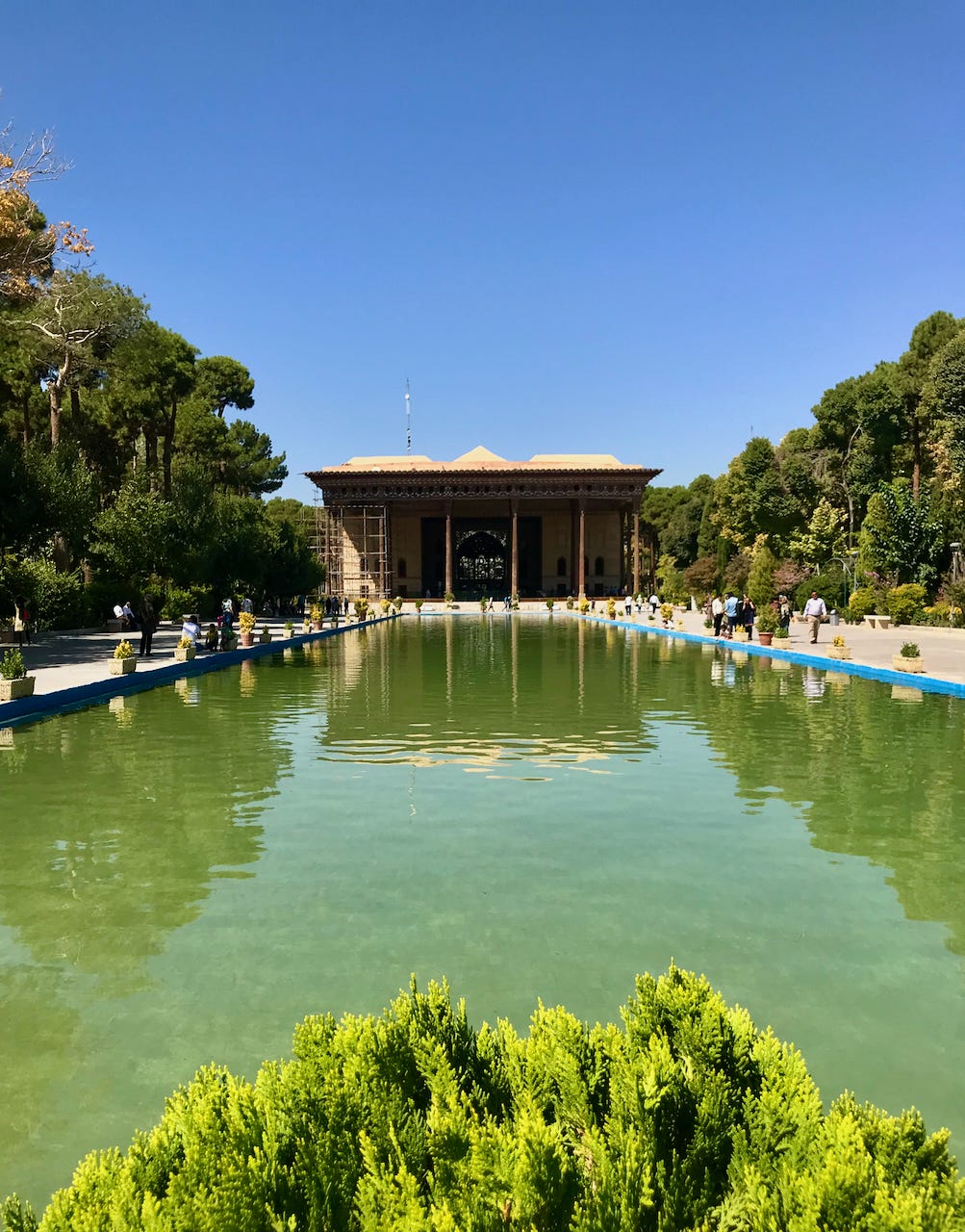
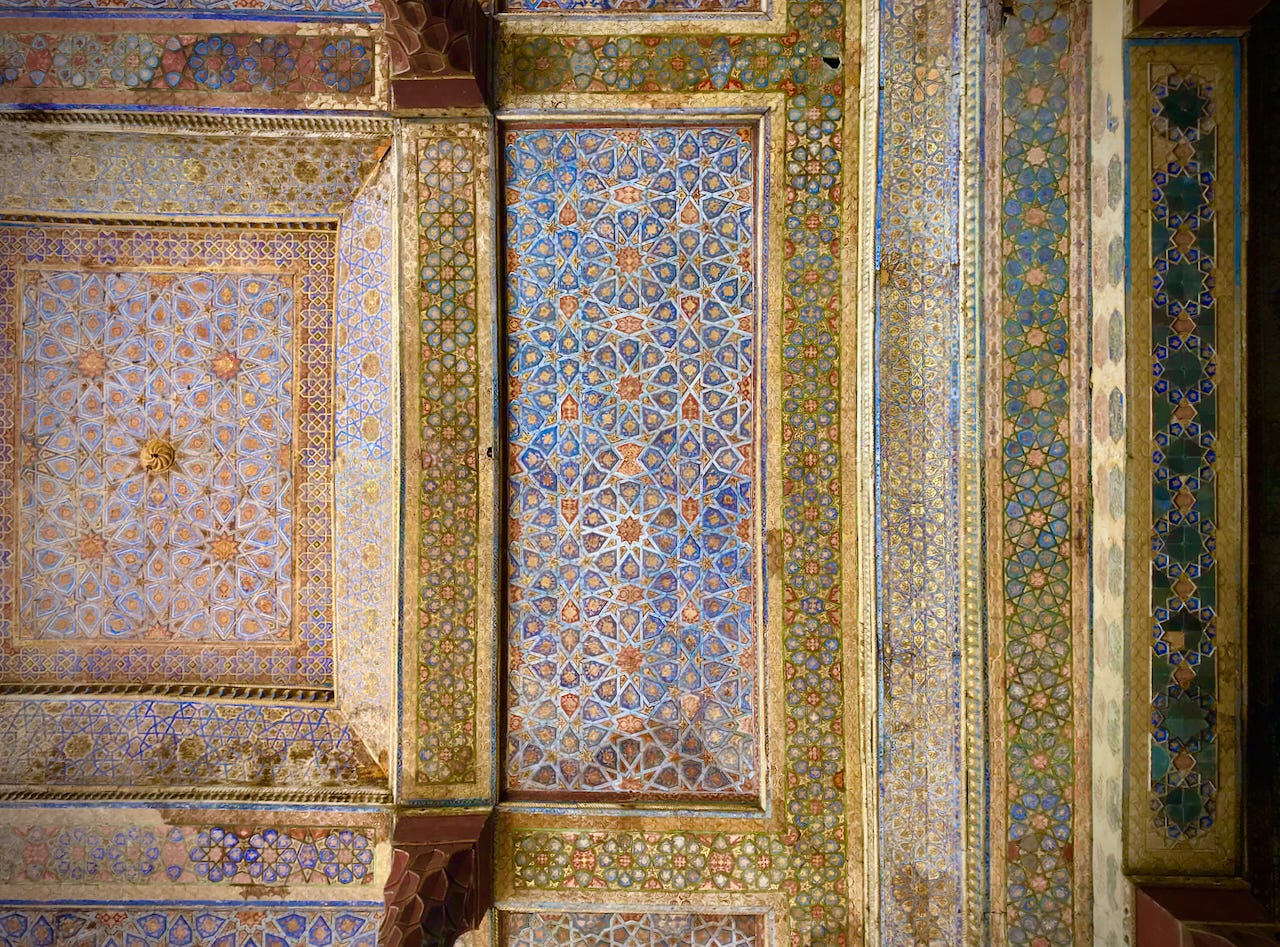
Ali Qapu Palace, one of the imperial seats of the Safavid Emperors, looks out over the square with a commanding view. But more beautiful, I thought, was the Chehel Sotoun (“Forty Columns”) royal complex, which had both extraordinary architecture (more amazing ceilings) and some richly mysterious and evocative early modern wall paintings.
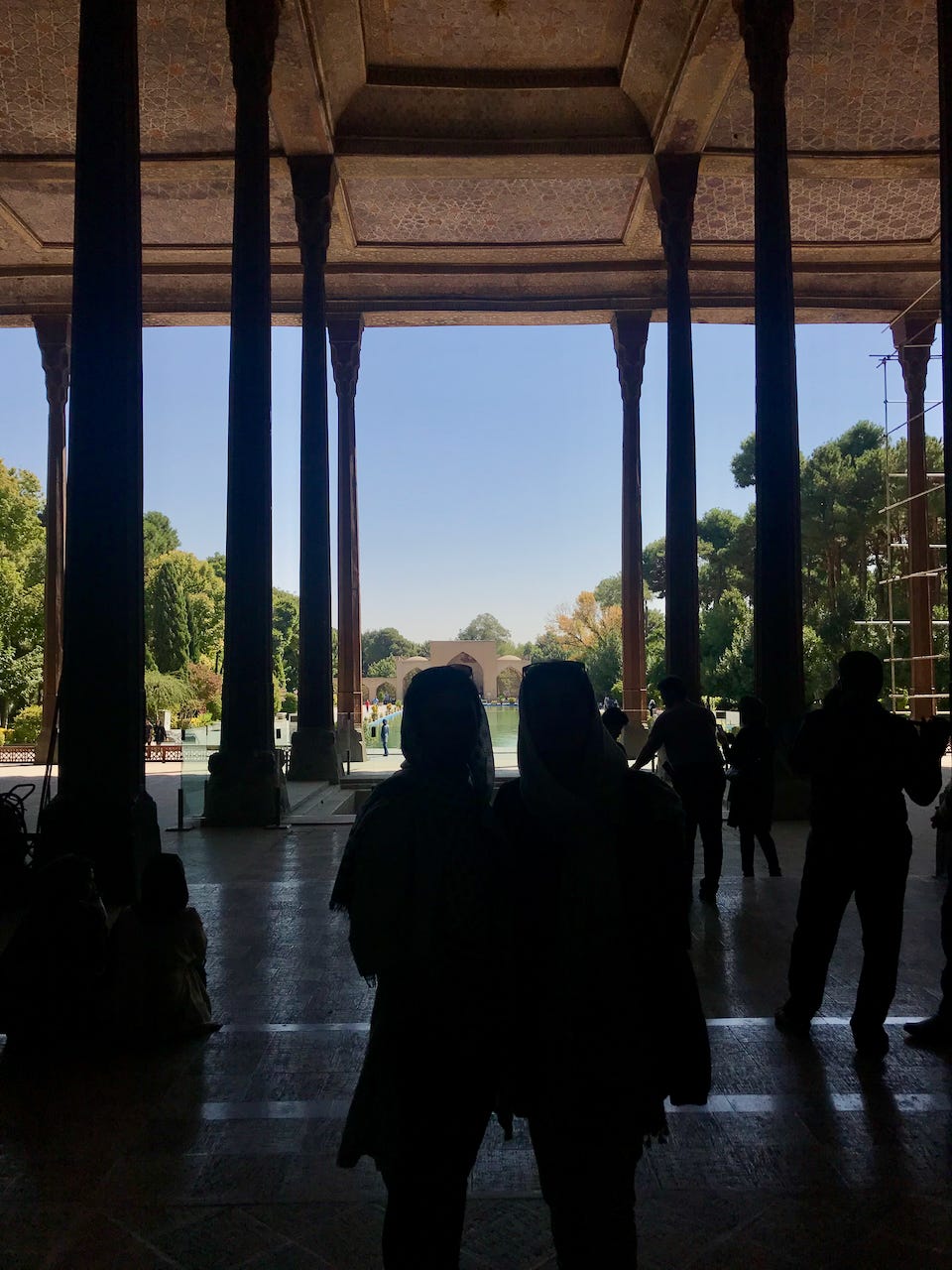
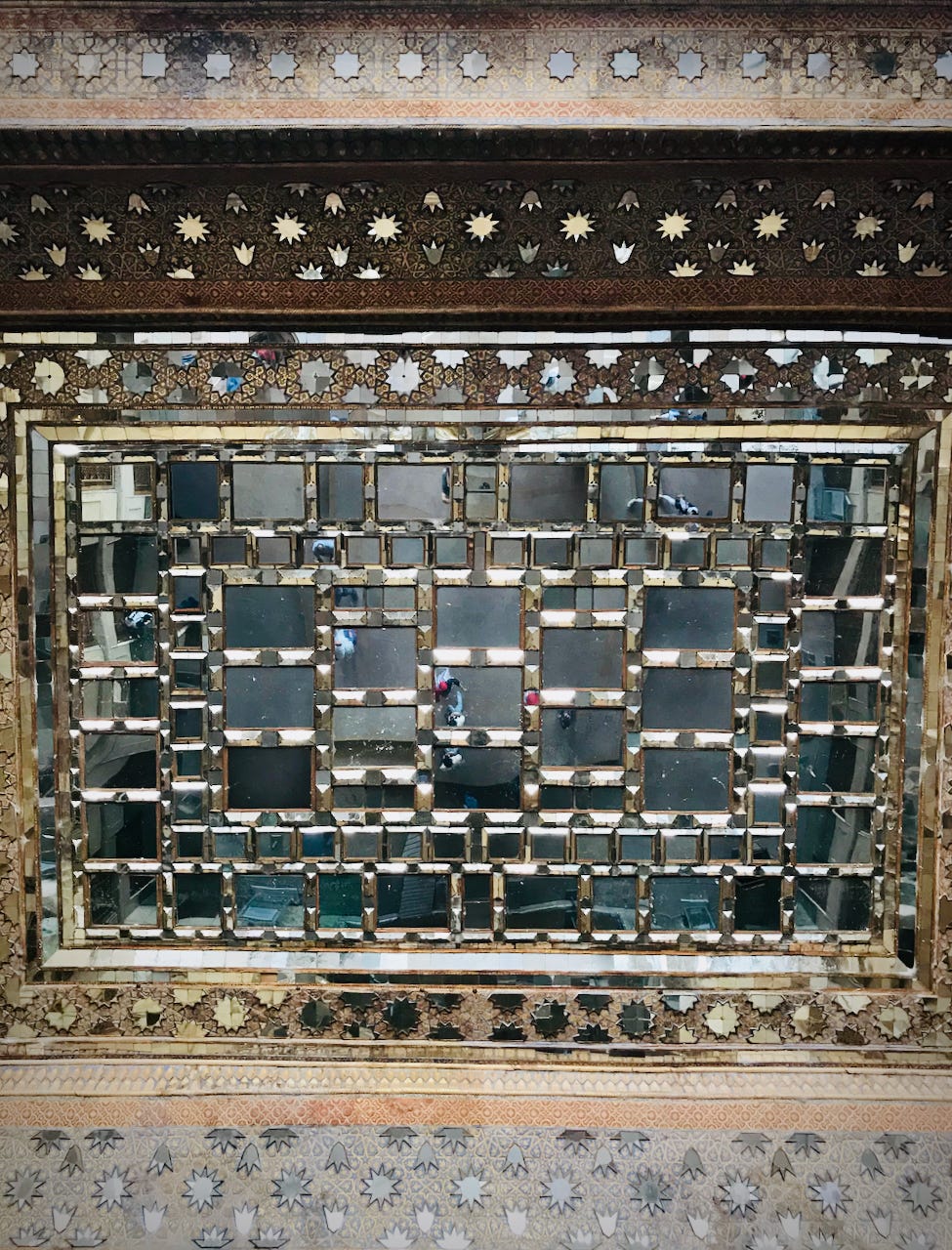
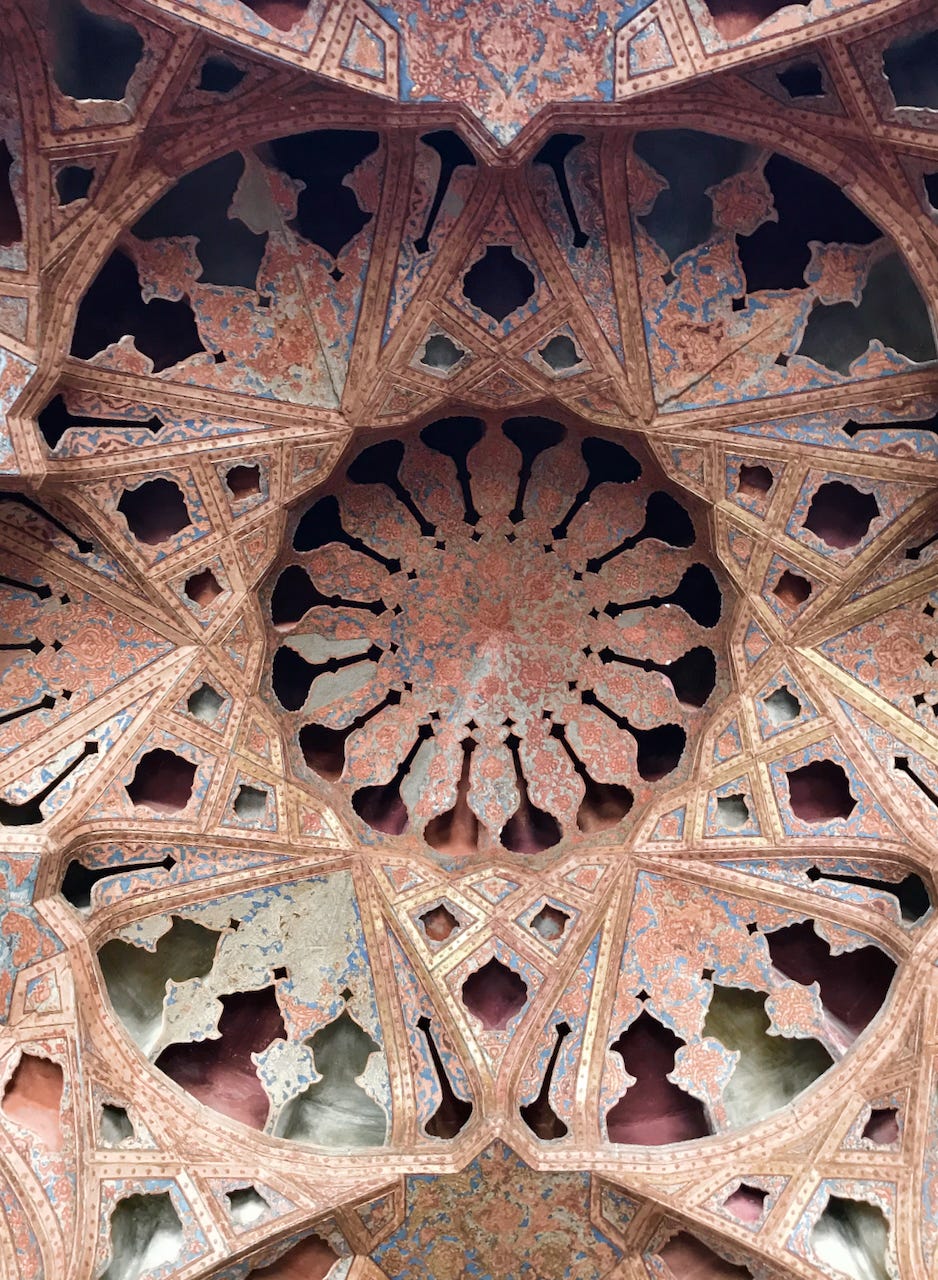
The ceilings were a mixture of inlaid/painted wood and cut glass mirrors.
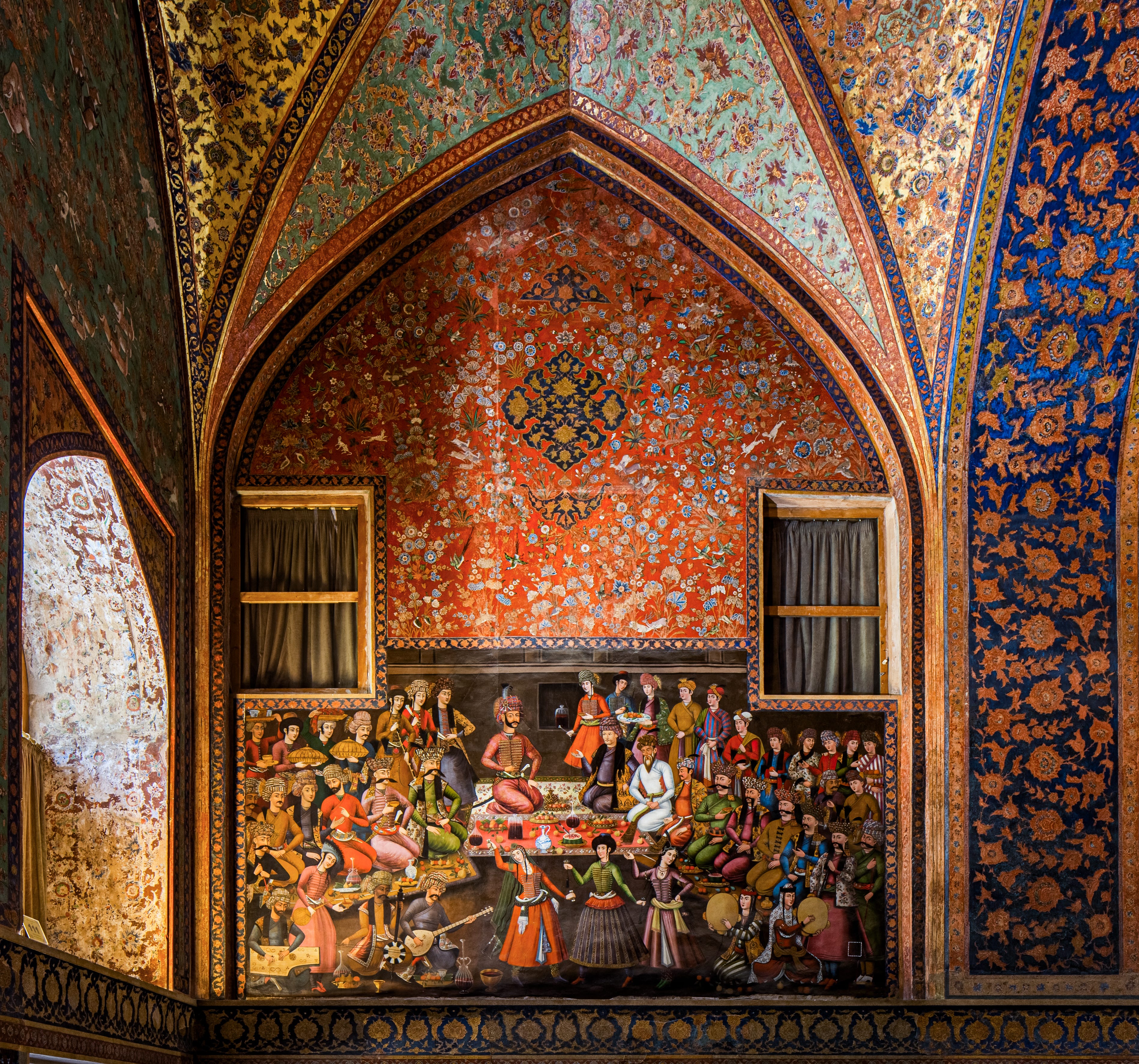
Paintings throughout the complex (some of which were damaged in recent bombing) show vivid scenes of Abbas the Great and his son doing such things as entertaining the Mughal Emperor, defeating the Ottomans in battle, and drinking copious amounts of wine.
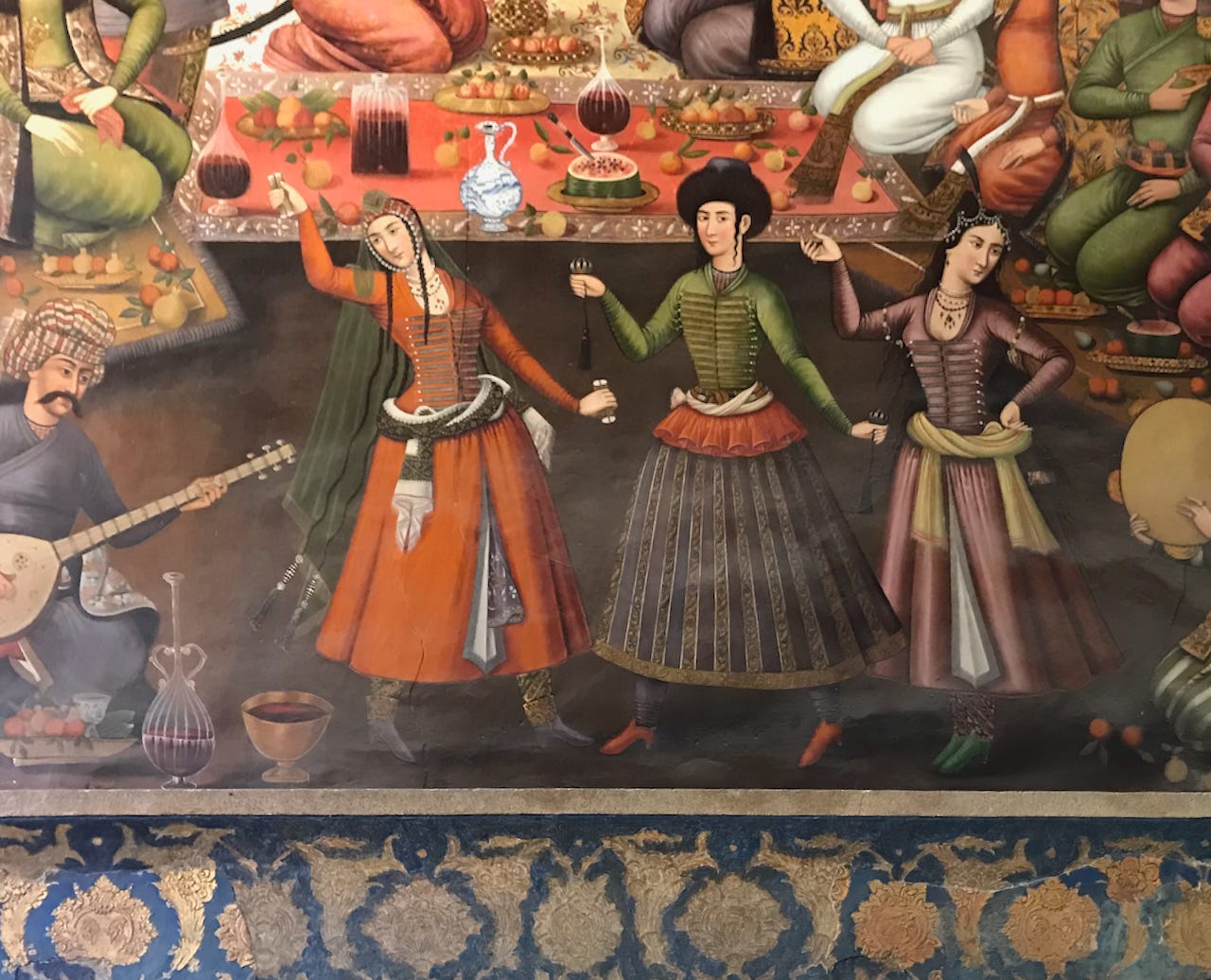
A detail of dancers and musicians in the painting of Abbas II entertaining the King of Turkestan. I am guessing that it may be Yalda night due to the prominent watermelon, but I might be wrong.

I didn’t take this photo - it’s from Wikipedia - but it gives a good sense of the scale and setting of this extraordinary painting:
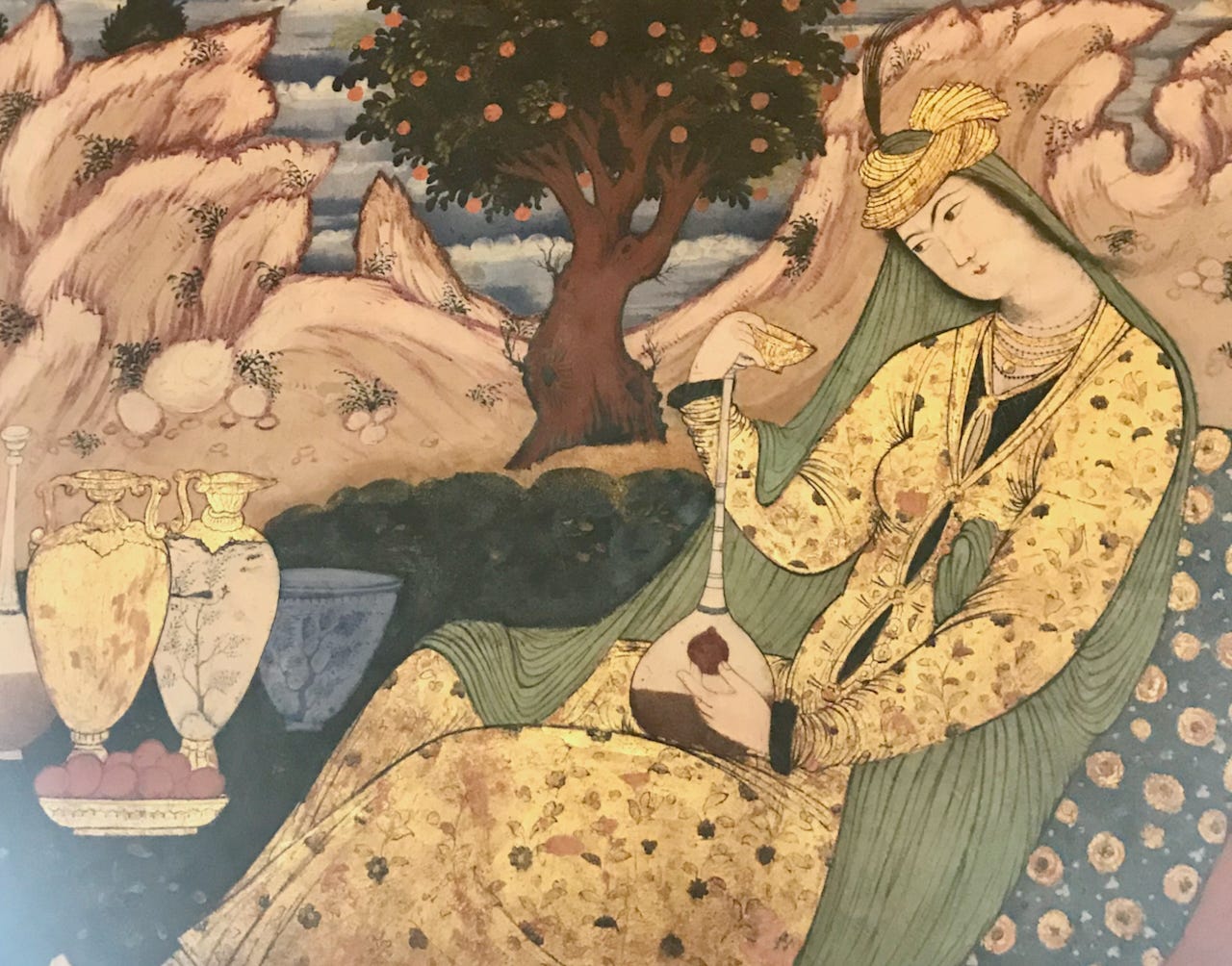
I was struck by this painting showing a barefoot woman relaxing on grass while drinking from a half-empty glass pitcher of red wine:
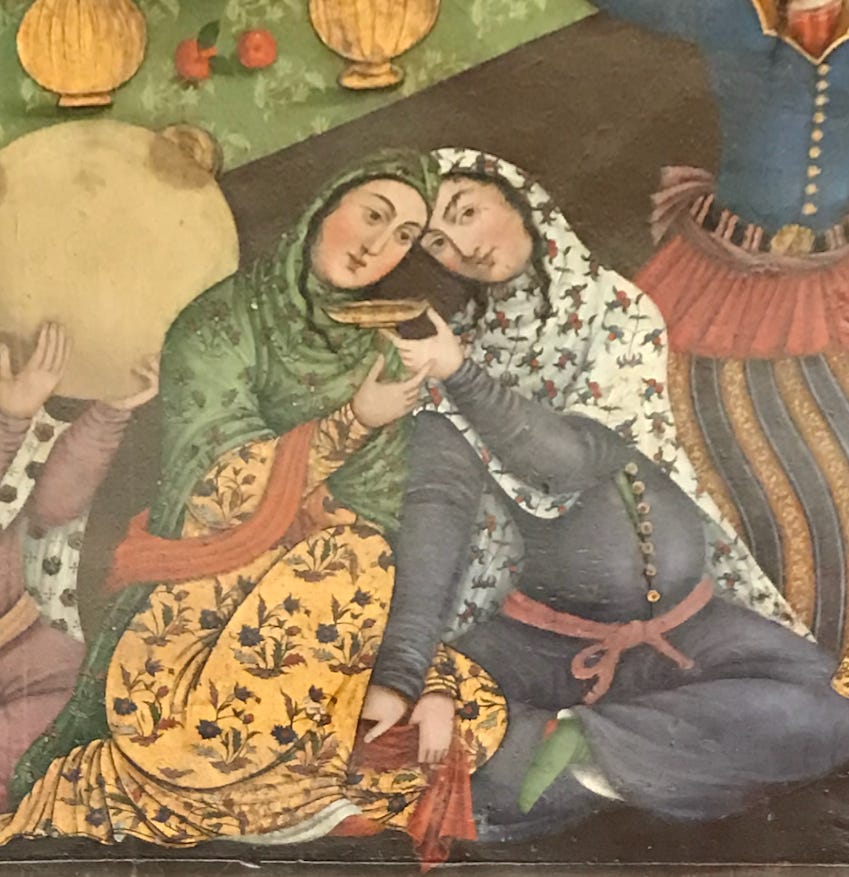
In addition to the wine-drinking on display throughout the murals in the complex, there is also at least one detail which may depict a truly risqué scene for any early modern artist: two women who may be depicted as lovers. (For more on this painting and the culture that produced it, see Afsaneh Najmabadi’s Women with Mustaches and Men without Beards).
The music room of the complex also featured cut-outs in the shape of wine vases, which I thought was a delightful touch, and also probably had an interesting effect on the acoustics of the room:
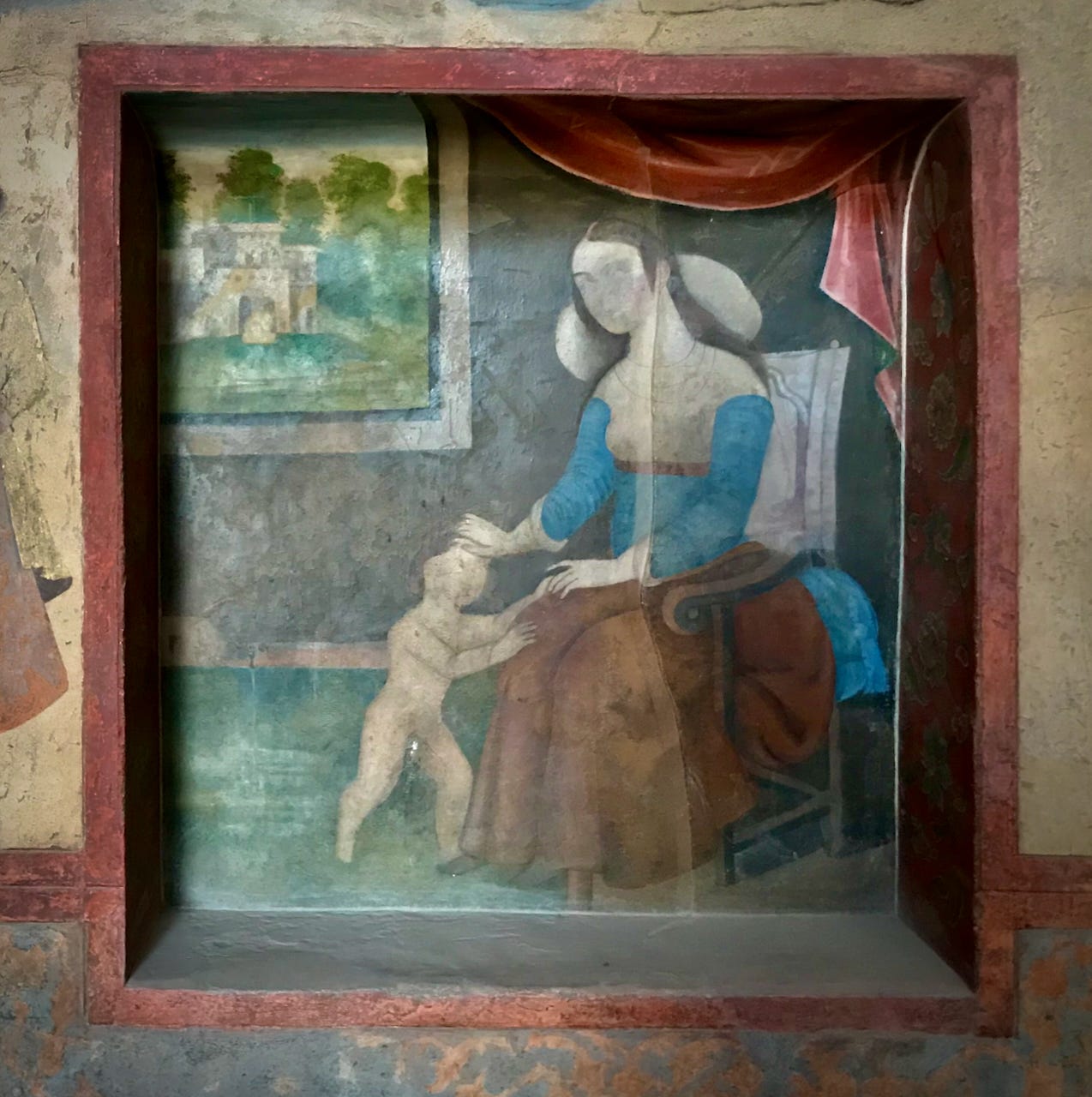
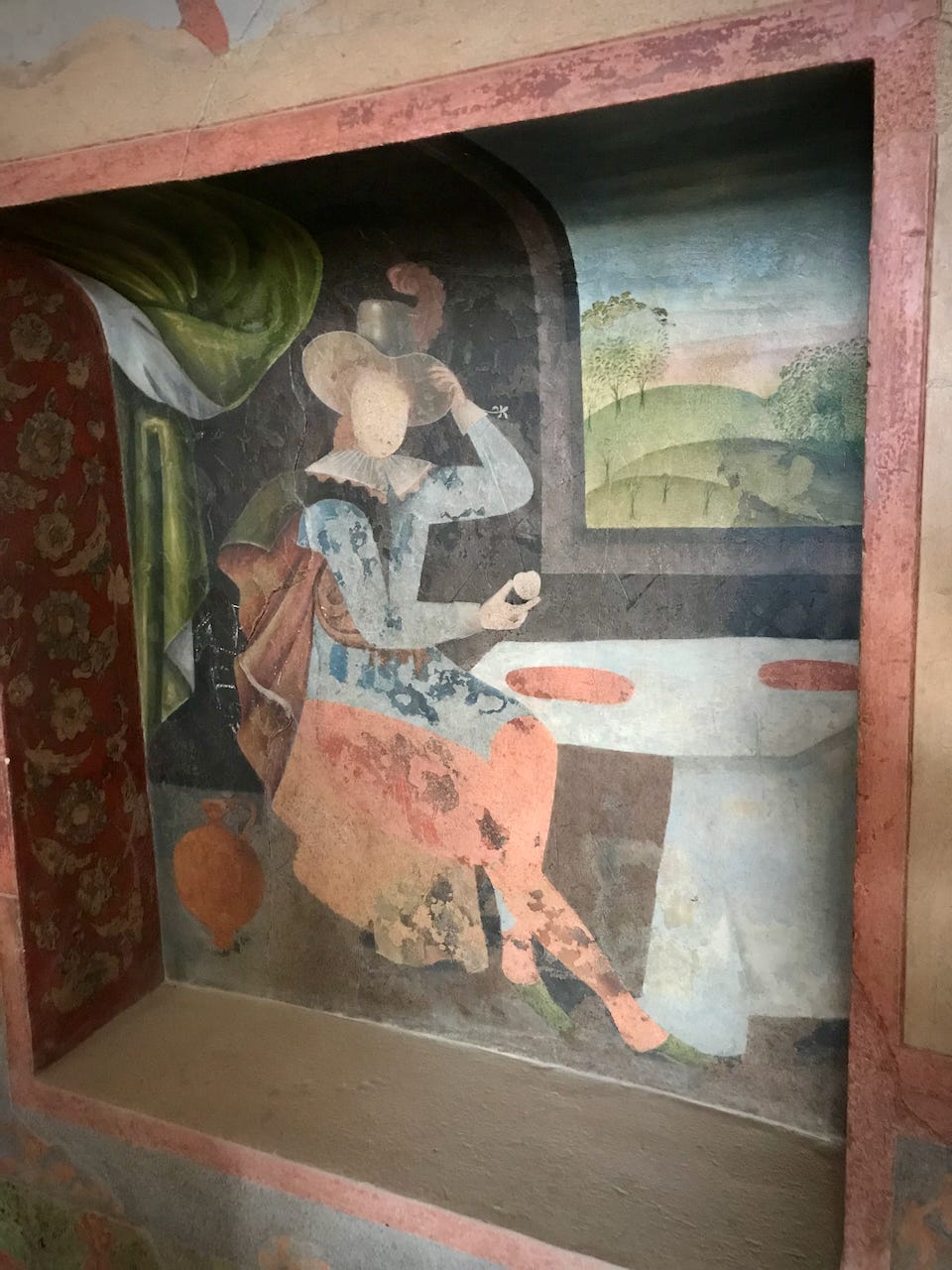
Finally, I was greatly struck by the European style paintings which appeared to depict “firangi” (Western European) nobles wearing clothing in the style of the mid-seventeenth century, seemingly influenced by Italian and Northern Renaissance art.
The area around Isfahan was a stark and arid landscape, heavily mountainous and quite desolate in parts. Continuing southeast to Shiraz brings you to a truly ancient region which was, in effect, the eastern edge of the Fertile Crescent. Shiraz is apparently first mentioned in Elamite tablets circa 2,000 BCE. It has been a wine-producing region for longer than that.
The local wine, though illegal, is still produced and can be purchased from illicit wine-sellers relatively easily. I unfortunately didn’t take a photo of it, but I remember it had been poured into a Coca-Cola bottle and tasted very much like Spanish sherry.1
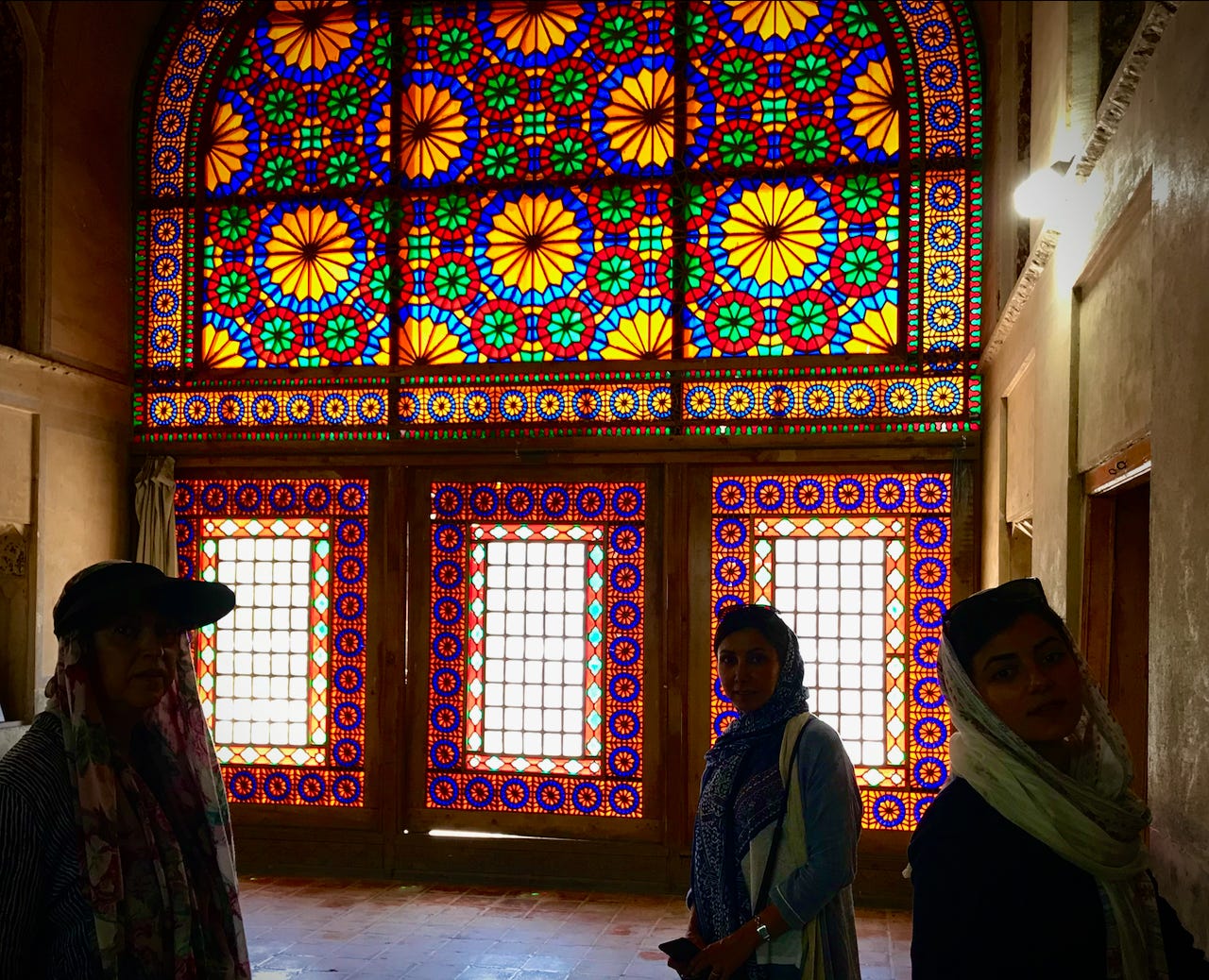
The brilliantly-colored stained glass windows of the Citadel of Shah Karim Khan, founder of the eighteenth-century Zand dynasty, in Shiraz.
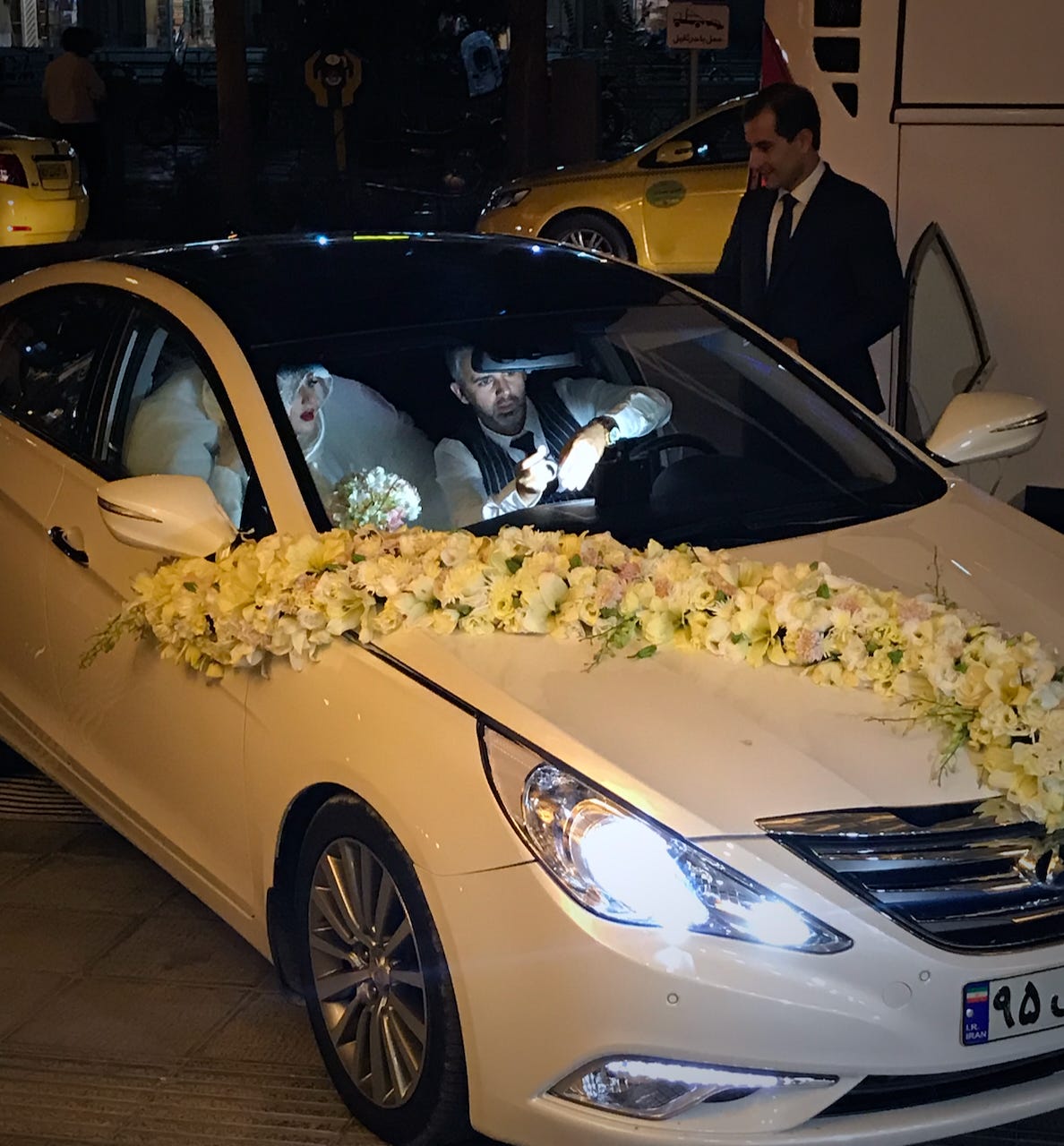
Walking through downtown Shiraz at night, I happened to pass right in front of a wedding party. Here is the bride arriving at the reception:
Not far from Shiraz is the world-famous ancient Persian palace complex of Persepolis, as well as the less-famous but equally interesting Naqsh-e Rostam, the burial site of four Achaemenid emperors including Darius the Great.
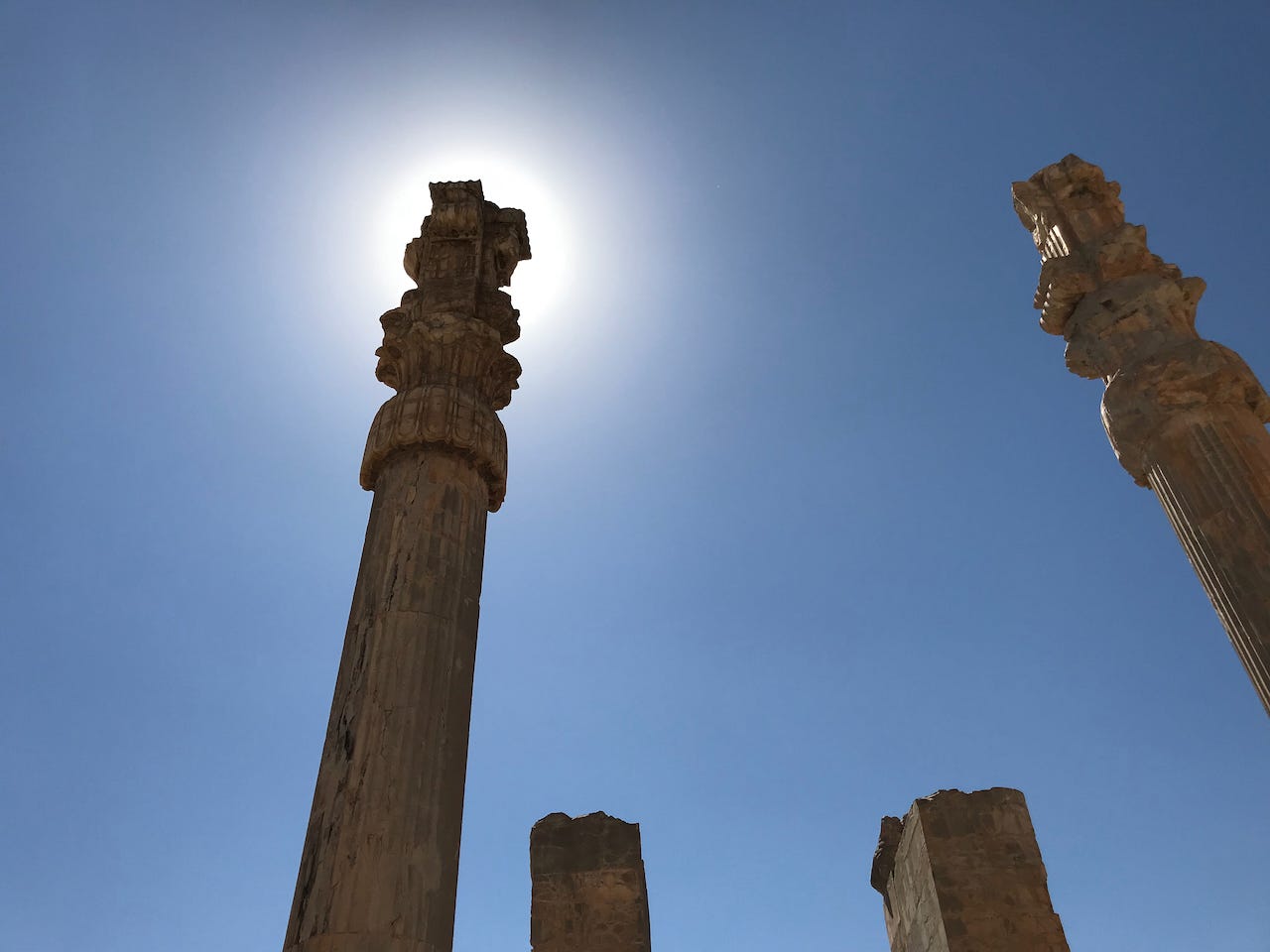
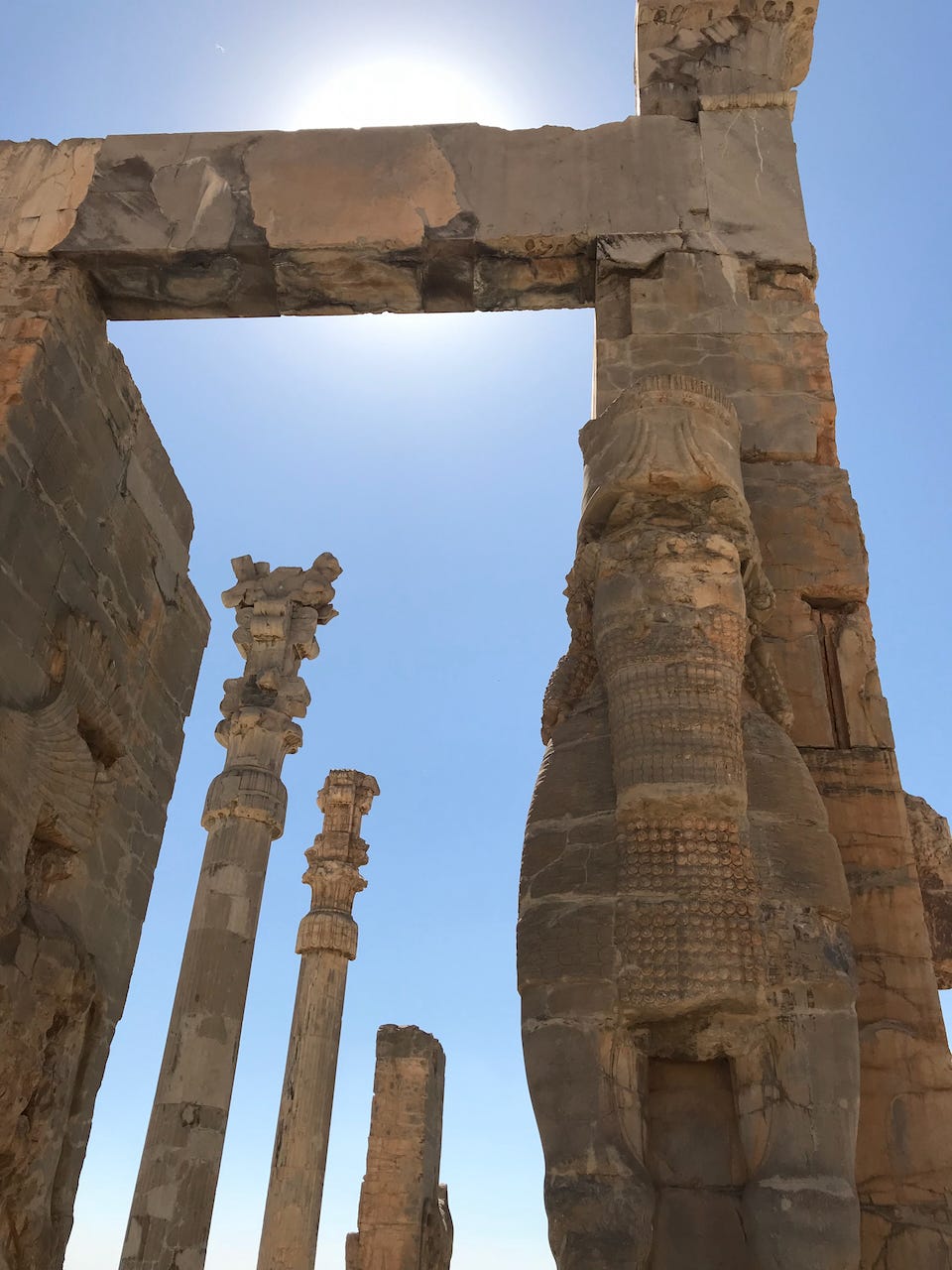
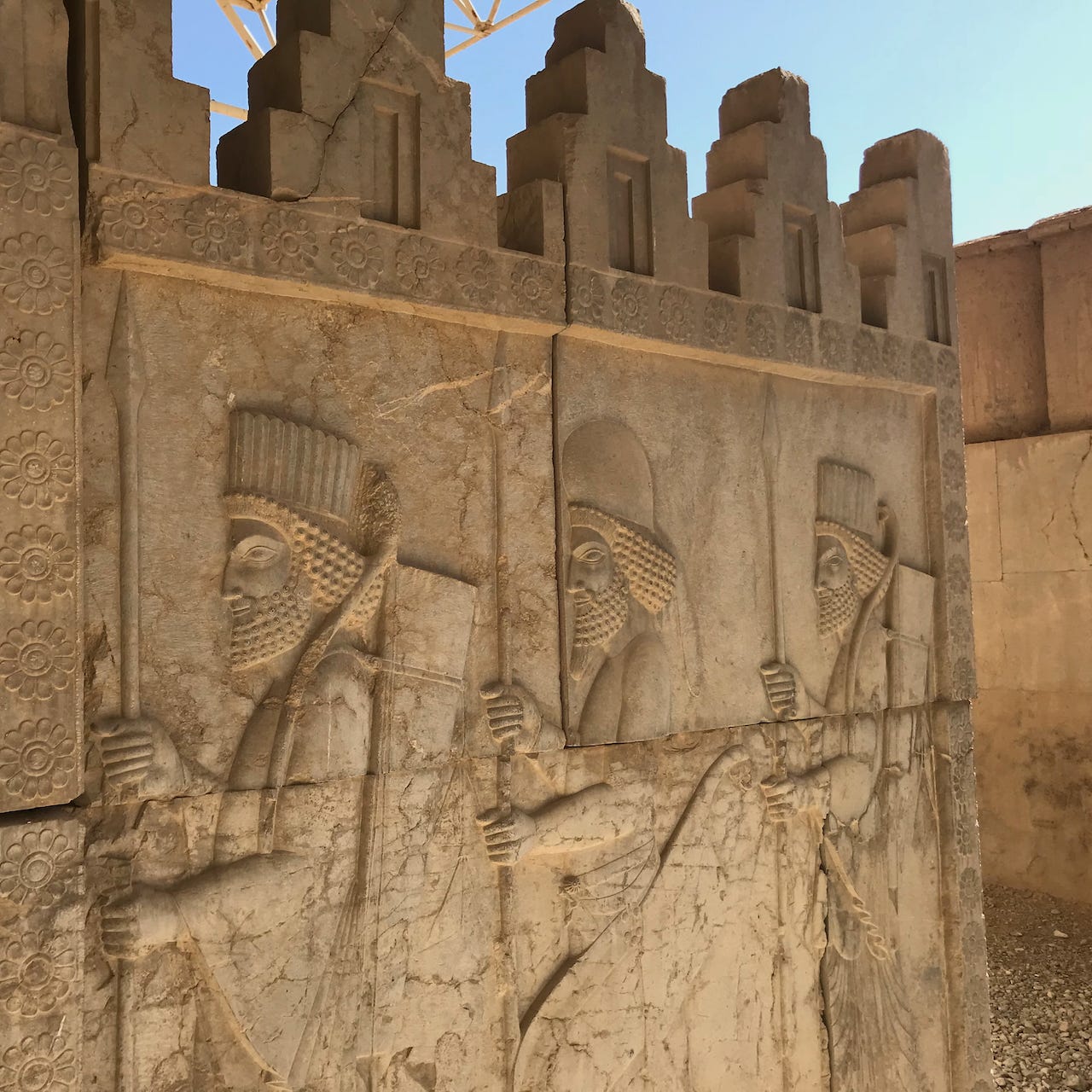
As an archaeological site, Persepolis is incredible. It is however not well maintained and has very little infrastructure. I hope that in some better time to come, a future Iranian government is able to create a museum here to rival its counterparts in Egypt and Greece.
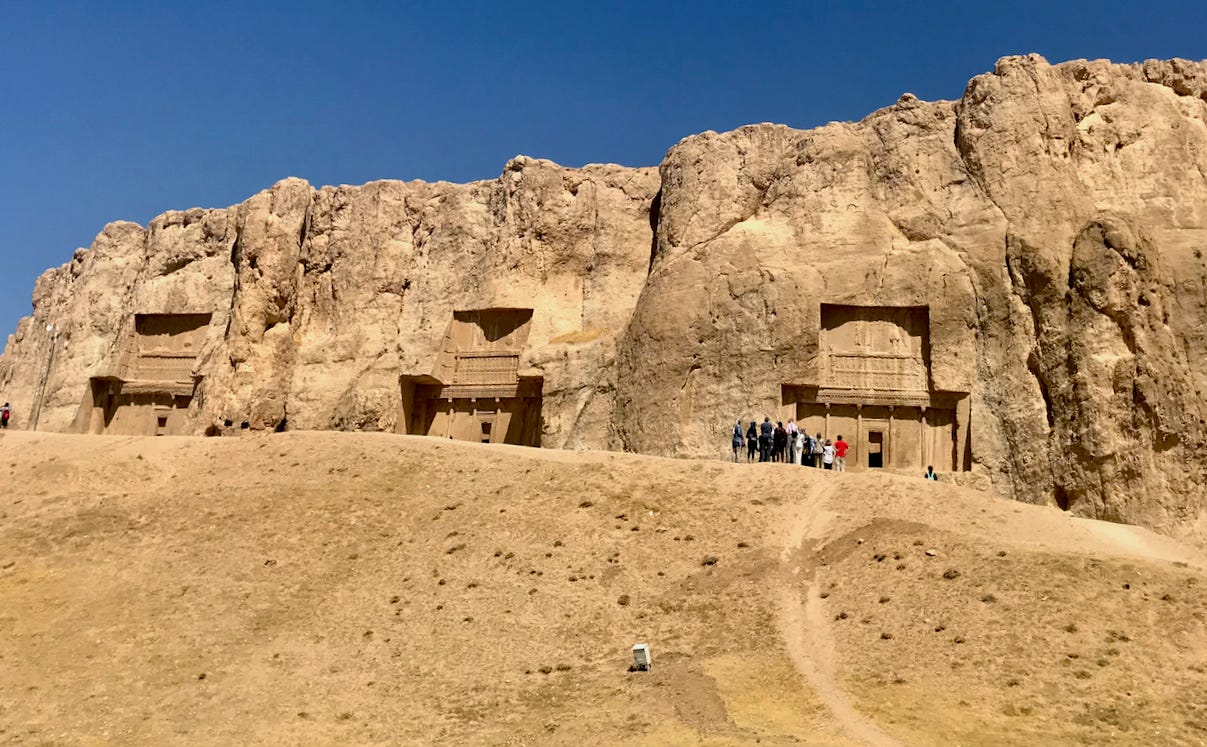
Naqsh-e Rostam, the ceremonial and burial site of the ancient Persian emperors, is within walking distance of Persepolis.
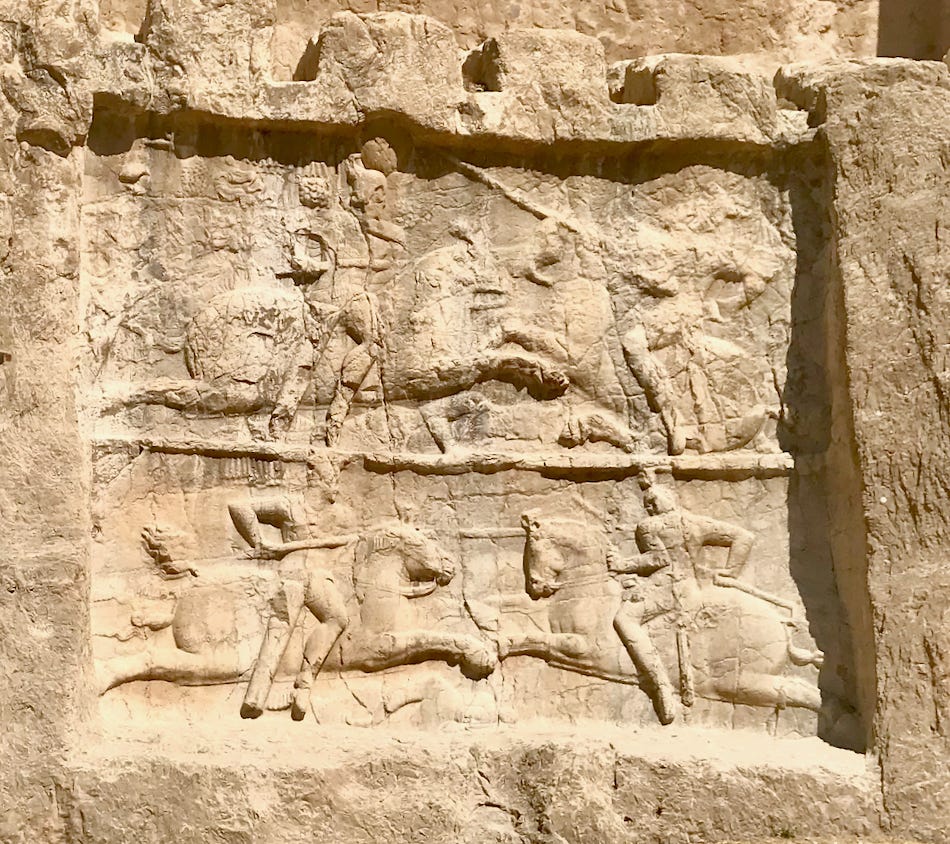
I remember spending at least a week studying the site in an art history class I took as an undergrad, and I can still remember my professor — the witty and erudite David Castriota — describing this Sassanian bas relief as the first depiction of the new technology (mounted, armored warriors on horseback with lances) that would evolve into the medieval knight. It was amazing to see it in person:
It was also fascinating to be able to see, firsthand, the depiction of the humiliation of Emperor Valerian by the Persian emperor circa 260 CE. Valerian was the only Roman emperor ever to have been captured in battle.
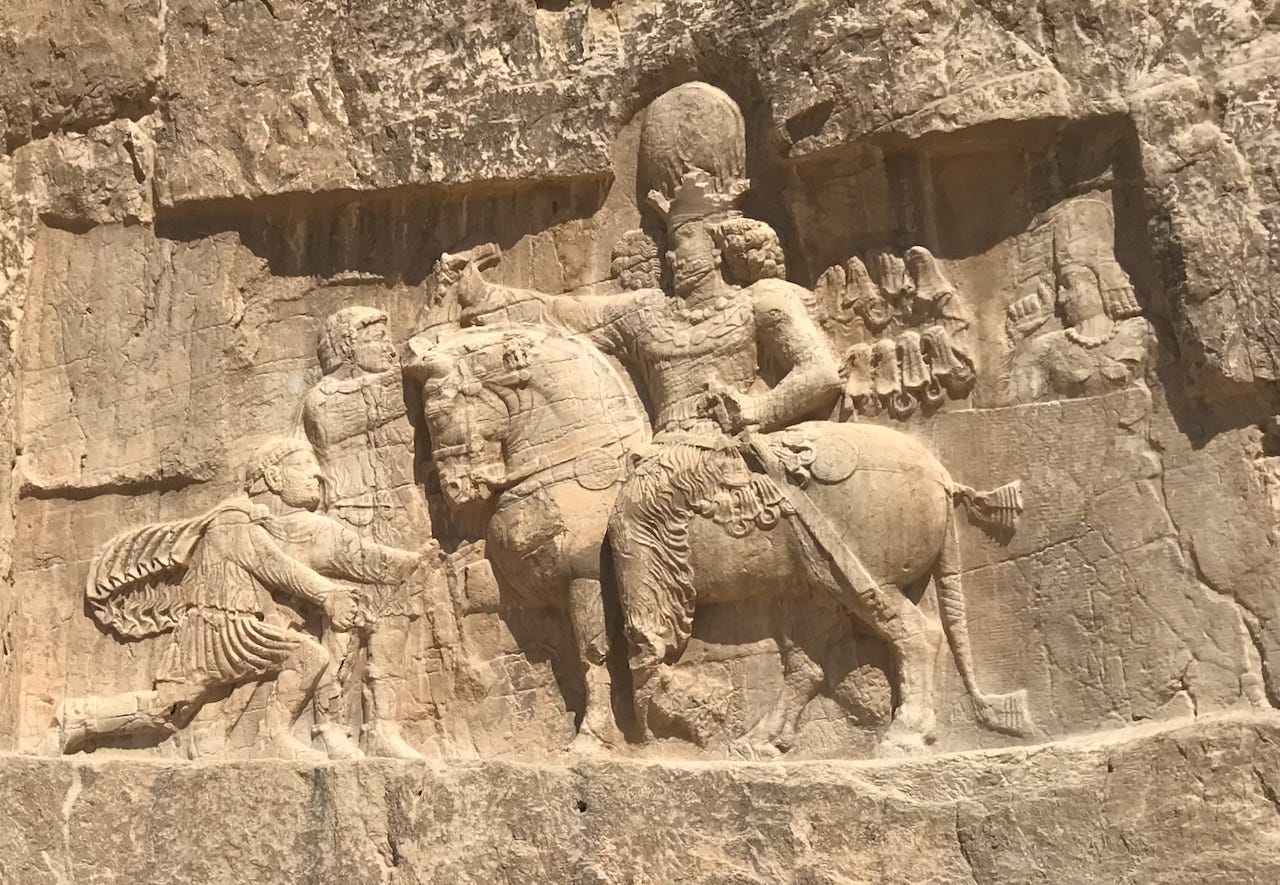
I’m quoting here from Wikipedia, which summarizes one Roman historian’s account of Valerian’s ultimate fate:
Valerian was subjected to the greatest insults and humiliation by his captors, like being used as a human footstool by Shapur when mounting his horse. According to this version of events, after a long period of such treatment, Valerian offered Shapur a huge ransom for his release.
In reply (according to one version), Shapur was said to have forced Valerian to swallow molten gold… and then had Valerian skinned and his skin stuffed with straw and preserved as a trophy in the main Persian temple.
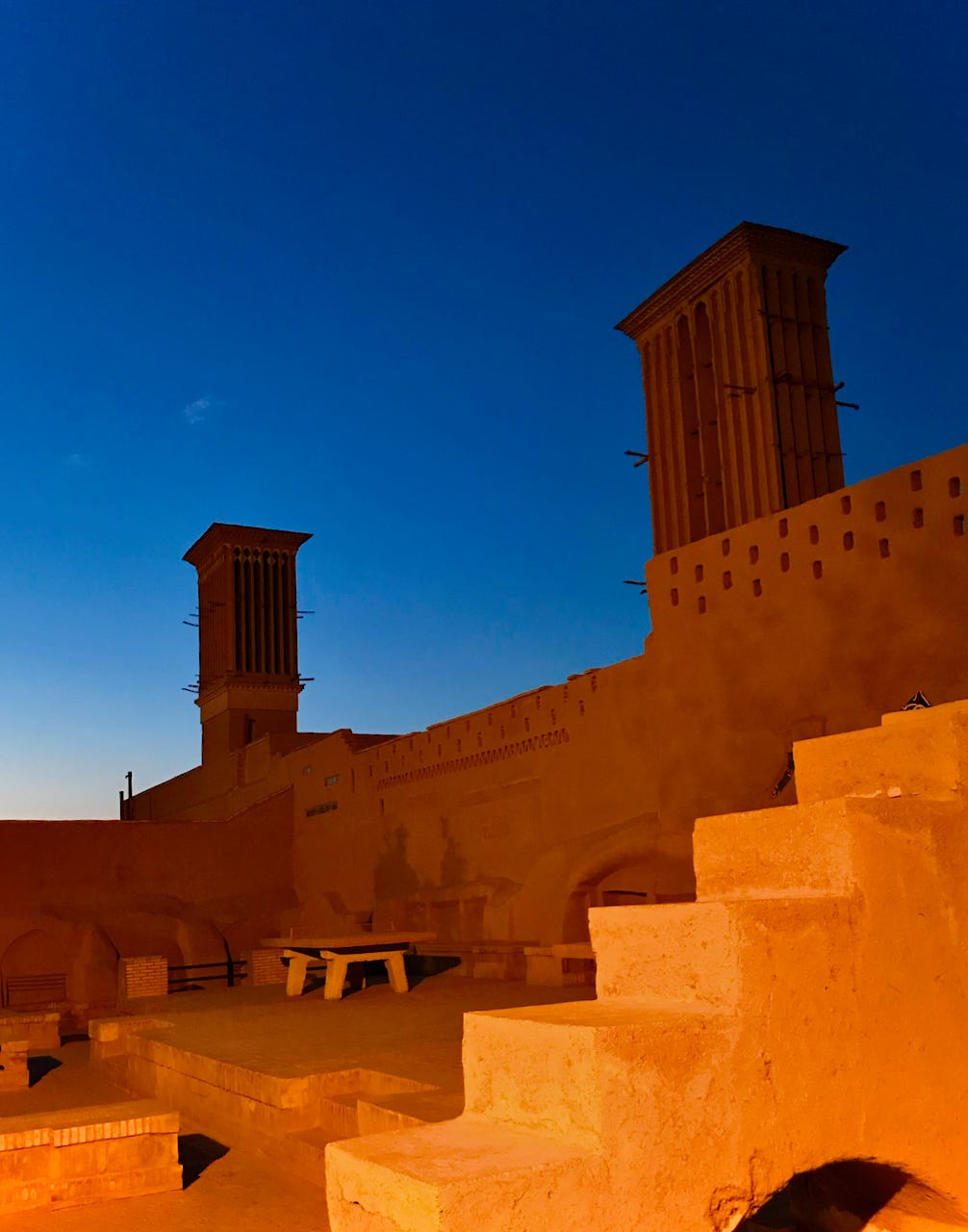
Finally, we wrapped up our roadtrip in Yazd, a city that Marco Polo visited and seems to have greatly enjoyed. I don’t think I’ve been anywhere besides possibly Oxford or Sienna that is so well-preserved as a premodern cultural site. The architecture both in the city and in the extremely arid region around it still preserves the ancient Persian architecture of qanats and Windcatcher towers designed to channel water and cool air through one of the hottest places on earth.
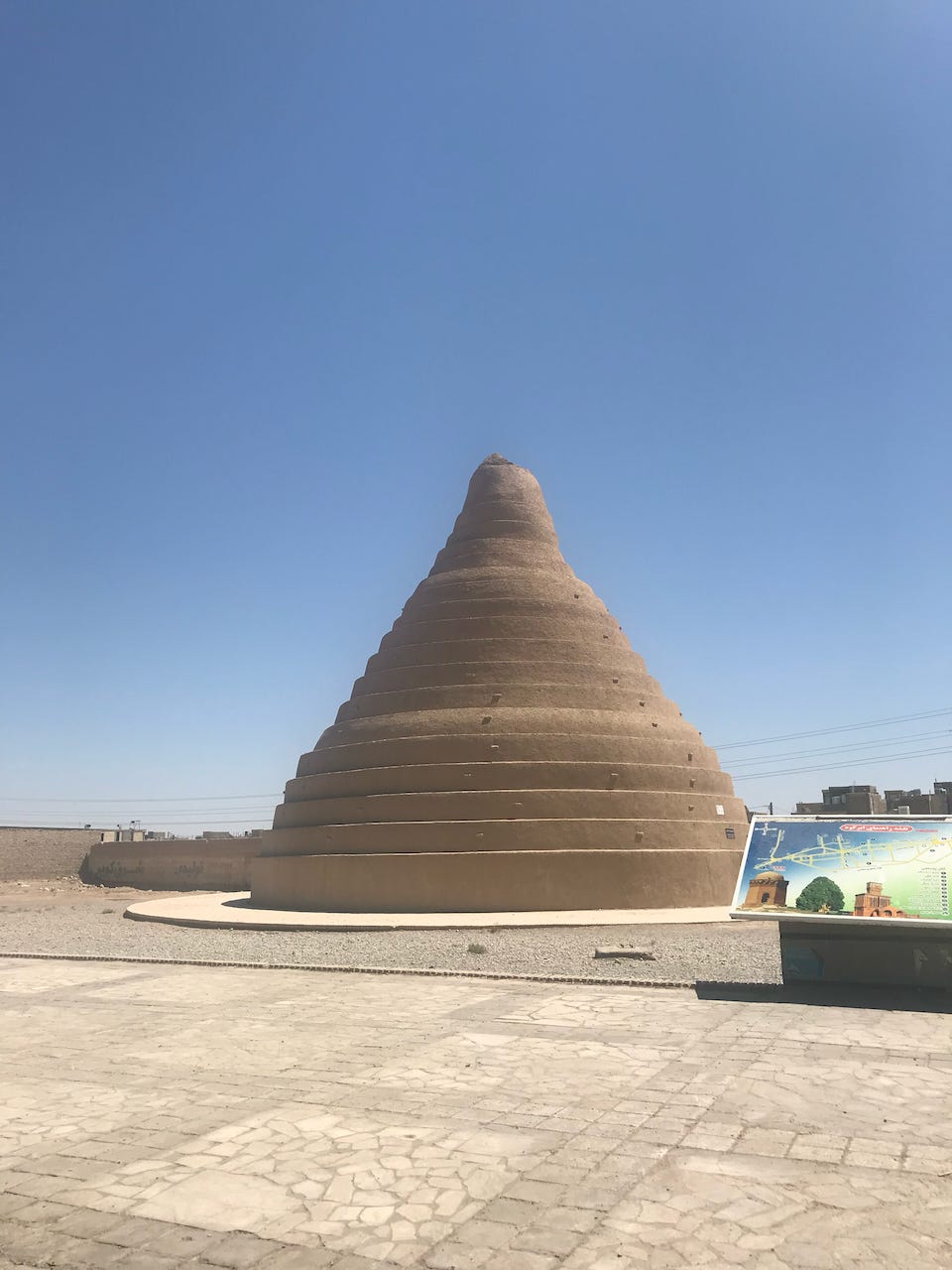
Traditional architecture and an “ice house” (yakhchāl) outside Abarkuh, two hours from Yazd:
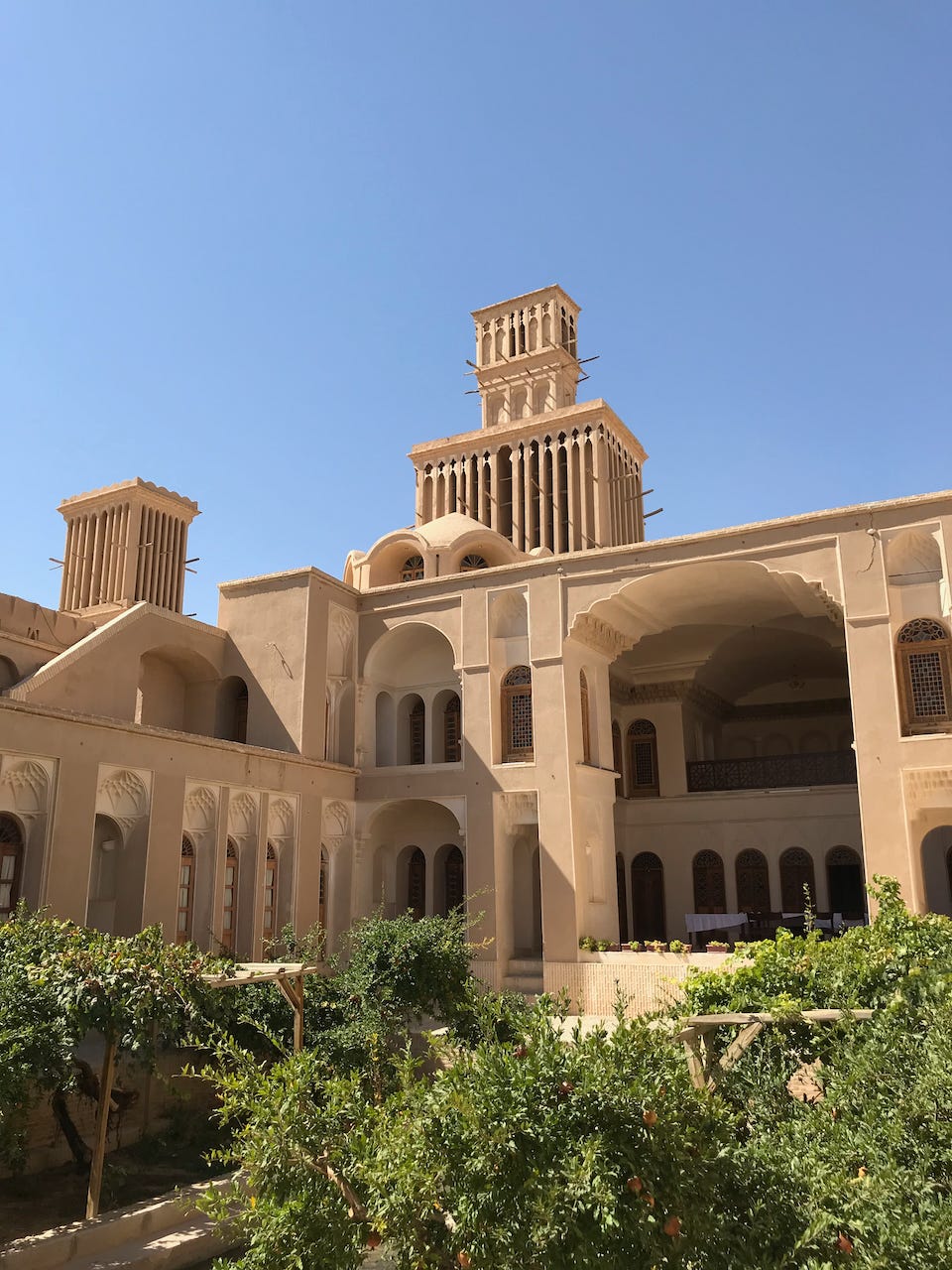
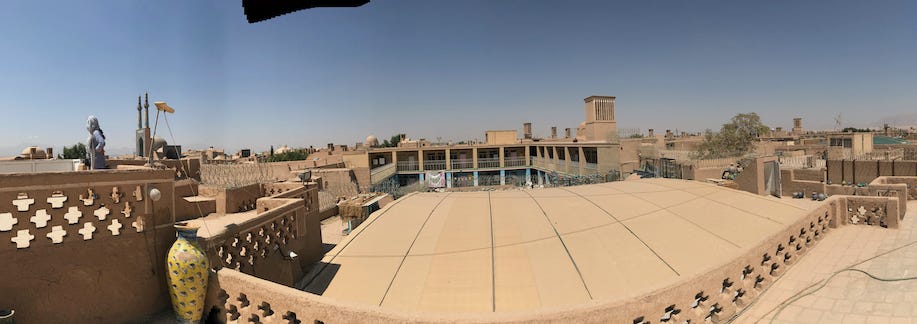
And a panoramic view of Yazd itself. Historically, the remote desert city was a stronghold of Zoroastrianism. The Yazd Tower of Silence had a continuous record of Zoriastrian-style “sky burial” (exposure of dead bodies to the elements) for roughly three thousand years, ending when the practice was banned in 1963.
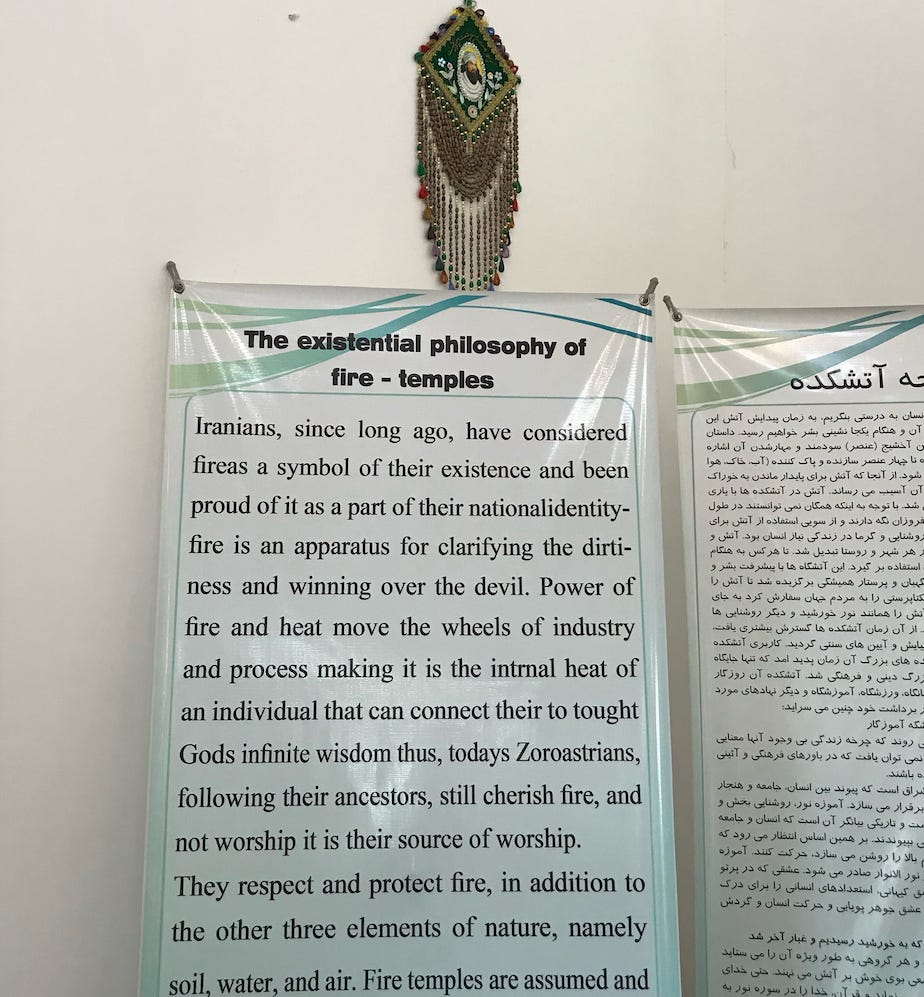
You can still visit the Fire Temple of Yazd which claims to house a sacred flame which has been continuously lit since 470 CE. It is the highest grade of fire in the Zoroastrian religion, described by Wikipedia as a flame combined from “sixteen different sources, including the fire created by a lightning bolt.”
Zoroastrians are few in numbers in today’s Iran (numbering in the low tens of thousands) and face religious persecution, but they still exist as an active religious movement. It was fascinating to see a place where they remain a large minority.
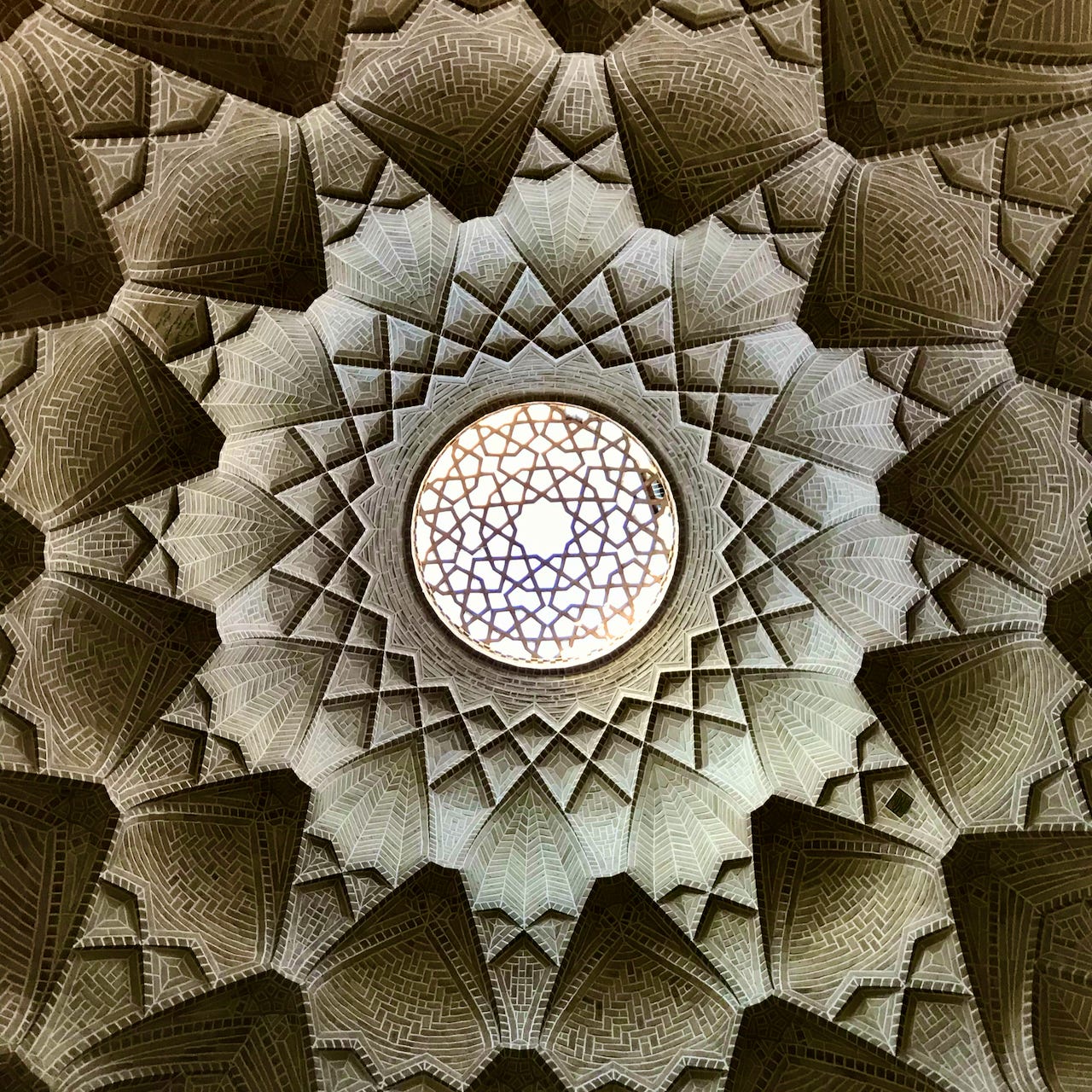
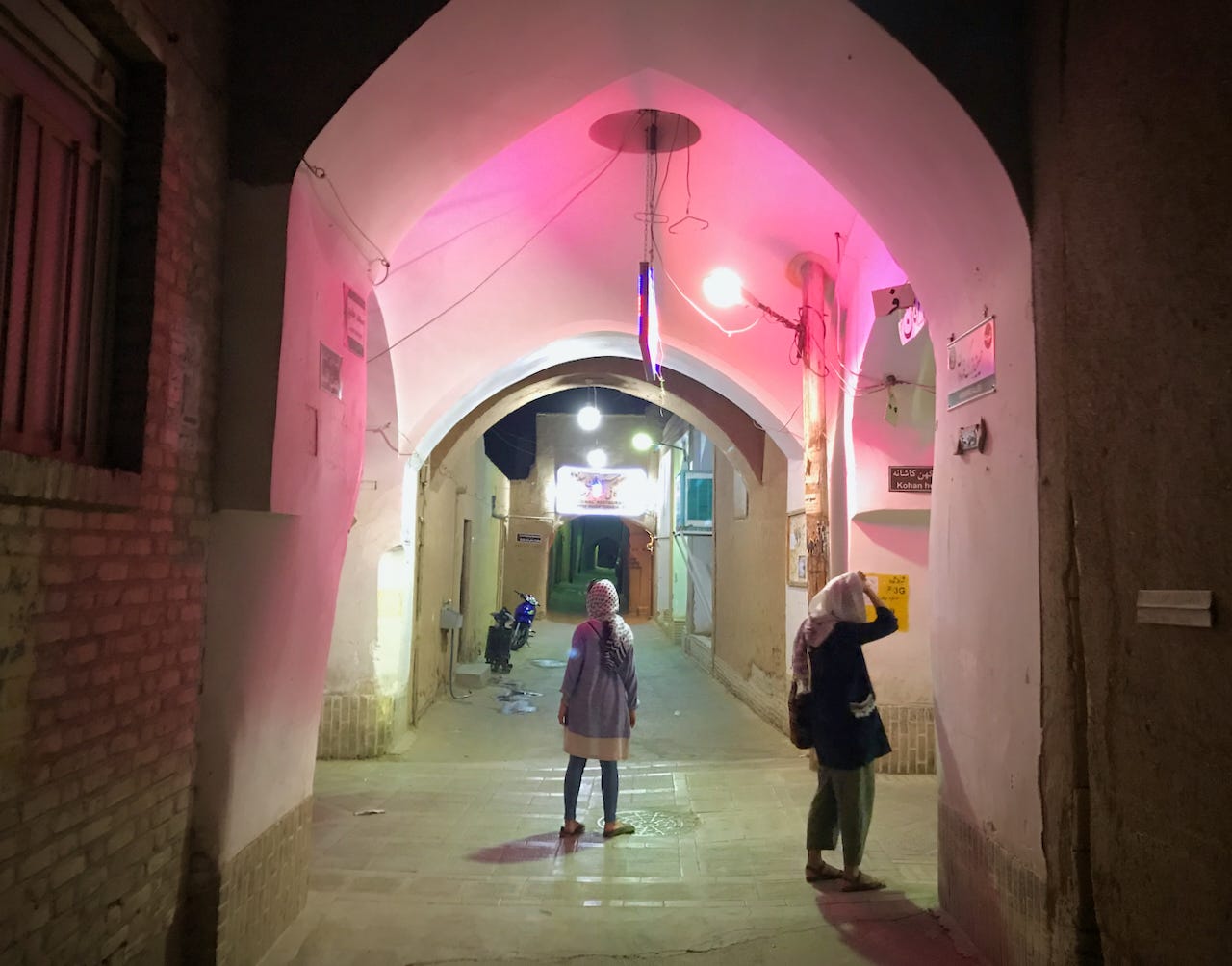
Yazd architecture is the most skillful adaptation to desert/arid conditions I’ve seen. The use of windcatcher towers, domes, and thick earthen walls genuinely works wonders to cool down interior spaces. Yazd lies on the edge of the Lut Desert, which is the site of the highest-known surface temperature on planet earth (70.7°C, or nearly 160 degrees Fahrenheit!) Yet walking through Yazd’s shady alleys and its thick-walled buildings, you would never know it.
Flags of the world at a Yazd hotel:
Just to reiterate, all photographs here aside from the one I flagged above were taken by me in 2017, and all are hereby released to the public under a Creative Commons Non-Commercial License.
As an American, I hope someday to be able to visit Iran again in better times, and I hope these images help give a sense of the country, the people, and its history.
• My wife Roya Pakzad wrote about one element of our 2017 trip to Iran not mentioned here, but one that also stuck with me: computer-assisted government surveillance of whether women wear hijabs, and the omnipresence of surveillance in general in Iranian life. There’s a reason why I saw 1984 being sold on so many street corners.
•For those in the Boston area: I’m going to be speaking at two events at Harvard this month. The first is “Psychedelics and the Specter of Mind Control” on April 6 (link for more info). The second is at the Psychedelic Intersections conference on April 11 (link). If you’d like to meet up while I’m in the area, please get in touch.