One of our interns is a senior at Stanford, and he mentioned that Palantir is the most common employer of his classmates. This shocked me. I knew defense tech was ascendant in Silicon Valley (Jasmine Sun wrote an excellent article about this last year)1 and that Palantir, long derided by the markets as a government consulting firm masquerading as a software business, had an insane run-up in its stock in 2025:
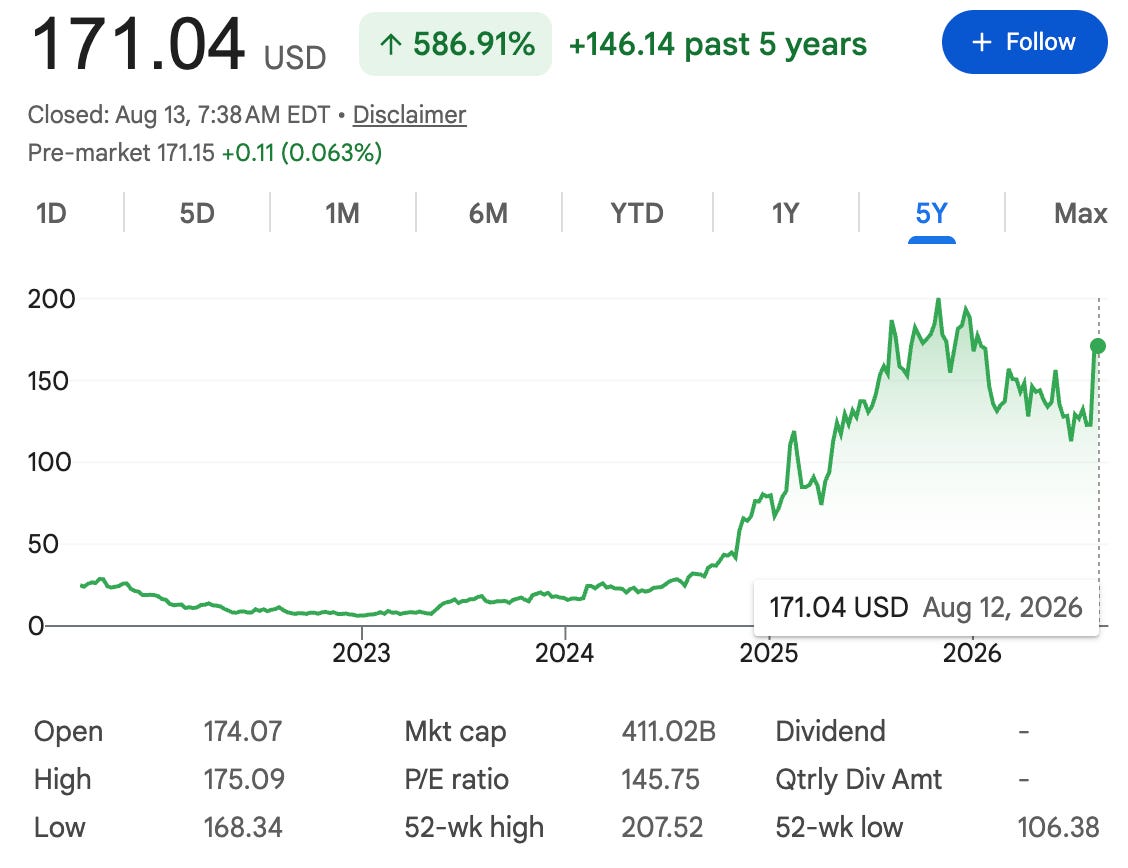
But I guess I didn’t grasp the magnitude of this shift. I think of Palantir, a Peter Thiel-founded company that works with ICE to build surveillance tech, among many other things, as perhaps the quintessential “evil tech company” in popular culture (for example, every few months I hear about a call to boycott emoji-laden event-planning app Partiful2 because its founders are Palantir alums). So, I’d expected the company to still be at least somewhat taboo among college students at a liberal-leaning university like Stanford.
Palantir attracting hordes of students from one of the country’s most elite institutions is a marker of the major shifts in the 2020s in the politics of corporate America and Silicon Valley in particular. I’ve generally thought of this as a shift rightward; it’s been obvious over the past 5 years that tech leaders particularly became much more comfortable publicly aligning with Trumpism, with tweets ranging from the pathetically sycophantic to the pathetically bigoted. But I wanted to see what this looked like among rank-and-file employees: how obvious is the political shift of the people who work for the most powerful companies in the world, the types of places where Stanford students end up?
Political donations provide an interesting window into the politics of different organizations, because donors are asked to report their employer and job title, meaning you can get a rough look at how employees of different companies have donated. This data is imperfect: it’s self-reported, and not well-standardized:
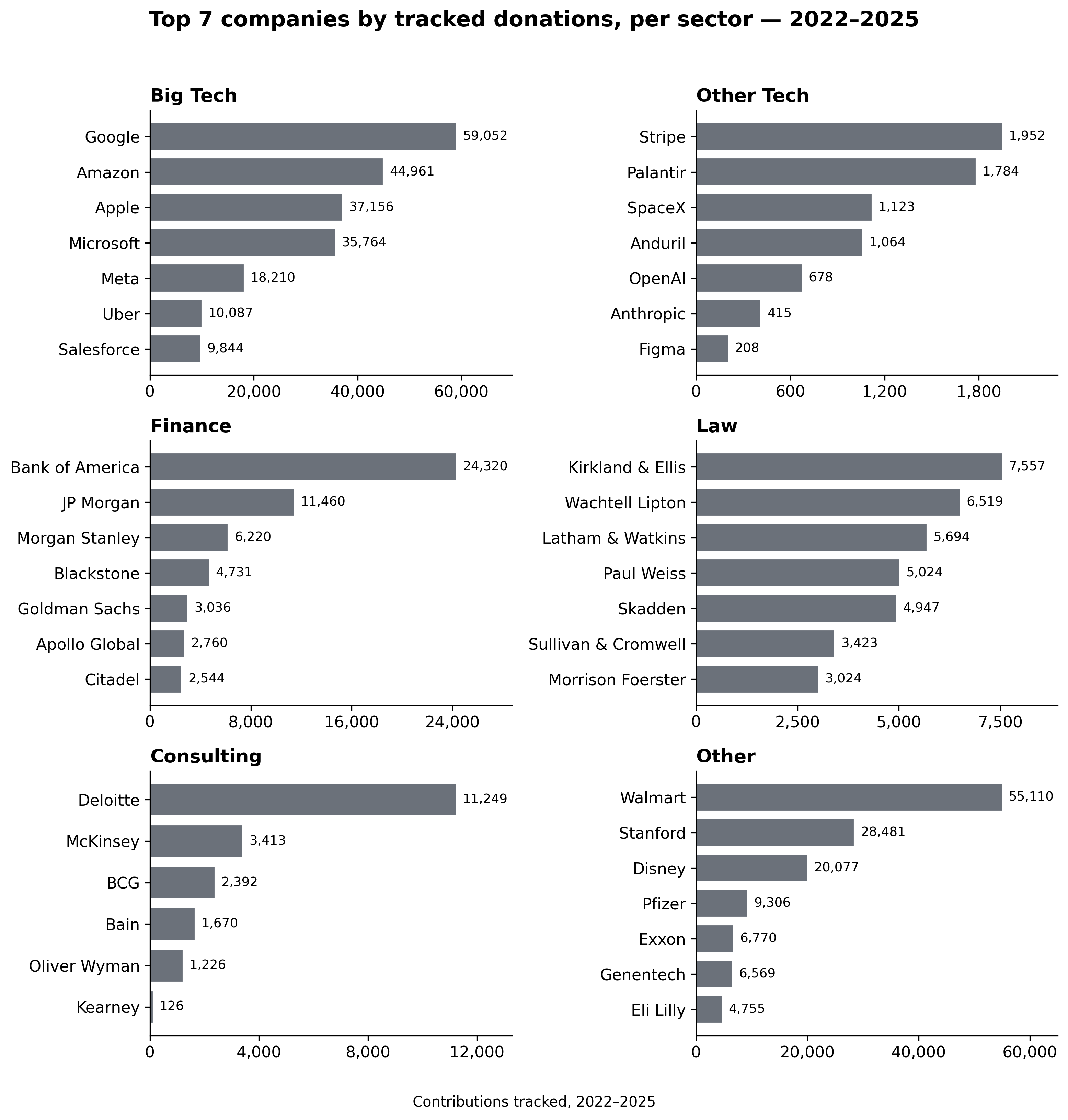
But it’s really fun data to analyze, So I pulled together3 a subjective sample of the types of companies that a Stanford student might go work for, and the political giving of these companies’ employees:
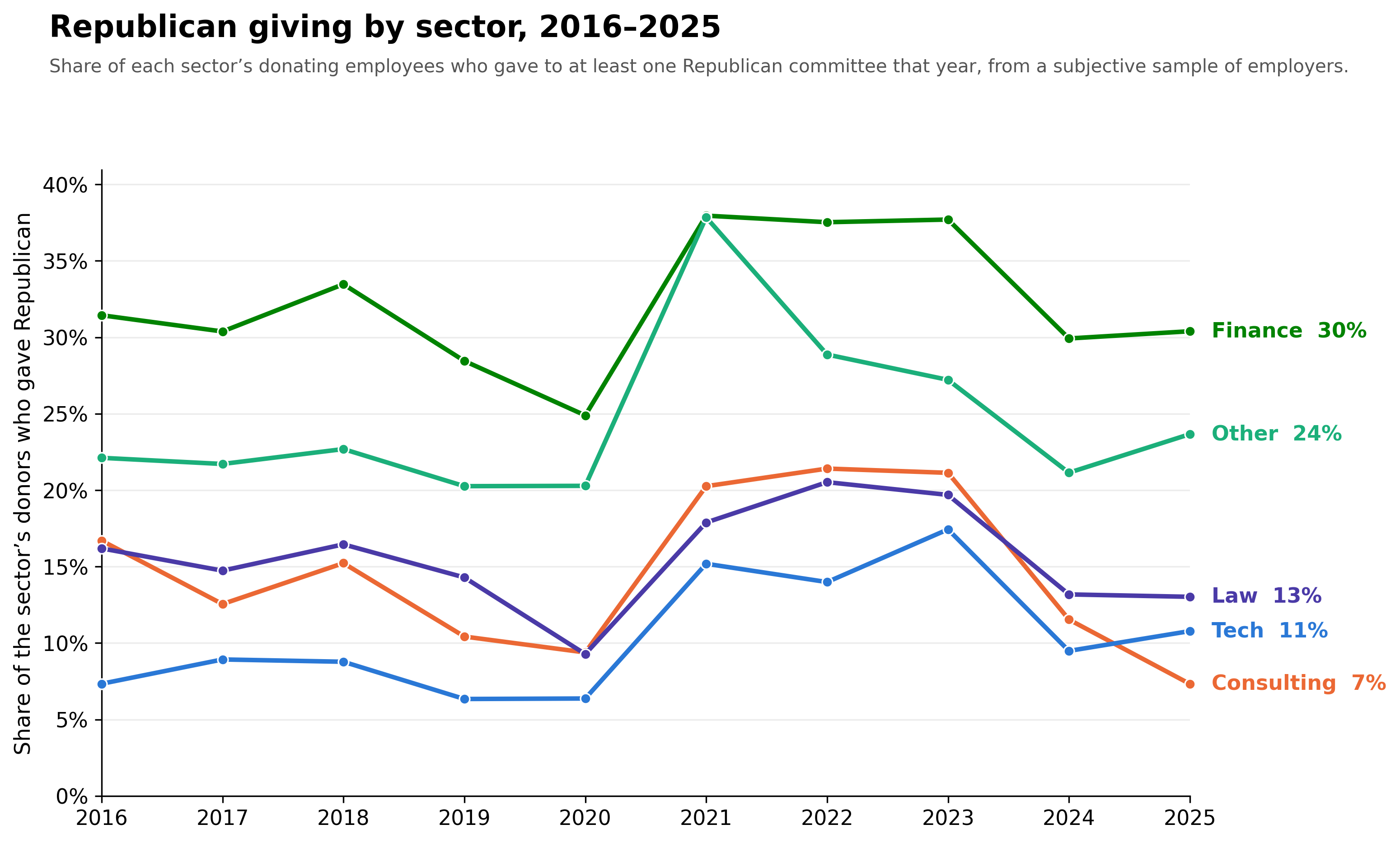
I expected to see a substantial uptick in the % of people donating to Republicans in the 2020s; this is pretty clear across sectors, with the share in tech ~doubling from 2020 through 2023, before reverting in the election year of 2024:
But I was surprised at how low the share of Republican donors were at any of these companies. Below is a tech sample — Anduril, an autonomous weapons manufacturer with a very outspoken Republican founder, leads with just 35% of donors giving to Republican causes since 20204. Palantir is in the middle of the pack, with just 13% of donors giving to Republican causes!
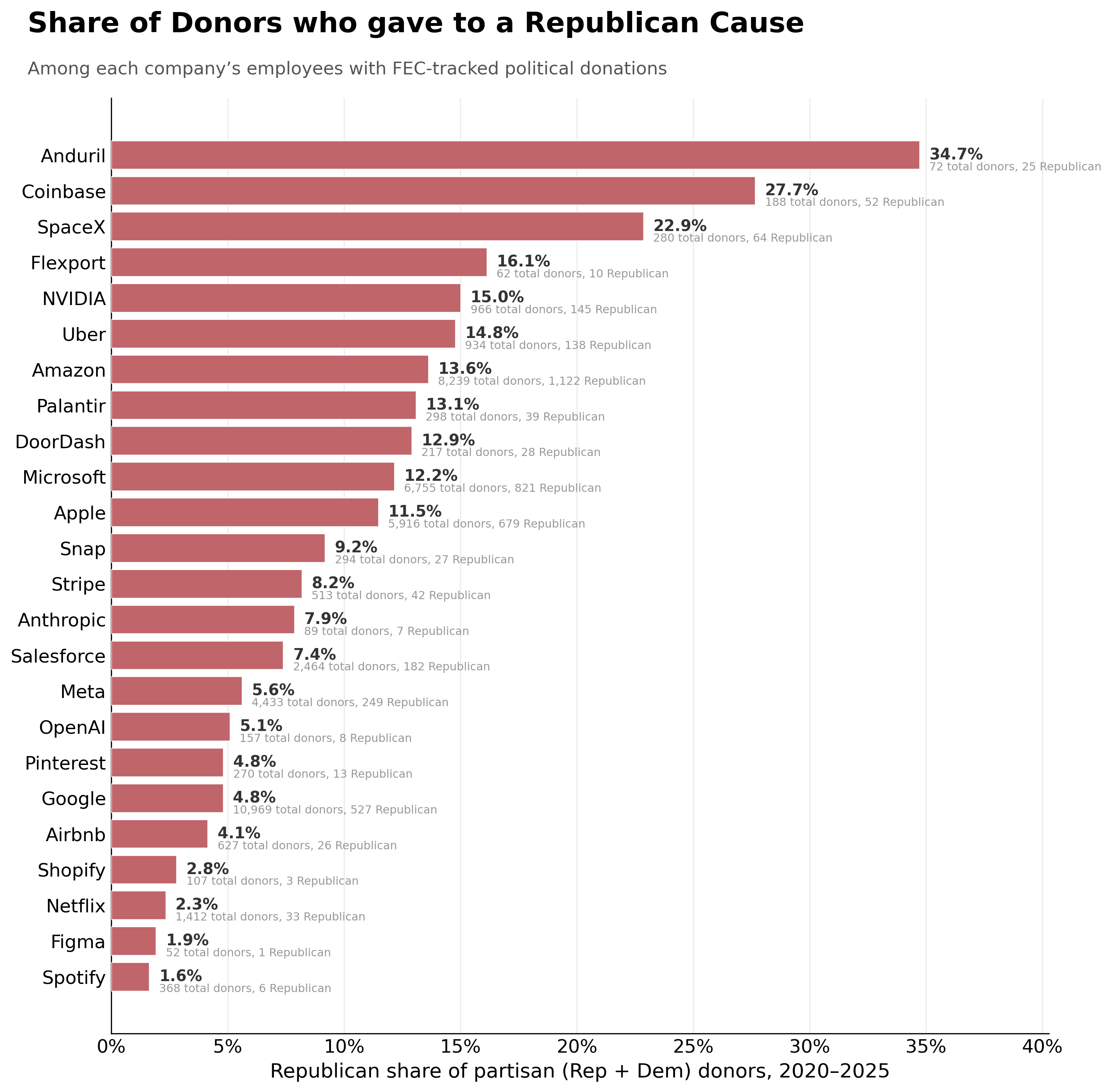
I expect this analysis undercounts Republican donors; it seems quite possible that Republicans who donate are more wary about sharing their employer. The donation platforms matter too — WinRed (the conservative small dollar donation platform) has only been around since 2019, whereas its Democratic counterpart ActBlue was started in 2004. These platforms itemize all donations, even those under $200, so if WinRed isn’t as widely adopted, small Republican donors would be undercounted.
But the relative counts between companies seem about right, and in any case it seems like there are more people libbing out at Palantir than I’d expected.
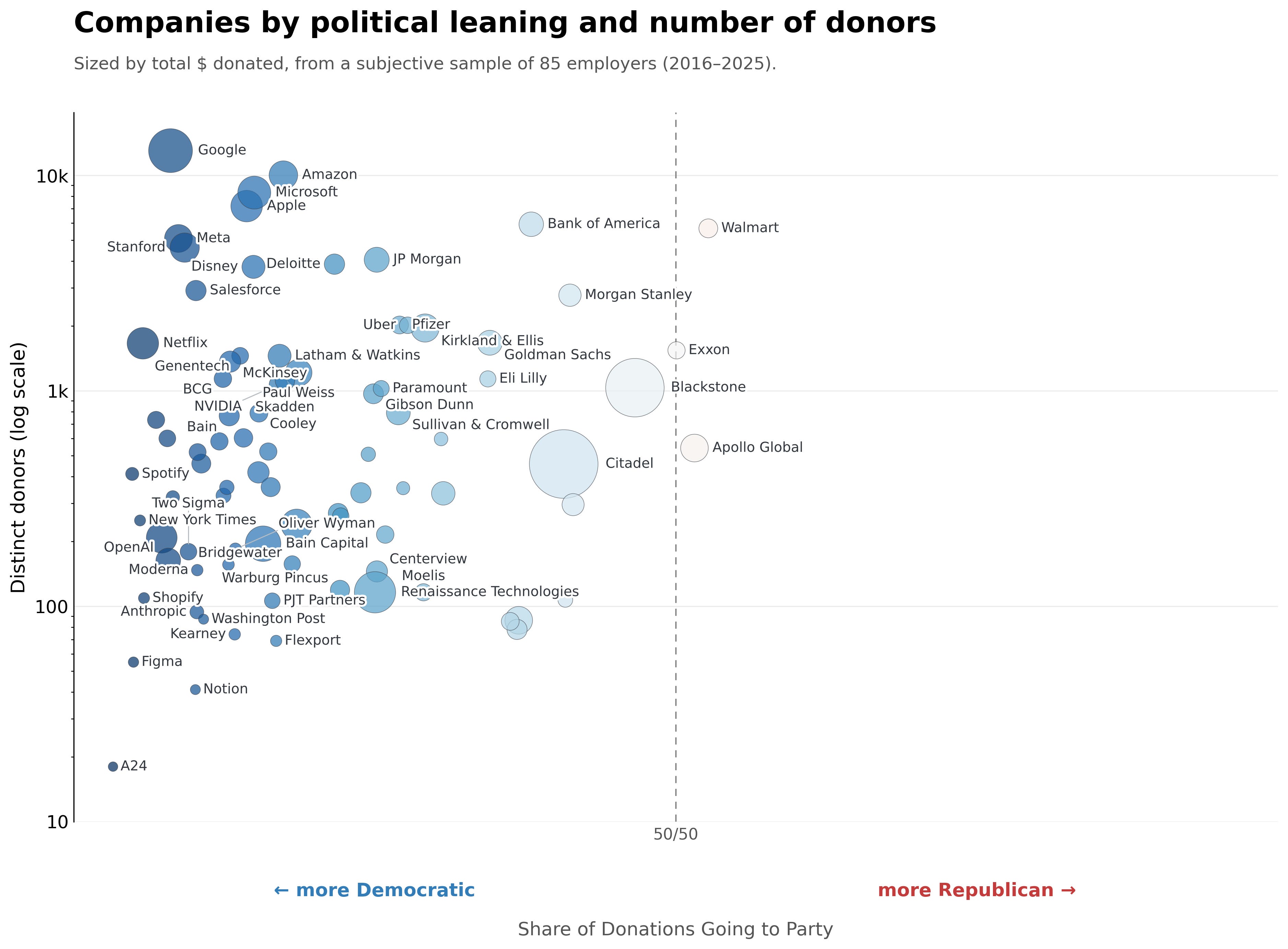
There’s way more to explore than I can fit here, so if you’re interested you can play with a dashboard here. These are some other things I found interesting about political giving at these firms:
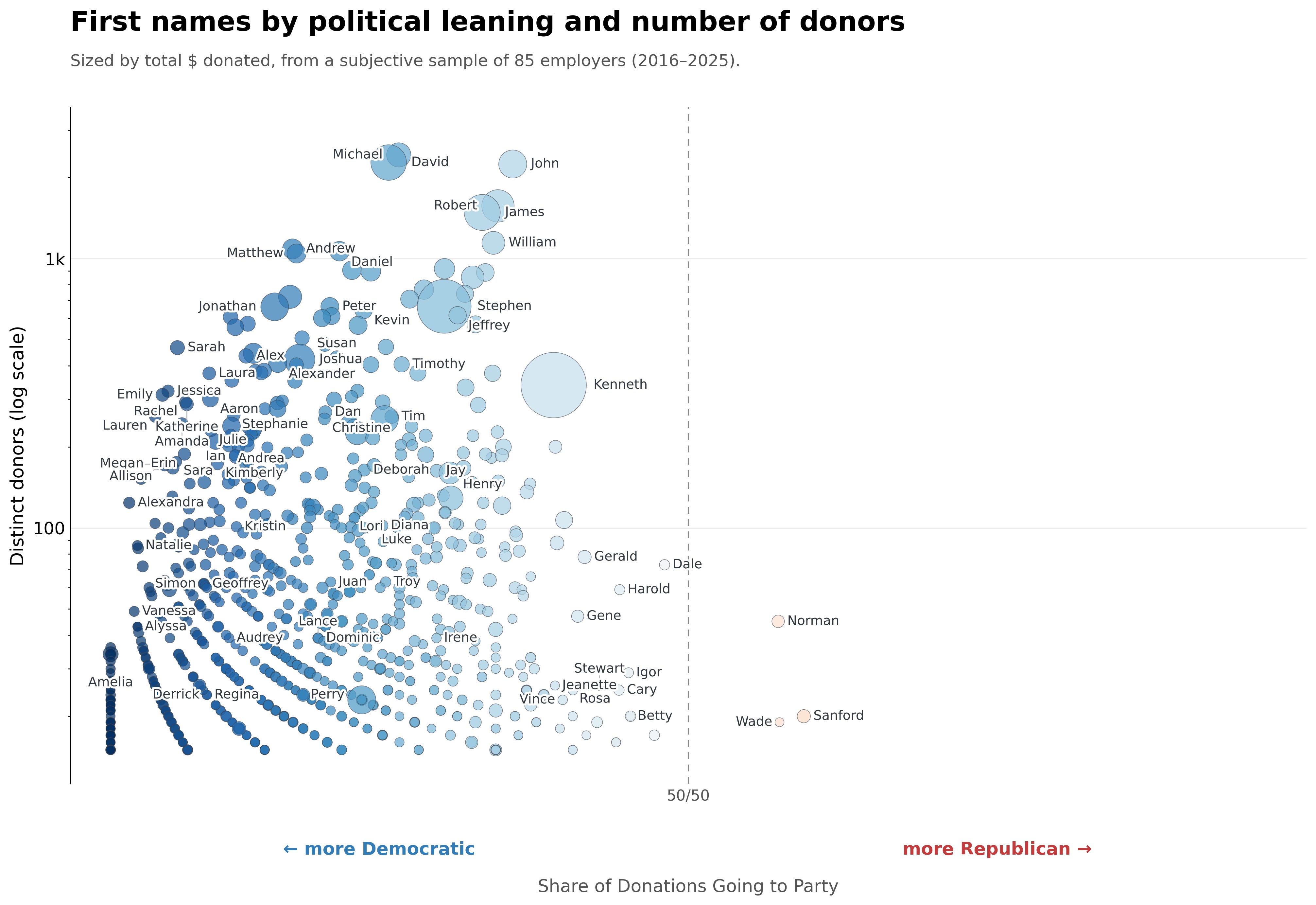
One thing that jumps out is how the most common female names from this sample donate almost exclusively to Democrats; the liberal Megan Erin Allison Emily contingent at these companies is very strong. The few names that skew conservative are, well, old white guy names:
Another is that the few job titles that skew conservative are by far the lowest paid. Cashiers and stockers at Walmart and maintenance workers or truck drivers at Amazon are much further to the right by the percentage of donations than their category manager or software engineering counterparts. Which is…odd! Because, at least based on my simplistic view on economic platforms of the two parties in the US, both groups are voting against their economic incentive.
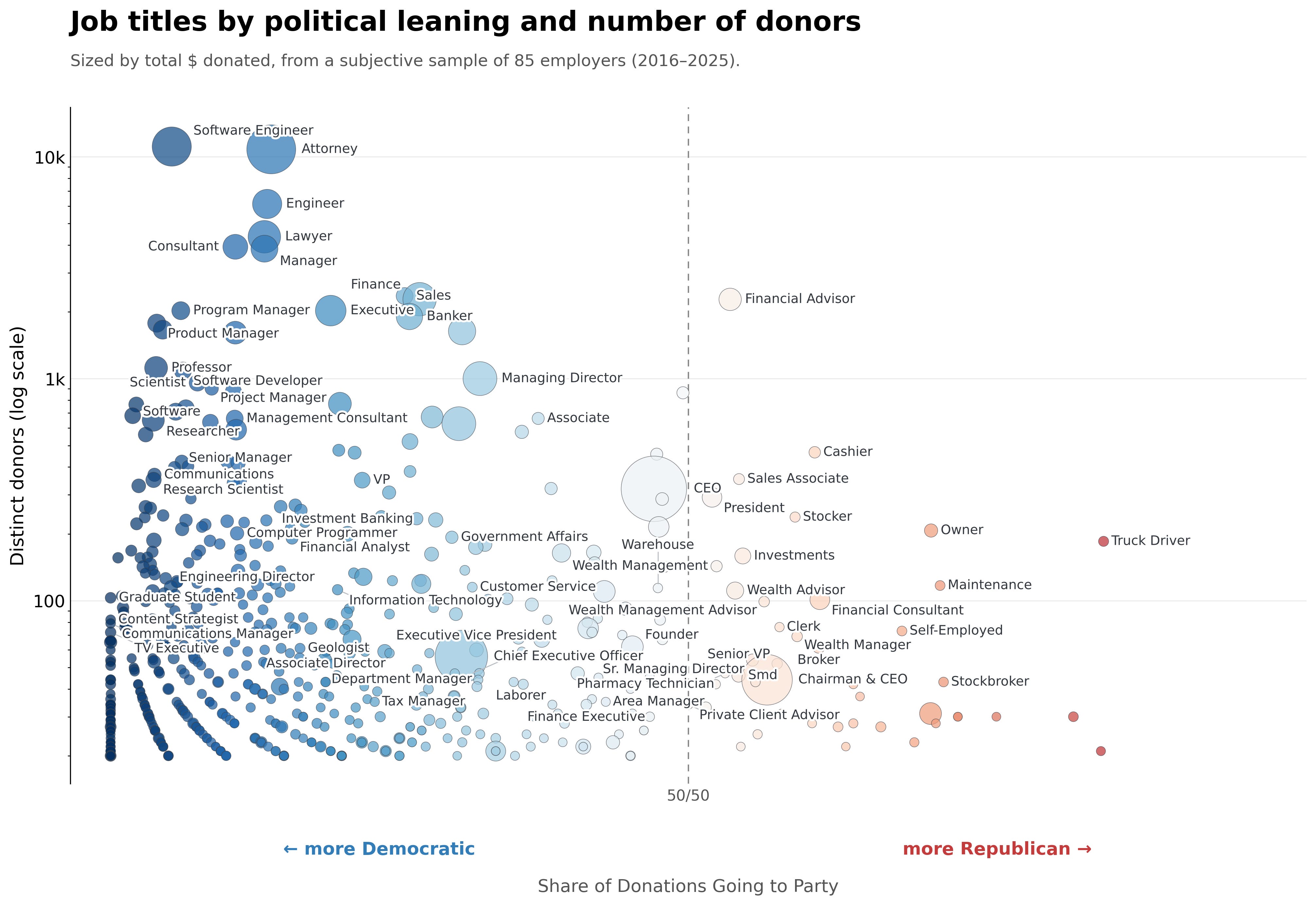
None of this is a revelation, of course. But it’s a good reminder of how important identity is, the power of a sense of belonging over an economist’s strict definition of rationality.
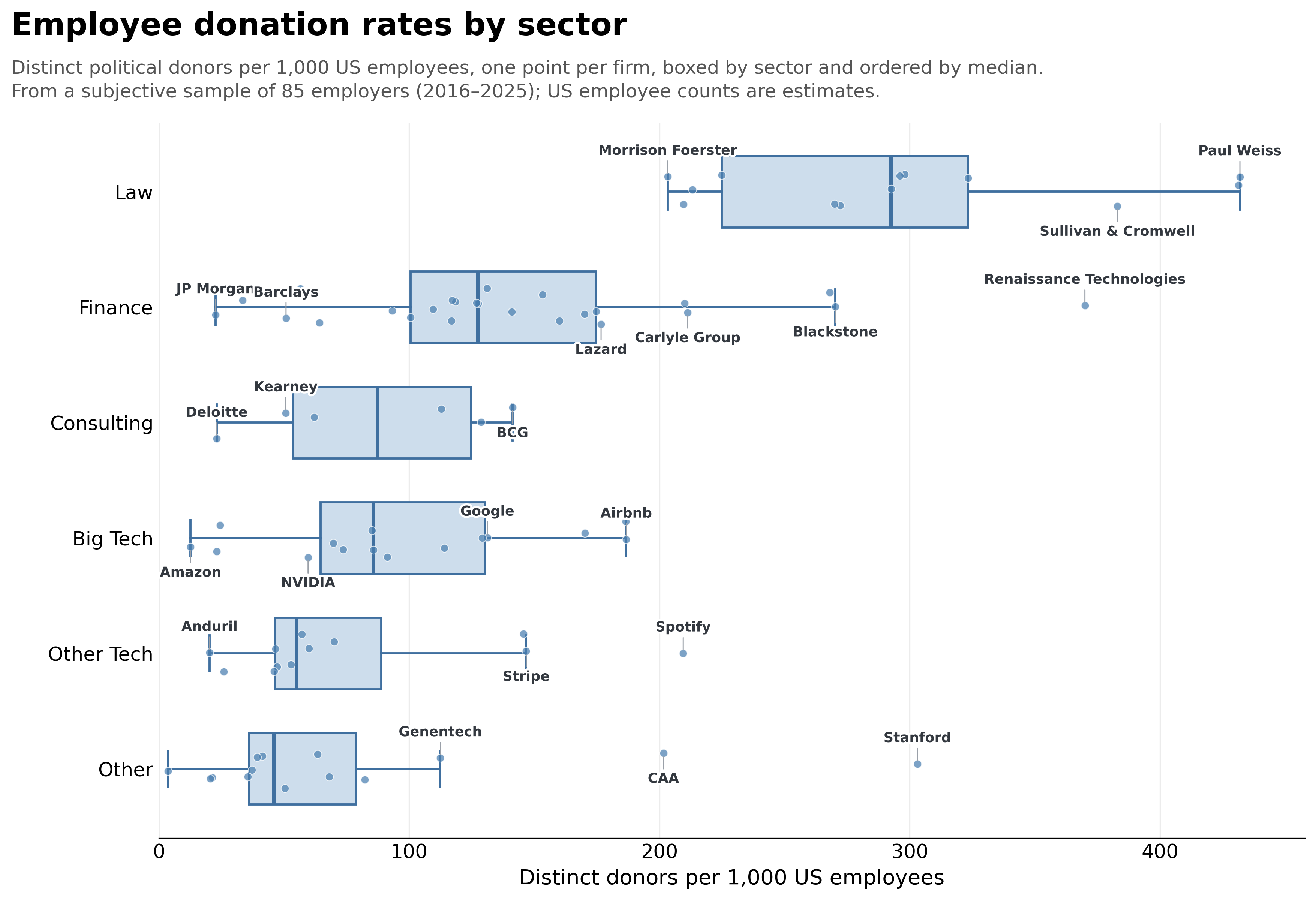
I guess this makes sense, as law is the dominant profession in politics (it may also be that lawyers are more scrupulous about filling out forms correctly). These are based on estimates of the number US employees at these firms, so it’s inexact, but they seem roughly right.
I have enjoyed the portrayal of Citadel’s Ken Griffin as an omnipotent Sauron-like figure after he bought the public portfolio of the struggling hedge fund Situational Awareness, a couple of days before the wunderkind fund manager’s wedding.5
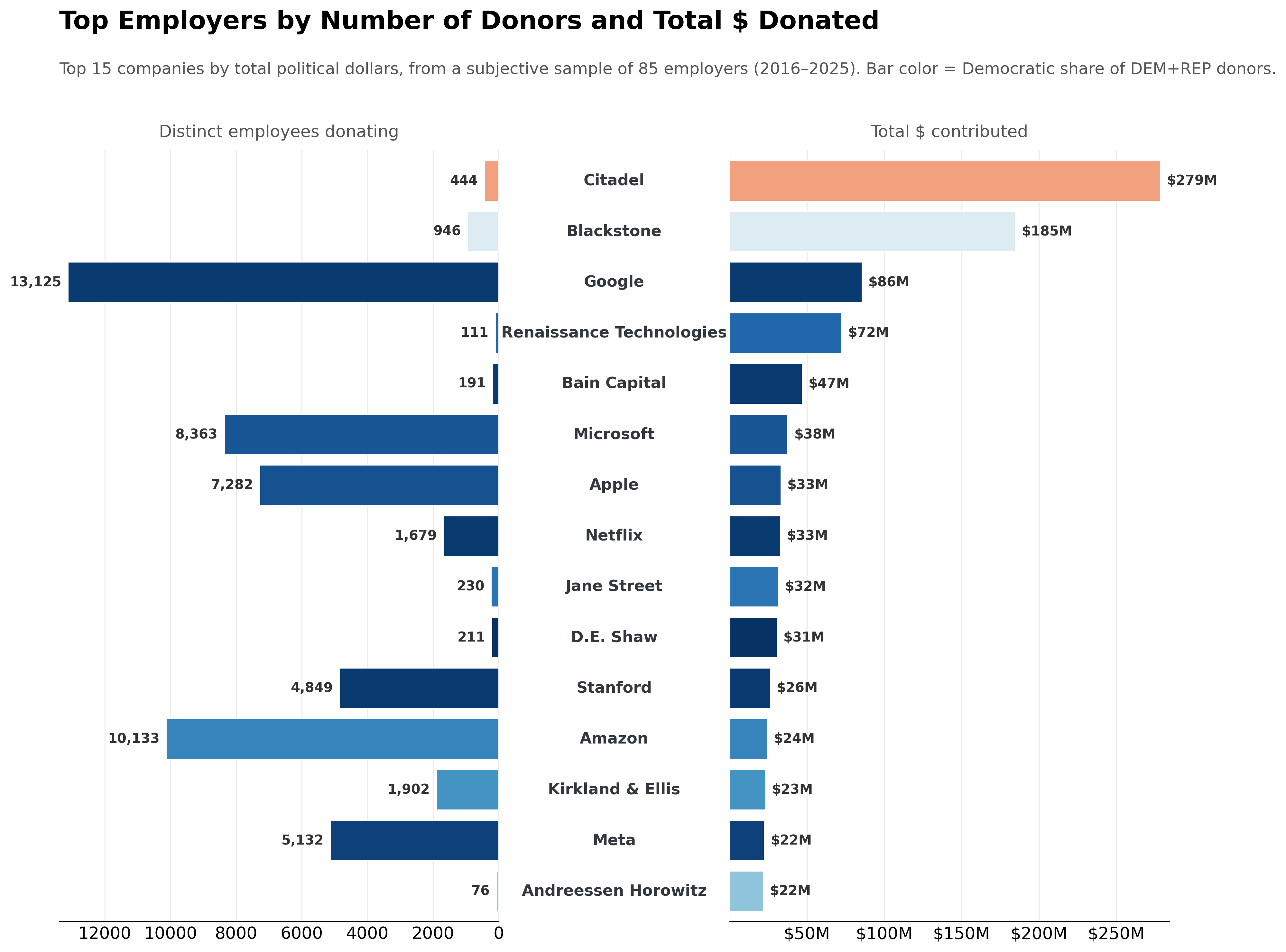
Griffin’s ruthlessness extends to his participation in politics, where he’s donated hundreds of millions of dollars, mostly to Republicans. I have to imagine he takes pleasure in outspending Blackstone’s Stephen Schwarzman in a competition to see who can accumulate the most board seats in American democracy:
Thanks for reading! As always, these views are mine alone.
I recently flew through Patrick Radden Keefe’s new book London Falling, which examines the impact of foreign money flooding into London in the 2000s, through the lens of the tragic story of a teenager being swallowed up by a Russian oligarchy-fueled underworld. London seems to be a much seedier place than I realized.
I also liked this article (and its comment section), by a mathematician mourning the change in his profession as LLMs race past humans at generating novel mathematics. I found it endearing how earnestly truth-seeking the mathematicians in the comments seem.
I was charmed that several of you liked my passive-aggressive LinkedIn comment on a post where Jay Van Bavel used a chart I made to promote his work (there’s also the below tweet if you’ve passed your weekly LinkedIn quota). You can see that post, and copy the link to it, here. Thank you!

Jay Van Bavel, PhD@jayvanbavel
What book has been life changing for you? For many people, a non-fiction book has changed their life. At least, according to countless book reviews. This is why we are now studying the power of non-fiction books to change lives and, in a tiny way, to try and make a world a

8:15 PM · Aug 4, 2026 · 119K Views
13 Replies · 41 Reposts · 264 Likes