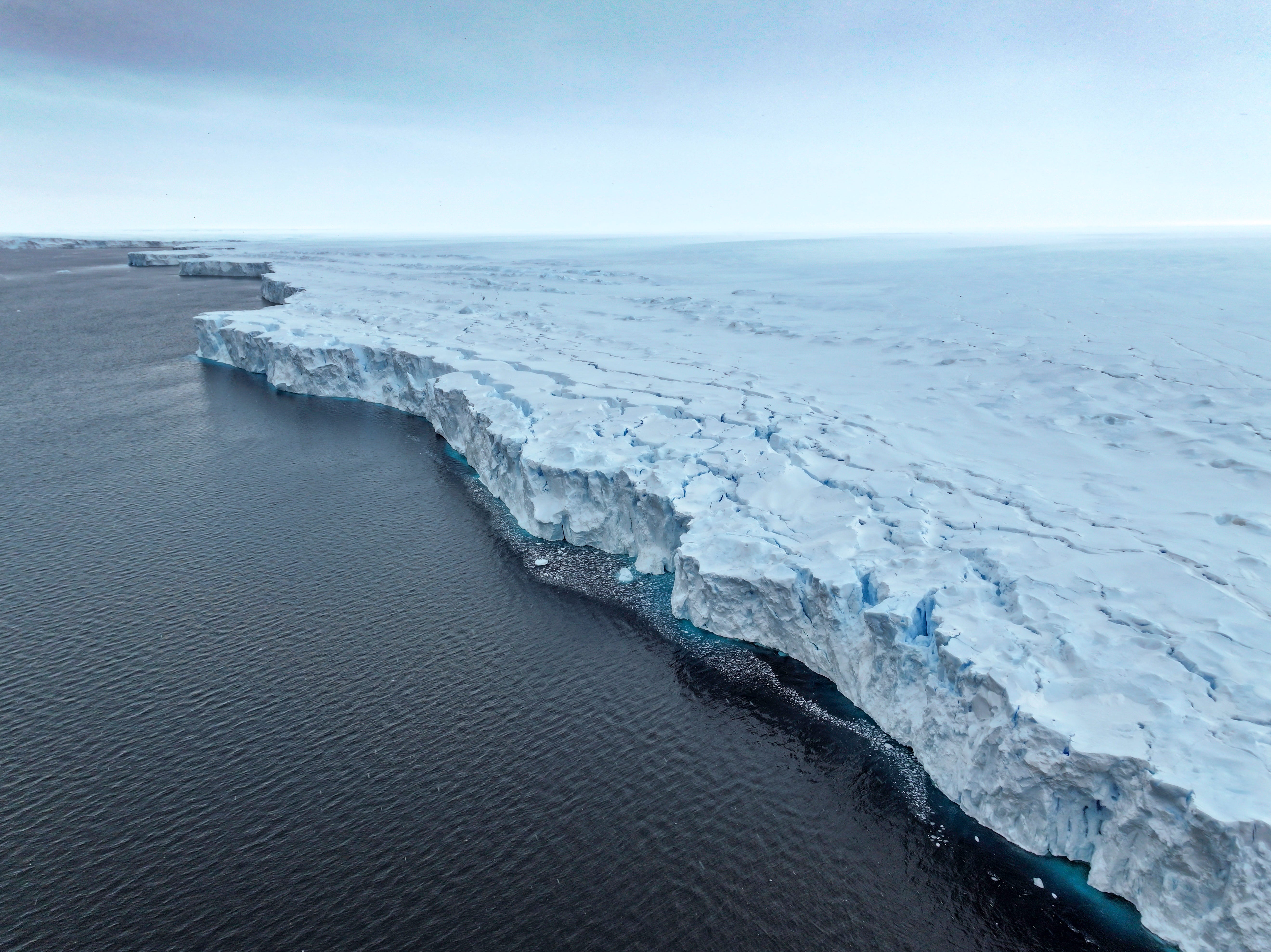
The scientists wanted to study the ocean near Totten Glacier, an East Antarctic behemoth that serves as the exit point for an ice area larger than California, and had been showing worrying signs of vulnerability.
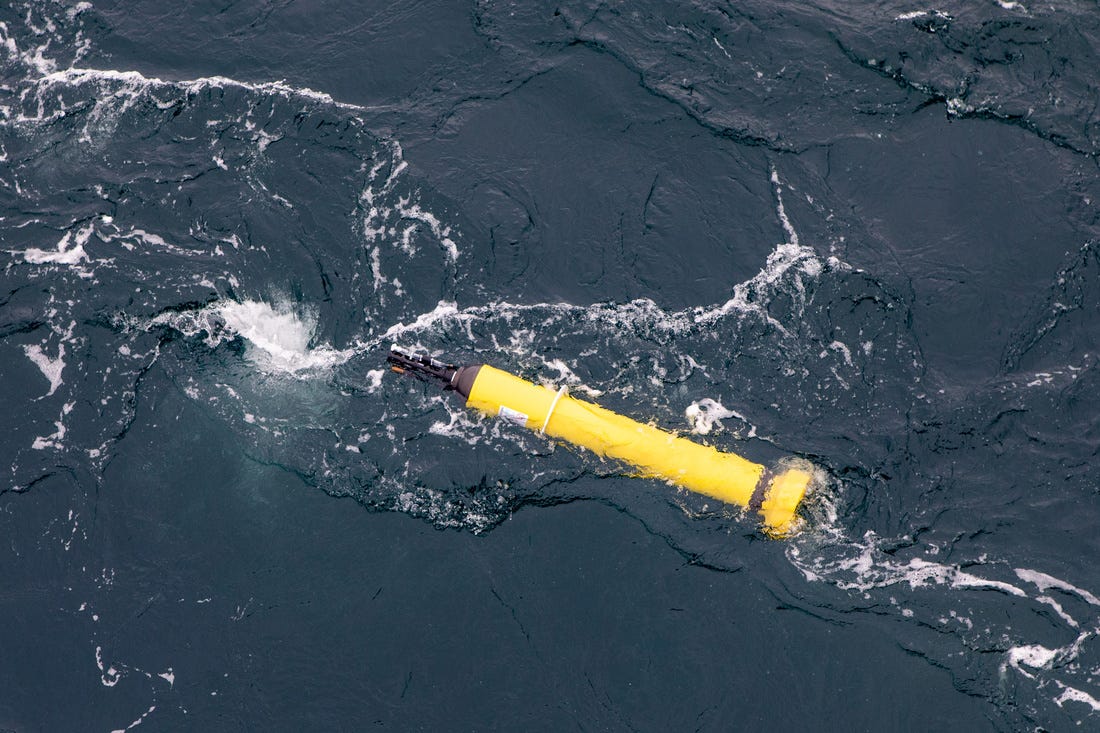
The year was 2019, and their tool of choice was the Argo float, a type of robot widely used to monitor temperature and other characteristics of the world’s seas. But the researchers, with Australia’s Commonwealth Scientific and Industrial Research Organisation (CSIRO), were using these floats a bit differently than usual.
They’d adapted them to bob up and down in icy environments, lingering on the seafloor of the continental shelf near Antarctica’s ocean-front glaciers, then rising to the surface. If the float couldn’t get all the way up, it would bounce off the underside of sea ice or even, in some cases, football-field thick floating ice shelves extending out over the water, like Totten’s.
The scientists hoped one such float, known simply by the World Meteorological Organization identifier 7900904, would travel along the shelf near Totten and sample an array of ocean conditions in extreme, little studied places unreachable by humans. But then — as I previously wrote in a much-read Washington Post story that now needs updating — the robot vanished.
From the ocean surface, an Argo float can relay information back to scientists via the Iridium satellite network. But in icy conditions, float 7900904 could not reach the open air. It went silent.
“The float drifted out of the region quite quickly and disappeared beneath the winter ice for 8 months,” recalled Esmee Van Wijk, a researcher with CSIRO and in the Australian Argo program, in an email. Van Wijk co-authored a new study about the float’s findings, just published Friday in Science Advances, with colleagues at CSIRO and the Institute for Marine and Antarctic Studies at the University of Tasmania.
It was just the beginning of what would turn out to be a multi-year, long range journey.
The float survived those eight months of submergence. Then, in September of 2020, it appeared hundreds of miles away, in an even harder-to-study place than Totten Glacier. That location was near Denman Glacier, which holds back 1.5 meters of potential sea level rise.
My 2023 Washington Post piece led with the story of an elephant seal who had also visited Denman back in 2011 wearing a scientific instrument, and had measured a worrying stream of relatively warm ocean water flowing inwards towards the glacier. As for the robot, which arrived later and found more or less the same thing, here’s how I put it back then:
Van Wijk and her fellow scientist and partner Stephen Rintoul were not actually present at Totten. They were at home in Tasmania. But a scientific vessel in the region deployed their research tools called Argo floats….[not] unlike that seal a decade earlier, one of the floats wound up in an unexpected place. It was carried off course by currents but, eight months later, fortuitously surfaced in front of Denman Glacier. It appeared “in a region we really wanted to sample, but is very difficult to sample with ships, it is often covered with quite heavy sea ice,” said Van Wijk. “So for us it is a case of getting very lucky.”
The robot was a little more thorough in its explorations than the seal. It also measured water that was even warmer at very, very close to zero degrees Celsius. Thanks to these measurements, the scientists were able to determine just how much of this warm water is flowing toward Denman Glacier. It was massive.
The mildly good news is that Denman is much smaller than the 80 mile wide Thwaites glacier on the western side of the Antarctic continent, and not losing nearly as much ice. But it is concerning nonetheless. Denman glacier sits atop the deepest subsea canyon known to exist beneath the Antarctic ice sheet (a recipe for the dreaded phenomenon that scientists call “marine ice sheet instability”). And it is already experiencing noticeable retreat.
Van Wijk, Rintoul and their colleagues published a paper in 2022 in Geophysical Research Letters about the relatively warm water (by Antarctic standards!) that is likely the cause of the glacier’s thinning and backpedaling. A modified version of the so-called Circumpolar Deep Water that has been driving ever more Antarctic melt, it is more than capable of eating away at Denman. That was alarming news, and their study is what first alerted me to the story of the float. When we talked, as I recall, Van Wijk also then told me about the seal, and I was hooked!
Sadly, I can’t tell you any more about what happened to that elephant seal after his unique trip to Denman. But I can now tell you that the robot still was not done.
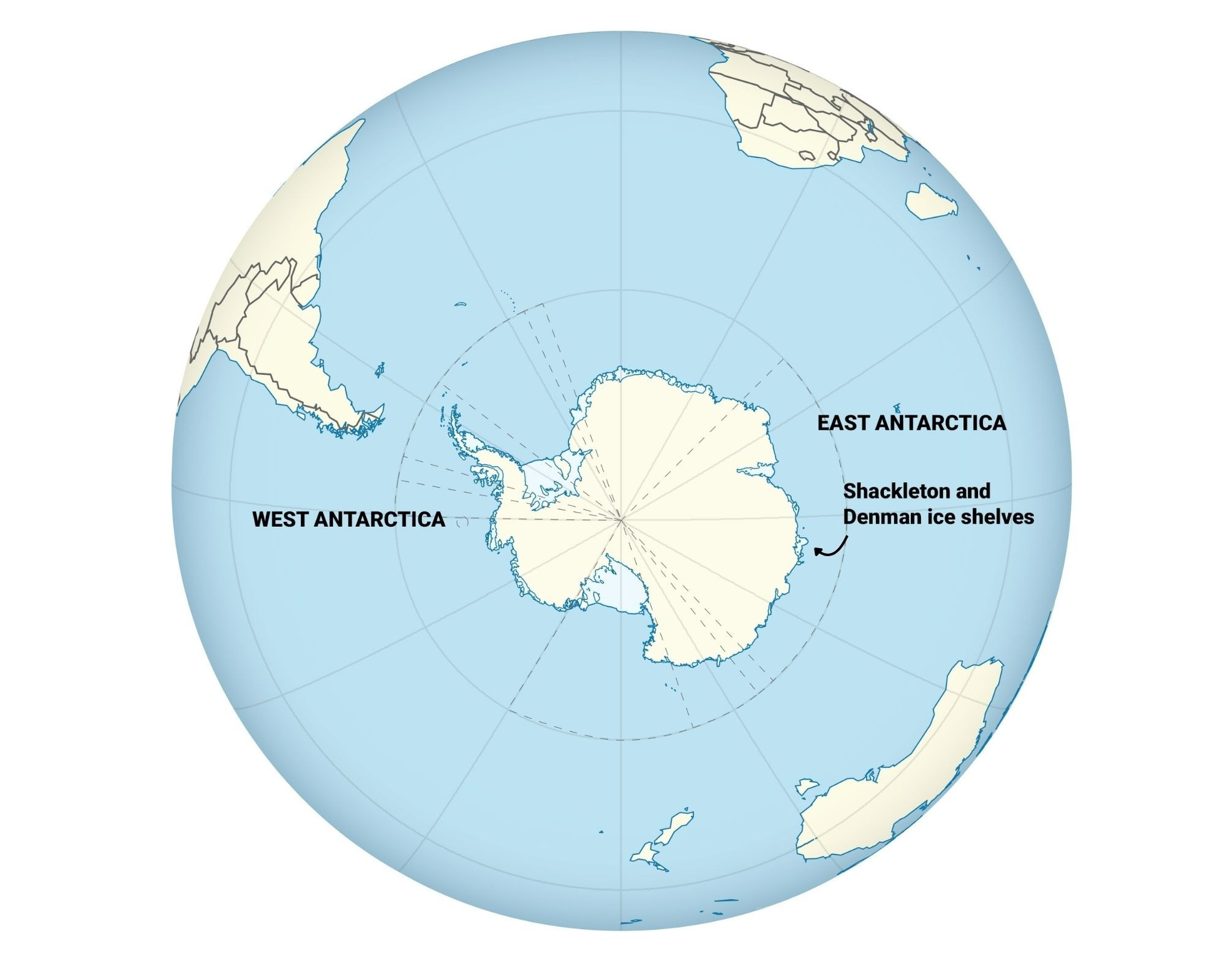
After arriving at Denman glacier in 2020, float 7900904 kept on going for more than two additional years, taking measurements all the way until March 2023, the scientists now report in Science Advances. It dove beneath Denman glacier’s floating ice shelf, and then undertook a subsea journey across the entire length of the adjacent, and even larger, Shackelton Ice Shelf.
“If you asked me whether, if a float passed under the ice shelf, it would survive, impacting the base of the ice shelf every 5 days, over a period of 8 months, I would say, they’re not designed for that,” said Rintoul in an interview. “Or hitting the bottom every 5 days for two and a half years, that’s not what these things were originally designed for. But it did survive that journey.”
The really important leg of the journey was an “epic traverse beneath the Northcliffe and Shackleton Ice Shelves, eventually reappearing on the western side of the Shackleton Ice Shelf another nine months later,” wrote Van Wijk in her email.
In the process the robot took measurements that led to a number of new scientific findings, both about the shape of the seafloor beneath these shelves and also about the way different layers of water circulate underneath them.
Here’s the second major leg of the robot’s journey, the one that came after its trip from Totten to Denman. For some sense of scale, note that a recent scientific paper says that the Shackelton ice shelf “extends for >250 km along the Queen Mary Land coast,” or over 150 miles:
In the past, scientists have tried to drill through floating ice shelves like Shackleton, and send down sensors and even long, thin, short-range underwater robots. But even then, they’re only getting data from a relatively confined section of a cavity hundreds of meters deep and many miles wide. That’s hardly comparable to a full traverse.
“When the float went under the ice shelves over the last 8 months of its drift, it really measured things that we’ve never seen before because measuring under ice shelves is so challenging,” said Rintoul.
The new findings are a mix of good and bad. They continue to support the contention that relatively warm water, capable of melting ice, is reaching Denman (which would explain well the glacier’s observed behavior). The water appears to be arriving through a narrow but deep trough in the seafloor in front of the glacier, around 900 meters down. Here, the warmest waters flow inward at the greatest depths.
The float discovered other similar crevasses in the region, some even more impressive at over a kilometer in depth. But they did not appear to have any of this warmer water in them, at least not when the robot was present. The historic Shackleton Ice Shelf therefore seems to be okay, for now.
But Denman, the researchers wrote, is “delicately poised”: It is experiencing melt, though nothing yet like what’s happening in West Antarctica. The problem is, as climate change advances, the ocean could mount a more concerted attack. And then the deep, deep canyon beneath Denman, for now filled with ice, could be in play.
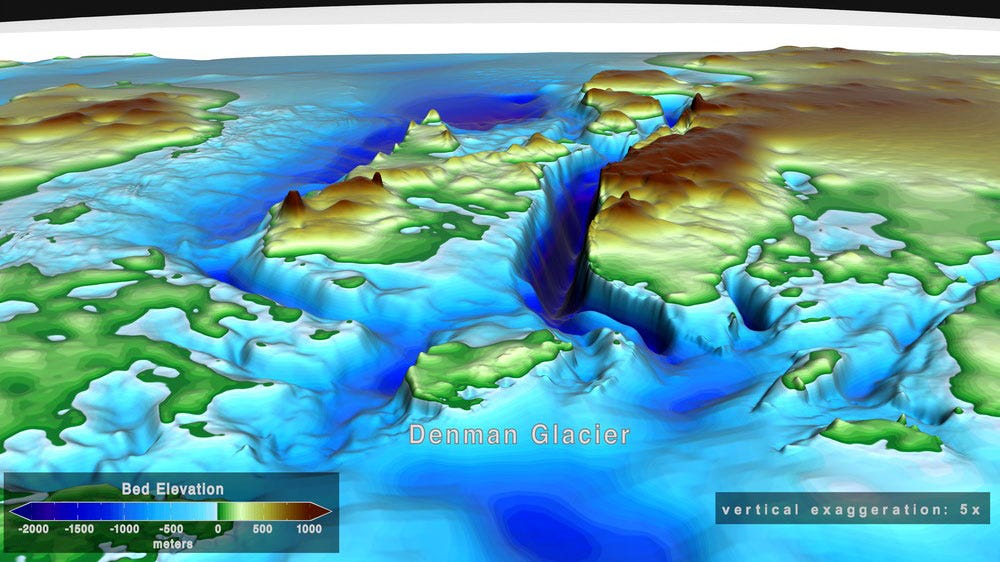
“The warm water is present but it is in a layer at the bottom,” said Rintoul. “There’s warmer water, just a little further on the continental shelf, that’s blocked from getting to the glacier by features on the seafloor. If that layer gets a little thicker, it can get past those obstacles.”
In other words, this region of East Antarctica can start contributing significant ice losses We’re not there yet, but the worry is that we’re getting closer. And Totten and Denman glaciers are the two major doorways into the Aurora Subglacial Basin, a marine based sector of East Antarctica that contains even more ice than West Antarctica does.
We never want these doorways to open.
This is all pretty different from what you’ve been hearing about East Antarctica lately. Recently there has been lots of buzz about ice gains due to heavy snowfall in this region. I first wrote about all of this here, and have kept on the case since:
What's happening in Antarctica

If you follow recent news about Antarctica amid worsening climate warming, you could reasonably be feeling pretty confused.
This modest ice gain is real, but it is often presented out of context, and may be a temporary blip. In the long run, scientists are more worried about the heat contained in the ocean and what it may be able to do.
As for float 7900904, at this point the expectation is that its journey is, at last, done.
“We think it’s gone,” Rintoul said. “We didn’t hear from it through the winter, but that’s expected. We’re coming into summer now. There’s a chance it may reappear, but it is probably getting to the end of its life.”
Still, the little robot moved science forward and proved that a combination of intensive scientific planning and effort, aided by a bit of additional luck, can yield powerful findings.
“Of the many hundreds of floats we have deployed over the past 25 years of the Australian Argo program, this intrepid float is my favourite,” wrote Van Wijk.
“I would say in most science, there’s an element of serendipity involved,” added Rintoul.
“It doesn’t always go according to plan, but you can learn a lot from that.”