👋 Welcome to The Global Move newsletter, where I share practical advice and ~100 relocation-friendly tech jobs every Thursday.
Become a paid subscriber to access weekly handpicked job lists and insights from recruiters at Atlassian, Meta, and more.
Since February 2025, I’ve been tracking and curating relocation-friendly tech jobs. The dataset now includes 4,815 verified positions, more than triple the 1,500 jobs I analyzed in my previous report, published in July. Each listing was manually checked to confirm it includes visa and/or relocation support, and I do not include postings with vague wording like “we offer relocation, but you need to have a valid work permit.”
These numbers show that companies are still hiring tech workers from other countries, even though overall hiring has slowed. It’s not a full survey of all tech employers, but it does include information about medium and large companies that actively sponsor visas/relocation.
So, in 2026, companies around the world continue to search beyond their borders for the engineers, data scientists, and technical leaders they need. Even if it seems everyone talks about AI or moving to the United States, some industries and countries are sleeper picks and are hiring more international talent than some readers might anticipate.
Shout-out to the Relocate.me job board team for helping structure and visualize the data.
This graph shows how demand is spread out across different tech jobs by looking at nearly 4,815 job ads that offer relocation help. It’s a real-time look at where companies are looking for international tech talent.
From late February 2025 to the end of 2025 and into the first week of 2026, these roles were continuously collected. They were sent to members of our private tech community every Thursday along with about 100 other carefully screened relocation jobs.
There is currently no single reliable place on the internet to filter relocation-supported jobs. So, each listing was checked by hand to make sure there is some public information about helping people move and sponsoring visas. It’s also important to avoid false positive results (like “visa sponsorship only for {this country} work visa holders”).
We also made an effort to include a variety of tech jobs to reflect the types of people who subscribe to our list.
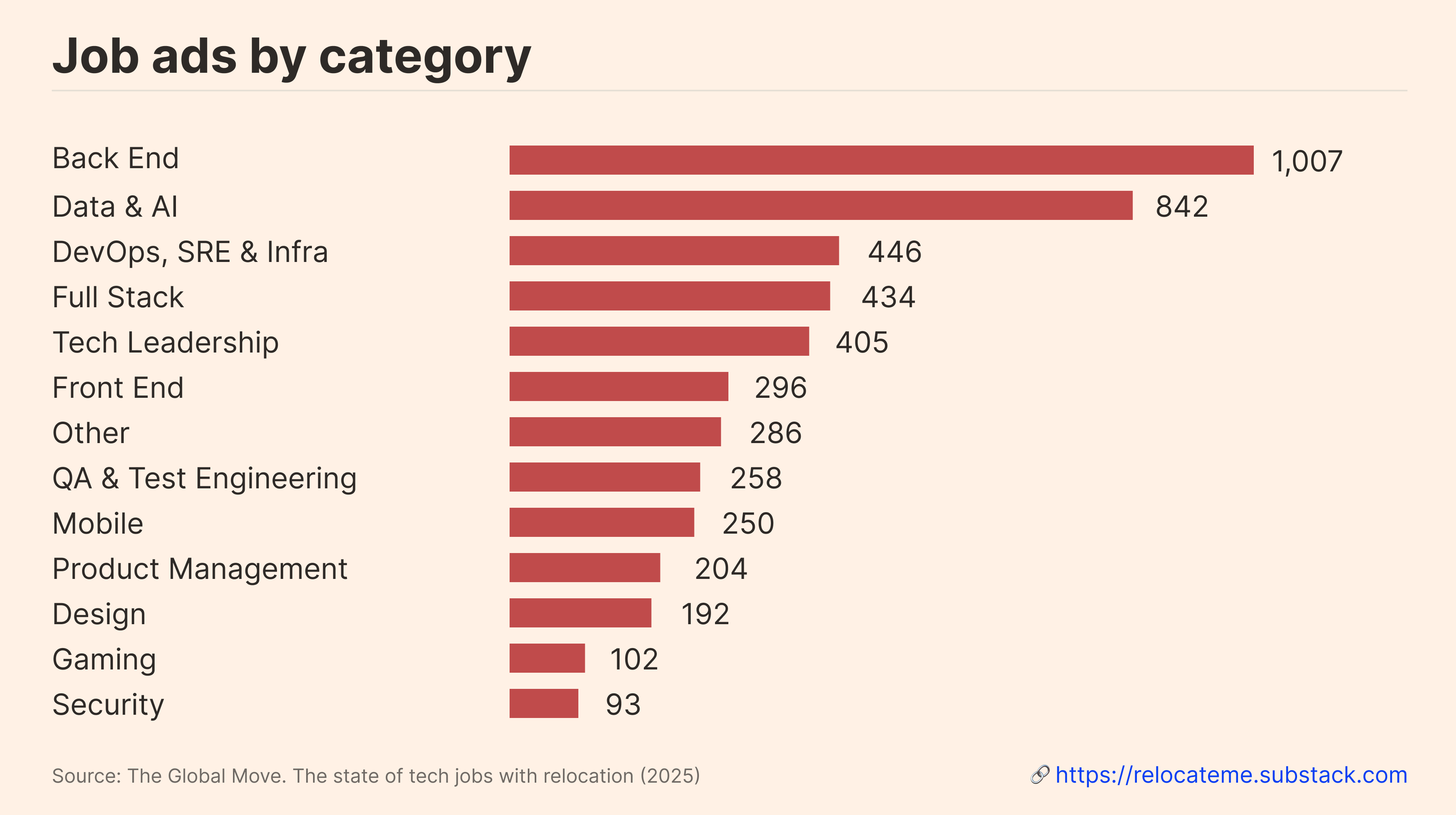
Back End roles dominate with 1,007 openings, roughly 21% of all positions. In my previous analysis, Back End represented 23% of the total, with 517 jobs. The percentage dropped because the dataset now includes far more roles across other categories, not because demand for back end weakened. Companies hiring internationally still prioritize engineers who can build and maintain core systems.
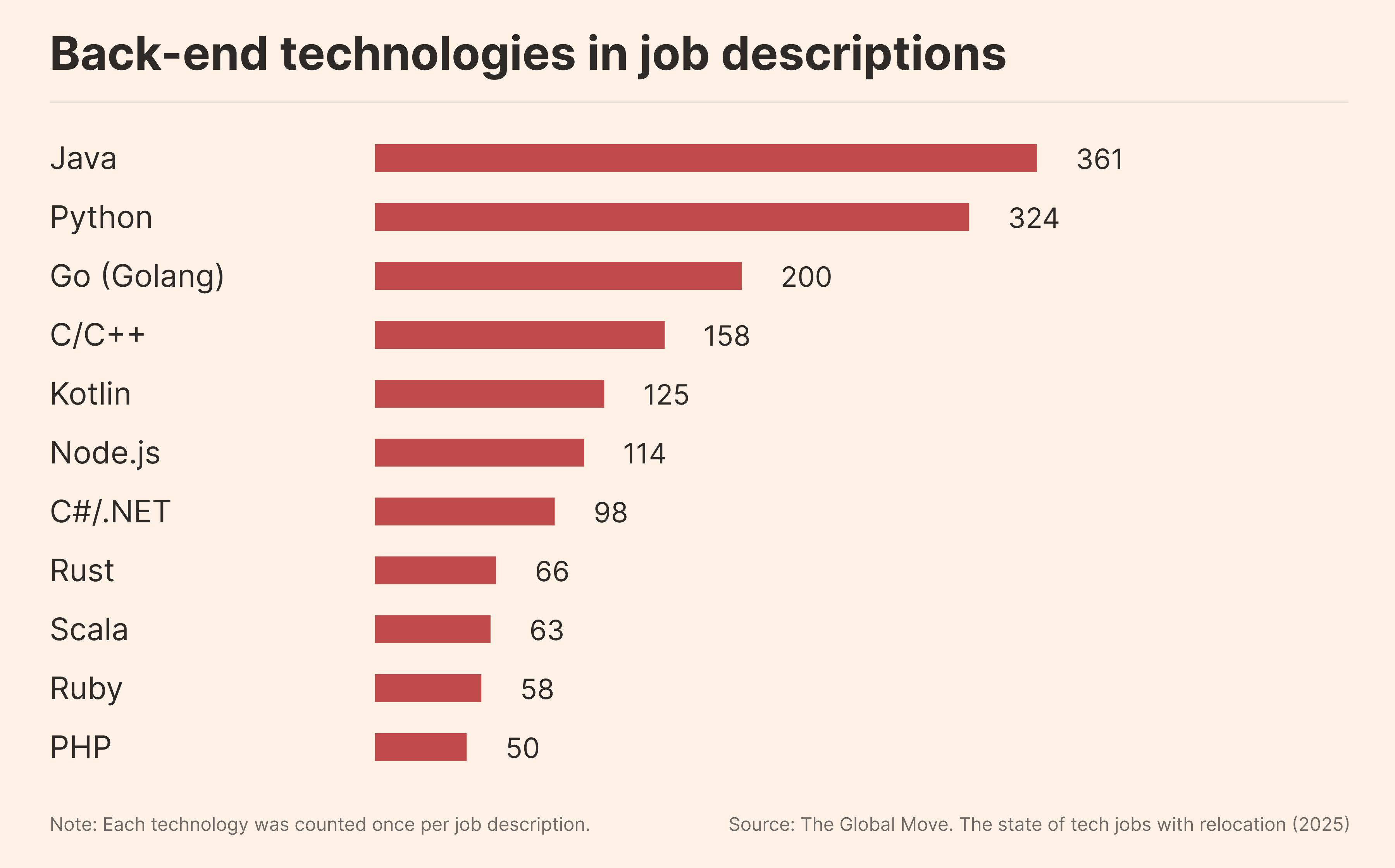
Java leads the technology mentions at 361 jobs, followed by Python (324), Go (200), C/C++ (158), and Kotlin (125). Node.js appears in 114 listings, C#/.NET in 98, Rust in 66, Scala in 63, Ruby in 58, and PHP in 50. For engineers whose skills might feel less fashionable than AI, this is reassuring. The data shows that Java and Python are still the workhorses of enterprise software.
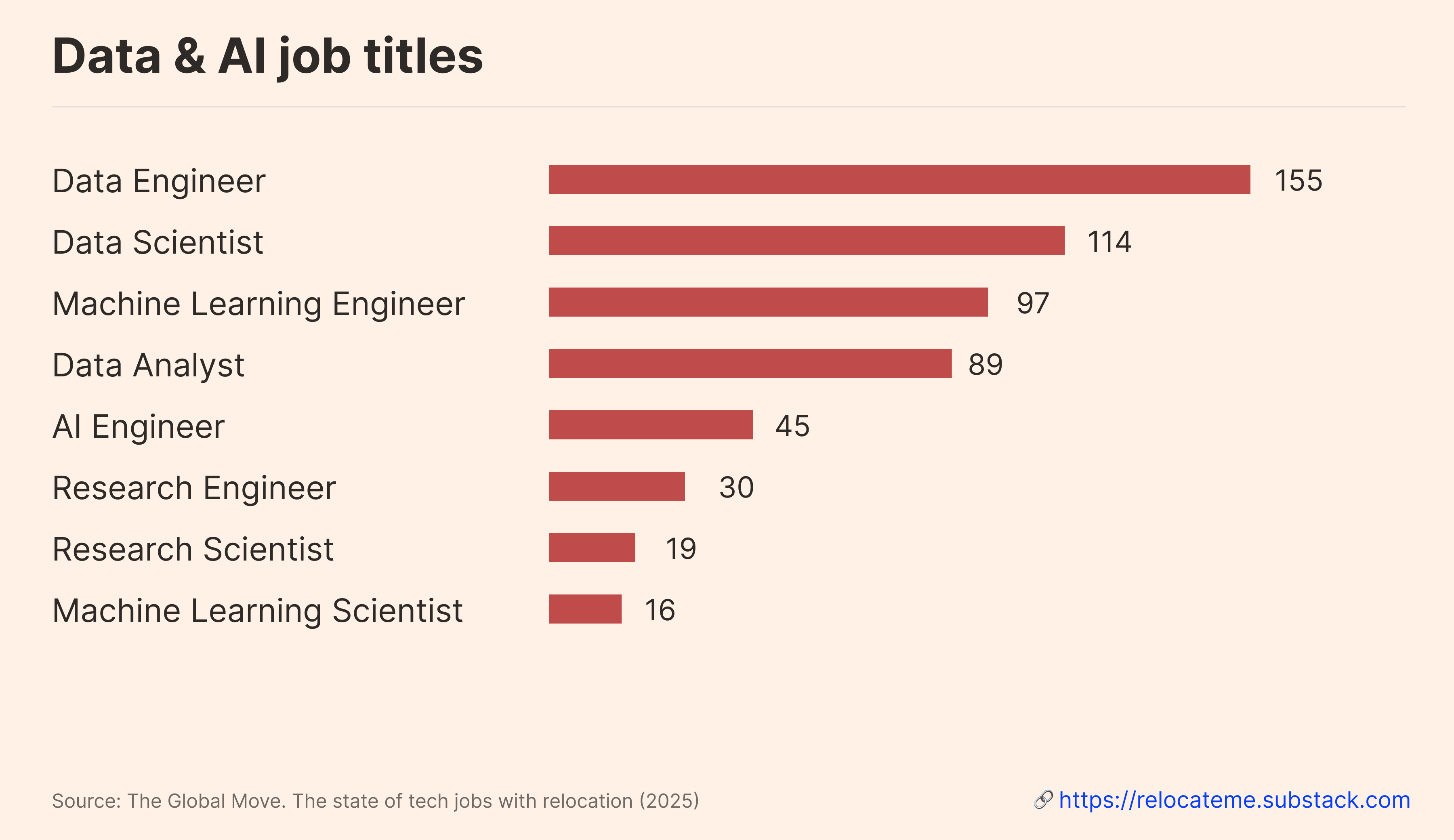
Data & AI roles come second with 842 openings, up from 352 in the July report. Within this group, Data Engineer (155), Data Scientist (114), and Machine Learning Engineer (97) make up the bulk. In my earlier analysis, these same three titles (Data Engineer at 72, Data Scientist at 63, ML Engineer at 61) also led the category. The proportions remain similar, but the scale has grown considerably.
The AI subcategory deserves special attention. AI Engineer appears in 45 listings, and Machine Learning Scientist in 16. Research roles, including Research Engineer and Research Scientist positions, total 49 listings. This signals that R&D hiring for AI hasn’t dried up. Companies are moving AI from experimental projects to production systems, and they need talent to make that shift work.
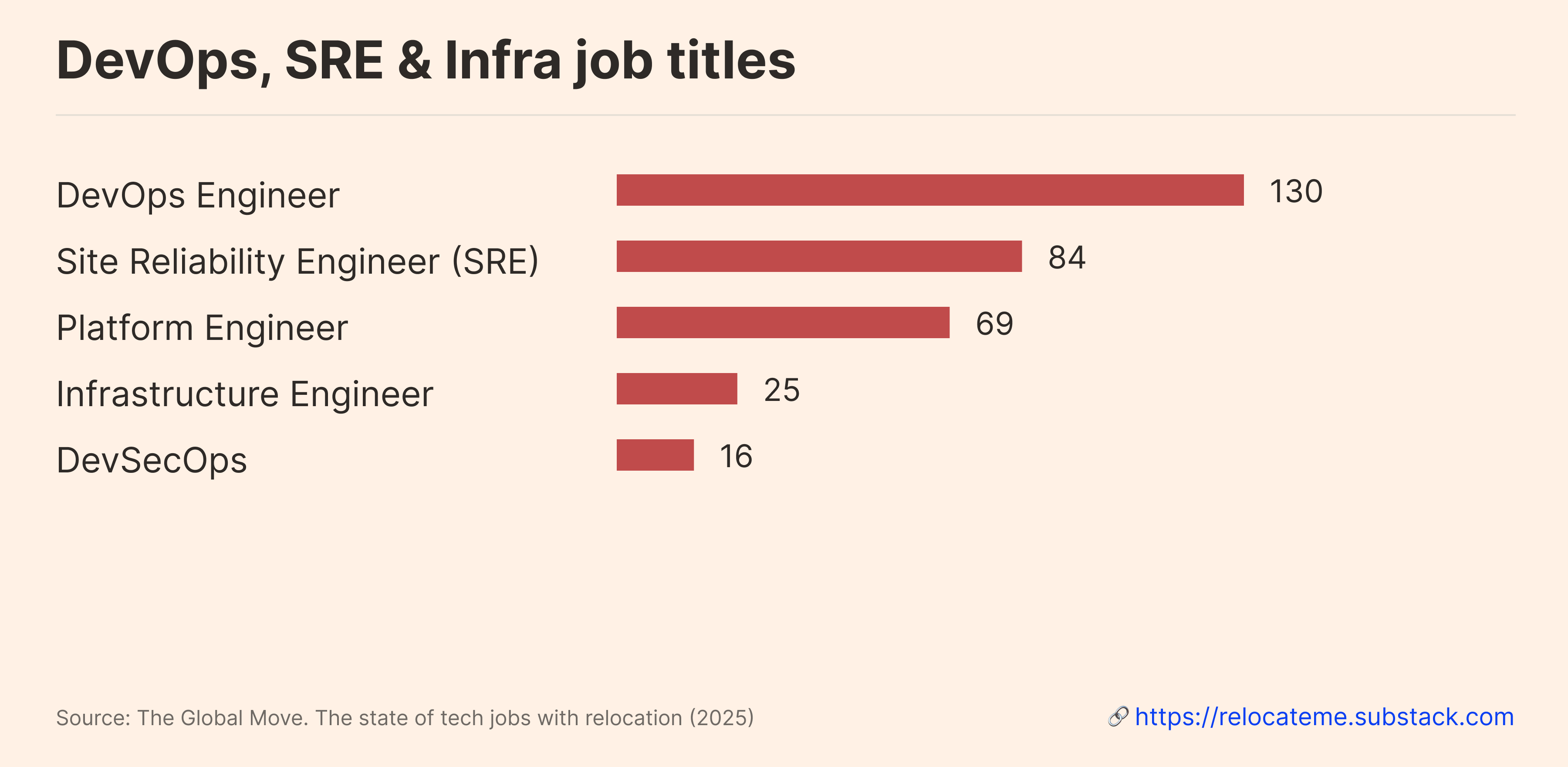
DevOps, SRE & Infrastructure holds third place at 446 openings, compared to 194 in my previous analysis. The category’s share grew slightly from 8.64% to 9.26% of total roles. DevOps Engineer (130) and Site Reliability Engineer (84) lead the subcategories, followed by Platform Engineer (69), Infrastructure Engineer (25), and DevSecOps (16). Even when businesses make their products bigger, they still need people to keep the systems running. As a whole, the industry is moving toward better tools and internal developer platforms, which is driving more companies to move experienced platform engineers when they can’t find them locally.
Full Stack roles have pretty much the same percentage of total roles, about 9%, with some growth from 8% based on the job ads in early 2025. That might also be one of the reasons why the Back End category slightly reduced in the total percentage of jobs and some of the Back End roles moved to the Full Stack realm. Employers hiring Full Stack engineers internationally typically expect comfort across the entire stack, from React or Vue on the front end to Node.js or Python on the back end, plus cloud infrastructure knowledge.
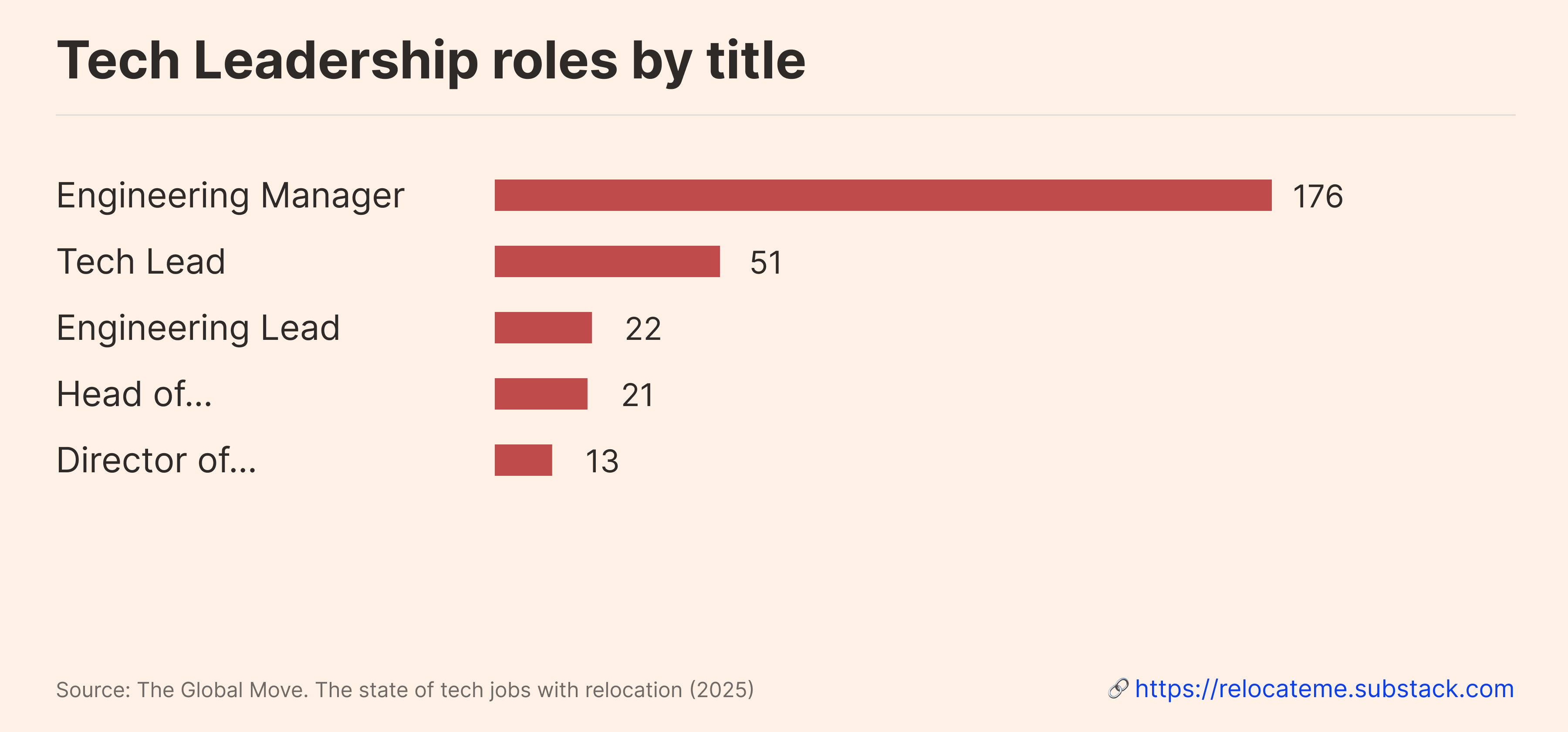
Engineering Management & Technical Leadership (405 vs. 171 previously) saw strong growth as companies seek leaders who can build and scale distributed teams. The breakdown includes 176 Engineering Manager roles, 51 Tech Lead positions, 22 Engineering Lead openings, plus senior titles like Head of Engineering (21) and Director of Engineering (13). Visas for these jobs are paid for by the companies because it’s really hard to find technical leaders who can work with people from different cultures and time zones.
Front End (296 vs. 149 previously) dropped slightly as a share of total roles, from 6.65% to 6.14%. At least 140 of these positions are senior-level. Employers consistently ask for TypeScript, React, GraphQL, and Next.js. About 40% of jobs require testing skills (unit, integration, and end-to-end testing, etc.). Jest is the most common test tool in this dataset.
Companies are looking for front-end developers who can make apps that can be scaled up or down and are easy to maintain. These developers should also be able to write clean, testable code that works with a variety of APIs and services and can deploy to cloud platforms.
Mobile and QA roles trail at 250 and 258 openings, respectively. In my previous analysis, Mobile had 130 openings and QA had 126.
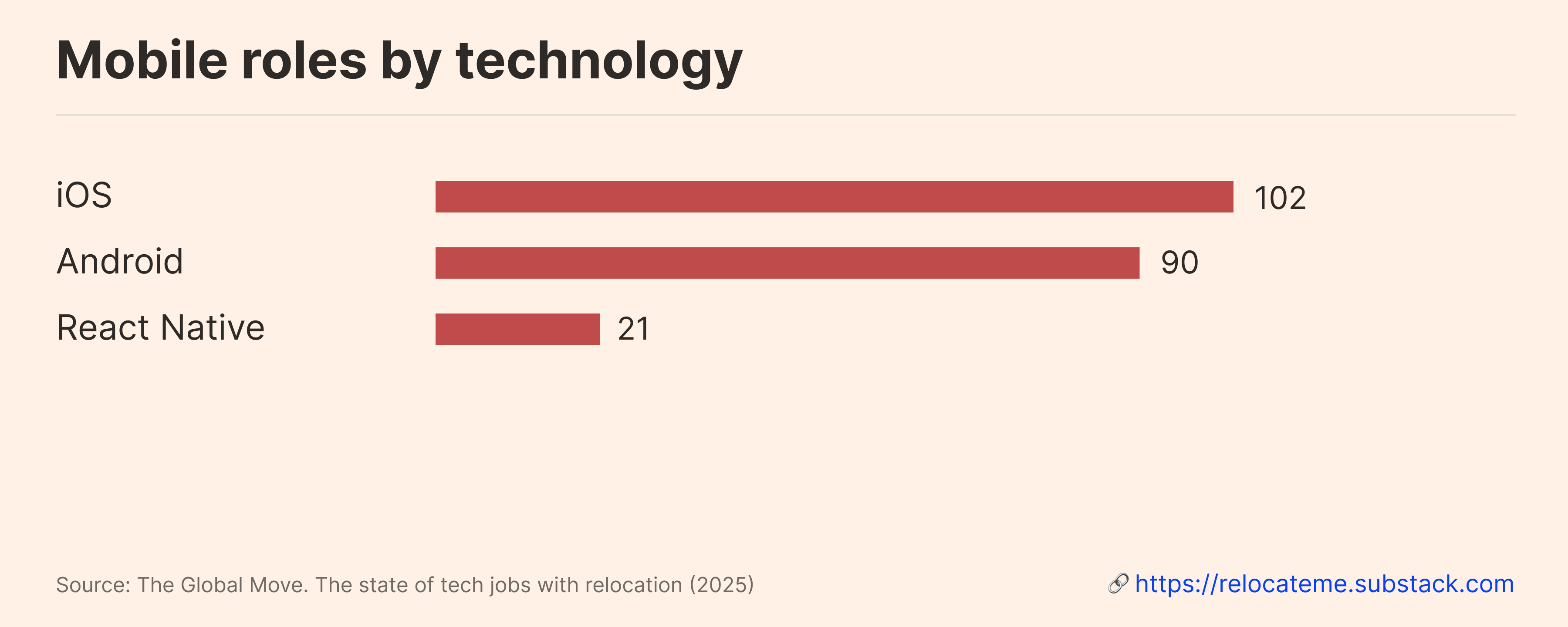
iOS (102 mentions) slightly outpaces Android (90) in mobile job titles, with React Native appearing in 21 listings.
Security (93 openings) and Gaming-specific roles (102 openings, separate from the Gaming industry count) round out the categories. Network engineering (18 roles) and Salesforce specialist positions (10 roles) appear in smaller numbers.
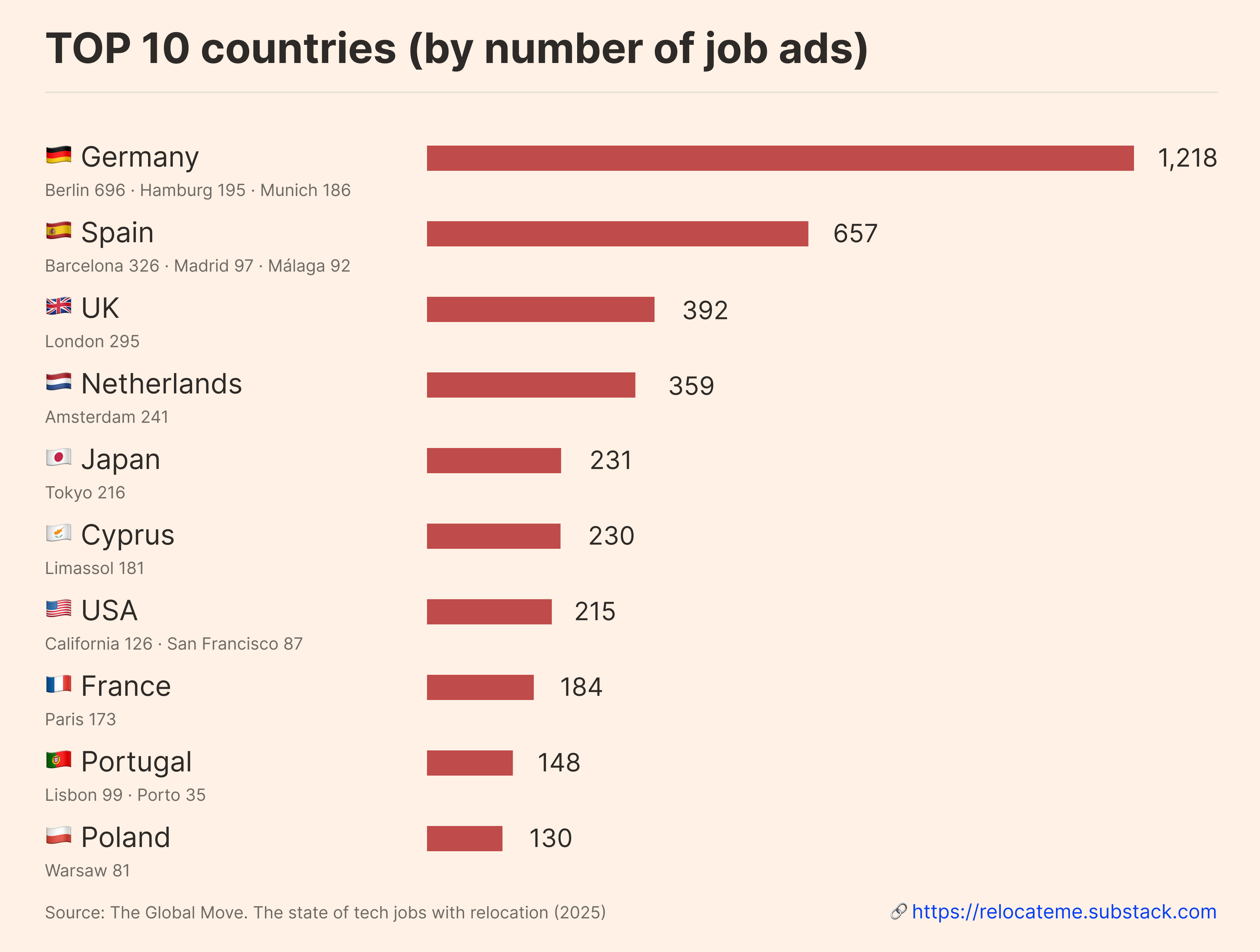
Germany leads by a wide margin with 1,218 jobs, roughly a quarter of all listings. In the July report, Germany had 564 jobs, so the country has more than doubled its share. Berlin alone accounts for 696 positions (up from just over 300 previously). This makes Berlin the single most active city for international tech hiring. Hamburg (195) and Munich (186) follow. This is somewhat unsurprising, since Berlin is often praised as one of the most expat-friendly and English-speaking cities in Germany and Europe.
Germany’s position comes from the fact that it has a chronic shortage of tech talent and an open immigration policy that started in the 60s. The country hosts over 139,000 startups and 48 unicorns, as I noted in my previous report. The EU Blue Card process remains one of the more straightforward routes into Europe for skilled workers. Berlin is easy for international talent to get to even if they don’t speak German yet because most people there speak English. I wrote a detailed breakdown of the process in my Germany relocation guide.
Spain holds second place with 657 jobs, up from 254 in my 2025 analysis. Barcelona (326), Madrid (97), and Málaga (92) are the main hubs. Spain’s 2023 Startup Law continues to bear fruit, and the cost of living remains lower than in Amsterdam, London, or Paris. With 8,580 active tech companies that generate €14.8 billion in annual economic impact and employ over 108,000 people, Spain has become a serious destination for tech workers who want a European lifestyle without Northern European prices.
From anecdotal testimonials, it looks like, in the last few years, many digital nomads (who maybe didn’t have a job at all) have been choosing their Iberian neighbours Portugal for relocating and working with sunny days and affordable sangría drinks. Looking at the data I collected, I wonder if sunny Spanish locations like Málaga might turn the country into the “new Portugal.” We’ll see!
The UK comes third with 392 positions, up from 157 previously. Nearly all concentrate in London (295). Brexit has complicated hiring, but British companies still compete for international talent through the Skilled Worker visa route. The UK’s appearance in the top three matches findings from Jobbatical, the relocation services provider. Their data from 2025 showed Germany, Spain, and the UK as the top three European destinations for actual completed relocations, in that order. My job posting data aligns almost exactly with their data on completed relocations. This match suggests something important: companies that post relocation jobs do actually follow through and hire. Deel’s Global Hiring Report corroborates this with their 98%+ visa approval rate across thousands of relocations.
The Netherlands (359 jobs, with Amsterdam at 241) and Japan (231 jobs, Tokyo at 216) round out the top five. Japan’s jump is striking. The country is clearly trying harder to get tech workers because its current workforce is getting older and there aren’t enough engineers in the country.
Cyprus surprised me at 230 jobs, up from 117 previously. Limassol (181) is the clear hub. The country’s 50% income tax break for new residents who earn over €55,000 annually, combined with a strong FinTech and Cybersecurity presence, has turned this small island into a genuine tech relocation destination. Cyprus also grants a 20% tax break for those earning under €8,550 per year and continues to invest in its tech sector through initiatives like the National Digital Decade Strategic Roadmap. I covered the full picture in my Cyprus relocation guide.
The US trails at just 215 positions offering sponsorship, up only slightly from 103 previously. That the numbers barely moved is telling. Companies in the United States are less likely to sponsor foreign workers because of higher H-1B fees and political controversies. Most US listings (126) are in California, with San Francisco (87) leading.
France (184), Portugal (148, with Lisbon at 99 and Porto at 35), and Poland (130, Warsaw at 81) also appear in meaningful numbers. Both Lisbon and Warsaw have become known as tech hubs that are affordable and have growing startup scenes.
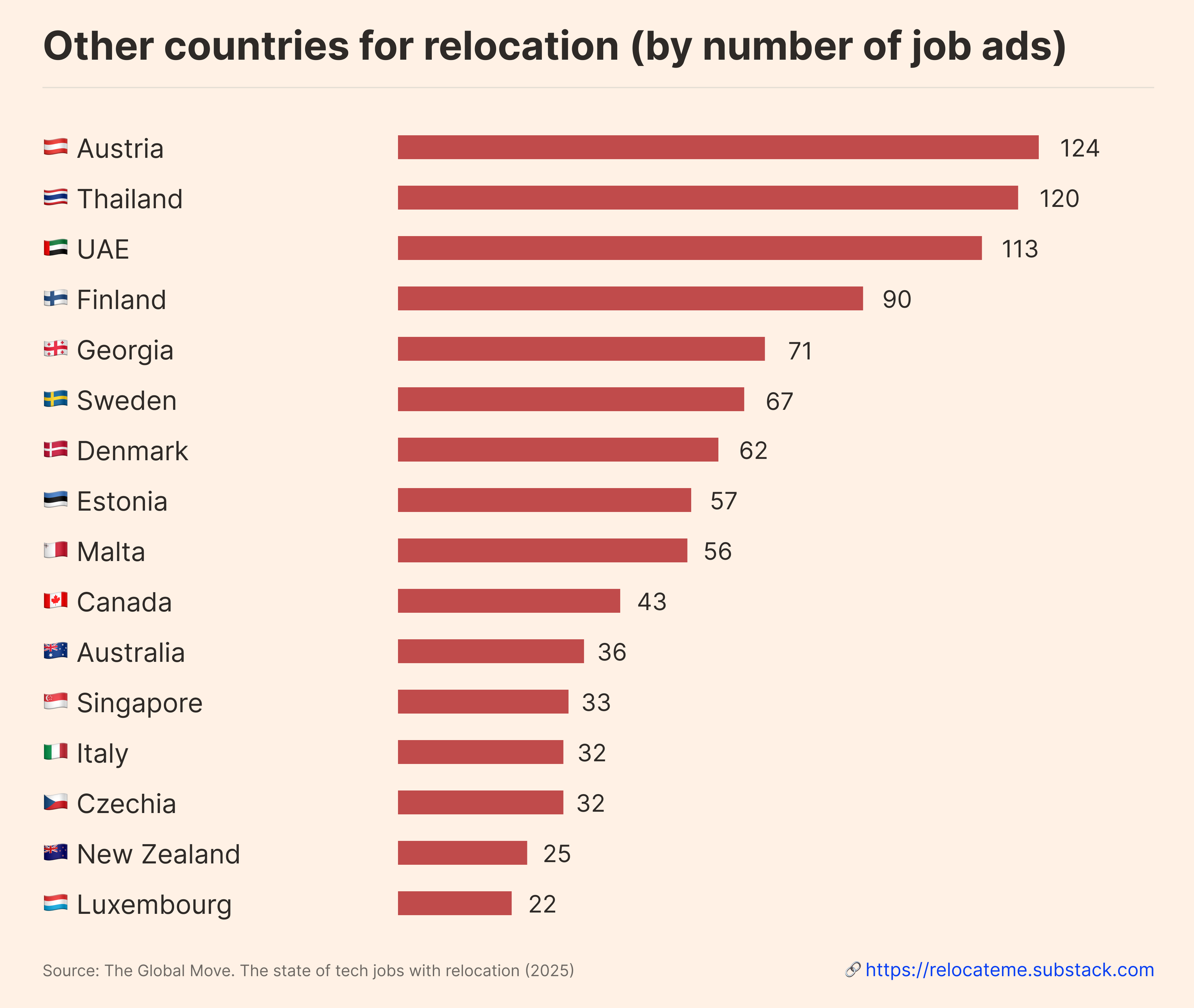
Austria (124), Thailand (120), the UAE (113 with Dubai at 67), and Finland (90) round out the notable destinations. The number of hires in Georgia (71), Sweden (67), Denmark (62), Estonia (55), and Malta (56), among others, is also significant.
When I wrote the previous guide, one of my underlying messages was: it’s not just AI you can work on, and please, don’t forget about FinTech! In this report, the message stays the same. Maybe against what most software engineers would wager, the hottest sector to get employed right now is FinTech.
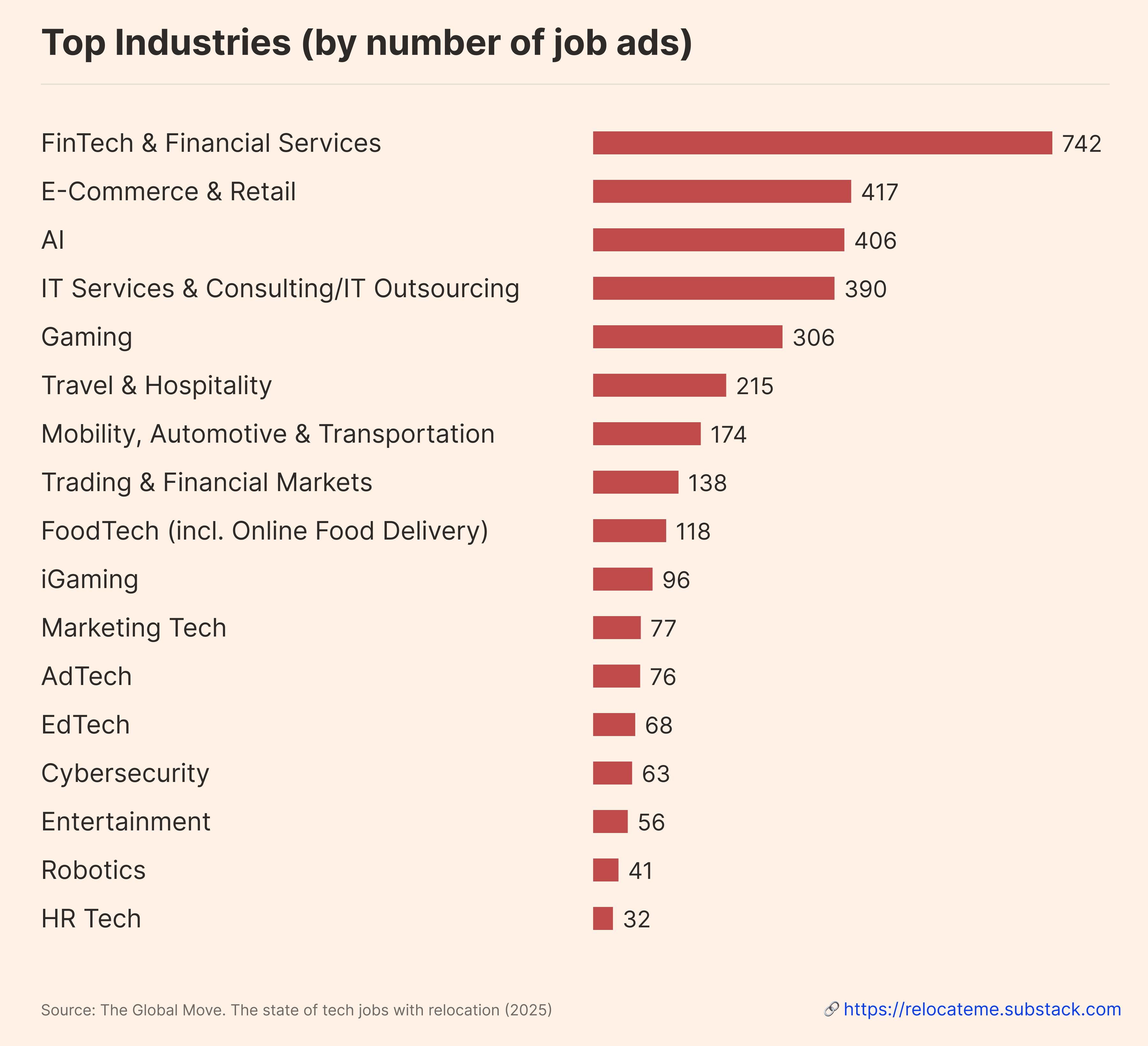
So yes. In terms of industries hiring, FinTech & Financial Services leads with 742 openings. Previously, FinTech also ranked first with over 300 jobs. The sector’s appetite for engineering talent remains strong as companies build everything from neobanks to payment infrastructure. There has been no slowing down of investments in financial technology since the end of the pandemic. Fintech companies are willing to hire engineers from other countries to find ones who can figure out complicated regulatory requirements and build systems that can grow as demand dictates.
E-Commerce & Retail (417) and AI (406) follow closely. AI ranks third, not first. This matters. Despite the hype cycle, AI companies are not the biggest source of relocation-friendly positions. Many AI roles remain concentrated in the US (where sponsorship is harder) or at companies that prefer local talent. In my previous report, AI ranked fifth among industries. Its rise to third shows growth, but FinTech and E-Commerce still hire more aggressively for international talent.
IT Services & Consulting (390), Gaming (306), and Travel & Hospitality (215) also hire actively. Gaming’s presence may surprise readers who remember 2024’s brutal layoffs, but studios continue to need tech folks, and the industry generated $184 billion globally in 2024. Gaming, maybe pushed by iGaming, lives on. Actually, iGaming companies, based heavily in Malta and Cyprus, consistently hire internationally due to the specialized regulatory and technical expertise required. It remains there, and the industry’s hiring hasn’t collapsed despite the headlines.
Mobility, Automotive & Transportation (174) shows that money is still being put into making electric cars, self-driving cars, and logistics technology. Trading & Financial Markets (138) and FoodTech (118) represent the next tier.
Marketing Tech (77), AdTech (76), EdTech (68), Cybersecurity (63), Entertainment (56), Robotics (41), and HR Tech (32) complete the industry picture. The diversity here is encouraging. Many industries hire tech workers from other countries, not just a few hot ones.
Once again, relocation hiring is led not by tech giants, but by mid-sized companies together with firms in the 500–1,000 employee range.
I pointed this out in my previous report and suspected the pattern would hold. The data confirms it: collectively, these companies outperform large corporates by a wide margin in job ads mentioning relocation support.
For your reference, before I go on, this is the company classification I’m using:
Small: ~1–50
Mid-size / Medium: ~50–500
Large: 500+
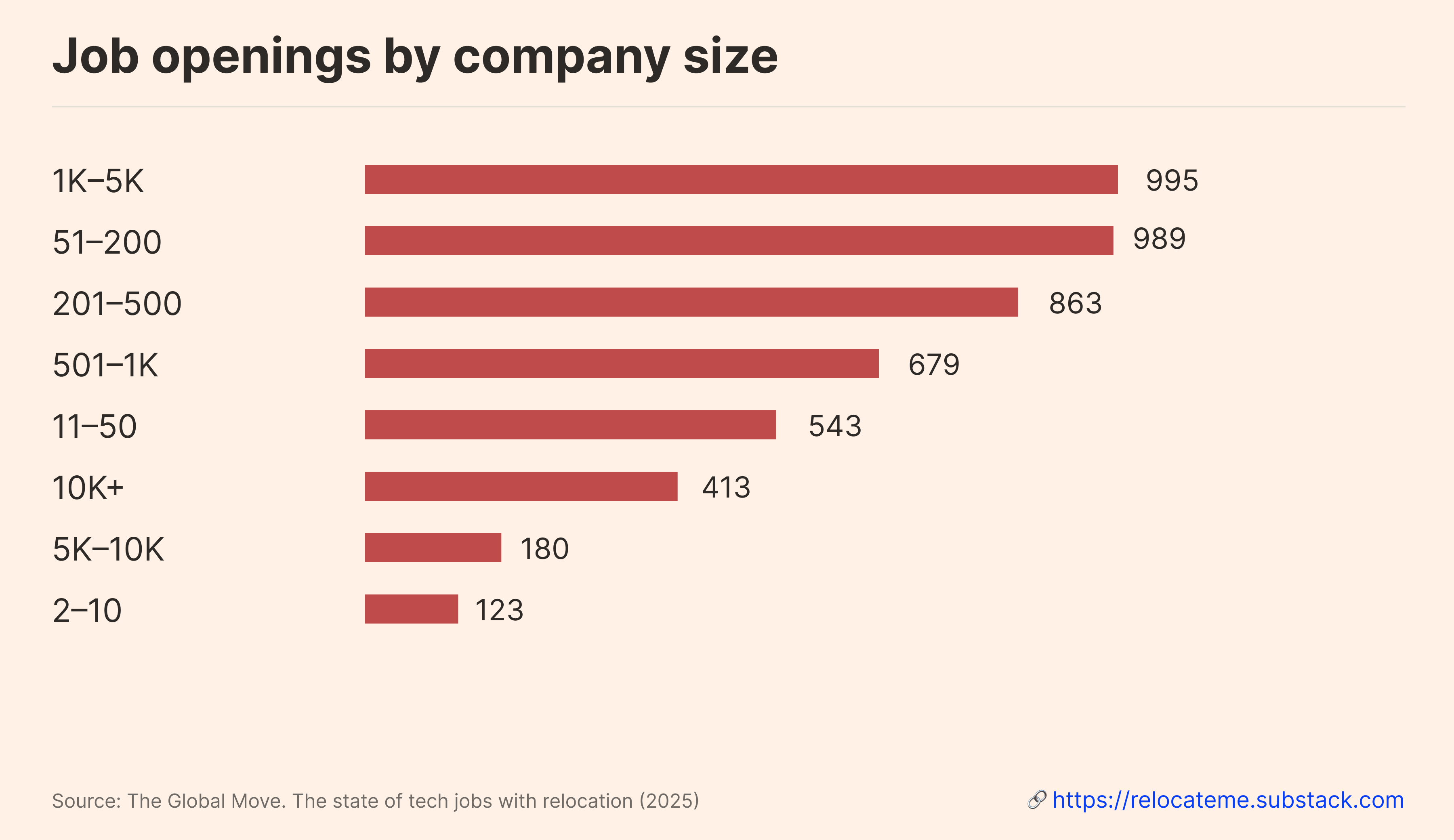
Companies with 1,000-5,000 employees posted 995 openings. Those with 51–200 employees posted 989. The 201-500 bracket contributed 863 jobs, and the 501-1,000 bracket added 679. Smaller companies (11–50 employees) posted 543 positions, and even tiny startups (2-10 employees) contributed 123 listings.
Meanwhile, companies with 10,000+ employees only account for 413 positions. The 5,000-10,000 bracket adds 180.
What does this mean for a software engineer, you might ask me? Well, if you’re waiting for a Google, Amazon, or Meta offer to move abroad, you should reconsider your strategy. While MAANG companies might still hire external talent with relocation, based on my personal talks with recruiters from these companies, they prefer internal mobility within the company, offer good packages in the local markets and only after considering foreign candidates.
Instead, scale-ups and mid-sized companies represent the majority of opportunities. These companies often grow faster, have more hiring options, and have more talent shortages in their home markets. I recently ran a guide on how to prepare for applying for a relocation-friendly job at least 6 months before clicking “submit.” If you go over and read it, you’ll notice quickly that most of those strategies might work better in mid-sized companies than with cluttered, swamped MAANG recruiters. So this is actually encouraging data.
Application volumes have gone through the roof (and upward). Recruiters consistently tell me that a single job posting now attracts 800 to 1,000 applicants. A few years ago, 200-300 was manageable. Because tech hiring has slowed down overall and LinkedIn’s “quick apply” feature makes it easy to apply for jobs, there are a lot of resumes for every open position. I wrote about how to use LinkedIn effectively for international job searches to cut through this noise.
This creates a paradox: more applicants but fewer hires. Recruiters get buried in applications, good candidates get lost in the noise, and companies end up re-posting the same roles repeatedly because they can’t process the initial wave. Application volume has become one of the most common topics in my conversations with recruiters who hire internationally.
Several factors converge to explain this new scenario. COVID and the shift to remote work made relocation jobs accessible to more talent globally. The overall number of tech jobs has contracted, so more applicants chase each opening. AI tools help candidates apply faster and at higher volume. And LinkedIn, whose business model benefits from generating candidates, actively encourages more applications.
Companies keep re-posting jobs. I frequently see the same position appear multiple times with different URLs as companies close and reopen listings. Often, they hit their applicant tracking system’s cap almost immediately and need to reset. For job seekers, this suggests a tactical approach: apply extremely early, or bypass the application flood entirely through referrals and direct outreach.
Fewer new companies enter the global hiring market. The pool of employers hiring internationally is becoming more concentrated. The same names appear again and again. This is partly the market maturing naturally, but it also means that breaking into relocation-friendly jobs hinges on knowing which companies actually follow through on their promises. I validated this with Jobbatical data in my previous report: companies that post relocation jobs do actually hire and relocate people. That finding holds true.
Also, don’t take this last change as something negative. Data is clear: there are more relocation-friendly job openings now than there were when I ran the first report. I’m realizing that fewer new players are joining up, but that’s not necessarily a bad thing.
Centralized job platforms for relocation have shrunk. Stack Overflow Jobs (RIP) and several other boards made it easy to filter specifically for visa sponsorship roles. Today, those options have largely disappeared. LinkedIn dominates international tech hiring, but its filters for relocation and sponsorship remain limited. Apart from Relocate.me and The Global Move archive of over 5,000 curated jobs, there’s not much specialized global source that aggregates relocation-friendly opportunities in one place.
US positions have stagnated. H-1B fees have risen. There’s even a $100,000 (writing this makes me sigh) fee for some applicants. The lottery remains unpredictable, and the political climate has shifted. So yes, predictably, American employers now hesitate to sponsor visas. H-1B transfers still appear, but new sponsorship is more of a rarity outside of specialized roles.
“Relocation support” increasingly means something different than visa sponsorship. More job ads offer help with moving logistics while requiring candidates to already hold work authorization for the target country. Companies want to reduce cost and complexity. For job seekers, this means reading the fine print carefully. True visa sponsorship gets reserved for senior or hard-to-fill positions.
Internal mobility matters more. Companies that face an overwhelming number of external applicants increasingly prefer to move their own people between offices. Referrals carry more weight than ever. As I wrote in The Wealth of Networking, building relationships needs to start months in advance. If relocation is your goal, consider joining a multinational company first and transferring later, or build relationships with employees at target companies before positions open.
The negotiation power has shifted. Three to four years ago, strong candidates could juggle multiple international offers and negotiate aggressively. Today, receiving even two offers simultaneously is rare. If relocation is your priority, and you get a solid offer, waiting for something better is a risky bet.
Read my Tech Talent Relocation Forecast for 2026, where I anticipated what will change, what will shrink and where demand will still exist.
Look: the report has some good news. The employers still keep relocating tech talent from abroad, some sectors which are not AI are booming, and classical, well-respected programming languages like Java or Python are taking a big chunk of the language pie. But you still need to use the data so that you can put together a strategy that leverages each point to your favor. If you’re serious about relocating with a tech job this year, here’s my advice.
Target your search geographically. Germany, Spain, the UK, the Netherlands, and Japan right now have the most opportunities. Each has distinct advantages: Germany for volume and straightforward immigration, Spain for cost of living and lifestyle, the UK for English-speaking roles, the Netherlands for work-life balance, Japan for those interested in Asia. If you’re interested in working in the USA, Canada, Australia, or another country, it will be harder to find jobs that say “relocation support” in the job description. Instead, you should look for signs that the company is willing to hire people from other countries.
Focus on high-demand categories. Back End, Data & AI, and DevOps roles dominate international hiring. If your skills fall elsewhere, you’ll face stiffer competition for fewer positions.
Look beyond Big Tech. Mid-sized companies and lower-large (50-5,000 employees) post the majority of relocation jobs. They’re often more flexible and faster-moving than large enterprises.
Apply early or find another way in. With hundreds of applicants per role, timing matters. Either be among the first to apply, or sidestep the crowd through networking and referrals. I’ve compiled free resume tools and written about preparing for recruiter interviews to help you stand out.
Consider internal mobility. If you’re already at a multinational company, transferring offices may be easier than finding a new employer willing to sponsor you.
Understand that the market has shifted. You may not have the luxury of comparing multiple offers. If relocation is your primary goal, and you receive a strong offer, take it seriously. I recently wrote about this on my LinkedIn page: don’t treat the market like it’s 2021 and everyone’s hiring software engineers like on a spree! Play your cards according to the setting you’re in (and that means 2026, amid the age of AI).
Consider relocating without a job. If your true goal is moving and living abroad, you don’t necessarily need a job to get there. In my Employer Not Required series, I went through three strategies that can get you to live abroad without a job offer in the first place. Also, I recently caught up with an engineer from South America who underwent the education path, got paid while studying, and now lives and works in the Netherlands.
The data is clear: companies around the world continue to hire international tech talent. The process has gotten harder, but the opportunities remain. With the right approach, you can find them.