This article is part of The Global Move’s visa series. Read the other guides:
I’ve published plenty of pieces on job seeker visas. I even put together a guide once (it was one of my first articles on The Global Move). I’ve also written separate pieces on Relocate.me for several countries. I think I’ve easily covered a dozen locations by now.
And honestly, I’m still impressed with how much of an opportunity they are.
This kind of visa is a little particular, because it’s the type that lets you arrive in a country and find a job while being there. You go in with a return ticket for a little while. In some countries, it’s nine months, in others four months or less
In that time window, you have the chance to find your job. It has its risky edges. It’s safer financially, of course, to find a relocation job offered from your home country before you move. But as a recruiter who helps this community of software engineers move and work in a new country, I think this is a resource worth keeping updated. There’s always some new development, and there’s always a market flying under the radar. And every time a market flies under the radar, for the person who reads about it first, that’s an opportunity!
This is because what characterizes the software engineering market in 2026 is brutally high competition and how easy it has become to apply. The application volume is so exacerbated that even for the recruiter it’s gotten hard to find, or even see, the best profiles.
Having a wider set of options, like the job seeker visa, is one way to play against that trend and try to beat it. It’s a backup path, an alternative to the classic relocation-with-a-job-offer route (and not the only alternative path). If you can land a relocation job from your home country, that’s almost always the safer bet. The job seeker visa is what you activate when you’d rather be on the ground while the search runs.
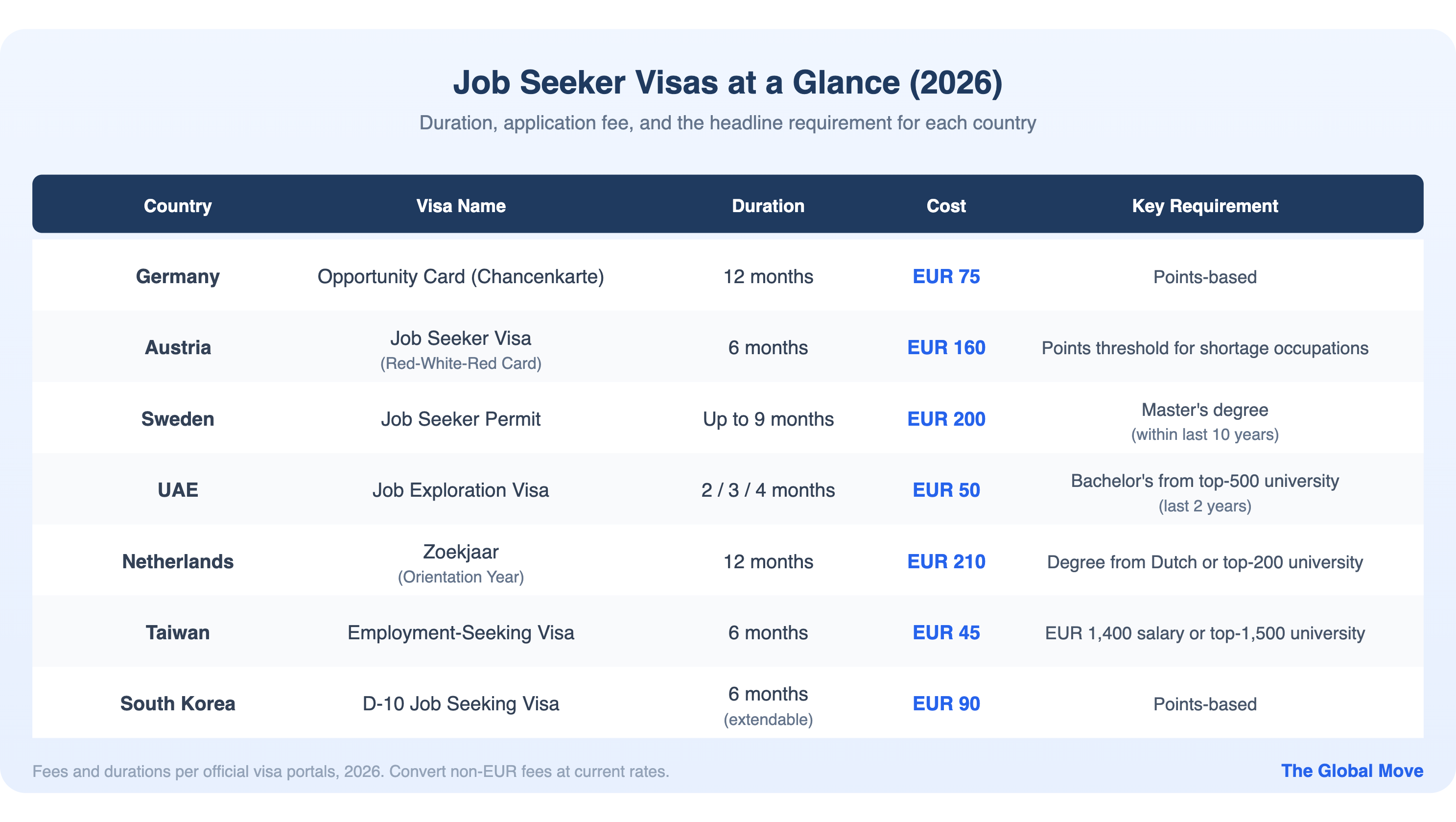
Here’s a list of countries that currently issue job seeker visas (or something close to it), what it costs, and what it requires.
The biggest market for relocation-friendly tech jobs in Europe.
Germany has two separate pathways, and you can pick the one that fits your profile better.
This is my favorite visa name: a card with which you’re allowed to take your chances, the Chancenkarte. Introduced in June 2024, this visa is points-based. You earn points for German language skills, professional experience, age (under 35 gets more points), and ties to Germany. You need at least 6 points to qualify.
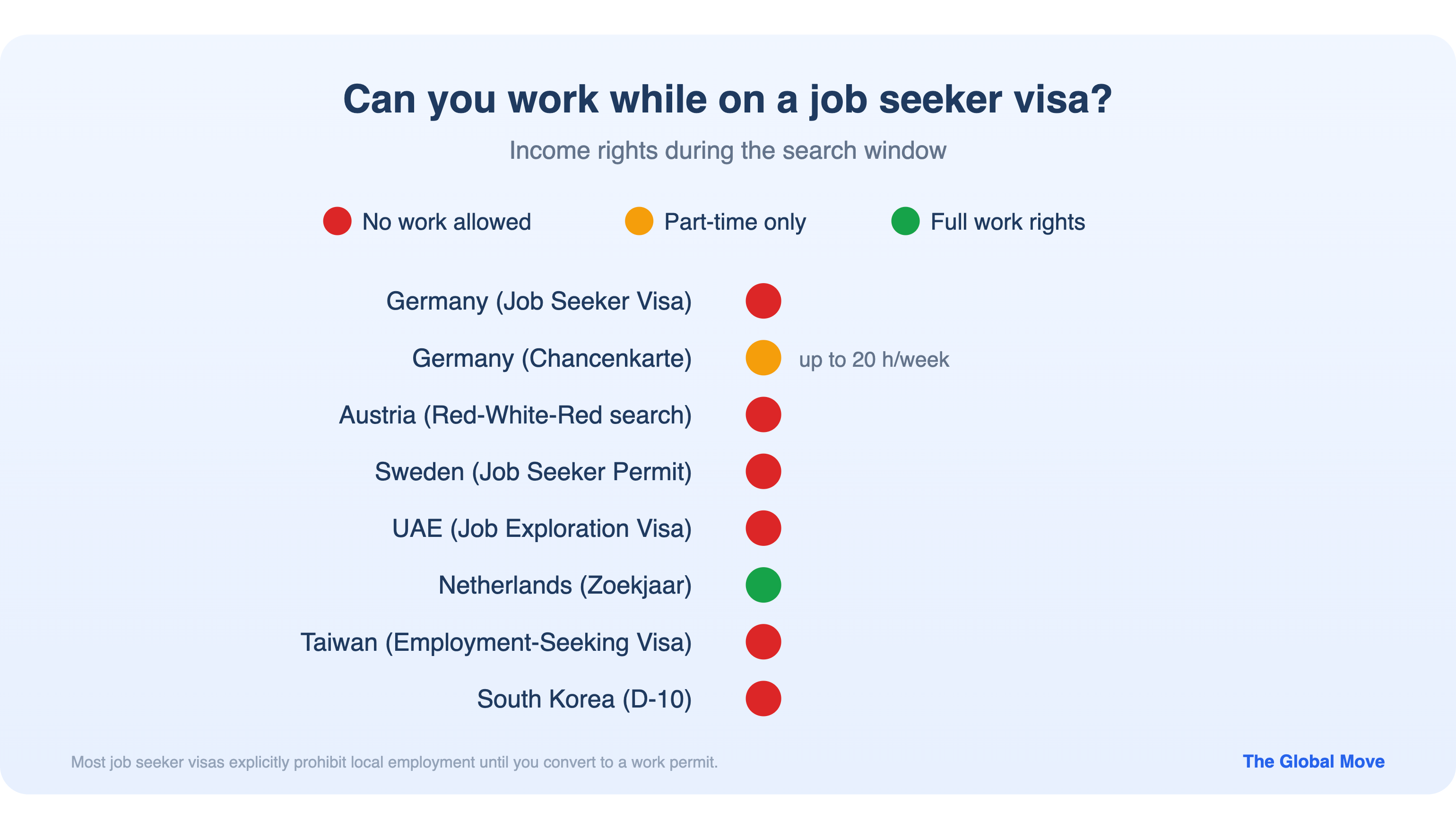
You can work part-time (up to 20 hours/week) while searching for a full-time role. This makes the 12-month duration financially realistic. It’s a rare job seeker visa with which you can work while you’re still looking for a full-time job!
Fee: €75
Duration: 12 months
Sources for more info: German Visa Navigator, Chancenkarte Info
With the launch of the Opportunity Card (Chancenkarte), this pathway is now mainly available to those already in Germany who have just completed a degree or vocational training (minimum 2 years) at a German institution. You get up to 18 months to find a job after graduation.
To be eligible, you need a recognized degree (Bachelor’s, Master’s, or PhD) or a vocational qualification obtained in Germany. You must also show proof of funds (sources point to €1,027 each month, which amounts to around €18,500 for 18 months) and health insurance.
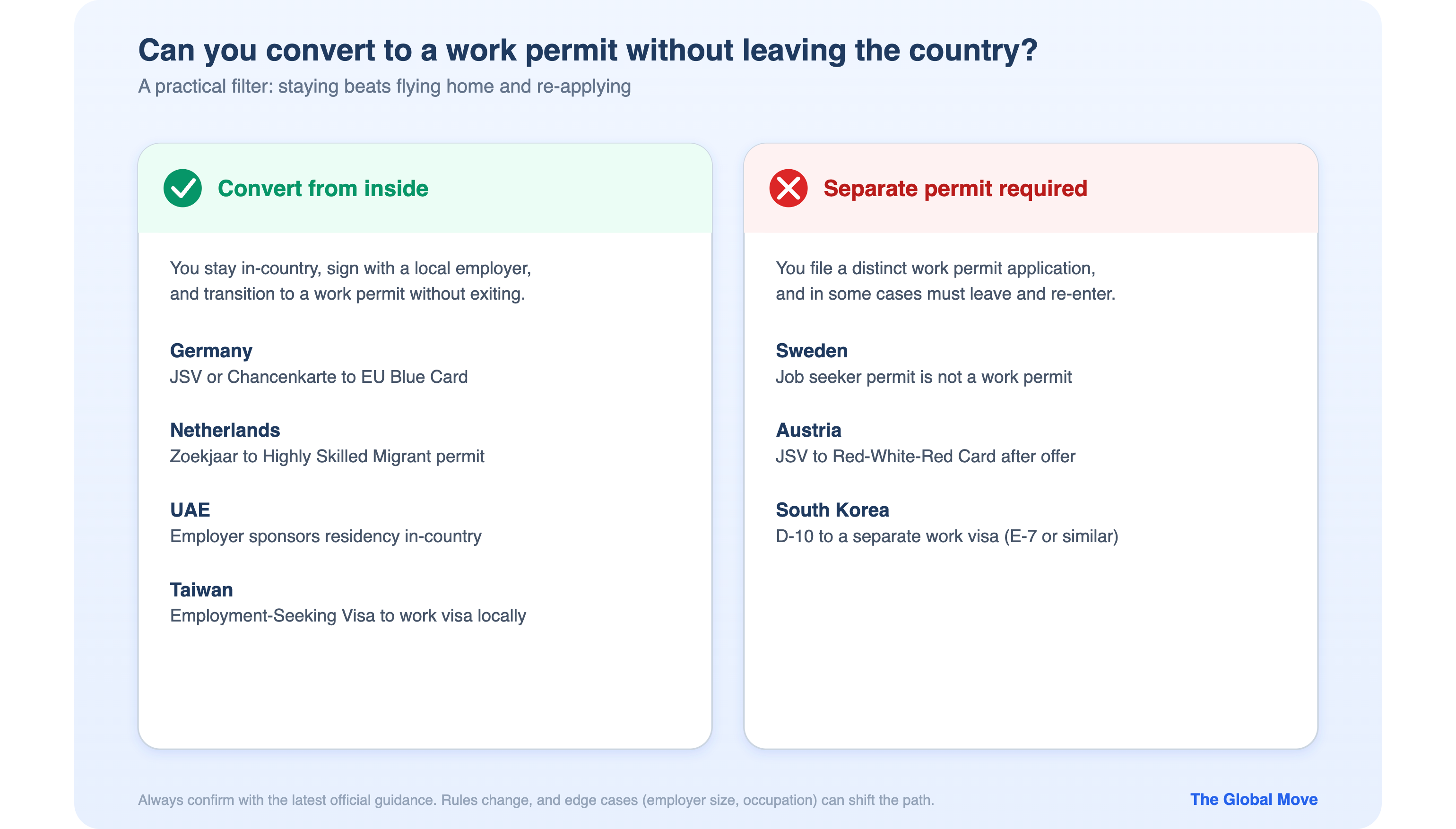
During those 18 months, you are allowed to work, which makes it more flexible while job hunting. Once you secure qualified employment, you can apply for a work permit (EU Blue Card or standard work visa) without leaving the country.
Application fee: €75
Duration: Up to 18 months (non-renewable)
Sources for more info: Job Seeker Visa vs Chancenkarte in Germany, Your Complete Guide to Germany’s 18-Month Job-Seeking Visa
On a final note: If you’re outside of Germany, go for the Opportunity Card (Chancenkarte).
Austria’s job seeker visa works through the Red-White-Red Card system. You apply for a 6-month visa to search for employment in shortage occupations. The Austrian government publishes an updated shortage occupation list each year, and tech roles (software developers, IT analysts, data engineers) consistently appear on it.
The points system evaluates your qualifications, work experience, age, and language skills (German or English). You must get at least a certain number of points. Candidates who are younger, have degrees in STEM fields, and can speak some German score more points.
Once you find an employer willing to hire you, you apply for the Red-White-Red Card itself, which grants combined residence and work rights.
Fee: €160
Duration: 6 months
Sources for more info: Official site, Austria Visa Guide by Relocate.me
Sweden might look a little strange to me in 2026. The country, perhaps because of the wave of gang-related incidents that have nothing to do with software engineers trying to make a living, has started enforcing very, very strict immigration rules. I even remember that a few years ago, when we were producing content for Relocate.me, it surprised all of us how much harder getting residency or citizenship in Sweden had become compared to just five years earlier.
I would glance over and see it, though. It’s still an excellent country with a fabulous quality of life and very, very interesting salaries, but if you’re really tempted by Sweden, you always have the option of looking at its neighbors. Remember that Norway and Denmark share a lot in common with it.
Sweden grants up to 9 months to search for work or start a business. But you need a master’s degree, a PhD, or an equivalent professional degree completed within the last 10 years. The degree must be recognized by the Swedish Council for Higher Education. With that hyperlink I just dropped, you can find out easily if your degree works thanks to their excellent site.
You must show funds of at least SEK 13,000 per month (that’s around €1,130) for the full duration of your stay. That means roughly €10,000 in your bank account for a 9-month permit.
You cannot work on this permit. If you find a job, you apply for a separate work permit. You also cannot bring family members until you convert to a work permit.
As I said, Sweden has made it harder for people to come to the country since 2023. They have done this by raising the minimum salary needed for work permits and being stricter about following the rules. The job seeker permit itself still exists, but the overall environment is less welcoming than it was five years ago.
Fee: €200
Duration: Up to 9 months
Sources for more info: Swedish Migration Agency
The UAE can issue a Job Exploration Visa in 60, 90, or 120-day increments. It’s aimed at recent graduates: you need a bachelor’s degree (or higher) from a university ranked in the top 500 globally, and you must have graduated within the last two years. What the top 500 universities are remains a mystery, since their official site in English won’t clarify it. My take: head to their site, Issuing a visit visa to explore job opportunities, and try to apply with your current degree.
The fees are affordable (€50 for 60 days, up to €100 for 120 days), and processing is fast. The UAE’s tech sector has expanded rapidly, especially in Dubai and Abu Dhabi.
If you find a job, your employer sponsors your work residency. The transition is straightforward, since the UAE is built around employer-sponsored residency.
The recent-grad rule here catches my attention, though. I’ve worked for years with candidates, I’ve helped many applicants land jobs, and working with them taught me what a strong profile actually looks like. I’d say this rule is incredibly exclusionary against the kind of profile that would do really well at a UAE company: a senior dev with a fabulous GitHub who’d accomplish great things in Dubai, and who, well, is left out of this plan. So I question it. But I didn’t write it.
Fee: €50–€100
Duration: 60, 90, or 120 days
Sources for more info: The official platform of the UAE Government
The Dutch country looks great for recent graduates of top universities.
The Netherlands’ Zoekjaar (Orientation Year) permit is available to graduates of Dutch universities or universities ranked in the top 200 globally (according to the THE, QS, or ARWU rankings).
The Zoekjaar is full of hidden treasures. During the orientation year itself, you can work freely. Your employer does not need a separate work permit to hire you. Actually, they only have to pay the legal minimum wage (which includes the holiday allowance). In 2026, the legal minimum wage in the Netherlands is €14.71 per hour. You can also use this orientation year to start your own business.
You must apply within three years of graduation. This gives you 12 months to find a job, start a business, or transition to a Highly Skilled Migrant permit.
The real advantage here is what comes next. The Netherlands’ Highly Skilled Migrant (Kennismigrant) permit has a relatively low salary threshold for tech roles, and your employer handles most of the paperwork through the IND.
There’s also the 30% ruling: qualifying expats can receive 30% of their gross salary tax-free for up to five years. On a €70,000 tech salary, that’s roughly €6,000 more in your pocket each year compared to a local employee. (The ruling has been gradually changed, and political debate is still going on, so make sure you’re applying under the most recent terms.)
Fee: ~€210
Duration: 12 months
Sources for more info: Official site of the Dutch government
You might also want to check out: Moving to the Netherlands for Work
Taiwan has two programs and some major 2026 reforms. So I’m tempted to say that this country has some of the most flexible options in Asia.
But let me get the details straight. I haven’t been deeply involved with this one, because relocation jobs in Taiwan haven’t had much of a selling point for expats. They’re often roles for people already in the region. Of all the more open markets in Asia for people who want to relocate, I’d say Japan is much stronger than Taiwan. And I’d also be watching very closely the geopolitical developments concerning Taiwan. I’d factor that in when choosing a visa.
The Employment-Seeking Visa gives you 6 months to job hunt in Taiwan. You need either a salary history of at least €1400/month or a degree from a university ranked in the top 1,500 globally.
Official source: Bureau of Consular Affairs
Look, this is not a job seeker visa and it’s more of a talent visa, which I have covered in the past. But since it was recently reformed, and it looks like a promising path because you can arrive in Taiwan without an employer sponsoring you, I’m mentioning it here. Taiwan’s Gold Card is a 4-in-1 document: work permit, residence visa, Alien Resident Certificate, and re-entry permit. It’s valid for 1 to 3 years and comes with an open work permit, meaning you can work for any employer (or multiple employers, or yourself) without sponsorship.
From what I’ve gathered, the Gold Card has become one of the most popular programs in Asia for tech professionals. Please refer to the official source: Taiwan Gold Card.
Taiwan passed significant reforms in 2026 that made both programs more attractive:
Fast-track permanent residency: Earners above NTD 6 million/year can apply for permanent residency after just 1 year (previously 5 years).
Spouse work permits: Spouses of Gold Card holders can now obtain work permits without employer sponsorship.
I know this is an article about job seeker visas, but frankly, I would really look at the Employment Gold Card. I find it really attractive.
Learning the Korean language and their exquisite alphabet from your home country might be really hard, so fortunately there’s still a pathway for expats who want to settle there and learn their ways by living in this exemplary economic powerhouse. South Korea’s D-10 visa is a job-seeking visa for foreign professionals. It can be earned by graduates of Korean universities (the most common way) or by professionals from other countries who meet certain points requirements.
For the points-based pathway, you need at least 60 total points. Points are awarded for education level, Korean language ability (TOPIK scores), age, work experience, and income history. Having 20+ “basic points” (from education and language) is a prerequisite.
The initial grant is 6 months. If you graduated from a Korean university (D-2 visa holders), you can extend up to 2 years total in 6-month increments. If you came through a language training visa (D-4), you can extend up to 1 year.
From October 2025 on, new rules increased the amount of money that internships could pay. You can now do an internship at the same company for up to a year. The limit on the total number of internships you can do has been lifted.
Fee: €90 for extensions
Duration: 6 months (extendable to 1–2 years depending on pathway)
These three visa types serve different purposes, and picking the right one depends on where you are in your career and what you want to do.
Job Seeker Visa is the right choice when you want to relocate permanently and find a local employer, and you’re ready to win and stay there, or lose and go back home with the frustration (and the financial setback!) fresh-cut in your mind. But there are pros, can’t shake that. You move to the country, interview in person, sign a contract, and convert to a work permit.
Talent Visa programs (like the famous O-1 visa in the United States, or France’s Passeport Talent) are for professionals who already have a strong track record and realize they can complete a checklist with which they’ll get a special visa that in turn will let them seek for a job. They give you right to work right away without an employer sponsor. If you have the credentials, these are faster and more flexible than job seeker visas.
Digital Nomad Visa programs let you live in a country while working remotely for a foreign employer. You typically cannot work for a local company. This is the best option for freelancers and remote workers who want to move without having to change their job.
In my experience, the path to permanent residency almost always runs through local employment.
Once you’re on the ground with a job seeker visa, the clock is ticking. Here’s how to make the most of it.
You’ll soon realize that no, job seeker visas don’t allow you to work (the Chancenkarte and Taiwan’s Gold Card are exceptions). This is obvious by now but I’m just spelling it out again in case you found some conflicting information online (which is too typical when discussing visas!)
So start before you arrive! Apply to jobs, reach out to recruiters, and schedule interviews before your visa starts. Your in-country time should be spent on final-round interviews and networking. I walked through the full timeline in this piece on preparing six months ahead of relocation.
Also, get your credentials recognized early. Germany, Austria, and South Korea all have formal credential recognition processes that can take weeks. Start this before you travel. For Germany specifically, check anabin to see if your university is already recognized.
You should also attend meetups and local events. This is why you’re physically in the country. Tech meetups, startup events, and coworking spaces are where informal hiring happens.
📚🎓 If you’re earlier in your career and don’t yet qualify for a job seeker visa, a master’s degree in your target country can be a backdoor. Many countries offer post-study work permits that function identically to job seeker visas. See the guide here: Study to Get a Job Abroad.
A job seeker visa isn’t for everyone. It can give you an edge: being physically present lets you change your location on LinkedIn, use a local phone number, attend face-to-face interviews, and get a real feel for the country, its tech scene, and daily life.
But it comes with trade-offs. You’ll be financing your own job applications on site. And you’ll also be working up against the clock (and the calendar). This is a riskier option compared to talent visas or employer-sponsored relocation. It’s best for people who are willing to take that risk because they really understand that there are plenty of alternatives out there.
If you’d rather move with a job already in hand, that route is very much still open. The 2026 Relocation-Friendly Tech Jobs Report found 1,200+ relocation-friendly tech positions in Germany alone, and the rest of Europe is well represented too.
You can also join The Global Move, the internet’s top community for software engineers who want to relocate. Every week, I share a curated list of tech jobs with relocation, plus some global remote roles. Subscribe and get them straight to your inbox. Good luck with your search!