I want to start with the rule, because the rule is simple. In 2026, a cover letter is worth writing only if you write it well. An average one is the least effective message you can send.
So… in 2026, what does it mean to write it well, you might ask?
I am writing this around a real letter. One of our subscribers here at The Global Move wrote a cover letter that opened a door for him, specifically at Ecosia, the German search engine that plants trees while earning revenue. He gave us permission to show it. I blurred the names of the people he mentions, but the rest is exactly as he sent it. I want to walk through it with you, the parts that work and the parts I would change, because the result was real, and that is what makes it worth studying.
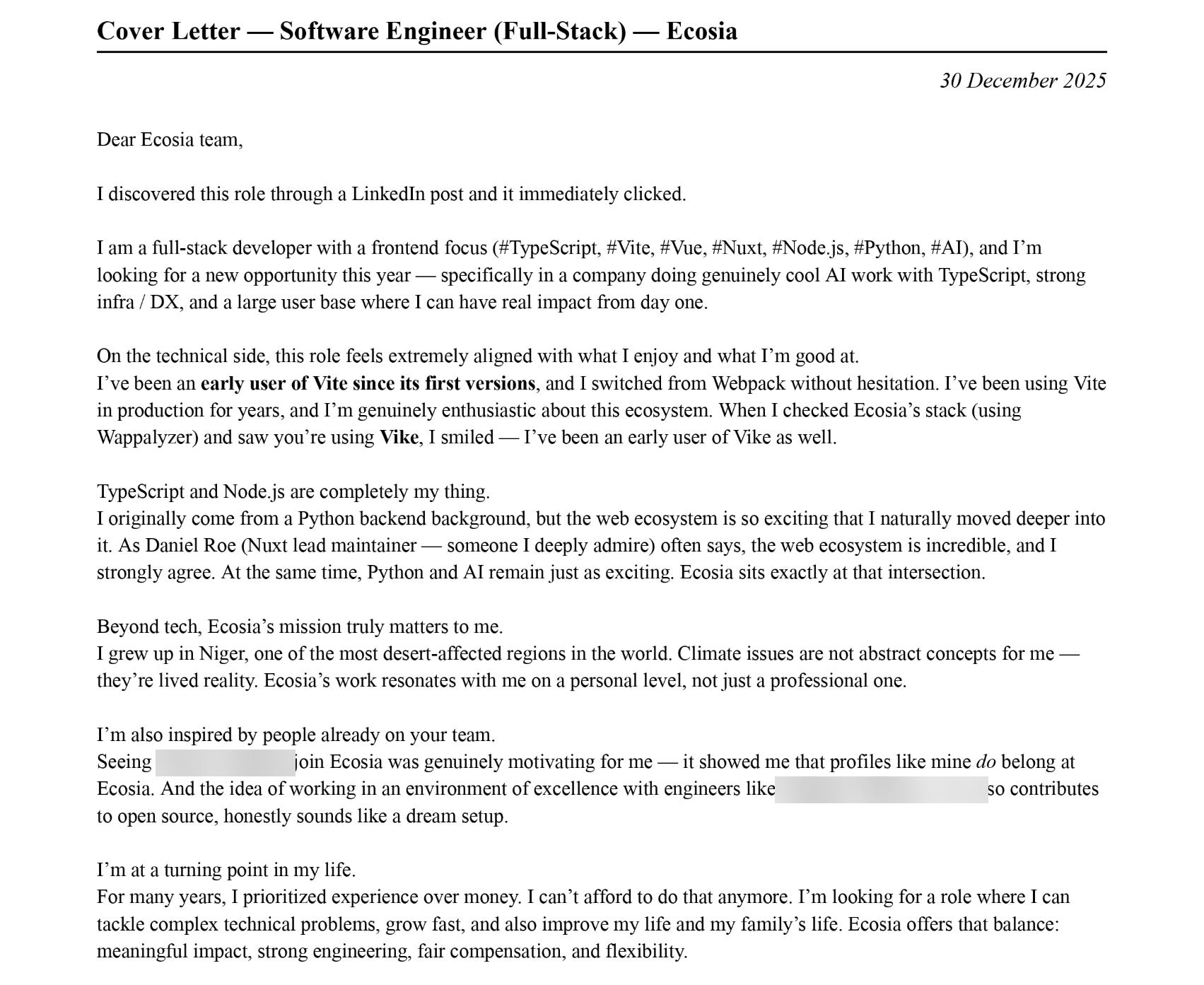
The cover letter I’m studying, with the names of the people mentioned blurred.
A few years ago, writing a cover letter took real work, and so did writing a long email. The effort itself was the signal. A colleague who reads The Global Move once got sent abroad to pitch the business, even though that was not his role, and he is convinced he got it because he read the brief carefully and wrote a very long email laying out everything that had to happen. The length proved he had done the work. That signal is gone in 2026. Writing something long no longer proves effort. At best, it proves compliance, and it can work against you. Copy and pasting a chat into a cover letter is a bad idea, and so is sending three paragraphs that just reword your resume.
You have seen designers complain that AI design all looks the same now. The same thing is happening to cover letters. When everybody uses the same prompts, every letter reads the same, and the value of writing one drops to zero. This is older than LLMs. Before cover letters became a commodity, if you googled what to say in an interview you got the same answers as everyone else. There was even a Heineken ad built on the joke between saying “I’m passionate” and saying “I’m stubborn.” Same concept. If you sound like everyone else, you do not stand out, and length no longer costs you anything, so it no longer earns you anything. (If any reader can send me that Heineken ad, I’d love to watch it again.) Which brings me to the main point here:
For your cover letter, either you nail it, or you skip it.
So if you are going to write the cover letter, write it well. Since this is the start, let me lay out what a modern cover letter is built to do. A strong one demonstrates three things. First, your expertise and experience that are relevant to this role. Second, the meeting point between that expertise and the value you can create for the company, and it lands harder if you can point to real numbers. Third, deep and personalized research that shows a genuine interest in this specific company and sets you apart from a generic application.
If you are waiting on a recruiter to reply, let go of the idea that the letter has to be long. Something short and well-thought-out, that fits in a single screen, will almost always do more for you.
Set one objective when you write it. You want the recruiter to want to talk to you. You want them to read it and reach for the keyboard, to reply or to set up a call, even when you are not the right fit. The best sign is an honest “thank you for applying” that was clearly written by hand and not fired off by an automation. If you get that, you’re on the right track!
So aim past “keep it short.” Short is good, but the real question is whether the letter is compelling. Did you touch a nerve? Did you speak to the pain a recruiter carries, or the goal the company is chasing? If you can fit that into a few short paragraphs, the way the Ecosia candidate did, you did it right.
I made a similar point in our post on how searching for tech jobs with relocation will look in 2026. Playing the numbers game is fine. The spray and pray approach, where you send the same generic application everywhere, is not that good, though.
PostHog says the same thing in their own hiring advice, and it is worth reading in full. They keep the letter short, they tell you not to reword your resume, and they show real examples of the cover letters that led to hires at PostHog and the ones that did not. That side by side is pure gold.
In 2026, almost everyone optimizes their resume for the ATS. They match keywords to the job description and use AI to make their accomplishments read better, so resumes look more and more alike. In tech the volume worsens it. PostHog shared their own funnel for an engineering role: 900 applications, 86 first interviews, so under ten percent, and 55 technical interviews, around six percent. With numbers like that, telling candidates apart on the resume alone is close to impossible. That is why they bother publishing examples of good letters in the first place.
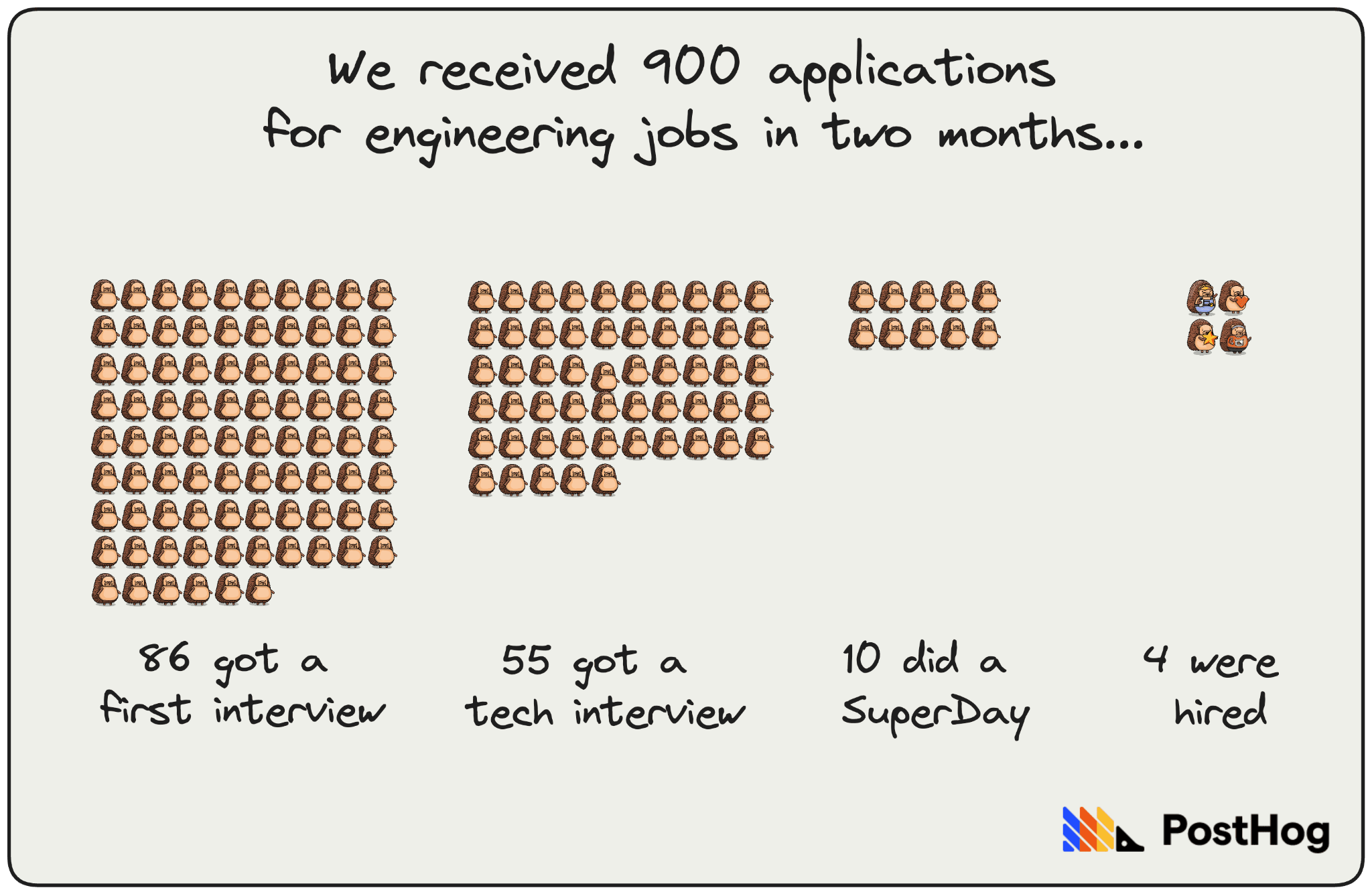
Don’t let these stats undermine your motivation, but you should acknowledge that this is the state of things for a company like PostHog!
It also helps to remember who reads you first. The first person looking at your application is usually a recruiter, not the technical hiring manager. They may not follow the deeper technical nuances of what an engineer, a data scientist, or a product person actually does, so a resume full of technical wins can be hard for them to judge. A cover letter is something they can read right away. It is verbal. They can see how you think, how you communicate, the effort you put in, and remember that effort does not mean length, and how you tie the role to your background. For a recruiter who is not technical, it is one of the few places, maybe the only one, where they can relate to you as a person, even when you come from a technical profile.
So the cover letter came back as one of the last real differentiators in a pile of hyper-optimized, AI-written applications. A letter that is done well can be the thing that makes the person on the other side of the screen stop, pay attention, and decide to give you a chance.
Before I take it apart, one thing about timing. This letter is dated 30 December 2025, and I am writing this in June. Close to six months passed between the letter and this post. Keep that in mind when you relocate. The process takes as long as it takes, and you have to be ready for that. We wrote a whole piece with Eli Gündüz, a Lead Tech Recruiter at Atlassian and founder of Careersy Coaching, on how to prepare months before you apply, and the patience part is not optional, unfortunately. It is what it is.
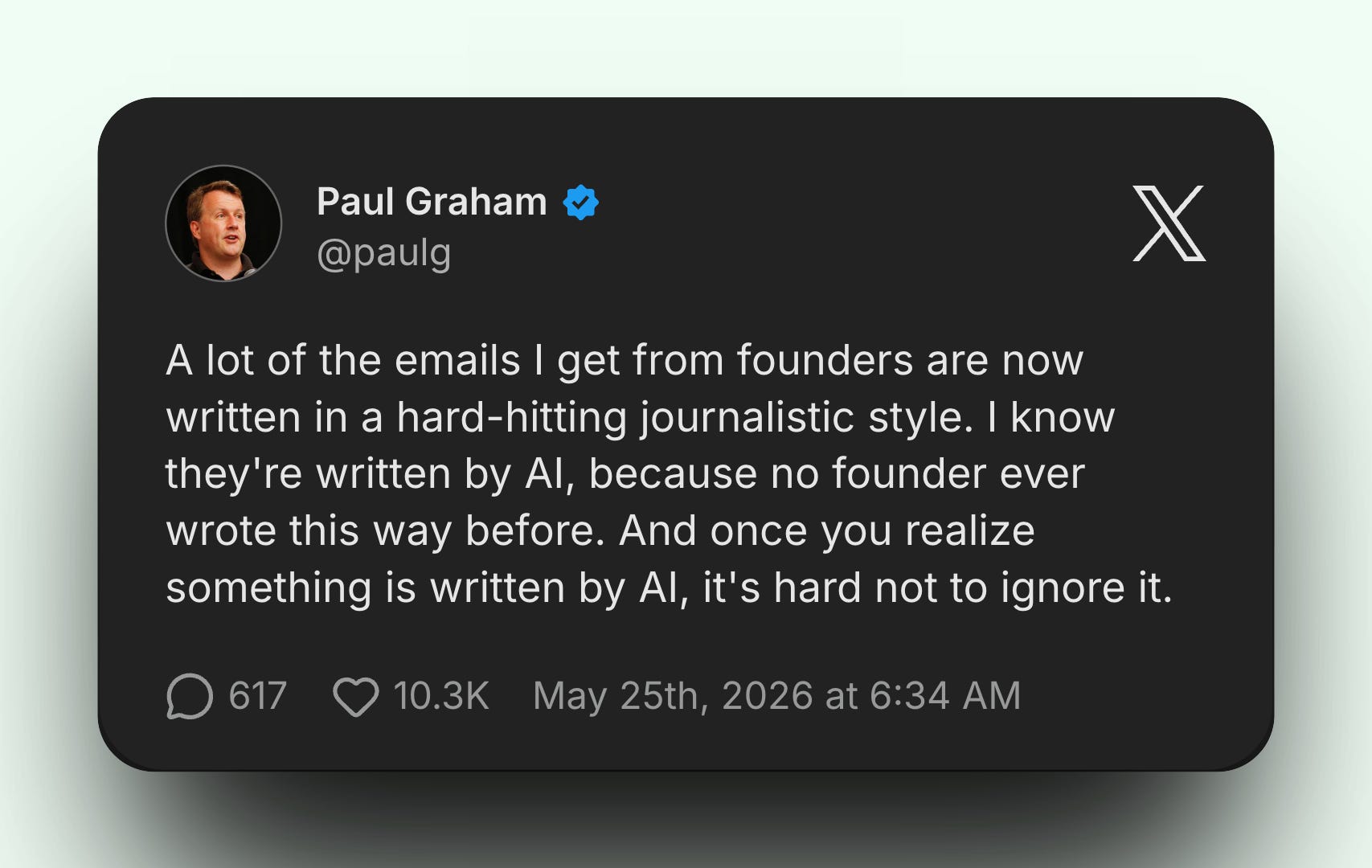
Let me say this out loud. The letter clearly used AI to draft the message, and that is perfectly fine. Even Paul Graham says it’s fine. If you scroll down and read the replies to the tweet I’m sharing a screenshot of, he says there’s a right way to use AI to draft messages. I agree! And Ecosia concurred, too. This candidate used it well, and you can see why by reading this letter.
Nobody has to be an expert English writer or sound like Shakespeare, especially if you weren’t born in Massachusetts or Belfast or Newcastle Upon Tyne. It is not the expected behavior, and it is not your contractual duty or obligation. Definitely, writing well always helped, and now there is a tool that makes it easier to write cleanly, without spelling mistakes, in the right register. Our colleague used it, and I know because I asked him and because I can read the phrases that came from a model.
Here is one of them.

An AI cliché worth cutting.
“Ecosia sits exactly at that intersection” is a very AI sentence. I would tell you not to use it. Here is another.

A second phrase anyone can spot as AI.
Look, I’m only saying this because I want to give my best possible advice here. If the letter is a 9/10, then cutting stuff like this will stretch it to a perfect 10. And the thing is, anyone reading that can tell a model wrote it, and that removes the originality out of a write-up. So my first note is to cut phrases like these. Use the tool, then read it back and remove the lines that sound like a thousand other letters. Everything below is what the letter gets right.
If you really send cover letters that have these phrases, just use my advice to prune them a bit, but don’t take it to heart! Again, you are not under the obligation to sound like Shakespeare. In any case, it’s commendable that you might be sending a write-up in a language that’s not yours (the exact same as my case, by the way).
I told you: This letter worked, so it means it got almost, if not everything, right. Here’s what it is, so that you can take inspiration.
The letter opens by laying out the whole technical profile, the tools, and what he actually does. This is the same move I praised in our post on what developers can learn from Soham Parekh, the engineer who landed several Y Combinator offers in a brutal market. He does not repeat his resume, and he does not tell you he is a passionate self-starter. He tells you why he can help.

The letter front-loads the stack instead of describing it.
He says he is a full-stack developer, and then he proves it. TypeScript, Vite, Node.js, Python, AI. Lovely way to start!
This is my favorite part. He checked the company’s stack with Wappalyzer, saw they use Vike, and wrote about it.

He researched the actual stack instead of guessing.
That single detail tells a recruiter he has the curiosity and the tools to find out what is really going on inside a company. He does the same with the team. He names someone already working there and explains that seeing that person join is what told him a profile like his belongs at Ecosia.

He researched the team!
You cannot fake this. The one thing a model can’t do for you is research (this might age poorly, by the way.) Research is also what makes a letter sound like it’s addressed to one company instead of all of them.
For a relocation letter, I think this matters a lot. He writes about his origin and ties it to the company’s mission.

Origin and motivation, tied to the mission.
Yes, that bit I highlighted is AI-drafted, and it does not sound enchanting. It is still true. It is genuinely true about where our colleague comes from, and a recruiter reads it as a real reason to move.
Think about what a recruiter actually wants. Security. They want to be sure that if they make an offer, the candidate will work out, and for a relocation role that means the candidate will actually move. This letter answers that worry before it is asked. Everything in it says: I have looked into your company, I know your stack, I know your people, I am ready to relocate. There is no doubt left on the table. That narrative is why the letter works.
If I have already read the resume, a letter that just repeats it gives me nothing. This one tells a story instead, a short one, about technical fit and real motivation to move. As a recruiter, that is the kind of person I want to start talking to.
There are two more lessons here, and they come from other authors with whom I agree.
The first comes from a 2021 piece in The Paris Review, written before LLMs turned the cover letter into a commodity. Address the letter to a person. “To whom it may concern” changes completely depending on whom you are actually writing to, so do the work to find out who that is. (You might relate to this. If you get a marketing email that says something like “Hello there” and they clearly haven’t even done the research to find what your name is, well of course you’re going to delete it more quickly than if they send something like “Hey Andrew” and it indicates that they did the research. I think it works the same way with cover letters.)
The second I picked up in an article on EURES, the European job mobility portal. Get familiar with the company and its values. Our colleague’s letter does this well. Before he wrote a word, he had clearly researched what the role offered, the people on the team, and where they came from. He found his own parallel story in theirs, realized he was a cultural fit, and said so.
I want to close with something bigger than the cover letter because, honestly, there are already many articles on how to write one, some better than others. What we have here is a winning letter, and the guidelines come from studying it. The point connects back to that piece on preparing well before you move. You have to get ahead of time and connect with your network.
That is the version of the cover letter that still works in 2026. Short, researched, addressed to a real person, honest about why you can help and why you are ready to move. If you cannot make it that, skip it. And it’s completely fine. But if you’re trying to increase your chances, you should be motivated by our fellow reader here. He put in the hard work, and that earned him a conversation about possibilities to live and work abroad. As we all know, getting that first interview is extremely hard! And the cover letter was his vehicle to get to that notoriously hard-to-get-there initial stage.
PS: I handpick and publish relocation-friendly tech roles every week here on The Global Move. If you’re planning an international move, subscribe and start building your runway now.
Paid subscribers also get access to a private job board with a searchable archive of those handpicked opportunities.