We use the term “serious writer” as if it were a stable category with a settled meaning bestowed by a higher literary court. But a while ago I heard the phrase so many times in separate conversations in one day that it began to irk me. What does it mean? So I launched an investigation. When people referred to a “serious writer” in my presence, I assumed the Socratic position and began hectoring them about what they were trying to say. Thankfully, all my friends are used to this behavior.
Here is my resulting list of the most common theories of seriousness:
The Serious Writer takes pains over, and achieves, some kind or quality of style.
The Serious Writer expresses or critiques the values of their society.
The Serious Writer serves the correct ideological program.
The Serious Writer speaks for some important demographic.
The Serious Writer pushes their tradition in new directions.
Yesterday, while I was listening to an acquaintance expound his belief in the serious writer as social critic, I asked myself for the first time what I mean when I use the phrase. Because, yeah, I’ve spontaneously uttered it myself from time to time. The answer that surfaced in my depths surprised me. It also made sense of some of my more eccentric literary opinions. I discovered that I believe:
The Serious Writer communicates an original point of view.
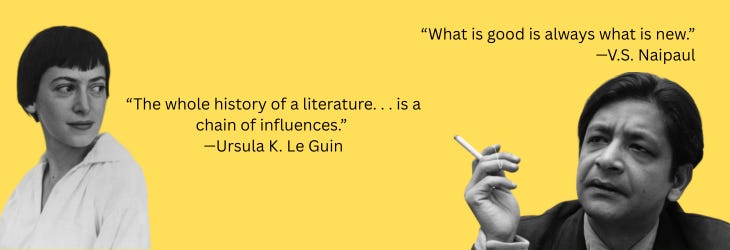
The moment this sentence occurred to me a whole bunch of consequences spooled out in my brain, but I also felt a twinge of anxiety. Was I plagiarizing V.S. Naipaul? That would be ironic. I was pretty sure he wrote something along the same lines. So I burrowed through my notes until I found the passage I remembered. It’s from his Nobel Prize acceptance speech:
Writing has always to be new; every talent is always burning itself out [...] Literature is the sum of its discoveries. What is derivative can be impressive and intelligent. It can give pleasure and it will have its season, short or long. But we will always want to go back to the originators. What matters in the end in literature, what is always there, is the truly good. And—though played-out forms can throw up miraculous sports [...] what is good is always what is new, in both form and content. What is good forgets whatever models it might have had, and is unexpected; we have to catch it on the wing.
Oh, thank goodness, I don’t quite agree. For one thing, I wouldn’t say that only what is new is truly good. The other qualities he mentions (impressiveness, intelligence, pleasurableness) also seem truly good to me, in their own ways.
But he also wrote, “literature is the sum of its discoveries.” That sentence clicked in my brain with the sound of a key turning the lock of my thoughts. I think I believe that literature’s “discoveries” are unique points of view. This essay is my way of working out the implications of that idea—implications that touch, I think, on many of the intuitions my friends expressed while helping me build my list of common theories about the serious writer.
Okay, it sounds nice, but what does it mean to ‘communicate an original point of view’?
Let me first make clear that, when I refer to a writer’s point of view, I do not mean their demographic categories. I’m not just rephrasing the familiar demand that we increase the scope of literature to give a stronger voice to marginalized groups. I’ve nothing against that goal, but it’s orthogonal to what I’m talking about here.
You haven’t identified Jane Austen’s point of view, in my sense, by saying she was a straight white Protestant Christian woman from the English landed gentry in the early 19th century. Any features of her writing that express merely these qualities, or any others by which you could assimilate her to some group, are by definition not unique.
The same goes for labels associated with literary history or aesthetic movements, by the way. You haven’t sussed out Austen’s point of view by calling her a novelist of manners, an ironist, a user of free indirect discourse, etc.
The originality I’m interested in is individual, not collective. It’s an originality of path-dependent, contingent historical consciousness, not an originality of type or representation. You can’t predict a serious writer’s point of view, no matter how much you know about them and their context: they have to communicate it, and to receive it you have to read them. Seriously reading a serious writer is about communing with another mind, a singularly interesting one.
You might object that everybody possesses a unique point of view in this hyper-specific, individualistic sense. We’re all different, right?
Moreover, virtually every story, poem, or essay constitutes a new and never-before-written sequence of words. Putting together such a sequence is easy. So isn’t it easy to be original?
No. Instead, to acquire an original point of view, a writer’s unique perceptions and thinking must first amount to something, and then their language must rise to the task of clearly communicating that something.
Perhaps I ought to distinguish between a vantage point (the possibility of a unique point of view) and the point of view itself. You get a vantage point for free, just by possessing a singular body and a finite consciousness. Congratulations. But you have to work to turn a vantage point into an original point of view.
Philistinism is the default attitude of the adult human. It’s easy for us not to reflect on and interrogate our beliefs about what is right or wrong, true or false, beautiful or ugly. It’s easy not to notice and probe our emotions, organize and question our preferences, assimilate and inhabit our experiences. It’s easy not to seek out what’s actually happening in the arts and letters of our day. These things take some doing, and the path of least resistance is to inherit some of your point of view from your parents, some by osmosis from the media to which you expose yourself, and some from the peer pressure of your acquaintances. To do otherwise requires attentive noticing, wide reading, hard thinking, and experiments in writing and speaking. On the far side of such work, a writer may become a person who perceives and takes an interest in the world not just as a body trying to survive and seek pleasure in life, but as a questing intelligence with an internal project, who actively digests and interprets experience in an unusual way. They may, in other words, acquire an original point of view.
I think most people have no interest in this work, or no time or inner peace to undertake it, or no idea of how to do it well. As far as I can tell, this has been true for all of recorded history, and every serious writer from Cicero to Sei Shōnagon, Al-Ghazali to Matthew Arnold, Nietzsche to Sinclair Lewis despairs of their own local horde of philistines.
But developing an original point of view is just step one. It’s only the precursor to literary originality, which involves communicating that point of view.
Language resists originality. The problem begins at the level of words, which only make sense when we share some idea of what they mean, and the problem intensifies higher up the ladder of complexity.
You’re most likely to encounter originality from other people in casual conversations. The more formal and complicated a type of language they try, the more similar and unoriginal the point of view communicated in their words tends to be. Social media proclamations and emails are less original than private verbal utterances, prepared speeches are less original than emails. By the time we work our way up to the venerable forms of literary communication, the story, the poem, the essay, most people are utterly without originality. (If you don’t believe me, I invite you to volunteer to read slush for a magazine. You will quickly acknowledge the point.) The LLM-generated tsunami sweeping across every digital platform is a culmination, a consummation of this unoriginality.
Serious writers set themselves against this tendency. They are the ultimate purveyors of anti-slop.
The Peruvian novelist Mario Vargas Llosa wonders, in a lecture published in A Writer’s Reality, “why it is not possible in a novel, as in a poem, to use only intense, rich, creative language?” He calls the alternative “el lenguaje muerto”—dead language. The desirable alternative, Vargas Llosa proposes, is literary language, “any language that has the capacity to take the reader from real reality and move him to a fictitious reality, to a separate reality.” He’s talking specifically about fiction, but I believe the same test can apply to any language seeking to express an original point of view: when it succeeds, the reader feels transported somewhere new. But, as Vargas Llosa also wisely wrote in the same text, “the characteristics of literary language cannot be specified”—there are no rules, no mechanical short cuts. You can’t learn how to do it in school or from a book of instructions.
Vargas Llosa’s own favorite technique for avoiding dead language in his novels was something he called “communicating vessels.” Basically, he interwove two scenes occurring in separate places and times, so a reader has to keep on their toes to figure out which scene a given sentence belongs to. If I simply ripped off that technique, it wouldn’t work. Even in some of Vargas Llosa’s own stories (especially toward the end of his career) it doesn’t work.
Writing seriously is a high-wire act where each new step requires as much concentration as the last. There’s no place on the wire where you’ve finally got it figured out and now you can relax, now you can just enjoy yourself. Screw up and you’re dead, or anyhow your language is.
I’ve painted a pretty dreadful picture of rhetorical difficulty here, but I have a suspicion that living language—for someone who has taken the trouble to really develop an original point of view—is as much a matter of restraint as of straining. Let me quote yet another serious writer, a personal favorite and hero of mine, George Bernard Shaw: “He who has nothing to assert has no style and can have none: he who has something to assert will go as far in power of style as its momentousness and his conviction will carry him.”
Basically, if you have something to say, if you’ve done the work to build an original point of view, you’ll have an easier time avoiding dead language.
Perhaps building a point of view and avoiding dead language are not two separate steps toward originality. They’re more like a virtuous circle. One feeds into the other.
And yet it’s not easy to stay inside this virtuous circle. I think it’s harder now than ever before, because so many would-be writers are addicted to social media, the unoriginality machine. I’ve watched time and again as the unique point of view of literary friends disappears from their writing. They become infected by the argot of their feeds, dominated by inside-jokes, collective antipathies, and a culture of continuous commentary on pseudo-events.
I was sharing these ideas with one of my long-suffering friends, and he asked me: if you’re such a fan of originality, how do you explain your willingness to read works of genre fiction, and not just avant-garde literary experiments? Only the latter are original, right?
In fact, I think traditional forms and existing genres introduce another potential element of originality: originality of interpretation. I’m not talking about hermeneutic interpretation—interpreting to bring out meaning—but the kind of interpretation that occurs when a pianist plays Bach’s Goldberg Variations or a calligrapher re-inscribes the Lantingji Xu.
Serious writers of genre fiction get to communicate their originality like serious classical pianists or serious calligraphers, by performing an individual version of a recognizable model. In other words, contra Naipaul, there is a version of originality that depends on models and does not forget them. (Remember? He wrote: “What is good forgets whatever models it might have had, and is unexpected.”) Ursula K. Le Guin and P.D. James—two serious writers who were wedded to specific genres, science fiction and the detective story—both independently compared working in their genres to writing sonnets. The rigidity of genre structure provided the occasion for an originality of interpretive performance, just like poetic structure does.
Nonetheless, Ursula K. Le Guin and P.D. James weren’t merely serious writers bankshotting their originality off the enduring structures of their genres. Part of their goodness is in consistently providing an exact and predictable kind of readerly experience. In my private lingo, I call the writer capable of providing this a “hack.” I know using the word “hack” is a potentially offensive choice, but I mean it to be complimentary. (The staff of a magazine I used to work for often tossed “hack” around as a compliment—that’s where I got in the habit of using it that way.) I mean to draw attention to an ideal which is truly admirable, but also quite distinct from originality. I see the hack and the serious writer as two regulative ideals in the craft of writing. The ideal serious writer is perfectly attentive to (and able to communicate) their unique point of view. The ideal hack writer is perfectly attentive to (and able to satisfy) their intended audience’s cravings. They are not mutually exclusive, and there have been many great hack writers who were also serious writers. Georges Simenon comes to mind, and so does Samuel Johnson. But let’s be honest: in every genre of genre fiction, there are many more successful writers who attain the regulative ideal of the hack than that of the serious writer.
Another friend complained that my theory of the serious writer was too arduous and static: it takes a lifetime to fully form a point of view. And she worried that her own work was, by my criteria, unserious, because she often finds herself communicating uncertainty or confusion. Her poems and essays are about wrestling with unresolved questions.
I understand this concern, but I think it derives from the false idea that one’s point of view is essentially expressed in a set of clear positions.
A lot of people assume this. When a novelist tackles a difficult, contentious subject, many readers will do their best to figure out the implicit normative position that novelist is taking in their own story. Surely no one would venture to write a novel about a moral conundrum they didn’t have a position on?
But I think that’s precisely what draws many writers to their material: uncertainty. A desire to wrestle with the unresolved.
Your point of view has as much to do with what frustrates and troubles you as with your conclusions about life. I mean, I wouldn’t be writing this very essay if I felt totally secure in my account of the serious writer. I’m writing to try out ideas, to see if they’ll take me somewhere interesting.
My favorite kind of novel stages a debate between different positions on a contentious topic without sneaking in a cheat sheet about the correct answer. Fictional narrative is brilliantly adapted to this purpose. In fact, I’d argue many novels do a much better job of this than the famous dialogues of Plato, which are often held up as the ultimate classics of dramatized disagreement, even though they usually involve Socrates leading people around by the nose. Three books I read recently, wildly different in origin and type, equally thrilled me with the drama of unresolved ideas. The Book and the Brotherhood by Iris Murdoch is organized around the question of whether devotion to individual people or to moral principles and intellectual projects is more essential to the good life. The Heroes by Joe Abercrombie is a grimdark fantasy novel that’s also a debate-in-action about the definition of heroism (genuinely worth reading alongside Plato’s Laches). Breasts and Eggs by Mieko Kawakami is a sentimental and dreamy Japanese novel that’s also an uncomfortable debate about whether it’s fair to bring another person into the world.
Staging these debates, even if the author comes to no conclusion, requires (and communicates) a point of view.
To be clear, I’m not racing to the opposite extreme. Settled conclusions and firm beliefs are also part of a serious writer’s point of view. We should beware the valorization of uncertainty which leads some to pretend to be tentative where they are secretly definite.
A funny thing happened as I was working on this essay. (Something I’ve been doing off and on over several years, as it happens.) Defining my use of the phrase “serious writer” has re-ennobled the notion of criticism for me.
Half a decade ago, I made a chunk of my living writing book reviews for various publications, from the tiny anonymous capsule-reviews in the publishing trade magazines to long-form critical essays in intellectual journals. I burned out pretty hard because I felt that I was only proffering consumer advice and sharing tedious aesthetic preferences, while failing to build toward anything meaningful in my thinking. (Perhaps this was only a problem for me because I was finishing up a PhD in philosophy. ‘Building toward something as a thinker’ is not a major concern for the average critic, I would imagine. But it’s the very heart of an aspiring philosopher’s work.) In the years after I stopped, when I wasn’t writing about books, I missed it, because it felt as if my reading suffered. I now think this is because what good criticism does—its highest function—is to try to enunciate the original point of view communicated by a serious writer to a serious reader. Trying to be a good critic, in other words, was forcing me to be a more serious reader. That’s probably the best possible reason to try to be a critic!
Good criticism is a place where two solitudes meet. The serious reader and the serious writer catalyze each other. So many great writers began their publishing careers as book reviewers—in other words, as serious readers! And obviously criticism serves the serious writer, too. A kind of empirical testing occurs in the work of an honest critic: is this book communicating an original point of view? Is it still doing so, ten years later? How about a hundred years later? Sometimes the answer changes, and reputations rise or fall as one era’s truism becomes another’s bombshell. One definition of a classic is a book that retains or renews its originality across different generations: a book capable of inciting trenchant critical response over and over again. An originality that holds up.
What we call literature began and largely persists for external, instrumental ends: to entertain, to instruct, to propagandize, to aid devotion, to coordinate action. But some of us love it in itself. We care about its persistence and evolution even apart from these external ends. We are serious readers and we live for the discovery of books that communicate new points of view. Serious readers depend on serious writers, and vice versa. Forget consumer advice and the literary marketplace: this is why book criticism will never, ever die, as long as there are serious readers.
And as for the serious writer, they are log added to the fire of literate culture, the only way the flames—that’s the readers—stay burning. A population of readers who feed exclusively on old books or unoriginal books will slowly wane and quench like a fire starved. The fire could go out. But the serious writer and the serious reader keep it alive.