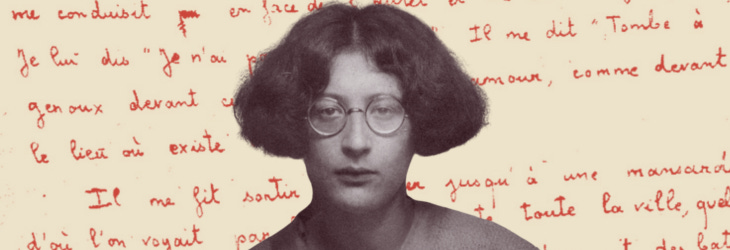
At the age of 27, Simone Weil was sent home from volunteering in the Spanish Civil War because she stepped in a cooking pot. Some of her comrades were relieved. They’d already had to insist she not use the heavy machine gun.
Physical awkwardness was a constant theme in her life, and that clumsiness extended, at first, to her handwriting. When she was a girl she wrote exactly the awful scrawl you’d expect. But then appeared in her life one of the most important influences on her thinking and habits. He was a philosopher named Émile-Auguste Chartier, but everybody called him “Alain.” (That was his pen name.) He suggested to Weil that she ought to fix her handwriting.
Alain was a teacher at Weil’s high school, the Lycée Henri-IV. He believed that the mind followed the body and that his job as a teacher was to arrange student’s bodies to improve their thinking. So he valued good handwriting.
By the time young Weil encountered Alain, he was already a well-known writer. He’d published hundreds of short essays in a daily column in the newspaper La Dépêche de Rouen. It was an odd format for philosophical writing, but he’d made it his own. “Each evening [Alain] would sit down before two sheets of paper, knowing before he started that the last line would be written on the bottom of the second page, and that within the confines of those two pages he would write a piece,” explains one of his translators, Robert Cottrell, “[and] he also knew that he would make no corrections, erasures, or changes; since the piece would be published the next day, he did not have time for the niceties of anguished composition.” He worked out his philosophical ideas with the help of this routine. Because his thoughts were machine-gunned into the world at the pace of a daily newspaper column, he depended upon calm and focus in each session. You can see why he cared about handwriting. In his process, immediate legibility was paramount.
Weil took Alain’s advice. She got hold of a child’s composition book and set to work. First she refashioned her approach to each letter. She used a matchstick to enforce straight verticals, practicing for several hours a day until she’d achieved the desired transformation.
It was an arduous labor to instill a private grace, a labor known only to her intimates, her correspondents, and her teachers. In other words: it was classic Simone Weil. She always tended to transform daily existence into a series of secretive mystical exertions. Later in her life, these projects would take the form of laboring over translations from Greek, poring over exercises in higher maths, or torturing herself with theological paradoxes. It’s not hard to see in the girl who changed her handwriting the woman who would seek out factory work as a form of philosophical research, who would speculate that following Jesus meant going to hell, and who would convince herself that starving to death was the best way she could fight Nazis. The exasperating grandeur of her personality—which made her a living, breathing reductio of practically every idea she got her teeth into—is all there in the microcosm of her handwriting.
“Instead of a rather sloppy, almost careless, scrawled handwriting,” recalled her friend (and eventual biographer) Simone Petrement, “she developed a square, perpendicular, constructed, designed, and completely willed handwriting, which as time went on became progressively less rigid and more supple and, finally, attained the pure, beautiful script of her last years.”
People who saw Weil’s handwriting sometimes tried to read her personality from it. “I told myself: the girl is either a madwoman or a genius,” wrote the economist Gabriel Tarde. “There were, in those letters, both candor and obstinacy: the serenity and the tension where madness lurks.”
The theory that one can see personality in penmanship is probably as old as writing, but it was formalized in the 19th century, and it was given the scientific-sounding name “graphology.” It became especially popular in France, where it served, by mid-century, the same function in the corporate world presently served by pseudosciences of personality like the Myers-Briggs test or the Enneagram. Graphology’s even more dubious sibling, “graphotherapy”—the attempt to alter one’s personality by altering one’s handwriting—was first theorized in France in the 1930s, five years after Simone Weil undertook to change her handwriting.
Graphology is the “scientific” version of a belief about handwriting long nurtured by occult traditions. Consider, as one example among many, the rapturist cult known as The Seekers. They expected to be abducted by UFOs on December 21, 1954, and they were led by a woman named Dorothy Martin, who claimed to be the recipient of alien communications. Her handwriting was the proof of her authority. She decided she was a medium when she got a message by her own hand from her dead father. “My hand began to write in another handwriting,” she recalled. “I looked at the handwriting and it was strangely familiar, but I knew it was not my own. I realized that somebody else was using my hand, and I said: ‘Will you identify yourself?’ And they did. I was much surprised to find that it was my father, who had passed away.” Automatic writing, like graphology, assumes a tight link between penmanship and personality—so tight that any disruption signals an otherworldly force. Possession.
I find all this pretty silly, but I have to admit that when I’m writing by hand I can sometimes find myself marveling at the way my pen steadily inscribes words even as my mind darts around, as if the hand writes with a mind of its own. I wrote that last sentence in a notebook, as I was scribbling notes to myself about this essay. Writing it, I also considered, developed, and discarded an entire additional tangent for this piece, all while my hand maintained a smooth and steady progress, like a machine I could wander away from, confident that it was carrying out its task in my absence. It’s easy to feel as if my pen is guided by some part of myself deeper than the surface of my consciousness, or by something that isn’t me at all.
For Alain and Simone Weil, the phenomenology of handwriting was not about the hand being possessed by a mind. Quite the opposite. It was about the mind being possessed by the hand. Too often, in Alain’s opinion, spoken words ran ahead of thought, but words written by hand kept perfect time with thought. He experienced this synchrony every night as he wrote his column. Handwriting amounted to a muscular attention to ideas. Handwriting was also, he thought, the best way to absorb ideas. To understand a text, one should copy it by hand. Once, Alain even expressed a wish to distribute stone tablets, hammers, and chisels to his students.
Thus, for Alain, handwriting marked the crucial point between receptivity and productivity. The same muscular activity involved in reproducing the texts of others would lead to serious thinking of one’s own. It wasn’t the hand that was subservient to the mind, a tool or medium to be possessed by an intelligence. Instead, the distractible mind was subservient to the attentive hand. The thinker’s task was to raise their feeble consciousness to the high standard of their handwriting.
In 1942, Weil came to London to work for the French Resistance. She hoped she would be sent to occupied France in some capacity. Instead, she was assigned to write reports that no one wanted to read. (Some of these reports—such as The Need for Roots—were subsequently published, and are now considered minor classics.) Her efforts to do something else, something more, were ignored. She proposed ludicrous ventures, like getting herself parachuted behind enemy lines to serve as a nurse despite her complete lack of medical training. Desperate to act, she began to think that she had a duty not to eat more than was available to those suffering in France. Around the same time she was diagnosed with tuberculosis. She declined. Eventually she was hospitalized and died. The presiding doctor described the cause of death like this: “the deceased did kill and slay herself by refusing to eat whilst the balance of her mind was disturbed.”
The balance of her mind might have been disturbed, but she was still quite shrewd as she lay dying. While she was hospitalized, she organized an elaborate deception for her parents, carried out via letter. David McLellan offers the following account: “[While in the hospital] she continued to write to her parents as regularly as before, pretending to be still living in her lodgings, at work in Hill Street, and enjoying the hottest early summer within living memory. She talked fondly of the London pubs, of roast lamb with mint sauce and roast pork with apple sauce as her favourite dishes and was careful to put the [address where she had lived before being hospitalized] on the back of the envelope. Her writing was still as firm and regular as ever, which must have demanded great effort, given how weak is the contemporaneous handwriting in her notebook.” Gabriella Fiori adds, in her biography of Weil: “She worked for hours on one page of her letters home, managing to keep her handwriting steady so that her mother and father could not detect any change.”
It’s as if Weil held herself upright as her strength failed by relying upon the exoskeleton of penmanship she had built for herself as a high school student in Alain’s class, twenty years before. She ended her life as a thinker just as she began it, bent hour after hour above manuscript pages, trying to keep her letters straight. I wonder, sometimes, about that divergence at the end, the public letters standing resolutely upright, while in the private notebooks the handwriting breaks down and the letters list like broken towers, verging back toward the unreformed scrawl of her childhood. Which was the real Simone, and which was the alien influence?