
The phrase “AI teammate” has dominated marketing around AI and agentic workplace collaboration tools for years. It’s warm, approachable, and rolls off the tongue with the careful calculation of a thousand focus groups. Asana has become the standard-bearer for this terminology, with their AI Teammates product line of “collaborative AI agents,” joined by Atlassian, who published an entire “Team Playbook” entry titled “Your AI Teammate,” walking through how to identify tasks suitable for AI automation and general instructions for how to build custom agents.
This week Anthropic made waves by dropping Cowork, which they’re marketing as “Claude Code for the rest of your work.” This research preview for macOS users is designed to perform entire workflows by accessing a folder on your computer, which it can then manipulate. Super useful (if you’re not put off by the potential security risk, of course). What is more, the name “cowork” seems to fit this tool’s intended function. Even Simon Willison approves, noting:
Cowork is a pretty solid choice on the name front!
While AI enthusiasts rejoice, I couldn’t help but be reminded of Sarah Franklin, CEO of Lattice, and the “digital workers” she predicted in an infamous 2024 LinkedIn post. For those who can’t remember that far back, suffice it to say that the internet did not like the term one bit. In fact, according to Sam Forsdick at Raconteur, Lattice “reportedly cancelled its AI employee features following the backlash.”
I strongly suspect that if Franklin posted this thought piece today it would barely make a ripple, and it’s worth discussing why. Consider our options. Maybe Franklin is still wrong. After all, ”digital worker” is not synonymous with teammate, coworker, or any of the bevvy of other labels vendors are testing out to describe these AI and agentic tools. Maybe it is the wrong layer of the stack. HR systems handle deeply sensitive personal information and are bound by legal regulations. But I suspect that Franklin was simply too early to the AI teammate party. Technology and model improvements aside, no one, and perhaps HR software users in particular, were not prepared to hear that they will soon have AI colleagues in 2024.
But let’s back up. Because the “AI teammate” and “AI coworker” is more than just marketing goo. These terms reveal how vendors want us to think about where agents fit into the future of work. And if you dig deep enough into the weeds of Hacker News posts, enterprise software announcements, and VC think pieces, you’ll begin to get a handle on why we’ve landed here.
Etymology of the AI Teammate
Are teammates and coworkers synonymous? No, (more on this below), but these and sibling terms—“AI colleague” is another, albeit less popular one—signal a similar move in the market. Consider the evolution: we started with “automation,” which sounded like impersonal factories. Then came “AI assistant,” which felt servile but safe. Then “copilot,” borrowing authority from aviation while keeping humans firmly in the pilot’s seat. And now “teammate” and “cowork[er]”—a horizontal framing that suggests equality rather than hierarchy.
This linguistic shift is deliberate, intended to signal addition rather than subtraction. You’re not losing a job to AI, you’re gaining a colleague. The headcount stays the same; it’s just that some of those heads are now silicon.
The rise of these horizontal terms is, ultimately, a story about how we relate to the machines that are increasingly doing our work. The “teamwork makes the dream work” framing is seductive because it suggests partnership rather than replacement, collaboration rather than automation. It’s easier to accept help from a “teammate” than to admit you’ve been replaced by software.
But the framing also obscures important questions about control, accuracy, and trust. A teammate who “hallucinates,” who “fails at 70% of basic tasks”—that’s not quite the collaborative partner the marketing suggests.
So how can we determine whether the AI tools gathered around your company’s metaphorical water cooler are teammates, coworkers, or something else entirely?
For starters, AI teammates are generally positioned as collaborators. They occupy a liminal space: not quite as passive as a copilot, not quite as independent as a fully autonomous agent. They reside in the Goldilocks zone of AI tools, possessing just enough autonomy to be useful but not so much that it triggers fears of human replacement.
This perhaps explains another notable distinction from earlier generations of AI tools. Teammates and coworkers are anonymous, in contrast to specifically named tools like Devin (Cognition) and Claude (Anthropic). According to Asana’s marketing, these AI teammates are “quick to deliver results and impact across mission-critical functions,” and have job titles like “Campaign Strategist,” “IT Ticketing Specialist,” and “Bug Investigator,” sounding vaguely like corporate-superhero monikers. The shift away from proper nouns is itself revealing—it normalizes AI as a category of worker rather than a singular novelty.
Of course, Asana didn’t just stumble into this framing. According to TechCrunch‘s coverage of the June 2024 launch, Paige Costello, then Asana’s head of AI, was explicit about the linguistic choice of “AI teammate”:
We believe that the future of work is humans not just working with humans, but humans also working with AI … And we believe in that world, that it’s going to be just as important to understand what you asked the AI to do, what it did and how much it cost to make that happen.
Perhaps no companies have embraced this type of collaboration-focused terminology more completely than Teammates.ai and Coworker.ai—startups that literally put it in their names. Teammates, originally known as Uktob.ai, rebranded in early 2025 to launch what they call “a category-defining platform that drastically transforms the way businesses operate,” while Coworker markets itself as “The AI agent for complex work.” When you name your company after the metaphor, you’re betting the farm on its staying power.
While many vendors are sanguine, it’s reasonable to be suspicious of this horizontal framing because for all it’s descriptive potential it also obscures important questions about control, accuracy, and trust. A teammate who “hallucinates,” who “fails at 70% of basic tasks”—that’s not quite the collaborative partner the marketing suggests.
The Teammate-Coworker Distinction
Before going further, it’s worth pausing on a distinction that’s easy to gloss over: teammate and coworker are not the same, and the choice between them carries different implications for how we’re meant to relate to AI.
A teammate is someone who shares your objectives. You’re playing the same game, working toward the same goal, invested in each other’s success. The teammate framing is intimate and aspirational—it suggests mutual dependence, shared stakes, and collective victory or defeat. A teammate has your back. A teammate will help you win.
A coworker, by contrast, is someone who shares your workspace—not necessarily your goals, your projects, or even your lunch table, but the same general orbit of fluorescent lights and coffee machines. The coworker framing is less intimate and more realistic. You might love your teammates, but you tolerate your coworkers. The coworker relationship is defined by proximity and organizational accident rather than chosen collaboration.
And perhaps that’s the quiet genius of Anthropic’s “Cowork” branding: it sets expectations at a realistic level. Your AI coworker isn’t promising to help you score the winning goal—it’s just promising to show up, do its job in the adjacent cubicle, and not microwave fish in the break room. To quote Vidyoot Senthil, software engineer at Ergo, “Your AI Coworker Should Be Boring.”
Interestingly, the term “AI coworker” has been popular on Hacker News for years. Way back in 2016, TechCrunch ran the headline: “Meet Aiden, your new AI coworker.” Although folks like Connie Loizos have argued that companies should “stop calling your AI a co-worker,” this request seems to have largely failed.
So… Are These Just Agents?
The AI teammate appears to be, in many cases, a friendlier stand-in for the term “agent”—itself a confusing enough term, as Willison reminds us. So why the rebrand?
Google’s Jerop Kipruto, Senior Software Engineer, and Ryan J. Salva, Senior Director of Product Management, published a blog post entitled “Meet your new AI coding teammate: Gemini CLI GitHub Actions” explaining that this teammate is:
a no-cost, powerful AI coding teammate for your repository. It acts both as an autonomous agent for critical routine coding tasks, and an on-demand collaborator you can quickly delegate work to.
Kipruto and Savla blur the distinction between agent and collaborator, suggesting that it is precisely this overlap that makes Gemini CLI GitHub Actions a teammate. The distinction here is instructive: an agent operates autonomously on your behalf, while a teammate operates collaboratively alongside you. The agent framing emphasizes capability and independence; the teammate framing emphasizes relationship and integration. In practice, the underlying technology may be identical—but the framing shapes how users understand their role relative to the AI.
And that explains is why the teammate metaphor may be so appealing. It represents a deliberate retreat from earlier, more threatening terminology. In a world where AI’s relationship to human labor remains deeply uncertain and anxiety inflicting, the teammate offers a comforting narrative of collaboration over competition.
The $6 Trillion Teammate
If you really want to understand why “AI teammate” has become the vocabulary du jour, follow the money.
The World Economic Forum published a piece last year framing AI teammates as a golden investment opportunity:
AI teammates could present a $6 trillion global opportunity by accelerating productivity and boosting skills and creativity.
The WEF article goes on to tout their virtues for “collaborative intelligence,” arguing that,
AI teammates will become a ‘when’ not an ‘if’ question as we attempt to build a better future for all.
Yeah maybe up in Davos. But not necessarily in the real world, where not everyone sitting next to you is a CEO or a head of state that flew in on a private jet.
Specific figures aside, the money matters when it comes to investing in AI tools. I was not at all surprised to see “ROI” listed as Atlassian’s #1 benefit of the AI teammate play, since demonstrating value is something more end users are demanding now that the blush is off the AI rose. The teammate framing, whatever its emotional appeal, ultimately needs to justify itself in spreadsheet terms.
What Hacker News and Reddit Reveal About the Terminology
When I first looked into the AI teammate/ coworker idea I wondered if developers would feel more skeptical of it than less technical users. After all, When Emilia David reported on Asana’s AI Teammates launch for The Verge, her headline pointed to the dystopian flip side, warning that the newfangled “‘AI teammate’ can tell people what to do at work.” This clickbaity headline feels quaint by 2026 standards, especially since developers are using AI tools specifically to create PRs. For instance, Greg Foster, Co-founder of Graphite, has written up best practices for improving “AI-generated pull request descriptions.” The work isn’t new, but the bureaucratic task of documenting and assigning it can be automated—and that surely is.
To that end, searching for “AI teammate” and “AI Coworker” on Hacker News yields plenty of results, particularly from startups in the agent space that use these phrases in their Show HN and Launch HN posts. But here’s what’s interesting: most of these companies quietly avoid the terminology on their actual marketing websites.
Take chatlily.ai’s recent Show HN announcement “We shipped an AI coworker as Claude Cowork launched,” or Shivon AI, which posted a Show HN in mid-2024 titled “AI Teammate for Recruiters—Automates Job Posts, ATS, Emails and CRM.” Visit the actual websites, chatlily.ai and beta.shivonai.com, and these terms are absent from the homepage. Similarly, Promptless is described on Hacker News as “an AI teammate that proactively updates docs while you ship software.” Yet their marketing website leads with “AI Agents.”
Reddit bears out this trend as well. I’ve found rampant conversations about AI teammates, such as one Redditor expressing enthusiasm about the “desktop AI teammate” Energent.ai, and an engaging AMA with Asana’s Nik Greenberg, Principal Product Manager, and Bradley Portnoy, Senior Engineering Manager.
This pattern suggests a telling split: while AI teammate tests well with human audiences in conversational contexts, it may feel too informal or imprecise for the buttoned-up world of B2B marketing pages. The teammate is welcome at the hackathon; for the enterprise sales deck, it needs to put on a suit and become an “agent.”
The AI Engineer Alternative
One significant holdout amid the crush of AI teammate boosters is Shawn “swyx” Wang. As founder of the AI Engineer World’s Fair and Latent Space, he has become a hype man for the competing term: the “AI Engineer.” In his writeup of Factory.ai, a company invested in popularizing the term “autonomous coding droids,” swyx draws an implicit contrast:
Unlike products marketing themselves as ‘your AI teammate’, the Factory platform is built by ‘droids’ that you can spin up. These are basically different agent personas: you can have a coding droid, a knowledge retrieval droid, a reliability droid, etc.
Swyx’s critique of the teammate language here is implicit, but I suspect it connects to what he termed “sloppy thinking” around AI in the workplace during a RedMonk conversation I recorded with him last year. As he explains:
People were saying things like software is going to go away because AI is going to write all software. That’s very sloppy thinking because obviously this is kind of thing that is said by people who don’t actually do the work.
The teammate framing, from this perspective, might itself be a form of sloppy thinking—an attempt to make AI palatable by obscuring its actual capabilities and limitations behind warm relational language. Swyx has laid out his vision for the “AI Engineer” across three types:
[First] it’s a software engineer that is enhanced by AI, so they use AI coding tools. The second one is a software engineer building AI products. And the third is a non-human software engineer that is completely AI.
That third type—the fully autonomous AI—is notable as the closest analogue to what others are calling a teammate. This type of AI Engineer takes the human out of the loop entirely, but remains categorically within the “AI Engineer” remit. I suspect the trouble others have had with swyx’s three-part definition is that as these tools expand and grow, each type of AI Engineer is going to need its own label. Clearly the terminological pressure isn’t going away.
The Future: From Teammate to… Boss?
If you think the AI teammate framing is already a bit much, buckle up because apparently we’re all in line for a promotion!
Microsoft’s 2025 Work Trend Index introduces the concept of the human as “agent boss“—a term that suggests your new AI teammates will need managing, feedback, and presumably annual reviews. What interests me about Microsoft’s framing is that they use workplace hierarchy labels (“assistant,” “colleague,” “boss”) to characterize the evolving relationship between agents and human workers:
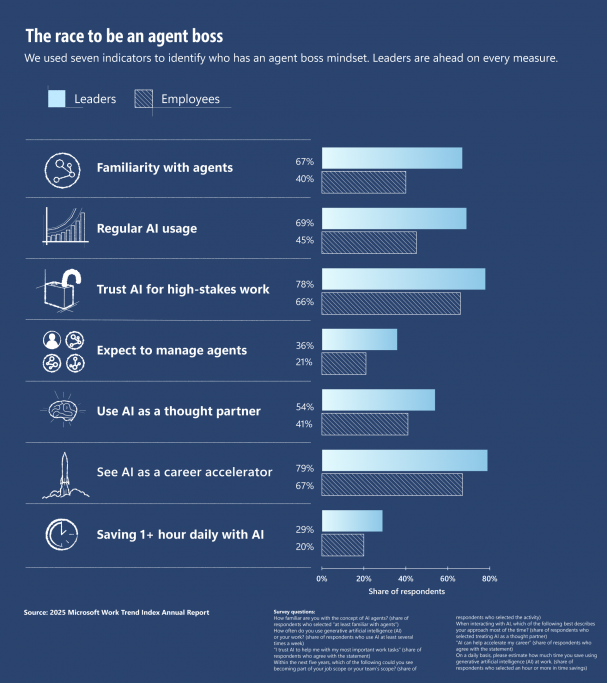
We see the journey to the Frontier Firm playing out in three phases. First, AI acts as an assistant, removing the drudgery of work and helping people do the same work better and faster. In phase 2, agents join teams as “digital colleagues,” taking on specific tasks at human direction—for instance, a researcher agent creating a go-to-market plan. These agents equip employees with new skills that help scale their impact—freeing them to do new and more valuable work. In phase 3, humans set direction for agents that run entire business processes and workflows, checking in as needed.
Many vendors would like to see this as the logical endpoint of the teammate metaphor. Not just working alongside AI, but supervising it. Which raises an interesting question: if the AI teammate needs a boss, is it really a teammate or just a very sophisticated direct report?
The next few years will likely determine whether AI teammate becomes as embedded in corporate vocabulary as “cloud computing” or “agile methodology.” Either way, the phenomenon tells us something important about this moment in tech history. We’re still figuring out how to talk about machines that might be genuinely good at their jobs because we haven’t quite figured out what that means for ours.
For now, the anthropomorphized AI teammate and AI coworker are here, ready to join your standup, analyze your workflows, and occasionally tell you what to do. Whether you accept that help or long for the simpler days of asking Rachel Stephens to fix your Excel is entirely up to you.
Just don’t expect it to bring bagels.
Disclaimer: Google, Microsoft, GitHub, and Atlassian are RedMonk clients.