For decades, Switzerland has been presented as the European exception. While much of Europe confronted ageing populations, stagnant labour markets, and weak demographic growth, Switzerland expanded. Its population rose rapidly, its cities densified, and its economy appeared resilient.
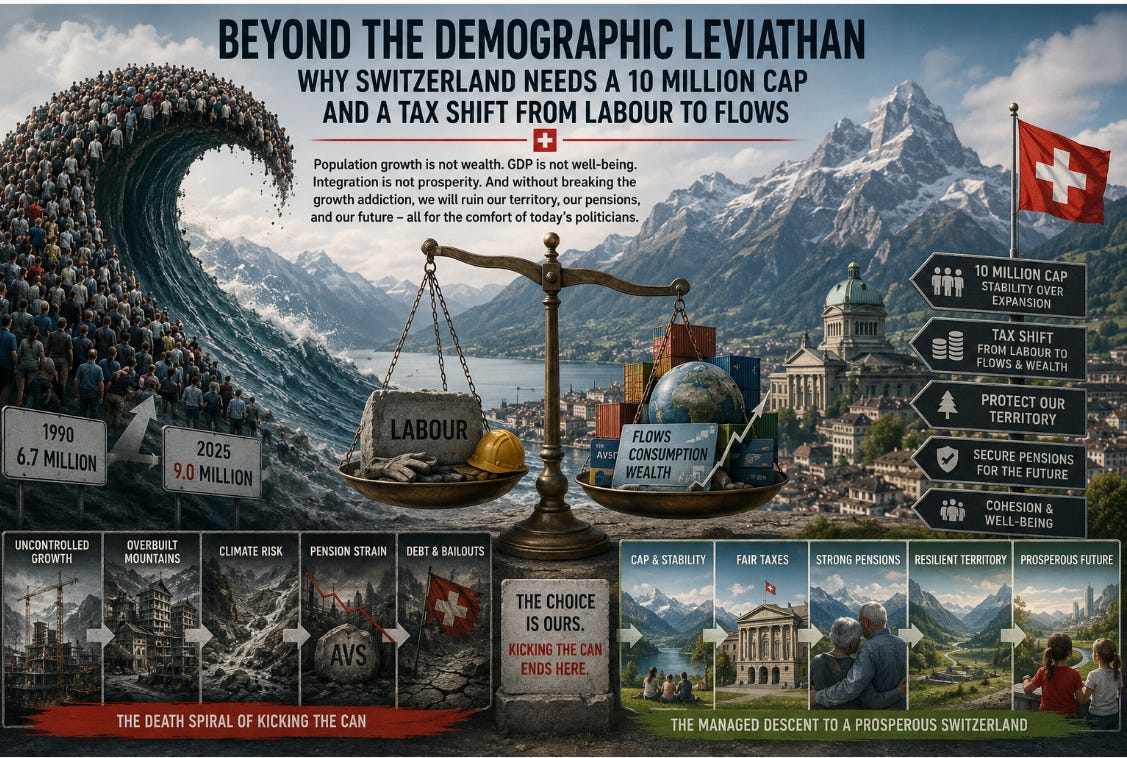
Between 1990 and 2025, Switzerland’s population increased from approximately 6.7 million to nearly 9 million inhabitants — an increase of more than one third. Over the same period, the European Union grew by less than 8 percent. Much of the Swiss increase was driven by immigration. The foreign-born share of the population rose from under one fifth to roughly one third.
The dominant political narrative interpreted this development as an unequivocal success. Population growth was assumed to support tax revenues, stabilise pensions, increase dynamism, and compensate for demographic ageing. More residents implied more economic activity; more economic activity implied prosperity.
Yet the evidence is considerably less reassuring.
Despite one of the highest rates of immigration in Europe and one of the OECD’s most successful records of labour-market integration, Swiss GDP per capita grew only modestly over the last three decades, roughly in line with — and in some periods below — broader European averages. Switzerland became larger, but not proportionally richer on a per-capita basis.
This distinction matters. Extensive growth — expanding output by increasing the number of people, buildings, and transactions — is fundamentally different from intensive growth, which raises productivity, technological sophistication, and per-capita welfare.
The Swiss model has relied heavily on the former while assuming it would automatically generate the latter.
This article advances three interrelated arguments.
First, prolonged demographic expansion in a geographically constrained alpine state generates mounting forms of capital dilution: pressure on infrastructure, housing, public services, territorial resilience, and environmental systems.
Second, Switzerland’s current fiscal and pension architecture remains structurally dependent on continued population growth, creating a dangerous political incentive to postpone reform through immigration and real-estate expansion.
Third, Switzerland requires a strategic transition toward demographic stabilisation, including a long-term population cap near 10 million permanent residents and a fiscal shift away from labour taxation toward consumption, financial flows, and accumulated wealth.
The argument is not anti-immigration in a cultural sense, nor does it deny the economic contribution of migrants. On the contrary, Switzerland has integrated immigrants more successfully than almost any advanced economy. The problem is structural rather than cultural: integration alone does not solve the deeper arithmetic of ageing, territorial limits, climate exposure, and capital dilution.
The central question is therefore not whether immigration can support growth in the short term. It clearly can. The question is whether perpetual demographic expansion constitutes a sustainable long-term strategy for a small alpine federation confronting climate instability, ageing infrastructure, pension stress, and finite territory.
The evidence increasingly suggests that it does not.
Between 1990 and 2025, Switzerland experienced one of the fastest demographic expansions in Europe. The increase was driven overwhelmingly by migration rather than natural growth.
Conventional economic reasoning interprets this trajectory positively. A larger workforce expands aggregate GDP, increases consumption, and enlarges the tax base. However, aggregate growth metrics obscure a more important question: whether living standards, productivity, and social resilience improved proportionally.
Measured in per-capita terms, the answer is ambiguous at best.
Over the same period in which Switzerland absorbed population growth at several times the European average, per-capita GDP growth remained relatively modest. The country avoided demographic stagnation, but it did not substantially outperform neighbouring economies in per-person prosperity.
This observation aligns with a broader empirical finding in economic literature: there is no automatic or universal relationship between population growth and per-capita wealth creation.
Population growth expands the denominator of economic systems as much as the numerator. Every additional resident requires housing, transport infrastructure, energy capacity, schools, healthcare systems, administrative services, and environmental adaptation. If investment in productive and public capital fails to outpace demographic growth, capital per capita declines.
This is the central mechanism of capital dilution.
In practical terms, a rapidly expanding population obliges society to devote an increasing share of investment merely to maintaining existing standards rather than improving them. Resources that might otherwise finance technological upgrading, productivity-enhancing infrastructure, or climate adaptation are redirected toward absorbing demographic expansion itself.
Switzerland increasingly exhibits precisely these symptoms.
Housing prices have surged far beyond wage growth in major metropolitan regions. Infrastructure maintenance costs continue to rise. Alpine transport networks face escalating climate-related stress. Public investment is increasingly defensive rather than transformative.
The issue is not that immigrants fail to contribute economically. In fact, they contribute substantially.
OECD indicators consistently rank Switzerland among the strongest performers in immigrant labour-market integration. Employment rates are high, educational attainment is comparatively strong, and language acquisition outcomes exceed those of many peer countries.
Yet this success raises a more difficult question.
If Switzerland has combined large-scale immigration with highly effective integration, why has this not translated into markedly superior per-capita prosperity growth?
The answer is that integration solves a distributional problem — enabling migrants to participate successfully within the existing economy — but it does not automatically solve the productivity frontier problem.
Nor does it eliminate the territorial and infrastructural costs associated with perpetual demographic expansion.
An alpine country possesses physical limits. Roads, valleys, flood defences, housing markets, and transport corridors cannot expand indefinitely without imposing ecological and financial costs.
At a certain point, demographic expansion ceases to function primarily as a source of dynamism and instead becomes a mechanism for postponing structural reform.
In conclusion, regarding the proposal for a 10-million population cap, it should be viewed not as an ideological constraint, but as the political expression of a statistical reality. To understand this dynamic, one only needs to cross-reference the projections of the Swiss Federal Statistical Office (FSO) with those of Eurostat. Current Swiss growth relies on a fragile premise: an inexhaustible reservoir of European labor. However, European data tells a different story. The European Union has already seen its working-age population (ages 15–64) begin to contract. By 2050, the EU is projected to lose tens of millions of active workers due to declining birth rates and the aging of the baby-boomer generation.
Countries like Germany and Italy—our primary sources of labor—will face massive internal shortages and will do everything they can to retain their workforce. Swiss economic appeal will inevitably collide with the drying up of this continental reservoir. The 10-million threshold is therefore not a sharp rupture or a wall being erected, but the pragmatic anticipation of an inevitable plateau. This target provides the essential planning foundation needed to transition from a model of migration-driven hyper-growth to the sustainable management of our infrastructure, in a Europe where demographic expansion is already a thing of the past.
The Swiss debate on demography often treats population growth as an abstract economic variable detached from geography. This is a profound analytical error.
Switzerland is not an unlimited territorial space. It is a highly developed alpine federation whose infrastructure, settlement patterns, and economic geography are increasingly exposed to climate-related instability.
Permafrost thaw, glacial retreat, slope instability, intensified precipitation, and seasonal water stress are no longer speculative future risks. They are measurable processes already affecting transport systems, tourism infrastructure, hydrological management, and insurance exposure.
Under such conditions, demographic policy cannot be separated from territorial resilience.
A larger permanent population requires more housing, more infrastructure, more energy consumption, and more construction in vulnerable regions. Yet climate adaptation simultaneously increases the maintenance burden on existing infrastructure.
This creates a structural tension.
As demographic growth slows in the future — an outcome that even optimistic projections increasingly acknowledge — Switzerland will face rising adaptation costs with a relatively smaller workforce and a progressively older population.
The consequences extend beyond public finance.
Swiss pension funds and cantonal banking systems remain deeply exposed to real estate valuations, including alpine and tourism-linked property markets. If climate risk progressively erodes the value of vulnerable assets while demographic growth slows, substantial portions of the current asset structure may become impaired.
The result is a potentially dangerous feedback loop:
demographic ageing increases pension stress;
pension systems rely on continued growth and rising property values;
climate instability undermines vulnerable territorial assets;
falling asset values weaken pension funds and banks;
governments compensate through higher taxation on a shrinking workforce.
This is not a speculative dystopia. It is the logical interaction of demography, territorial exposure, and fiscal dependency.
A society that assumes endless demographic expansion as the solution to pension sustainability risks amplifying the very vulnerabilities that later destabilise the system.
In this context, a long-term population stabilisation target is no longer politically unthinkable; it is strategically necessary.
A population cap near 10 million permanent residents should not be understood as a nationalist slogan or an anti-migrant instrument. It should instead be interpreted as a macroeconomic and territorial planning mechanism.
Its primary purpose is to force institutional adaptation.
Without a demographic ceiling, virtually every major actor in the Swiss system retains incentives to defer reform:
pension systems assume future contributors;
real-estate markets assume endless housing demand;
cantonal planning assumes continued expansion;
banks assume perpetual asset appreciation;
political leaders postpone difficult structural decisions.
A stabilisation target changes the logic of the system.
It compels Switzerland to shift from an expansionary model toward a productivity-oriented model.
It creates a predictable denominator for infrastructure planning.
It enables more rational climate adaptation strategies.
And it forces a direct confrontation with pension sustainability rather than relying indefinitely on demographic substitution.
Critics will object that such a cap risks labour shortages.
However, this objection confuses permanent demographic expansion with labour-market flexibility.
Switzerland already relies extensively on cross-border commuters and temporary labour arrangements. A stabilisation strategy for permanent residents does not preclude targeted labour mobility. What it rejects is the assumption that permanent population growth must continue indefinitely in order to sustain economic systems designed under very different demographic conditions.
Others will argue that economic growth itself depends on demographic expansion.
Yet advanced economies increasingly demonstrate that prosperity depends less on population volume than on productivity, innovation, automation, institutional quality, and capital efficiency.
The relevant question for Switzerland is therefore not whether it can become larger.
It already has.
The question is whether it can remain prosperous, resilient, and territorially stable under conditions of demographic maturity and climate stress.
The demographic challenge confronting Switzerland is intensified by the structure of its fiscal system.
A significant share of pension financing and social insurance remains linked directly to labour income. This model functions relatively well in expanding societies with broad working-age populations. It becomes progressively unstable in ageing societies with slower workforce growth.
The response of many European states has been implicit rather than explicit: maintain demographic expansion through immigration in order to preserve contribution ratios.
This strategy postpones adjustment but does not eliminate it.
Over time, each new cohort also ages, generating renewed pension liabilities and renewed pressure for further expansion.
The result resembles a self-reinforcing cycle in which demographic growth becomes necessary not because it creates lasting prosperity, but because the fiscal architecture itself depends upon constant enlargement.
Switzerland therefore requires a gradual but decisive fiscal transition away from excessive reliance on labour taxation.
Several reforms deserve serious consideration.
First, part of pension financing should shift from payroll contributions toward broader consumption taxation. A moderate increase in VAT combined with reduced labour taxes would broaden the financing base to include retirees, tourists, and capital-supported consumption while reducing the burden on labour itself.
Second, Switzerland should explore low-rate taxation of large-scale financial flows and cross-border transactions. Even extremely small levies on high-volume financial activity could generate substantial revenues with limited distortion if designed efficiently.
Third, modest federal taxation of very large concentrations of wealth should enter the debate, particularly given the long-term concentration of assets in ageing societies.
Finally, environmental externalities should increasingly finance adaptation itself. Carbon-intensive consumption and high-impact transport activities impose real future costs that current fiscal systems often fail to internalise adequately.
The objective of these reforms is not punitive redistribution.
It is systemic resilience.
A society with slower demographic growth must learn to finance itself through productivity, accumulated capital, and economic activity rather than through perpetual increases in the number of contributors.
The core problem confronting Switzerland is not demographic decline alone.
It is dependency on growth.
For decades, political systems have relied on expansion — more residents, more construction, more consumption, more real-estate appreciation — as a substitute for difficult structural adjustment.
This model generated short-term stability but also increasing fragility.
The consequence is a dangerous interaction between several mutually reinforcing pressures:
ageing demographics;
pension dependency on workforce expansion;
climate vulnerability in alpine territory;
real-estate exposure in banking and pension systems;
rising infrastructure maintenance costs;
declining political willingness to undertake structural reform.
Without intervention, these pressures may produce a gradual erosion of territorial resilience and fiscal sustainability.
A managed stabilisation strategy offers a different trajectory.
Under such a model:
population growth slows and stabilises;
fiscal systems diversify beyond labour taxation;
climate adaptation becomes central to territorial planning;
speculative overbuilding declines;
productivity and technological upgrading become primary sources of growth;
long-term infrastructure planning becomes more predictable.
This transition would not eliminate all demographic challenges. No advanced society will avoid the consequences of ageing entirely.
But it would replace reactive expansion with strategic adaptation.
The alternative is to continue treating demographic growth as a universal remedy while the underlying structural vulnerabilities intensify.
Switzerland is entering a demographic and climatic transition that can no longer be managed through assumptions inherited from the late twentieth century.
The central illusion of the current model is the belief that perpetual demographic expansion can indefinitely sustain pensions, public finance, territorial development, and asset values.
It cannot.
Population growth may increase aggregate GDP, but aggregate expansion alone does not guarantee higher per-capita prosperity, stronger productivity, or greater resilience.
In a geographically constrained alpine state confronting climate instability, the costs of unmanaged expansion accumulate over time.
The choice facing Switzerland is therefore not between growth and stagnation.
It is between two different models of adaptation.
One model continues to rely on demographic enlargement, real-estate expansion, and deferred reform. The other accepts demographic maturity and reorganises public finance, territorial planning, and economic strategy around stability, productivity, and resilience.
A population stabilisation target near 10 million permanent residents, combined with a gradual fiscal shift away from labour taxation and toward broader economic flows, represents one possible framework for such a transition.
Whether policymakers adopt this framework is ultimately a political question.
But the underlying constraints are no longer theoretical.
Demographic ageing is measurable. Climate instability is measurable. Territorial exposure is measurable.
What remains uncertain is not whether Switzerland must adapt, but whether it will choose to adapt deliberately — or wait until adaptation is imposed by crisis.
This article builds upon earlier work on demographic transition, welfare sustainability, and climate-linked territorial risk (https://substack.com/@rdellatorre/p-196400152 ). It also draws conceptually on recent scenario modelling by the Swiss Federal Institute for Forest, Snow and Landscape Research (WSL) concerning possible Swiss futures to 2100 (https://www.nccs.admin.ch/nccs/en/home/climate-change-and-impacts/nccs-impacts/socioeconomic-pathways.html)
The interpretation presented here — particularly regarding capital dilution, demographic dependency, and the interaction between pension systems and territorial climate risk — remains the author’s own.
Switzerland’s population continues to rise. The more important question is whether its institutional capacity and political imagination are rising with it.