The late summer of 1997, I matriculated into the only public art school in the United States: Massachusetts College of Art. I was a depressed and anxious teenager. I had applied to exactly one school, and if I didn’t get in, I simply wasn’t going to college.
I got in.
My application strategy: apply as a sculpture major (because who wants to major in sculpture??!!) and then switch to Graphic Design in year two. The real vision.
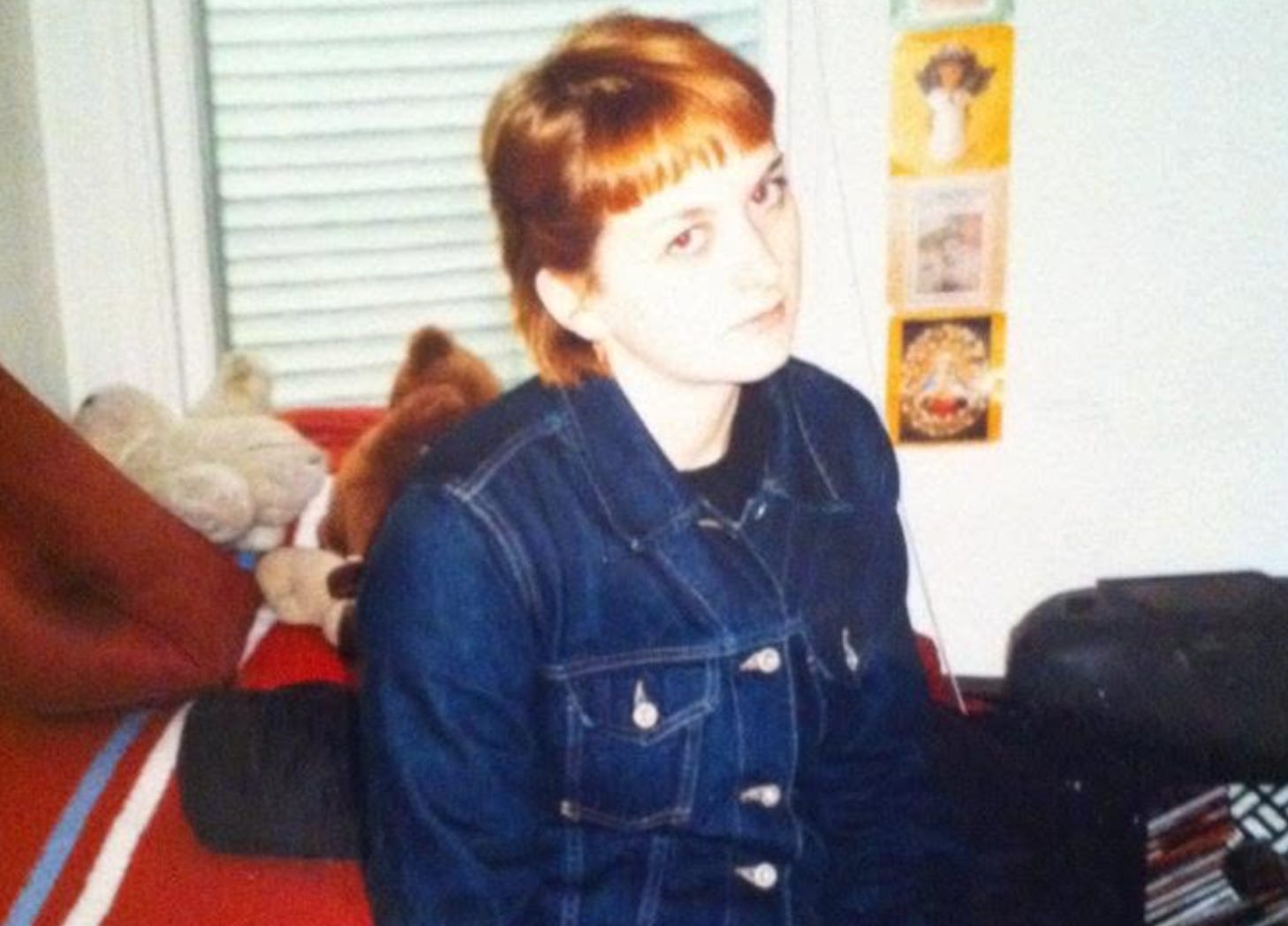
I never made it to year two. I barely made it through year one. I was rebelling a bit late, and too depressed, unengaged, and busy partying with bike couriers to really focus on color theory. I did love my sculpture class, though—ironically.
It wasn’t that I didn’t like school. As a kid, studying was everything to me. But the newfound freedom of a very big city was all I wanted at that moment.
So I dropped out and got a job at an iconic ice cream shop in Harvard Square. Toscanini’s. I worked alongside other dropouts, students, and miscellaneous freaks. It was fun. We listened to Elliott Smith starting at 6am. We served coffee, too.
Toscanini’s had an outpost on MIT’s campus. As scoopers, we rotated between locations—Harvard Square, Central Square, and the final stop: MIT. The dreaded Saturday shift meant making milkshakes for about 20 people in a run club. The coach believed in post-run milkshakes for health reasons. It was a slog. No tips.
Anyway—I finally found my groove again around age 23, when I entered (with focus and determination) another art school on the North Shore to study graphic design. I graduated at 25—ancient, in my mind.
In between, I briefly attended UMass Boston to study literature. My parents lured me in with the promise of my grandmother’s car. It worked—until I dropped out again. I kept the car.
What’s missing in all of this is the fantasy I’d had since childhood about college: four blissful years of reading and writing in big libraries, crisp leaves, grassy lawns. None of that materialized. The regret I feel about my education—my mental health at the time, the downward spiral—is a loop I haven’t quite been able to break.
I wish I could go back and do it properly. Four tight years in a row. Lifelong friends. A network. Reunions. Alumni events.
So now, I turn to DIY education to satisfy that part of me. Although—I’m romanticizing. I have a long list of what I don’t like about college, too. Not to mention the cost, which is the real issue in the U.S.
So: I present to you an alternative. Free courses from MIT. Curated by me—classes I want to take, and maybe will one day. A while back, I started a film course that sent me all the way back to the earliest films—Nanook of the North, Buster Keaton.
For anyone else yearning for studies and libraries—this is our chance to cosplay academic summer school.
Here’s a list of 78 courses that were of interest to me. There are hundreds of more course options at MIT OpenCourseWare. Please visit, if you want to go deeper.
The Nature of Creativity
Intro to philosophical, psychological, and cognitive theories of what creativity is across human life. Taught Fall 2005Global Africa: Creative Cultures
Examines African and diasporic cultural production—literary, musical, visual, scientific—through anthropology and social theory. Taught Spring 2018Feeling and Imagination in Art, Science, and Technology
Seminar on how feeling and imagination shape creativity in art, science, and tech through philosophy, psychology, and literature. Taught Spring 2004
Writing Workshop
A creative writing workshop designed for overloaded MIT students to carve out space for literary expression. Taught Spring 2008Writing and Experience: Reading and Writing Autobiography
Workshop focused on reading autobiographical texts and writing your own life narratives. Taught Spring 2014Writing and Reading Poems
Introduces the craft of poetry through close reading and the writing of original poems. Taught Fall 2006Writing and Rhetoric: Designing Meaning
Teaches rhetorical strategies for shaping meaning in written communication for different audiences and contexts. Taught Fall 2016Writing Science Fiction
Studio course on reading and writing science fiction, with attention to world-building and speculative ideas. Taught Spring 2016Writing About Race: Narratives of Multiraciality
Explores multiracial identity through reading and crafting narratives about race and self. Taught Fall 2008Genre Fiction Workshop
Workshop on writing in popular genres—mystery, fantasy, SF—while studying conventions and reader expectations. Taught Spring 2013Writing and Reading the Essay
Focuses on the literary essay as a form, combining close reading with essay-writing practice. Taught Fall 2005Writing and Experience: Exploring Self in Society
Uses personal writing to investigate how individual identity is formed within social structures. Taught Spring 2004
Photography and Truth
Anthropological look at photography as a technology of truth, memory, and representation. Taught Spring 2008Introduction to the Visual Arts
Studio and lecture course introducing major ideas, media, and practices in contemporary visual art. Taught Spring 2007Art of Color
Explores color theory and perception through studio exercises and discussion.
Taught Spring 2005Modern Art and Mass Culture
Studies how modern art interacts with mass culture, advertising, and everyday visual life. Taught Spring 2012Advanced Projects in the Visual Arts: Personal Narrative
Advanced studio focusing on personal narrative as a driving force in visual art projects. Taught Spring 2004Social Visualization
Investigates how data and social phenomena can be visualized, with projects in information design. Taught Fall 2004Philosophy of Film
Philosophical analysis of film as an art form, medium of representation, and vehicle for ideas. Taught Fall 2004Art Since 1940
Historical survey of major movements, artists, and debates in art from 1940 onward. Taught Fall 2010Understanding Television
Explores television as a cultural form, analyzing genres, audiences, and industrial contexts. Taught Spring 2003The Film Experience
Introduces film analysis through close viewing, criticism, and historical context. Taught Fall 2013Indistinguishable From… Magic as Interface, Technology, and Tradition
Looks at interfaces and technologies as “magic,” blending design, cultural history, and speculative thinking. Taught Spring 2015Digital Typography
Studies typographic design in digital environments, from letterforms to screen-based layout. Taught Fall 1997
Gender & Media: Collaborations in Feminism and Technology
Seminar on feminist approaches to media and tech, often involving collaborative projects. Taught Spring 2016Screen Women: Body Narratives in Popular American Film
Analyzes representations of women’s bodies and narratives in mainstream American cinema. Taught Spring 2014Gender and Technology
Explores how gender and technology intersect in design, labor, and everyday life. Taught Spring 2013Gender, Race, and the Complexities of Science and Technology: A Problem-Based Learning Experiment
Uses case-based learning to examine how gender and race shape science and tech institutions. Taught Spring 2009Traditions in American Concert Dance: Gender and Autobiography
Studies American concert dance traditions through gender and autobiographical performance. Taught Spring 2008Gender, Race, and the Construction of the American West
Investigates how gender and race inform myths and histories of the American West. Taught Fall 2014Queer Cinema and Visual Culture
Examines queer representation in film and visual media across different periods and contexts. Taught Fall 2017
Designing Your Life
Uses design thinking to help students plan and iterate on their lives and careers. Taught January IAP 2007Composing Your Life: Exploration of Self through Visual Arts and Writing
Integrates visual art and writing to explore personal identity and life stories.
Taught Spring 2006Ethics in Your Life: Being, Thinking, Doing (or Not?)
Intro ethics course framed around everyday moral choices and ways of living.
Taught Spring 2015The Meaning of Life
Anthropological seminar on how different cultures and people construct meaning in life. Taught Spring 2019Weight Training
Practical course in strength training techniques, programming, and body mechanics. Taught Spring 2006
The Art Museum: History, Theory, Controversy
Explores museums as institutions of display, power, and public culture.
Taught Spring 2014Fans and Fan Cultures
Studies fandoms, participatory culture, and fan practices across media.
Taught Fall 2024Media Literacy in the Age of Deepfakes
Teaches critical media literacy with a focus on synthetic media and misinformation. Taught Spring 2021Cultures of Computing
Anthropological look at computing cultures, from workplaces to hacker communities. Taught Fall 2011Philosophy of Love
Examines philosophical texts and ideas about love, relationships, and value.
Taught Spring 2013Media in Cultural Context
Analyzes how media circulates and shapes culture, with attention to readerships and audiences. Taught in Spring 2007, Fall 2007, Fall 2015
Comedy
Looks at comic literature and theory, tracing how comedy works across genres and periods. Taught Spring 2022At the Limit: Violence in Contemporary Representation
Explores how contemporary media and literature represent violence and its ethics. Taught Fall 2013Bestsellers: Detective Fiction
Studies detective fiction as popular literature, focusing on structure, character, and readership. Taught Fall 2006Bestsellers: The Memoir
Analyzes memoirs that have become bestsellers, with attention to voice and market. Taught Spring 2010Popular Culture and Narrative: Serial Storytelling
Investigates serial narratives in TV, comics, and fiction and how they hook audiences. Taught Spring 2013Introduction to European and Latin American Fiction: Great Books on the Page and on the Screen
Survey of major European and Latin American works in both print and film adaptations. Taught Spring 2017Race and Identity in American Literature: Keepin’ it Real Fake
Looks at race and identity in American texts that blur lines between realism and performance. Taught Spring 2007Medieval Literature: Love, Sex, and Marriage
Explores medieval texts around intimacy, marriage, and social norms.
Taught Spring 2015Foundations of World Culture I: World Civilizations and Texts
Intro to global civilizations through key literary and cultural texts.
Taught Fall 2011The Supernatural in Music, Literature and Culture
Studies how the supernatural appears across artistic and cultural forms.
Taught Fall 2013Bestsellers: Out for the Count
Focuses on bestselling works dealing with crime, counting, and cultural anxieties. Taught Fall 2018American Authors: Autobiography and Memoir
Reads American autobiographical and memoir texts with attention to narrative selves. Taught Fall 2013Media in Cultural Context: Popular Readerships
Examines how different publics read and engage with media and texts.
Taught Fall 2007Popular Narrative: Masterminds
Focuses on narratives about masterminds—criminals, strategists, visionaries—in popular culture. Taught Fall 2004Medieval Literature: Medieval Women Writers
Reads medieval texts authored by women, exploring voice and authority.
Taught Spring 2004Popular Culture and Narrative: Literature, Comics, and Culture
Explores narrative across prose, comics, and popular culture artifacts.
Taught Fall 2010Reading Cookbooks: from The Forme of Cury to The Smitten Kitchen
Treats cookbooks as literary and cultural texts, from medieval recipes to blogs.
Taught Spring 2017Reading Fiction: Dysfunctional Families
Examines contemporary fiction centered on messy family dynamics.
Taught Spring 2007The Science Fiction of Freedom
Uses science fiction texts to think through freedom, constraint, and political imagination. Taught Fall 2024Popular Culture and Narrative: Use and Abuse of the Fairy Tale
Looks at how fairy tales are adapted, subverted, and commercialized in modern culture. Taught Fall 2015
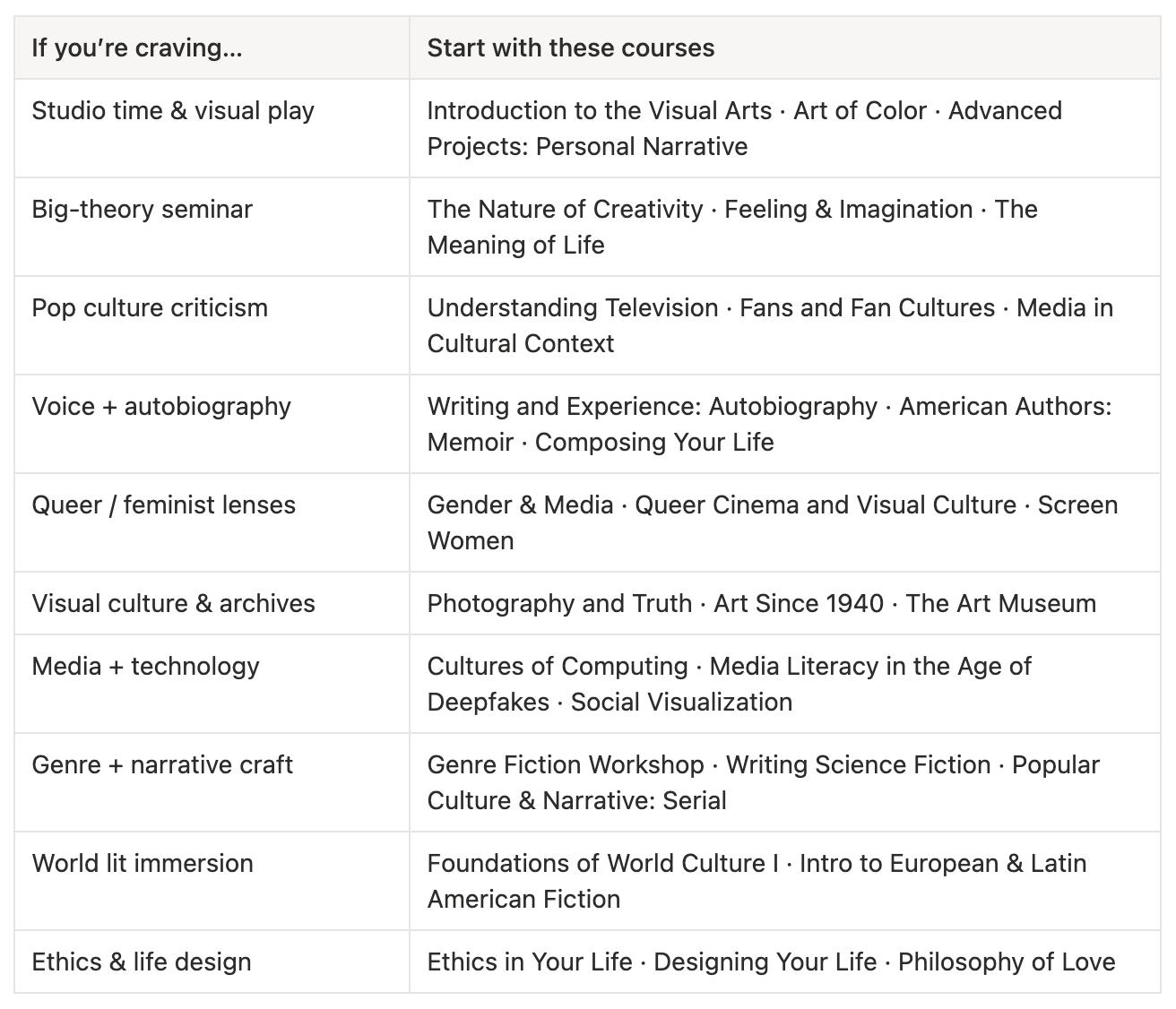
Further reading. If you like this compilation, you might like:


Also let me know if you know any more free higher-education platforms like this.
I’m going to start with Composing Your Life: Exploration of Self through Visual Arts and Writing — so very me-core. Truly.