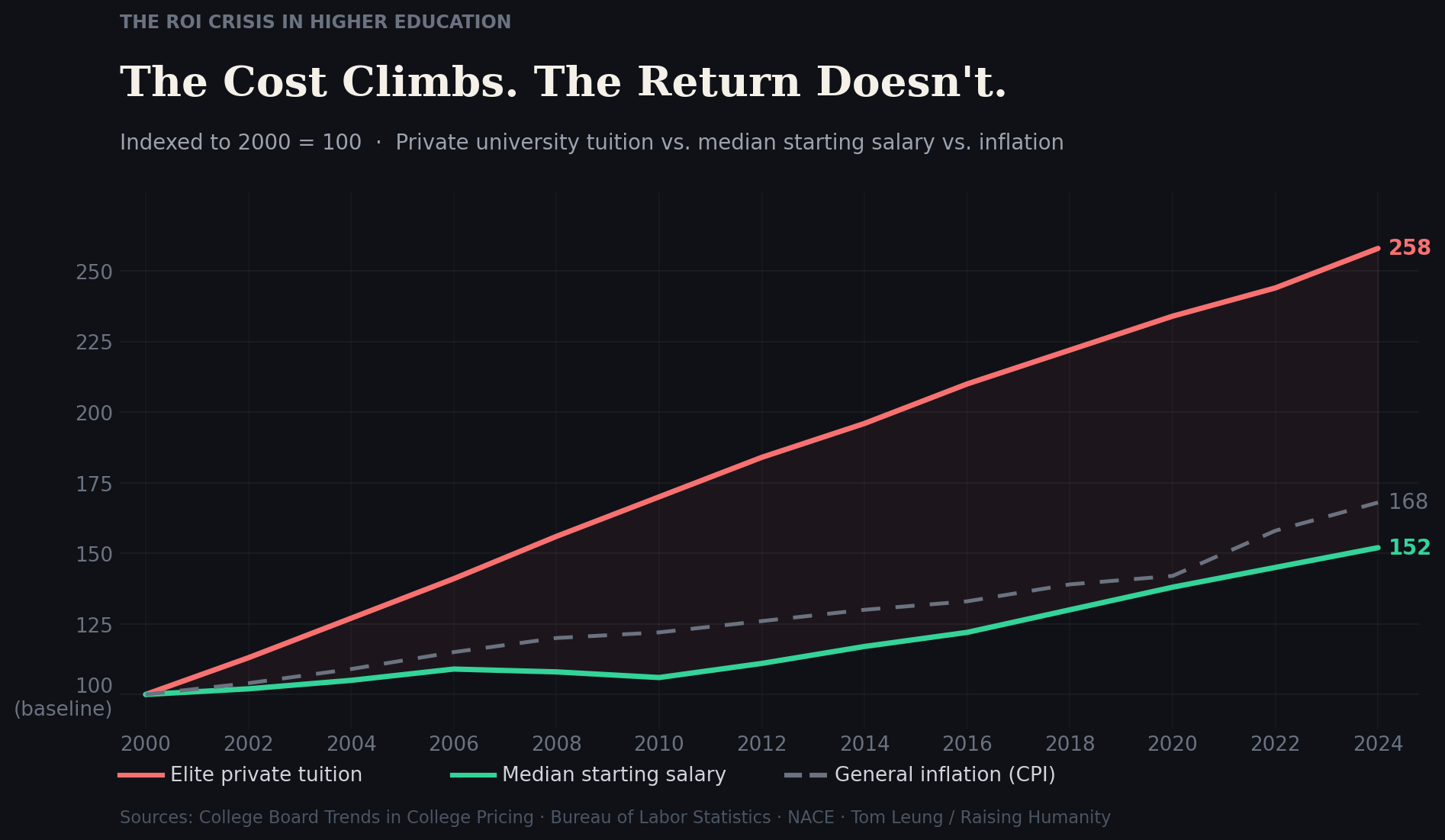
Something that would have been unthinkable a decade ago is now happening more often each year: some middle class families are turning down offers from elite universities and choosing in-state honors programs instead. Not because their student wasn’t admitted to the better-known school. Not because they couldn’t afford it. But because they ran the numbers and the math no longer worked.
I watched this dynamic up close this past year while going through the college admissions process with my son and trading notes with other parents. The conversations happening among families in our community, families with every resource available to them, were different from anything I had heard before. For most of the last century, higher education was treated like healthcare. You didn’t scrutinize the line-by-line invoice. You paid the bill because the alternative, whatever it was, seemed worse. Asking about the cost was like asking for the price of the specials at a fine dining restaurant; you didn’t ask and just convinced yourself it’ll be more but it’ll be worth it. That era is over.
Three things are happening simultaneously, and together they are more destabilizing than any one of them is on its own.
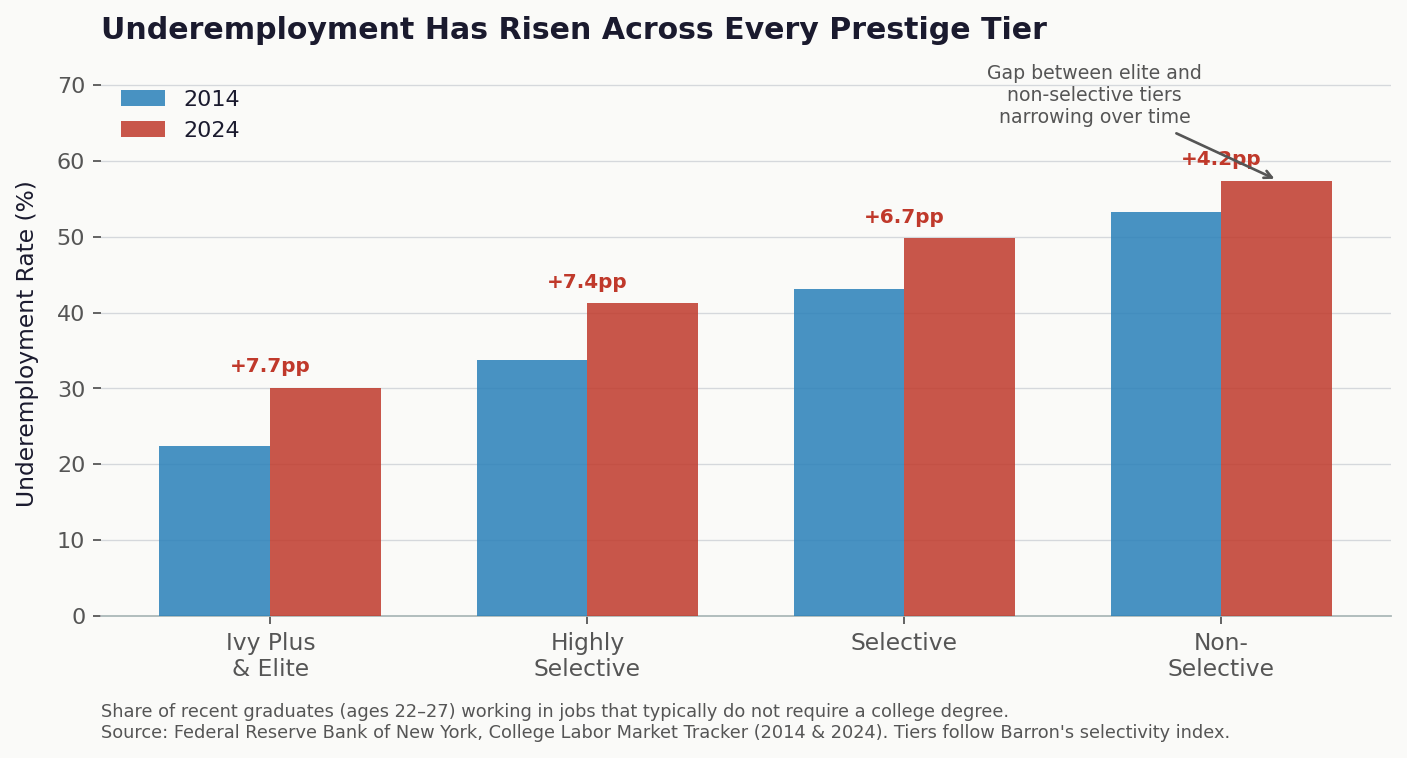
The first is the compression of employment outcomes across the institutional prestige hierarchy. It would have been genuinely shocking, five years ago, to hear about a Stanford CS graduate or a Harvard magna cum laude struggling to land a blue-chip job six months after graduation. That is no longer shocking. It is not yet common but it’s happening. The credential that once reliably converted into lifetime employment and high earnings is losing some of its automatic conversion power, and the gap between ultra-elite, elite, near-elite, and very good is narrowing in ways that discerning families eyeing a potential $400K investment for each kid are starting to notice and price into their decisions.
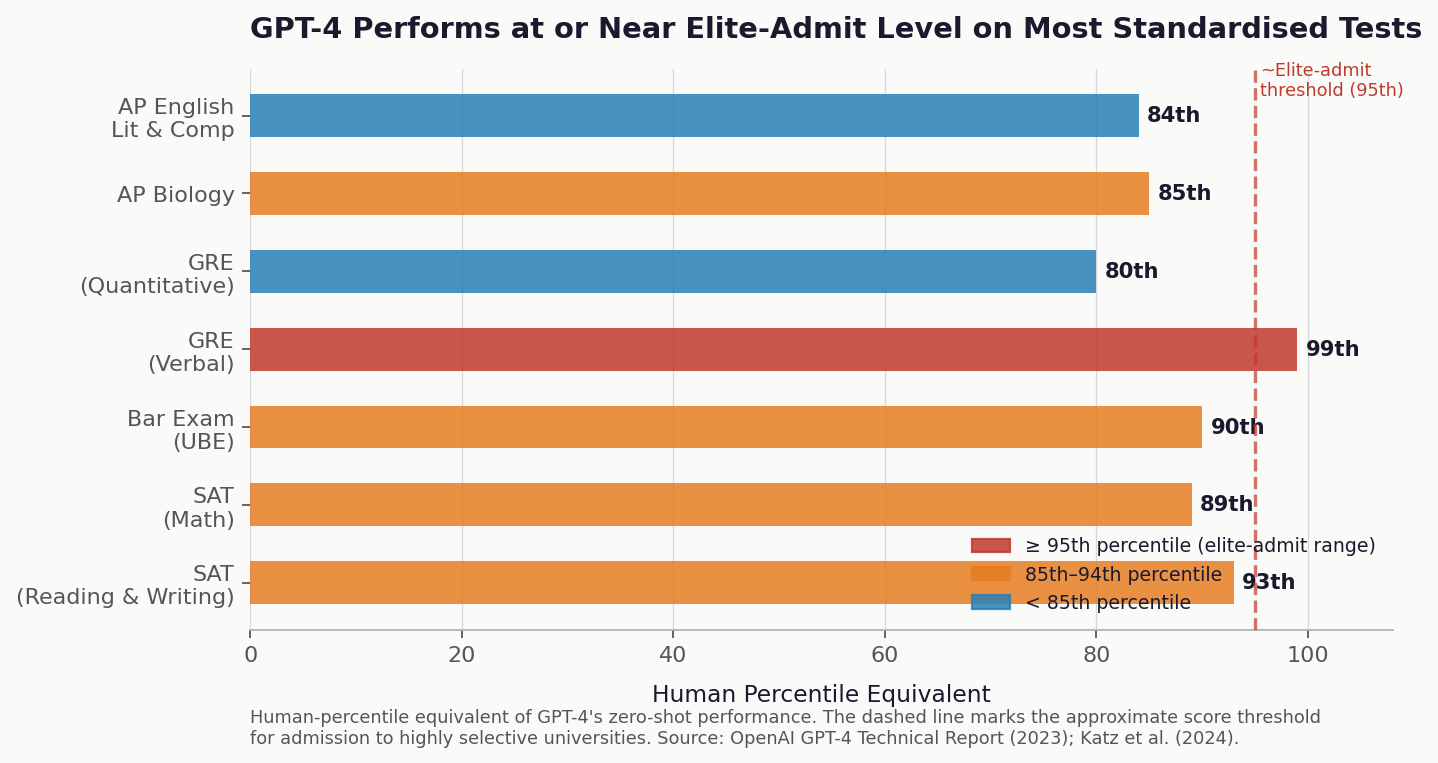
The second is that the competencies elite admissions has historically selected for are precisely the skills that generative AI has made broadly accessible. For decades, high AP scores and SAT results were proxies for the ability to acquire, retain, and synthesize knowledge. Those proxies made sense when those capabilities were scarce. Today, you do not have to be exceptional at analyzing information and connecting the dots entirely in your head to do strong analytical work. You can become a capable writer with an AI editor. The cognitive moat that the admissions process was designed to identify is not gone, but it is shallower than it ever was.
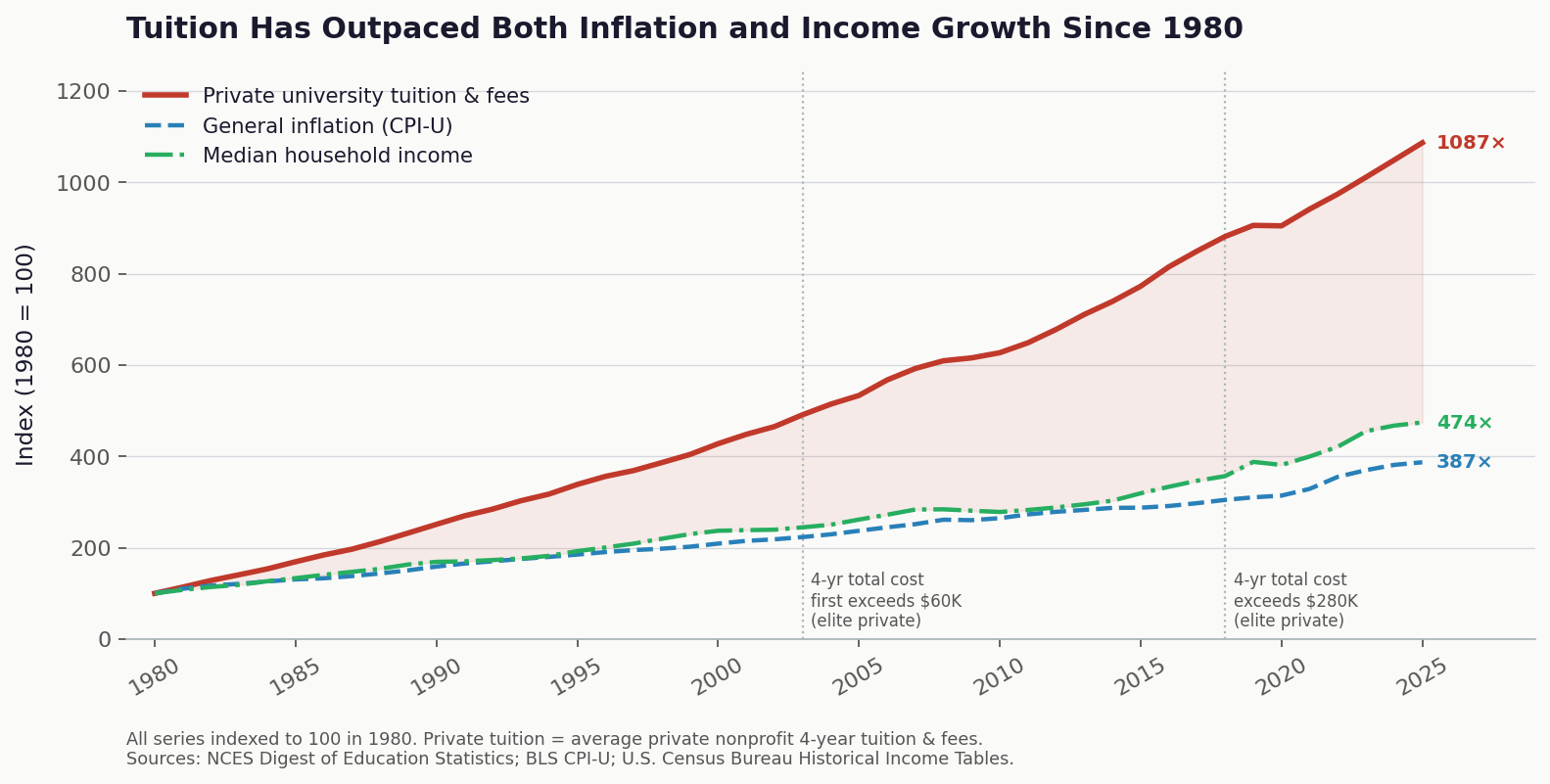
The third is a decades-long inflation in tuition costs that has finally crossed a psychological threshold for middle class families. Families who are ineligible for financial aid (but not so wealthy that cost is irrelevant) are asking a question they never had to ask before: what is the incremental value of Private University B over the in-state honors program? At $400K total, and with employment outcomes compressing and the cognitive credential eroding, a lot of them cannot find a compelling answer.
Add these three forces together and you have a perfect storm. So if I were the president or dean of admissions at an elite institution today, here is how I would rebuild it.
1. Rebalance Admissions: From Academic Performance to Landed Impact
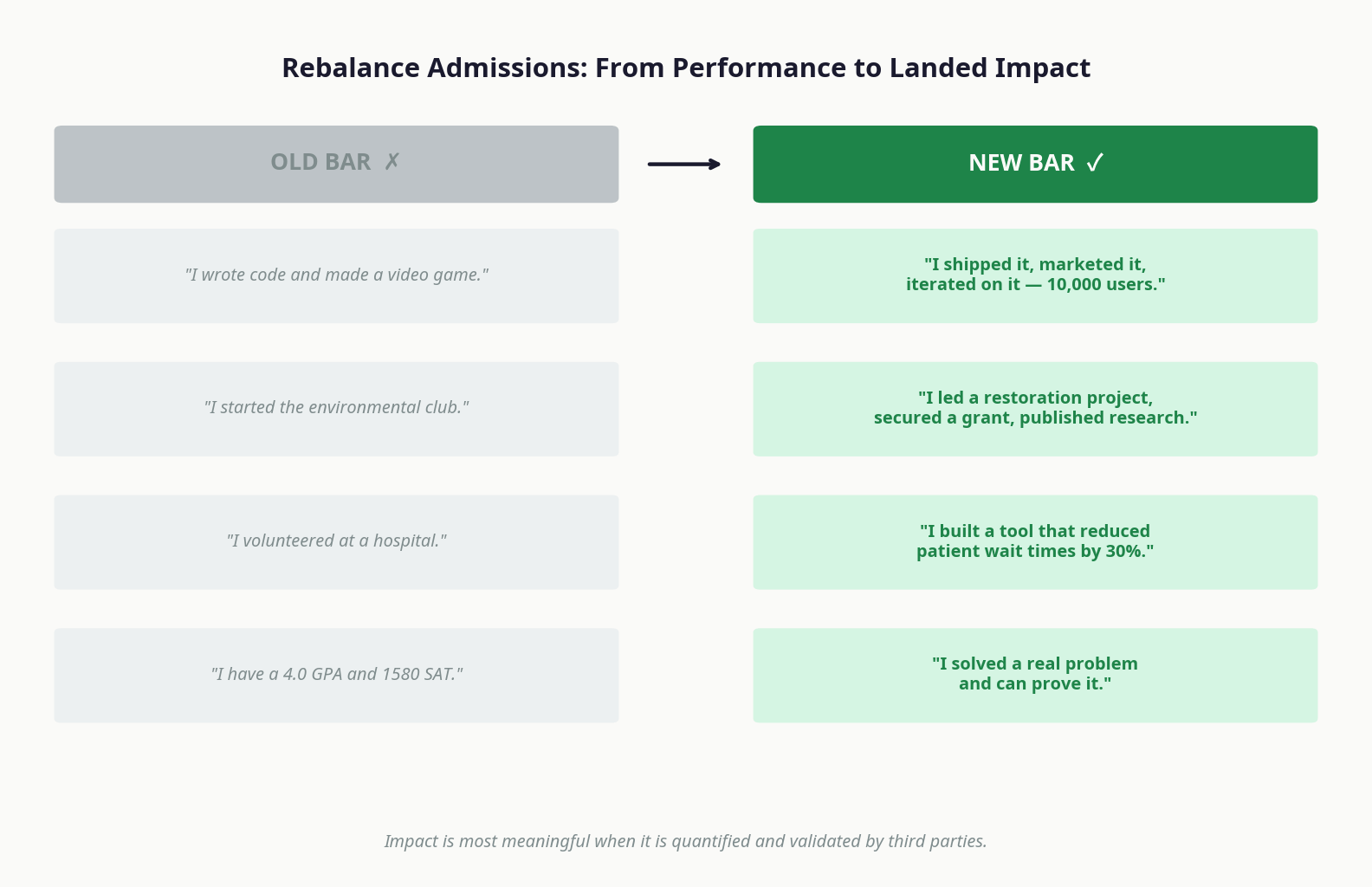
Strong academic ability should remain a baseline expectation. But it should no longer be the primary differentiator. The question I would want the admissions process to answer is different: has this student taken initiative, worked on a complex long-term project, ideally with a team, and delivered measurable, lasting impact?
It is not enough to say “I wrote some code and made a video game.” The bar is: “I wrote some code, made a video game, marketed it, iterated on it, and now it has 10,000 users.”
It is not enough to say “I started the environmental club.” The bar is: “I led a restoration project, secured a third-party grant, published peer-reviewed research, and earned a recommendation from a community leader who worked directly alongside me for over a hundred hours.”
Impact is most meaningful when it is quantified and validated by third parties. Admissions readers can already tell the difference between a manufactured extracurricular and genuine landed impact. If a college gets exceptionally good at finding students who use every tool available, including AI, to solve real problems, their graduates will have high-impact careers. That is the selection signal worth optimizing for.
The common counterargument is that this model advantages wealthy families who can fund these projects. I do not find that persuasive. The truly curious, driven, determined student with a phone and an internet connection has access to the same AI tools, the same research databases, the same distribution platforms as a kid in the most resourced zip code in America. If anything, measuring landed impact rather than polished credentials flattens the playing field.
The student who actually executed a meaningful project in a low-resource environment and can prove it is a more compelling candidate than one who had a college counselor craft a narrative around a club they nominally led. The brilliant, hardworking first-generation student, given the tools that now exist, can run circles around more typical students in highly resourced environments if the measure is actually building and finishing something real.
2. Question the Four-Year Default
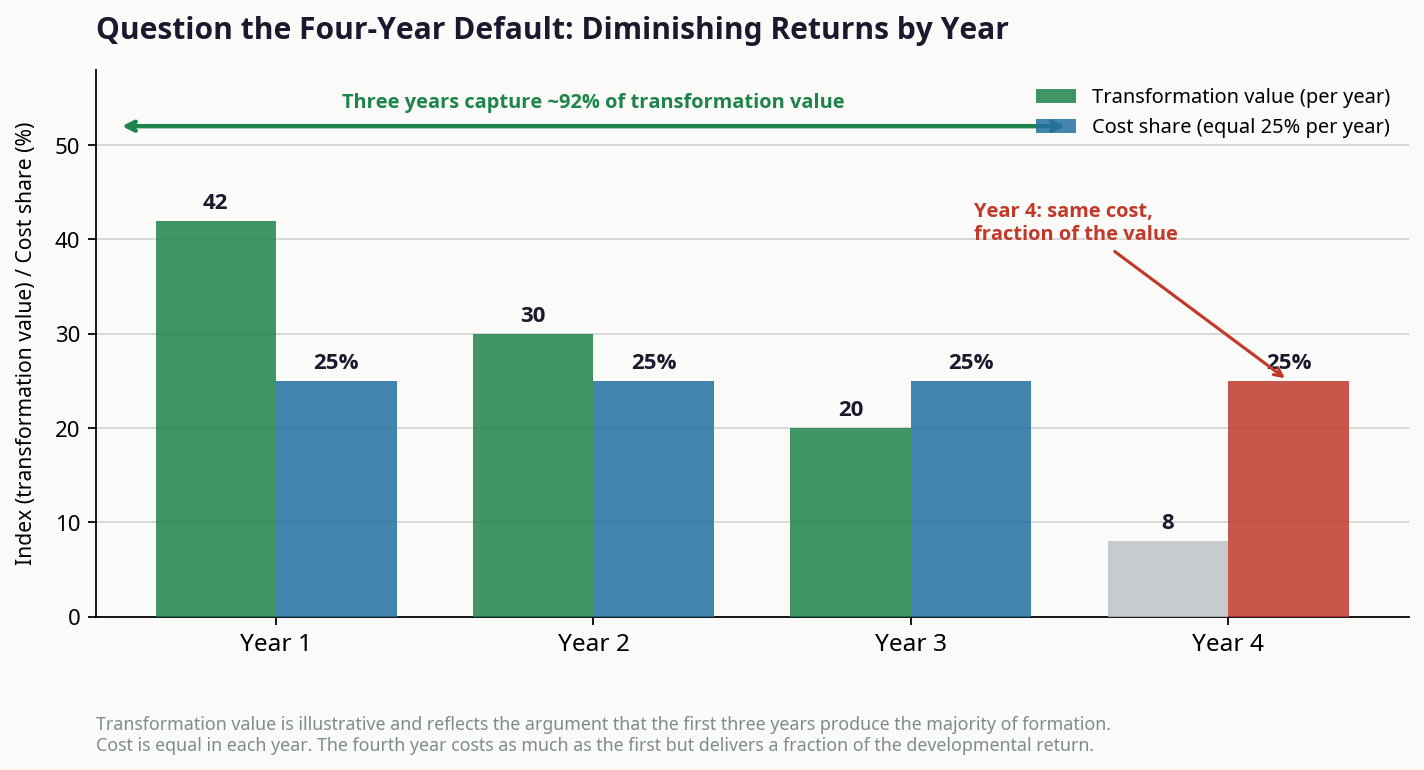
Nobody ever rigorously justified why a degree should take four years. It has always been four years because it has always been four years. Five years? Two years? Three years? The question is rarely asked.
Start from first principles. After high school, if a student is pursuing the next credential, the goal is to leave genuinely more capable and more valuable than they arrived. The right length is an optimization: weighing the cost of each additional year against the incremental formation that year actually produces. By that logic, the most transformative years are almost certainly the first, second, and third. The fourth year is still accretive, but not nearly accretive enough to justify one quarter of a $400K price tag.
Compressing to three years would require real discipline: earlier declaration of major, fewer elective requirements, and a curriculum designed around what actually produces transformation rather than what has always filled the catalog. That discipline, applied honestly, would almost certainly result in a better product for society.
The accreditation question is real but answerable. The 120 credit hour standard for a bachelor’s degree is not a federal law, it is a standard set by regional accrediting bodies, and those bodies can approve redesigned programs. Ensign College launched fully accredited three-year degrees in 2026 by eliminating required electives without touching core or major requirements. Employers recognize the degree as equivalent. The path exists. Elite universities simply have not chosen to walk it.
3. Require a Live Oral Defense for Every Class
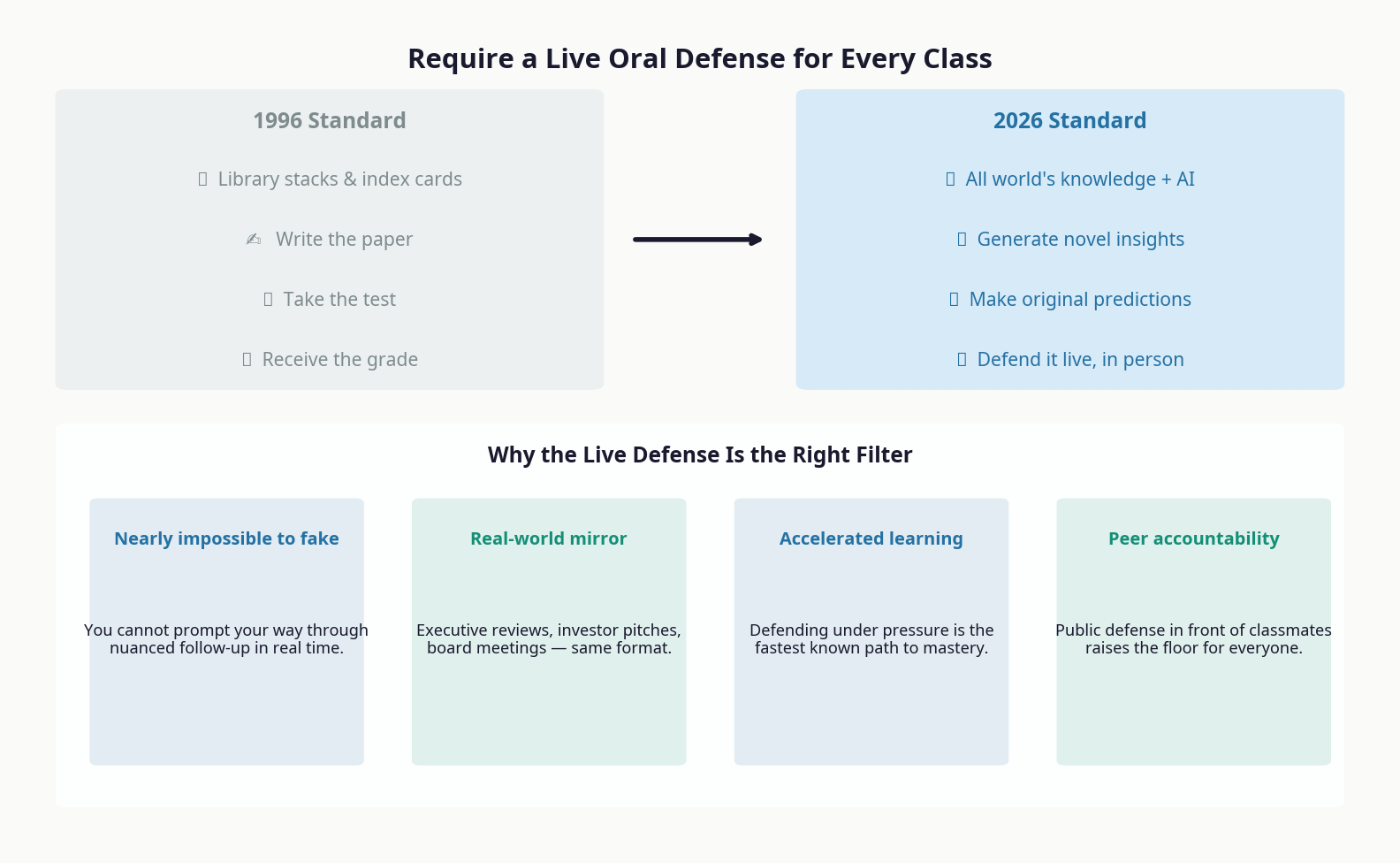
You cannot hold a student in 2026 to the same standard as a student in 1996. The student in 1996 was in the library stacks with dusty books and index cards. The student today has access to all of the world’s knowledge and generative AI tools that can produce a competent paper on modern Chinese economic reform in an afternoon.
The bar for great work has to rise. The new standard should not just be writing the paper nor taking the test. It should be developing original predictions based on the analysis and tracking whether they bear out. It should be generating genuinely novel insights by combining current discourse with publicly available data. And because the baseline is so much higher, the expectation should be work that is publishable for peer review.
How do you prevent this from becoming an AI prompting arms race? You take a page from the oldest playbook: the live, in-person thesis defense, required for every class, not just the capstone. Whatever work you produce must survive a panel that challenges you with nuanced follow-up questions in real time, in front of your peers. If you do not know the material and cannot think on your feet, you will not survive it. This is exactly what happens in executive reviews, state capitols, investor pitches, job interviews, and board meetings in the real world. It is nearly impossible to fake your way through a live defense. It is also, done well, the most accelerated form of learning available.
4. The Three Legs of the Stool
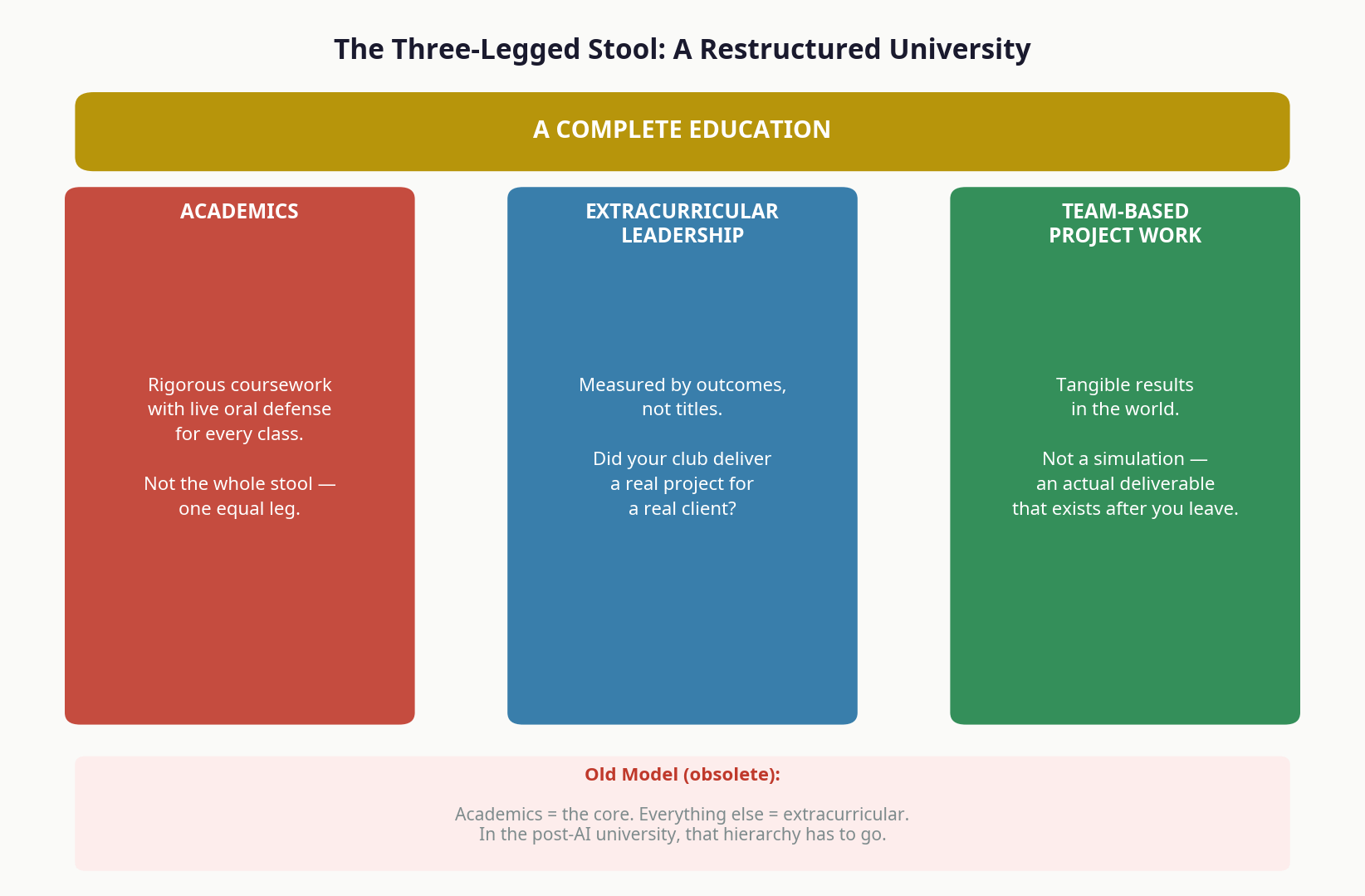
In the traditional university, academics are the core and everything else is extracurricular. That model is obsolete.
In the post-AI university, academics should be one leg of a three-legged stool standing on equal footing with two others: extracurricular leadership measured not by title but by outcomes (if you are president of the consulting club, your club needs to have delivered a real project with real impact for a real client) and team-based project work that produces tangible results in the world. This is not a soft addition to the academic experience. It is a restructuring of what the experience is for.
What This Looks Like
A handful of institutions are already pointing the way. Olin College built its entire model around project-based engineering education and produces graduates who are disproportionately capable relative to its size. The University of Waterloo’s co-op program has long embedded real-world work into the degree in ways that most universities have not matched. MIT has been deepening project-based learning across several of its programs for years. These are not fringe experiments. They are proof of concept.
The likely trajectory is not that a handful of small innovative schools corner this model while large research universities stay frozen. It is the opposite. The project-based, impact-driven model will become the mainstream expectation, and the pure academic experience will invert into what it probably should have been all along: a specialized path for students pursuing research careers and doctoral study, not the default for everyone.
The elite universities that move first will define what elite means for the next generation of students and employers. The ones that wait will find that the families with options have quietly stopped waiting.
As someone who interviews, hires, and does performance reviews and promotions of many elite college alumni, I can tell you that where a person went to school registers briefly and then fades. What I am actually probing for is their biggest accomplishment - why it was hard, what fell apart, how they adapted, whether they got it done. There are plenty of people with elite degrees who struggle to execute and plenty of people from less famous schools who end up running divisions or entire companies. The skills the admissions market selects for overlap with, but are not the same as, the skills that produce high-impact leaders.
If you are a university president or a trustee reading this, you do not need a five-year strategic plan to start. Pick one program. Design a pilot around project-based learning, real-world team impact, and oral defense requirements. Launch it this September. The families making decisions about the class of 2031 are watching. Give them a reason to choose you.
Tom Leung is a Director of Product Management at a major tech company in Silicon Valley, a volunteer instructor at Foothill College, a student advisor at Stanford and UC Berkeley, and a Bowdoin and Harvard alumnus. He is also the father of two boys navigating the education system in real time. Raising Humanity is where he thinks out loud about what it actually takes to prepare the next generation for a world that keeps changing the rules.