The militia-patriot movement in America has embraced radio communications in a big way. Within the past decade, the methods and communications gear have evolved from basic CB or FRS radios, to now include VHF-UHF FM, HF SSB, and HF digital communications. This article focuses on some of the radio gear and channel frequencies utilized by various groups. Radio comms now play an active role in armed confrontations, as part of rump militia training, in outreach, and in organizing groups.

Militant in Oregon 2016 using VHF UHF radio
Photo shows armed militant in Oregon using a VHF-UHF radio. A closer look at the radio display shows the channel frequency is…
The original source of this article is RadioMaster Reports.

Zoom enhanced image: VHF-UHF radio of militant in Oregon 2016 shows Baofeng UV-5R tuned to Channel MURS 3
An enhanced zoom into the above image shows the militant radio is easily recognizable as a Baofeng model UV-5R. There is a blue A/B button on the left side of this radio (obscured by the stock of the assault weapon) that selects which of the 2 displayed channels is active. Showing on the display, the channel name CPOINT2 is at top, and the lower line shows the active channel name MURS 3. The triangular symbol ► at the lower left of the alpha numeric characters indicates the active talking channel: MURS Channel 3 ( 151.9400 MHz FM simplex ), which has become the nationwide primary MURS channel for the militia patriot community. MURS is the longest range VHF radio service that can be legally utilized by anyone without the need for a radio license.
…

Militant militia squad attacks US Capitol government building in Washington DC USA using Baofeng HT radios VHF UHF during the Capitol Riot failed coup d’état on 2021 January 06
Listening To Militia Radio Frequencies
SWL Short Wave Listeners, UTE utility radio listeners, Ham operators, and radio scanner buffs enjoy tuning in to unusual activities on the radio spectrum. When a militia activates its radios for a training exercise or mission in any given area, it is likely to pop up on the receiver of some radio listener. There are thousands of radio aficionados everywhere, they are in every county in America. Many tend to mutually share information about unusual activity and the frequencies they hear it on. This RadioMaster Report includes such information, along with validation imagery, some data gleaned from internet sources, and some captured through real time monitoring by anonymous sources close to the scenes.

Armed militants at Missouri 2015 demonstration with Wouxun KG-UV6D VHF-UHF radios

Oregon 2016 Standoff militant guards use Baofeng VHF UHF HT with long antenna
Militia Frequency List – Short Range
MILITIA PATRIOT CHANNEL FREQUENCY LIST - SHORT RANGE
BAND| CHANNEL |FREQUENCY MHZ| DESCRIPTION
=== | ======= | ============| ======= ======= ======== ====
UHF |HAM U975=| 446.9750 FM | MILITIA HAM SIMPLEX
UHF |HAM U025=| 446.0250 FM | PATRIOT HAM SIMPLEX
UHF |FRS 3 ===| 462.6125 FM | MILITIA PATRIOT FRS PRIMARY
VHF |MURS 3 ==| 151.9400 FM | MILITIA PATRIOT MURS PRIMARY
VHF |HAM 42 ==| 146.4200 FM | PATRIOT MILITIA HAM SIMPLEX
VHF |HAM 485 =| 146.4850 FM | MILITIA HAM SOUTHEASTERN SIMP
VHF |HAM 53 ==| 146.5300 FM | PATRIOT MILITIA HAM SIMPLEX
VHF |HAM 55 ==| 146.5500 FM | PATRIOT HAM SIMPLEX
VHF |HAM 725 =| 146.7250 FM | MILITIA HAM SIMPLEX
HF =|HAM 10 M | 028.3000 USB| MILITIA HAM EASTERN
HF =|HAM 10 M | 028.3050 USB| PATRIOT HAM NATIONWIDE PRIMARY
HF =|HAM 10 M | 028.3100 USB| PATRIOT HAM NATIONWIDE
HF =|HAM 10 M | 028.3200 USB| PATRIOT HAM NATIONWIDE
CB =|CB 3 AM =| 026.9850 AM | MILITIA PATRIOT CB COMMON
CB =|CB 3 USB | 026.9850 USB| MILITIA AM USB OR LSB
CB =|CB 14 AM | 027.1250 AM | MILITIA CB SOUTHEASTERN LOCAL
CB =|CB 32 LSB| 027.3250 LSB| MILITIA CB SSB SOUTHEAST
CB =|CB 36 USB| 027.3650 USB| MILITIA PATRIOT CB
CB =|CB 37 USB| 027.3750 USB| PATRIOT CB SSB NATIONWIDE
The source of this frequency list is RadioMaster Reports.

Militant in the Oregon 2016 standoff show of force displays a tactical vest outfitted with radio and accessories. Baofeng UV-5R tuned to MURS Channel 3 (151.940 MHz) with add-on throat microphone earpiece and big PTT button.
No Big Secret

Militant in southeastern area during 2014 field training exercise with Baofeng UV-5R and earbud

Florida militant radio operator at field exercise in command tent with Icom IC-7000 HF-VHF-UHF and Baofeng radios
MURS channel 3 has become the primary Nationwide Patriot Channel 151.940 MHz FM simplex. It is mainly utilized for initial communications, call up, rendezvous among the III% (threepers), militia members, and between neighboring groups of patriots. It is both a calling channel and interoperability channel. Initial call up may start on this channel and then might change to another mutually agreed upon frequency. This is a legal VHF channel that can be used by anyone without a license, and it has the longest range with typical Baofeng, Zastone, or Wouxun radios when using the longer antennas. Most really serious patriots have graduated from older FRS GMRS radios, but there are still some who are using the older FRS Channel 3 Nationwide Patriot Channel 462.6125 MHz FM simplex for this same purpose. This FRS channel has shorter range, but works with existing Walmart Midland, Cobra, Talkabout, or Uniden bubble pack radios.

Patriot Radio Channels. Frequencies for Freedom.
There are some channels which may be widely published, and other channels which are kept private and not given out. Some radio users in the militia patriot community want to keep their frequencies a big secret. But more knowledgeable radio techs don’t see the need for it, since all VHF-UHF FM transmissions can easily be received with a common scanner or Ham radio. After all, most patriots and militia feel they have nothing to hide; talking on the radio is an exercise in First Amendment and free speech.
Tuning In To Militia Radios

Typical SDR (software defined radio) USB dongle as utilized in the interception of VHF-UHF FM signals such as MURS-FRS-GMRS transmissions, set up on a remote hilltop
A nearby scanner listener simply pushes the seek button and the frequency is displayed on their screen within a few minutes. Using a modern consumer-grade scanner (in the $100 range), the process of intercepting a local transmission frequency is nearly instantaneous (less than 1 second). Spectrum analyzers, band scopes, or scanner seeking features such as Close Call and Signal Stalker (CC/SS), or Signal Sweeper make finding a militia frequency simple. A common handheld frequency counter device such as the Optoelectronics Digital Scout ($500) can grab a VHF/UHF frequency within less than a second. Newer SDR software defined radio dongles (in the less than $50 range) that plug into the USB port of a smartphone, pad, or laptop can display the radio frequency spectrum visually in real time. SDRs combined with software apps provide instantaneous seeking and decoding of HTs for both FM and digital signals, over a wide range of frequencies.
No Secret Channels Either
The SOI standard operating instructions of patriot militia radio operators teaches never to give away secret channels, to keep some compartmentalized or covert frequencies, and to fly under the radar whenever possible. Some channel frequencies are considered public, others are considered private, and others are reserved as part of a rotating pool of tactical channels for missions. Practically speaking, the choice of which channel is utilized is often determined by the type and capability of the lowest common denominator radio owned by a militia team member.

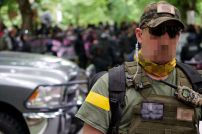
Right wing militant shows off his bubble pack radio outside Oregon statehouse in June 2019 with Midland GXT 1050VP4 Camo FRS GMRS UHF radio on Channel 7

Midland GXT1050VP4 Camo FRS GMRS UHF bubble pack radio popular among militants
Anyone using plain old VHF-UHF FM who thinks they can have their own secret channels or maintain frequency comsec is creating a false sense of security that deceives only themselves. Radios send RF signals in all directions, not just to those who are the intended receivers of the transmission.

Typical handheld beam antenna capable of long range interception and radiolocation of militia patriot tactical radio traffic
Even a small HT can be picked up by a scanner at a safe distance a few miles away. With a handheld beam antenna or a mobile unit parked on a hilltop, a militant VHF UHF tactical net can be monitored up to about 10 or 20 miles away, depending on terrain. Aerial drones or UAV can easily receive tactical militia communications at visually and audibly undetectable distances away from the action.

Stock image of Baofeng model UV-5R, a VHF-UHF handheld transceiver, popular among militia
Baofeng: The Militia Radio
Beginning around 2012, the Baofeng VHF-UHF handheld transceiver (HT) rapidly became the field communication device of choice for militias. This Chinese-made import HT is extremely cheap, at around $25 to $35 per unit. Out of the box, it is capable of being easily field-programmed for Ham, MURS, FRS, GMRS, Marine, and other land-mobile radio services. It transmits and receives FM and FM-narrowband in the frequency range of 136 to 174 MHz on VHF and 400 to 520 MHz on UHF. Militants really go for the low cost, and the wide array of accessories such as: extended battery packs, range-extending antennas, headsets, and speaker-microphones. The ubiquitous nature of the Baofeng model UV-5R (and its variants) can be seen in many of the following images of militant activities.

Militant at Oregon 2015 mine standoff using a Baofeng UV-5R radio with the add-on optional AA cell battery pack
Militia Radios In Action
During the mid-2015 militant mine standoff in Oregon, militia radio techs maintained VHF-UHF radio communications.

Oregon 2015 mine standoff militant radio tech with Baofeng 5R-2. Zastone radios were also utilized.
Both MURS and FRS radios were utilized. MURS Channel 3 and FRS Channel 3 were the calling channels. Several other frequencies were utilized for tactical and control point contacts.
The radio techs programmed radio channel frequencies using Chirp cloning software with a common channel plan that was utilized by those individuals who owned Baofeng and other brands of VHF-UHF radios. MURS channels were favored by those who had capability, due to its longer range, while more common FRS (Channel 3) radios were utilized by those who didn’t have capability for MURS.
Multiple monitoring reports from these and various other militia sites indicate continued use of these channels for interoperability and initial calling purposes. Generally speaking, all FRS and GMRS channels are widely utilized by militia and patriot groups in their tactical and localized activities and during field exercises.

Militia at 2016 Oregon standoff make a show of force with Baofeng radios

Militant in Oregon 2016 using Baofeng UV-5RB with add-on NSKI model NA-771 VHF-UHF antenna to extend the distance
Some of the militants from the mid-2015 Oregon mine standoff action went on to attend protests during December 2015 in eastern Oregon, and then later showed up with their Baofeng radios (utilizing the same or similar channel programming) on MURS Channel 3 at the 2016 Oregon standoff.
Whether paired with sidearms or long guns, accessories add flair to the look and feel of battle-rattle gear. Accessories really make the outfit.

Oregon 2016 standoff – last of the armed militant holdouts dug in and communicated using VHF-UHF HT radios
Extending The Reach of Mobile Militia
The trend toward equipment standardization on VHF-UHF HT radios for tactical use in the militia community has led to a modular approach for vehicular mobile units. Simply by attaching an external magnet mount antenna (in the $15 range) to the top of the car or truck, the handheld transceiver becomes the heart of a versatile mobile radio system.

Accessories such as external VHF UHF magnet mount antenna and battery charger / battery eliminator with 12VDC cigarette lighter adapter, form a versatile inconspicuous vehicular mobile station with extended range
Cigarette lighter plug charger cables provide continuous 12 Volt DC power (in the $15 range), and the car battery has enough power to run a militia HT radio for many days without even starting the car engine. This vehicular mobile antenna setup extends the range of the militia VHF radio from 2 miles to about 5 miles, and provides effective communications to handheld or base units within a large area of operations.
Militia convoys may talk car-to-car, or engage in mobile patrols ranging much further from the base station, due to the increased communication distance. This alleviates the need for militia vehicles to maintain a conspicuous visual distance apart while travelling in convoy. The mobile radio system enables militants to coordinate a rendezvous point or carry out a mobile tactical maneuver quickly on the fly.

Michigan militia using VHF UHF radio in vehicle with external antenna
Mobile VHF UHF radios capable of 40 Watts transmit output provide more dependable communication at longer distances. Linear amplifiers which increase a handheld’s transmitter output power in the vehicle are also available. A militia radio officer in such an equipped vehicle, parked on a hilltop with a relatively inexpensive radio setup, thus becomes a very effective command and control asset (or radio relay station) covering a 30 mile diameter area of operations.

Militants in truck at 2016 Oregon standoff talk on VHF radio with earphone-microphone.

Militant in Oregon 2016 with Baofeng walks near a militia vehicle equipped with a quarter-wave VHF magnet-mount antenna capable of operation with a Baofeng or other transceiver on MURS, HAM 2 meters, marine, etc
CB Radio Use By Patriot Community

Militant Oregon 2016 standoff vehicle has CB radio

Militant at end of Oregon 2016 standoff waves flag on truck with CB magnetic mount antenna
CB radios using AM and SSB on 27 MHz are still utilized for car-to-car/car-to-base by some militia mobile units. CB has remained popular over the years due to its superior distance range in hilly terrain, the ability to communicate within the rural community, and the ability to communicate with or monitor truck drivers when traveling. CB is also utilized for patriot culture and militia community morale; it includes extreme long distance skip talking at distances of 300 to 3000 miles. But, due to the erratic nature of ionospheric propagation in the upper HF spectrum above 15 MHz, skip talking is usually undependable on a daily basis for militia operations.
Most militia groups tend to have a local focus, and CB lends itself well to coverage of an entire rural county. The 27 MHz radio airwaves are not crowded anymore, since most of the older casual users in the suburban and urban population have long ago stopped using CB. An SSB CB radio in a vehicle can easily cover a distance of 10 to 15 miles car-to-car. This is more than double the distance of a typical Baofeng using a vehicle antenna.
This makes CB SSB an attractive ancillary communication method for those militia units projecting force over a wide rural area of operations in forested terrain that is not very suitable for FM simplex VHF-UHF line-of-sight propagation.

Militant in Oregon 2016 standoff waves around a Baofeng UV-B5 during a major network media circus tour
Radios As Symbolic Power

Militant in Oregon 2016 standoff flaunts a Baofeng UV-B5 radio for media camera crew

California militants at 2014 rally show UHF VHF radios with speaker microphones

Michigan militia show of power at rally in 2016 using Baofeng UV-5R on MURS and GMRS
In addition to the utility of free instantaneous off-grid communication, HT radios have turned out to be a great prop that exudes a powerful air of militia authority. The 16-inch long flexible VHF quarter-wavelength antennas (in the $10 range) are sold as an aftermarket accessory to attach to Baofengs and other HTs. These antennas are perfectly suited to be waved around for emphasis and are tremendously useful as a pointer for press cameras during network media circus tours. The wiggle of the antenna adds exciting visual accent to the look and feel of social media videos.
Prominent display of a Baofeng radio on the front of tactical vest rigs is just as important as the properly slung gun in the militia fashion accessory ethos. When a gun is not being actively displayed, the radio has surpassed the role of the knife in taking the gun’s place as a power statement.
The symbolic power of the radio stems from its ability to instill fear: it has the potential to project unseen levels of armed militia force to bear, upon a simple voice command, or at the touch of a button. The radio is not so stylish if worn under clothing or attached to the back of the vest. When no tactical rig is being worn, the HT may be grasped firmly and prominently in the hand while walking, to add vital purpose to the gait.

Militant armed bodyguard in the Oregon 2016 standoff swaggers along whipping a Baofeng antenna
 Militia Guard and Sniper Nest Comms
Video of chaotic militia radio chatter on FRS and VHF frequencies during siege in Oregon 2016 standoff

Militant snipers in commandeered fire lookout tower at Oregon 2016 standoff talking on VHF-UHF radio. A government repeater antenna is visible on the side of the tower.

Article excerpt highlighting militant radio use in the watchtower sniper nest at 2016 Oregon Standoff

Militant sniper at Oregon 2016 standoff in commandeered fire watchtower uses Baofeng UV-5R radio and Simmons 20-60x60mm spotting scope

Oregon 2016 standoff militant sniper in tower with Baofeng UV-5R VHF-UHF radio

Militant 2016 Oregon standoff guard on fire watchtower with Baofeng

2016 Oregon standoff VHF UHF HT guard in tower

Militant gate guards in Oregon 2016 standoff use Baofeng model UV-5R V2+ radio with Nagoya NA-771 antenna to communicate with security perimeter and lookout tower (commandeered track vehicle in background is roadblock)

Militant Oregon 2016 standoff resupply wish list shows Midland radio (FRS) and Ham radio, along with batteries and other common items
Militia Logistics Resupply Comms
A logistics resupply wish list issued by the Oregon 2016 standoff militants includes Midland FRS radios from Walmart, a HAM radio, and batteries. These items were part of a generic list of other common items such as warm blankets, flashlights, snacks, first aid, domestic essentials, and food items. It also shows that FRS bubble pack radios were treated as a common commodity during the armed confrontation.
The contents of this wish list and the fact that it appeared on the second day of the armed standoff tends to indicate that these particular militants were neither preppers nor survivalists. They forgot to bring sleeping bags and food; but they remembered to bring ammo and Baofengs.

Oregon 2016 standoff militants pose for a group photo taken in the commandeered government building during the first few days of the standoff. Their To Do List board on the wall reads “SET UP COMMO” as the first action item, showing their emphasis on radio communications.

Militant at Oregon 2016 standoff using a commandeered government radio on a VHF government frequency to communicate about logistics resupply with a compatriot in a commandeered government vehicle. The kitchen and dining area was also center for radio dispatcher base station.

Police capture Oregon 2016 standoff militant on resupply run with commandeered government vehicles containing VHF radio on government frequency

Government VHF repeater antenna on fire watch tower at Oregon 2016 armed militia standoff
Commandeering Of Radios
Oregon 2016 standoff militants commandeered government buildings and vehicles. The facility included a radio base station on a government VHF frequency (about 170 MHz), a repeater on the fire watch tower, and many vehicles with VHF mobile radios. The militants utilized the government VHF radios to communicate around their immediate area of operations and to arrange resupply logistics runs to nearby towns.
In one instance, it appears that the legitimate government users of that radio system may have overheard the militants talking about their resupply convoy to the supermarket and reported the vehicle location to police. The police ended up arresting one of the militants and taking the vehicles away.
Militia Frequency List – VHF Common TACTICAL Channels
 MILITIA PATRIOT ALTERNATIVE TACTICAL FREQUENCIES VHF
BAND| CHANNEL |FREQUENCY MHZ| DESCRIPTION
=== | ======= | ============| ======= ======= ======== ====
VHF |MURS 1 ==| 151.8200 FM | MILITIA PATRIOT ALTERNATE
VHF |MURS 2 ==| 151.8800 FM | MILITIA PATRIOT ALTERNATE
VHF |MURS 3 ==| 151.9400 FM | MILITIA PATRIOT PRIMARY
VHF |MURS 4 ==| 154.5700 FM | MILITIA PATRIOT SECONDARY
VHF |MURS 5 ==| 154.6000 FM | MILITIA PATRIOT ALTERNATE
VHF |RED DOT =| 151.6250 FM | MILITIA PATRIOT ALTERNATE
VHF |PURPLEDOT| 151.9550 FM | MILITIA PATRIOT ALTERNATE
VHF |MARINE 72| 156.6250 FM | MILITIA PATRIOT BOATS
VHF |MARINE 76| 156.8250 FM | MILITIA PATRIOT BOATS

The source of this frequency list is RadioMaster Reports.

Michigan militants at 2016 rally with VHF UHF Midland GXT FRS-GMRS radio RadioShack Pro-651 scanner Baofeng radio, etc.

Militant in training exercise with FRS radio

Militant at Oregon 2016 armed standoff uses FRS radio

California militant showing loadout gear with Baofeng UV-5R with earphone and PTT microphone accessory set

Pennsylvania militant showing loadout gear with Baofeng UV-5R V3+ utilized on GMRS frequencies

Militia radio operator on hilltop position at a 2014 California rally action

This militant at Boise Idaho 2016 rally seen here with a new VHF-UHF radio, was a bridge sniper at the Nevada 2014 armed standoff (see next photos)

Nevada 2014 standoff sniper on bridge. Many militants acquired Baofeng radios for VHF during this action.

Nevada 2014 standoff militant sniper uses Midland GXT FRS radio on FRS channel 3. Many militants acquired Baofeng VHF radios during or after this action.

Militia commander at 2014 Nevada standoff poses in battle gear with an FRS GMRS UHF radio.

2014 Nevada standoff militia commander with FRS GMRS radio and Baofeng UV-5R VHF UHF radio attaches a flag to an antenna at the militia camp base station communication system

2014 Nevada standoff militia commander acquired a new Baofeng UV5R radio with Nagoya antenna

Nevada 2014 Standoff militant camp main VHF-UHF radio base station. Portable commo trailer with 12VDC solar power supply and antenna pole. Radio alarm security perimeter intrusion sensor devices.

Militant at Nevada armed standoff 2014 unboxing a truckload of Baofeng UV-5R radios. Zastone ZT radios were also utilized. Many militants acquired VHF capability at this armed confrontation, or shortly afterwards. This event can be considered a turning point for the transition away from FRS and toward VHF (MURS) as the new standard for patriot militia and III% comms.
Militia Frequency List – Short Range UHF Common Tactical FRS GMRS
 MILITIA PATRIOT COMMON TACTICAL FREQUENCIES UHF
BAND| CHANNEL |FREQUENCY MHZ| DESCRIPTION
=== | ======= | ============| ======= ======= ========
UHF |GMRS 15==| 462.5500 FM | MILITIA PATRIOT GMRS
UHF |FRS 1 ===| 462.5625 FM | MILITIA PATRIOT FRS GMRS
UHF |GMRS 16==| 462.5750 FM | MILITIA PATRIOT GMRS
UHF |FRS 2 ===| 462.5625 FM | MILITIA PATRIOT FRS GMRS
UHF |GMRS 17==| 462.6000 FM | MILITIA PATRIOT GMRS
UHF |FRS 3 ===| 462.6125 FM | MILITIA PATRIOT FRS GMRS
UHF |GMRS 18==| 462.6250 FM | MILITIA PATRIOT GMRS
UHF |FRS 4 ===| 462.6375 FM | MILITIA PATRIOT FRS GMRS
UHF |GMRS 19==| 462.6500 FM | MILITIA PATRIOT GMRS
UHF |FRS 5 ===| 462.6625 FM | MILITIA PATRIOT FRS GMRS
UHF |GMRS 20==| 462.6750 FM | MILITIA PATRIOT GMRS
UHF |FRS 6 ===| 462.6875 FM | MILITIA PATRIOT FRS GMRS
UHF |GMRS 21==| 462.7000 FM | MILITIA PATRIOT GMRS
UHF |FRS 7 ===| 462.7125 FM | MILITIA PATRIOT FRS GMRS
UHF |GMRS 22==| 462.7250 FM | MILITIA PATRIOT GMRS
UHF |GMRS 15A=| 467.5500 FM | MILITIA PATRIOT GMRS
UHF |FRS 8 ===| 467.5625 FM | MILITIA PATRIOT FRS
UHF |GMRS 16A=| 467.5750 FM | MILITIA PATRIOT GMRS
UHF |FRS 9 ===| 467.5875 FM | MILITIA PATRIOT FRS
UHF |GMRS 17A=| 467.6000 FM | MILITIA PATRIOT GMRS
UHF |FRS 10 ==| 467.6125 FM | MILITIA PATRIOT FRS
UHF |GMRS 18A=| 467.6250 FM | MILITIA PATRIOT GMRS
UHF |FRS 11 ==| 467.6375 FM | MILITIA PATRIOT FRS
UHF |GMRS 19A=| 467.6500 FM | MILITIA PATRIOT GMRS
UHF |FRS 12 ==| 467.6625 FM | MILITIA PATRIOT FRS
UHF |GMRS 20A=| 467.6750 FM | MILITIA PATRIOT GMRS
UHF |FRS 13 ==| 467.6875 FM | MILITIA PATRIOT FRS
UHF |GMRS 21A=| 467.7000 FM | MILITIA PATRIOT GMRS
UHF |FRS 14 ==| 467.7125 FM | MILITIA PATRIOT FRS
UHF |GMRS 22A=| 467.7250 FM | MILITIA PATRIOT GMRS
(Common bubble-pack FRS-GMRS radios)

The source of this frequency list is RadioMaster Reports.

Militant at Nevada 2014 standoff uses VHF UHF radio to coordinate forces
Other Possible Militia Frequencies
Many militias pride themselves on law and order; they often make prominent public statements about their respect for the law. For militia patriots who don’t have a Ham Radio License, and who don’t want to run afoul of the law, there are only 3 types of channel frequencies available:
- CB (40 channels on 27MHz) see list here.
- FRS/GMRS (14+ channels on 462 and 467MHz) see list below.
- MURS (5 channels on 151 and 154 MHz) see list above.
Any other channel frequencies that militia may program into their radios are considered either freeband or bootleg operation. A good example of bootleg operation is the use of Marine VHF boat channels, which are widely bootlegged on by the general public.

Coast Guard remote radio tower in the Nevada desert
However, the Coast Guard monitors and records some of the Marine VHF channels from their remote monitoring sites. While most Coast Guard remote sites are near the coasts and major bodies of inland waters and navigable rivers, there are other government monitoring sites which are far inland. Around big urban harbor coastal areas, Marine channels are recorded and monitored 24/7 by the Coast Guard.

Militia at Arizona border strike a pose with Baofeng radio, extended AA battery pack, and speaker mic

Militants from Arizona at the 2016 Oregon standoff show their Baofeng radios

Militant at Oregon 2016 armed standoff uses an Icom ICF4011 UHF radio to communicate
DIGITAL OR ENCRYPTED RADIOS
The average militia individual can’t afford the $7,500+ price tag of a 5 watt VHF HT radio that has high levels of encryption combined with frequency hopping capability; anything less than that (such as a $150 to $1500 DMR or P25 digital radio) can be intercepted or decrypted in realtime. The use of high end digital encrypted radios is very likely to draw down more unwanted attention by major adversaries than normal FM HTs would. Some militant groups or individuals are known to possess Motorola iDEN DirectTalk type PTT 900 MHz handsets and similar low power HTs (900 MHz or 2.5 GHz) which use FHSS frequency hopping spread spectrum. But these squad-level devices often are: too low powered for long range comms, undependable to keep paired/connected, jammable (the preferred thing for an adversary to do when they can’t realtime decode), too low-powered for ground clutter terrain at tactical distances, or can be decrypted by governmental interception systems who have backdoor access or high-end brute force methods. Other potential adversarial problems presented by inexpensive digital HTs are: Denial-Of-Service (DOS) attacks, man-in-the-middle attacks, spoofing, bug exploits, kill-switch attacks, and radio-stun attacks. A kill-switch or radio-stun attack is triggered by an encoded signal sent by an adversary to a digital radio which causes it to either brick or go inert until it is reprogrammed by a tech (or receives the proper encoded signal to revive it). The user of a radio that is target of such an attack would just think that the radio is malfunctioning, or simply unable to connect. Susceptibility to kill-switch and radio-stun attacks is a significant vulnerability point among current digital radios. A few kill-switch transmissions by a suitably-equipped adversary can brick all the radios of the entire militia’s digital encrypted squad radio system within less than one minute. One particular type of common digital radio technology is susceptible to a type of triggered peer-to-peer DOS attack, in which the adversary sends commands to cause all the radios in the target system to repetitively transmit. This causes all the digital radios to silently and randomly jam each other, unbeknownst to the radio users. Since digital radios have PTT (push-to-talk) transmit controlled by the radio’s internal firmware/software (instead of the manual PTT button of a common FM HT), another type of digital radio attack can cause the targeted digital radio to transmit constantly with its microphone live, providing the adversary with the capability to use the remote monitor feature to pick up nearby conversations surreptitiously. A typical adversarial attack might consist of a volley of targeted radio stuns on all but one of the radios in the militia group, combined with a remote monitor hot-mic on the team leader’s radio; this could effectively occur silently without the target users even realizing it has happened. Digital radios are essentially similar to cellphones in their potential for security risk and Stingray-type intercept intrusion. Consumer-grade, public service grade, or commercial-grade digital encrypted radios have a different and more complex type of comsec vulnerability than plain old FM radios; for this reason, many militant-patriot groups are quite wary of the security problems associated with digital radios.
Militia VHF-UHF Freeband Channels
Militants often don’t conform to normal radio service regulations, so it is not unusual for any frequency at all to be utilized for tactical or rendezvous purposes, solely at the whim of the one who programs the radios.
The most likely frequencies chosen at random by militant groups are within the spectrum capabilities of the usual Baofeng VHF-UHF radios (136-174 MHz and 400 to 520 MHz).
For example, one recent monitoring report from 2014 in Oregon intercepted a militant radio operation from eastern Idaho that had arbitrarily picked some VHF frequencies for their Baofengs which caused interference to an emergency medical service channel (155.175 MHz), as well as railroad channel 1605 (160.185 MHz) which is utilized for dispatching and coordinating the movement of freight trains.

A Nevada 2014 Standoff militant appeared in federal court in April 2016 and was ordered to be detained without bail. Part of the evidence cited were photos showing that he was “armed with a sidearm and radio”.

Same militant from secret militia training camp shows up later walking along next to horse riders at Utah procession in February 2016 with Baofeng UV-5R

Militant from the east coast learns to ride a horse at a secret militia training camp in the southwest in February 2016 with Baofeng UV-5R
Blending In : COMSEC BREVITY CODES
By blending in on the channel frequencies using procedures of existing commercial or industrial radio services, a militant unit may adopt radio gray man concept or chameleon techniques; this enables quite a good potential for hiding-in-plain-sight on the airwaves. Instead of investing in costly advanced digital radio technology, militia members simply use common open channel methods. This often involves the use of Brevity Code words when communicating in the clear to obscure the true meaning with terse phrases or slang terms that only other team members should know. For example, the Brevity Codes could mimic the jargon of industrial janitorial workers, hotel workers, or a pizza delivery service. Whether in the heat of an action or during common training drills, human nature often exposes the weak points in code-word verbal obfuscation. The risk of this is that savvy radio scanner fans listen in regularly and usually catch on eventually to Brevity Code comsec jargon.
Militia Hide In Plain Sight On Radio Frequencies
The more clever militia radio techs may set up their radios on certain Business Band frequencies where they can hide in plain sight. They can masquerade as normal business band radio services on these channels. Frequencies that militia can easily program into Baofeng radios are specific Business Band Itinerant VHF channels in the 151 to 158 MHz range and UHF channels in the 457 to 469 MHz range. Some of these are commonly called the Color Dot or Star Channels. They are also widely known by their Motorola event business radio channel numbers. These channels are often utilized by retail stores (such as Costco or Walmart), hotels, resorts, private security services, taxi, towing, businesses, and various radio rental services. It is easy to blend in on these channels because the normal legitimate users never use callsigns or any type of identification. It is possible for patriot militia and sovereign citizens to freely bootleg on these business band channels for covert or tactical purposes for many years without drawing any attention or suspicion:
 MILITIA PATRIOT CHANNEL FREQUENCY LIST
SHORT RANGE TACTICAL VHF UHF FREEBAND
BAND| CHANNEL = |FREQUENCY MHZ| DESCRIPTION
====| ========= | ============| ======= ======= =======
UHF | BROWN DOT | 464.5000 FM | MILITIA PATRIOT FREEBAND
UHF |YELLOW DOT | 464.5500 FM | MILITIA PATRIOT FREEBAND
UHF |==== J DOT | 467.7625 FM | MILITIA PATRIOT FREEBAND
UHF |==== K DOT | 467.8125 FM | MILITIA PATRIOT FREEBAND
UHF |SILVER STAR| 467.8500 FM | MILITIA PATRIOT FREEBAND
UHF |= GOLD STAR| 467.8750 FM | MILITIA PATRIOT FREEBAND
UHF |=  RED STAR| 467.9000 FM | MILITIA PATRIOT FREEBAND
UHF |= BLUE STAR| 467.9250 FM | MILITIA PATRIOT FREEBAND
VHF | RED DOT 1 | 151.6250 FM | MILITIA PATRIOT FREEBAND
VHF |PURPLE DOT2| 151.9550 FM | MILITIA PATRIOT FREEBAND
VHF |BUSINESS 3 | 152.8850 FM | MILITIA PATRIOT FREEBAND
VHF |BUSINESS 3A| 154.5700 FM | MILITIA PATRIOT FREEBAND
VHF |BUSINESS 4 | 152.9150 FM | MILITIA PATRIOT FREEBAND
VHF |BUSINESS 4A| 154.6000 FM | MILITIA PATRIOT FREEBAND
VHF |BUSINESS 5 | 151.7000 FM | MILITIA PATRIOT FREEBAND
VHF |BUSINESS 6 | 151.7600 FM | MILITIA PATRIOT FREEBAND
VHF |BUSINESS 7 | 152.9450 FM | MILITIA PATRIOT FREEBAND
VHF |BUSINESS 7A| 151.8200 FM | MILITIA PATRIOT FREEBAND
VHF |BUSINESS 8 | 151.8350 FM | MILITIA PATRIOT FREEBAND
VHF |BUSINESS 8A| 151.8800 FM | MILITIA PATRIOT FREEBAND
VHF |BUSINESS 9 | 151.8050 FM | MILITIA PATRIOT FREEBAND
VHF |BUSINESS 9A| 151.9400 FM | MILITIA PATRIOT FREEBAND
VHF |BUSINESS 10| 151.5125 FM | MILITIA PATRIOT FREEBAND
VHF |BUSINESS 11| 151.6550 FM | MILITIA PATRIOT FREEBAND
VHF |BUSINESS 12| 151.6850 FM | MILITIA PATRIOT FREEBAND
VHF |BUSINESS 13| 151.7150 FM | MILITIA PATRIOT FREEBAND
VHF |BUSINESS 14| 151.7450 FM | MILITIA PATRIOT FREEBAND
VHF |BUSINESS 15| 151.7750 FM | MILITIA PATRIOT FREEBAND
VHF |BUSINESS 16| 151.8650 FM | MILITIA PATRIOT FREEBAND
VHF |BUSINESS 17| 151.8950 FM | MILITIA PATRIOT FREEBAND
VHF |BUSINESS 18| 151.9250 FM | MILITIA PATRIOT FREEBAND
VHF |BUSINESS 19| 152.7000 FM | MILITIA PATRIOT FREEBAND
VHF |BUSINESS 20| 154.4900 FM | MILITIA PATRIOT FREEBAND
VHF |BUSINESS 21| 154.5150 FM | MILITIA PATRIOT FREEBAND
VHF |BUSINESS 22| 154.5275 FM | MILITIA PATRIOT FREEBAND
VHF |BUSINESS 23| 154.5400 FM | MILITIA PATRIOT FREEBAND
VHF |BUSINESS 24| 153.0050 FM | MILITIA PATRIOT FREEBAND
VHF |BUSINESS 25| 154.6550 FM | MILITIA PATRIOT FREEBAND
VHF |BUSINESS 26| 158.4000 FM | MILITIA PATRIOT FREEBAND
VHF |BUSINESS 27| 158.4075 FM | MILITIA PATRIOT FREEBAND
*BUSINESS BAND ITINERANT CHANNELS

The source of this frequency list is RadioMaster Reports.

Militia at 2016 Ohio rally show of force with Baofeng UV-5R
Militia Frequency List – Long Range
MILITIA PATRIOT CHANNEL FREQUENCY LIST - LONG RANGE
BAND| CHANNEL |FREQUENCY MHZ| DESCRIPTION
CB =|CB 36 LSB| 027.3650 LSB| PATRIOT CB SSB
CB =|CB 37 USB| 027.3750 USB| PATRIOT CB SSB NATIONWIDE
HF =|HAM 10 M | 028.3050 USB| PATRIOT HAM NATIONWIDE TECH
HF =|HAM 10 M | 028.3330 USB| MILITIA CONSTNL SIGNAL CORPS
HF =|HAM 20 M | 018.1300 USB| PATRIOT HAM
HF =|HAM 20 M | 014.1100 USB| PATRIOT DIGI CONTESTIA 4/250
HF =|HAM 20 M | 014.2420 USB| PATRIOT HAM
HF =|HAM 20 M | 014.3150 USB| PATRIOT HAM
HF =|HAM 20 M | 014.3300 USB| MILITIA NEVADA STANDOFF HAMS
HF =|HAM 20 M | 014.3375 USB| MILITIA HAM
HF =|HAM 20 M | 014.3420 USB| PATRIOT HAM
HF =|HAM 20 M | 014.3450 USB| MILITIA STANDOFF HAMS
HF =|HAM 40 M | 007.1100 USB| PATRIOT DIGI CONTESTIA 4/250
HF =|HAM 40 M | 007.1100 CW | PATRIOT HAM CW USB
HF =|HAM 40 M | 007.2420 LSB| PATRIOT MILITIA HAM
HF =|HAM 40 M | 007.2300 LSB| PATRIOT HAM
HF =|HAM 40 M | 007.2350 LSB| MILITIA HAM
HF =|HAM 40 M | 007.2750 LSB| MILITIA HAM EASTERN
HF =|PIRATE 40| 006.9000 LSB| MILITIA PIRATE BROADCAST
HF =|HAM 80 M | 003.5450 CW | PATRIOT HAM CW
HF =|HAM 80 M | 003.5880 USB| PATRIOT DIGI CONTESTIA 4/250
HF =|HAM 75 M | 003.8180 LSB| PATRIOT MILITIA HAM
HF =|HAM 75 M | 003.8380 LSB| PATRIOT MILITIA HAM
HF =|HAM 75 M | 003.8600 LSB| PATRIOT MILITIA EASTERN HAM
HF =|HAM 75 M | 003.8880 LSB| MILITIA HAM SOUTHEASTERN
HF =|HAM 75 M | 003.9300 LSB| MILITIA HAM
HF =|HAM 75 M | 003.9330 LSB| PATRIOT MILITIA HAM
HF =|HAM 75 M | 003.9500 LSB| PATRIOT HAM DISRUPTED NETS
HF =|HAM 75 M | 003.9950 LSB| PATRIOT HAM NETS
The source of this frequency list is RadioMaster Reports.
Militia Patriot Ham Radio HF Activity

Armed militant leaders of the 2016 Oregon standoff traveled in a Ham Radio equipped Subaru vehicle with Nevada Amateur Radio callsign license plate. On the right side of the vehicle is mounted a Little Tarheel brand HF screwdriver antenna capable of extreme wide area regional SSB and Data communications.

KTVZ television twitter video clip: A Ham radio equipped Subaru vehicle carrying the armed militant leaders during the Oregon 2016 standoff. The video clip shows a VHF-UHF antenna on the left side and a Little Tarheel brand HF screwdriver antenna on right side.

This is the actual Ham radio equipped vehicle that carried the armed militant leaders during the 2016 Oregon standoff. It is an olive drab green 2015 Subaru all-wheel-drive model Outback PZEV owned by a licensed Ham operator stationed in Nevada. The image clearly shows the Little Tarheel brand HF antenna utilized for extreme long range regional SSB communication.

A southern militia radio operator in a field training exercise communicates using a Yaesu model FT-857 with LDG Z-100Plus antenna autotuner. The Yaesu is a 100 Watt radio capable of HF-VHF-UHF.
Militia radio techs are commonly recruited from the ranks of amateur radio operators. The level of involvement and commitment to the cause varies quite a lot. Some patriot-minded amateur radio operators participate actively in militia training or field exercises. A relatively small number of ham operators are willing to risk stiff fines or loss of their amateur radio license by using ham radios to assist armed standoffs, or while actively using radio communications to facilitate militant-related crimes. A larger number of hams tend to volunteer in a more aloof way to help set up radios or program the channel frequencies for friends who are militia or patriot group members. Most ham operators are cognizant of the rules against using codes or ciphers on ham radio. However, some militia-associated ham nets flout that rule and have been monitored using codes to try to obscure the meaning of messages on the air. The cipher rules don’t apply to MURS, however; a fact which contributes to the popularity of MURS channels among militants.
A number of amateur radio patriot nets, militia nets, and calling frequencies exist on the HF (high frequency shortwave) bands. The most active HF frequencies are included in the Long Range list above. These frequencies cover wide regional areas using ionospheric propagation, and many involve SSB single sideband voice mode using radio station setups with 100 Watts to 2 kiloWatts of transmit power and large antenna systems. Portable HF stations or mobile HF vehicle radios are utilized for long distance field communications. Regular scheduled nets for militia and patriots groups mostly happen in the evening, with their schedule times usually posted on their group websites. Most of the nets use SSB, but there are several which use ham radio digital modes such as Contestia 4/250 or PSK31. A few nets use CW morse code.

2015 Oregon mine standoff militants advertised for HAM communications Technicians to program radios, brief operators on radio protocol, and be assigned to work at sites. Equipment list for all militants involved in the operation included HAM Radio. “Bring your own communications. Preferably Baofeng UV-5R / BF-F8+ to simplify programming and setup”.
Some of the SSB late night patriot nets on the 75 meter band (3.9MHz) tend to be raucous opinionated bull sessions which may often encounter intentional interference, jamming, or harassment by other ham radio operators. Extreme long-winded political or religious diatribes may commonly be heard on the 75 meter nets. Very little useful communication goes on with these nets, but they serve the important cultural purpose of stoking the fires of discontent and encouraging us-versus-them groupthink.
On the other hand, there are militias and patriot groups which engage in more organized HF nets for the purpose of emergency SHTF communications training. These tend to be less boisterous and more centered on discussions of how to relay messages or set up stations, or the subject of prepping. Some of the militia nets use obscure acronyms or innocuous-sounding names for their nets and try to blend into the woodwork with normal ham radio activity on the air. Most casual HF radio shortwave listeners (SWLs) and Hams would probably not notice these hiding-in-plain-sight militia HF nets, simply by listening to their mundane conversations on the air.
Militia Bootlegging On Ham Radio Frequencies

VHF UHF RDF Antenna with real-time Radio Direction Finding capability
Many militia have also programmed their radios on Ham Radio frequencies. Militia use of those Ham Radio frequencies to transmit without a license is probably not too smart. It is way more stupid than bootlegging on Marine or Business Itinerant frequencies. Hams are everywhere; they tune in and monitor Ham band frequencies all the time; hams have frequency-vigilante groups who make it their patriotic mission to track down frequency-lawbreakers.

Ham Radio frequency-vigilante groups geolocate any transmitter from many miles away
Hams tend to be extremely protective of their own frequencies, and many have RDF Direction Finding equipment or beam antennas that can easily geolocate militia bootleg transmissions. Also, Hams have a nasty tendency to file monitoring reports to the government, which leads to hefty fines and costly legal processes for the perpetrators. But, there are 3 really big common sense reasons for militia not to use ham radio frequencies:
- Ham operators are very likely to notice militia operating on VHF-UHF Ham Radio Frequencies, and they often record the transmissions and send those recordings to the government. This isn’t a good situation for those militia wanting to keep a low profile comsec status.
- Ham Radio laws forbid the use of any cipher or code meant to obscure a message. Hams will record anything suspicious and report it. This kind of examination under a microscope can’t be good for militia comsec.
- Hams have extremely powerful radios that can easily jam militia tactical HT reception from miles away. Some Ham operator with a huge kilowatt radio may lie in wait, then decide to jam militia bootleggers at an opportune moment, thus blinding the militia comms in the heat of a mission. The pitiful Baofengs are no match against this kind of electronic warfare attack. It is like bringing a knife to a gunfight. Militia won’t win that battle.

Ham Radio multi-kiloWatt transmitter linear amplifier
Militia Patriot – Shortwave Broadcasts
Shortwave stations, including both legitimate commercial radio stations and pirate radio stations, have aired militia patriot oriented programming. Shortwave has the potential to reach wide regional areas via ionospheric propagation of the radio waves. The most popular frequency range for clandestine shortwave pirate radio stations is 6.850MHz to 6.995 MHz just below the 40 meter Ham band, using AM Amplitude Modulation, LSB Lower Sideband, or USB Upper Sideband. The widely published militia patriot clandestine broadcast channel is 6.900 MHz, but few bonafide militia pirate radio stations have actually been monitored broadcasting on it. It is thought that it may only be activated in the event of some sort of uprising or SHTF scenario, since there is no need for it while the internet provides an excellent outlet for militia patriot podcasting and social media.

Logo of a militia parody pirate radio station
In early 2001, a Kentucky militia station using the self-assigned callsign KSMR broadcasted programming called “The Militia Hour” at a power level of 800 Watts on 3.260 MHz LSB and 6.890 MHz LSB. The program included coded group messages, in the clear militia messages, and a militia slant on the news. The militia station, run by a militia member who was a Ham radio operator, planned to also operate on 12.181 MHz USB but there were no reports at the time of it being active on that frequency. The station operator used threats of armed force when FCC notified the owner to get off the air. Some other non-militia pirate radio stations (such as one called Moron Lube , a parody on the phrase Molon Labe), which operated on nearby 6.9 MHz frequencies were not fond of the Kentucky militia station drawing heat that increased the FCC focus on their operations; so some of the shortwave pirates aired humorous parody broadcasts that imitated the style or made fun of the Kentucky militia station. After the KSMR militia station had been on the air for a few months, the owner of it was pulled over in an unrelated local traffic stop for having a tail light out. He responded by opening fire on deputy sheriff officers, and fled the state. He was on the run for over a year before being featured on the “America’s Most Wanted” television show, which led to his capture in 2002 and eventual prison sentence.
 MILITIA PATRIOT SHORTWAVE BROADCAST FREQUENCIES
HF|CHANL |FREQUENCY MHZ| DESCRIPTION
HF|WWCR *| 003.2150 AM | PATRIOT COMMERCIAL BROADCAST
HF|WWCR *| 003.1950 AM | PATRIOT COMMERCIAL BROADCAST
HF|PIRATE| 003.2600 LSB| KENTUCK MILITIA KSMR DEFUNCT
HF|WWCR *| 004.8400 AM | PATRIOT COMMERCIAL BROADCAST
HF|WWCR *| 005.0700 AM | PATRIOT COMMERCIAL BROADCAST
HF|WWCR *| 005.8900 AM | PATRIOT COMMERCIAL BROADCAST
HF|WWCR *| 005.9350 AM | PATRIOT COMMERCIAL BROADCAST
HF|WWCR *| 006.1150 AM | PATRIOT COMMERCIAL BROADCAST
HF|WWCR *| 006.8750 AM | PATRIOT COMMERCIAL BROADCAST
HF|PIRATE| 006.8900 LSB| KENTUCK MILITIA KSMR DEFUNCT
HF|PIRATE| 006.9000 LSB| MILITIA CLANDESTINE BRDCASTS
HF|WWCR *| 007.4650 AM | PATRIOT COMMERCIAL BROADCAST
HF|WWCR *| 007.4900 AM | PATRIOT COMMERCIAL BROADCAST
HF|WWCR *| 007.5200 AM | PATRIOT COMMERCIAL BROADCAST
HF|WWCR *| 009.3500 AM | PATRIOT COMMERCIAL BROADCAST
HF|WWCR *| 009.9800 AM | PATRIOT COMMERCIAL BROADCAST
HF|WWCR *| 011.5800 AM | PATRIOT COMMERCIAL BROADCAST
HF|WWCR *| 012.1600 AM | PATRIOT COMMERCIAL BROADCAST
HF|WWCR *| 013.8450 AM | PATRIOT COMMERCIAL BROADCAST
HF|WWCR *| 015.8250 AM | PATRIOT COMMERCIAL BROADCAST
*COMMERCIAL STATION* SOME PATRIOT MILITIA PROGRAMS
The source of this frequency list is RadioMaster Reports.

Beam antenna
militant
mil·i·tant /ˈmiləd(ə)nt/
adjective
1. combative aggressiveness in support of a political or social cause, and typically favoring extreme, violent, or armed confrontational methods.
2. having or showing a desire or willingness to use strong, extreme, and sometimes forceful methods to achieve something.
synonyms: aggressive, violent, belligerent, bellicose, vigorous, forceful, active, fierce, combative, pugnacious; radical, extremist, extreme, zealous, fanatical
noun
1. one who engages in force of arms.
2. a member of a militia.
3. a participant in a political or protest activity while armed, or in association with armed participants.
4. an aggressively active person.
synonyms: activist, extremist, radical, zealot
“I am not only a pacifist but a militant pacifist. I am willing to fight for peace. Nothing will end war unless the people themselves refuse to go to war.” -Albert Einstein
militia
mi·li·tia /məˈliSHə/
noun
1. a military force that engages in rebel or terrorist activities, typically in opposition to a regular army or government.
2. a group of people who are not part of the armed forces of a country but are trained like soldiers.
3. a military force that is raised from the civil population to supplement a regular army in an emergency.
“Just able barely to mount a horse and ride about a little in the spring of 1866, my life was threatened daily, and I was forced to go heavily armed. The whole country was then full of militia, robbing, plundering and killing.” -Jesse James
patriot
pa·tri·ot /ˈpātrēət/
noun
1. An anti-government nationalist.
2. A pro-government nationalist.
3. A political extremist.
4. A freedom fighter or member of a resistance movement.
5. A person actively opposing enemies of their fatherland.
6. A militant separatist or secessionist.
7. A strong supporter of one’s country.
“Patriot: the person who can holler the loudest without knowing what he is hollering about.” -Mark Twain
“It is lamentable, that to be a good patriot one must become the enemy of the rest of mankind.” -Voltaire
“Patriotism is not a short and frenzied outburst of emotion but the tranquil and steady dedication of a lifetime.” -Adlai Stevenson
“Patriotism is when love of your own people comes first; nationalism, when hate for people other than your own comes first.” -Charles de Gaulle
COMSEC
com·sec /käm’sək/
noun
1. acronym for Communications Security, which encompasses cryptosecurity, emission security (EMSEC), transmission security (TRANSEC), and physical security of electronic communications equipment.
2. measures taken to deny unauthorized persons information derived from electronic communications or to ensure the authenticity of communications.
“The President can make you a general, but only communications can make you a commander.” -General Curtis LeMay
freebander
free·band·er /frē(h)bandər/
noun
1. A radio user who intentionally transmits communications on unauthorized spectrum outside the limits of a normal channel frequency or band.
2. A technician who modifies or hacks a radio to transmit on frequencies beyond its usual design parameters.
“License? Freebanders don’t need no stinkin’ license!” -RadioMaster Reports
bootlegger
boot·leg·ger /bo͞otˌlegər/
noun
1. An unauthorized or unlicensed transmitter user of a radio channel or band of frequencies, who masquerades as a bonafide user through seemingly normal operational procedures, by using fake callsigns, or by mimicking technical methods.
2. A distiller or smuggler of moonshine liquor or tobacco who avoids taxes or regulatory laws.
3. A purveyor of musical recordings or videos, which circumvent copyright or copy protection.
“When I sell liquor, it’s called bootlegging; when my patrons serve it on Lake Shore Drive, it’s called hospitality.” -Al Capone
RadioMaster Reports wishes to thank several sources, which shall remain anonymous, for their contribution of monitoring reports, imagery, and detailed information for this article.

Disclaimer: Content provided in RadioMaster Reports is included for the sole purpose of providing educational information on a passive basis. This information may be useful to the public in the event of emergencies. Users of this educational information are solely responsible for their actions.
©2016 RadioMaster Reports