“Oh, the Oscars was yesterday,” my friend said to me while walking through town. She noticed that a nearby bar had the TV tuned to a replay of the ceremony.
What surprised me was who said it. This is a person who is deeply, spiritually committed to things like what movies are in theaters and new fictional television shows. She loves the arts. She listens to jazz. She goes to see Broadway plays. She watches every prestige movie she can and regularly comments about what media has won what award. She follows celebrity gossip with the focus of a Vatican archivist. Her interests sit precisely at the intersection of everything the Oscars supposedly celebrates and is entrenched in.
And yet she missed the award show entirely.
That, in a nutshell, is the problem. Over the last several years, the Oscars have quietly drifted from being the cultural event, the night when the entire entertainment world stopped to watch, into something closer to an industry banquet that occasionally spills onto television. The ceremony still arrives with the same self-importance it had in the 1990s, but the culture around it has moved on. What used to feel like a shared national moment now feels more like political rally fused with fashion show and a desperate attempt to take 120 second acceptance speeches to prove one’s IQ is not in double digits.
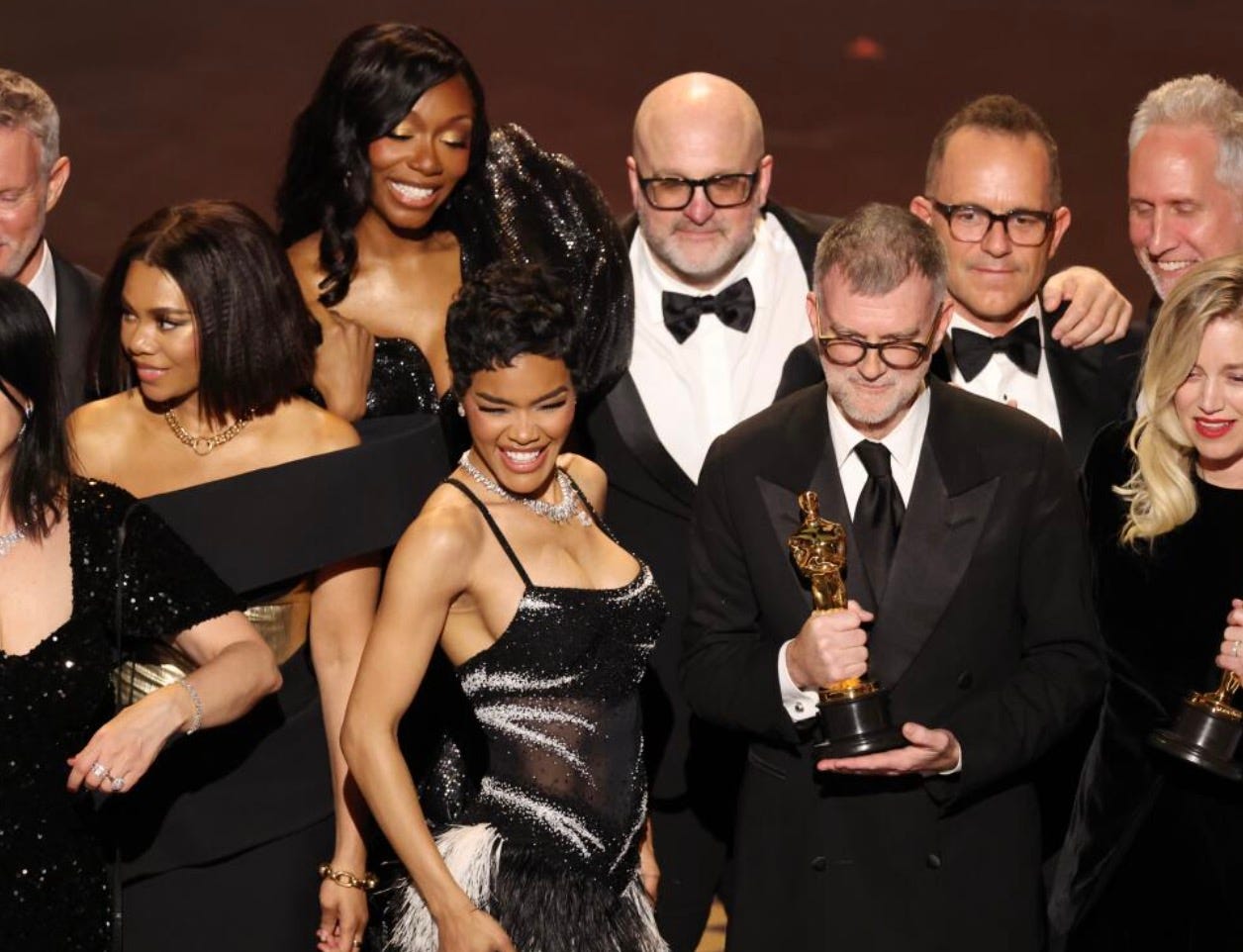
Part of the issue is that the movies the Academy rewards are increasingly invisible to the people watching at home. The ceremony still talks as if the audience has seen every nominee, debated every performance, and formed passionate opinions about the cinematography categories. In reality, most viewers have maybe heard of one of the films, vaguely recognize a second, and accidentally streamed a third while half-watching it on their phone during laundry. When the biggest award of the year goes to a movie the average viewer hasn’t encountered in any meaningful way, the victory lap feels oddly private, like a group of insiders congratulating each other for something the rest of the room didn’t witness.
The show itself doesn’t help. The broadcast has developed an identity crisis in formal wear. Every year producers seem to wrestle with the same question: is the Oscars ceremony supposed to celebrate movies, chase television ratings, or gently lecture the audience about the importance of humanitarian issues? The result is a three-hour spectacle that manages to feel both desperate for attention and slightly resentful that anyone expects it to be entertaining. There are bits that go on too long, music that nobody seems to have asked for, and awkward attempts to manufacture viral moments that land with the energy of a corporate retreat icebreaker.
Meanwhile, the Oscars no longer function as the center of the film universe the way they once did. For decades the ceremony acted as a kind of cultural referee, the place where the industry gathered to declare what counted as the year’s great movie. That authority has eroded. Today the internet hosts a thousand parallel award ceremonies every day. Critics release their own rankings. Fans debate endlessly on movie apps. TikTok spins up new waves of film discourse every afternoon. Entire YouTube channels are dedicated to explaining why the Academy got it wrong in 1997, 2013, or last year. By the time the envelopes are opened on Oscar night, the real arguments about movies have already happened somewhere else.
What’s rushed in to fill the vacuum is something else: a stage increasingly used for political signaling. Acceptance speeches drift into activist manifestos. Presenters pause the show to deliver moral instruction. Carefully rehearsed moments of “importance” are inserted between categories as if the ceremony itself must justify its existence by proving it stands for something larger than movies. No to war! He’s so brave!
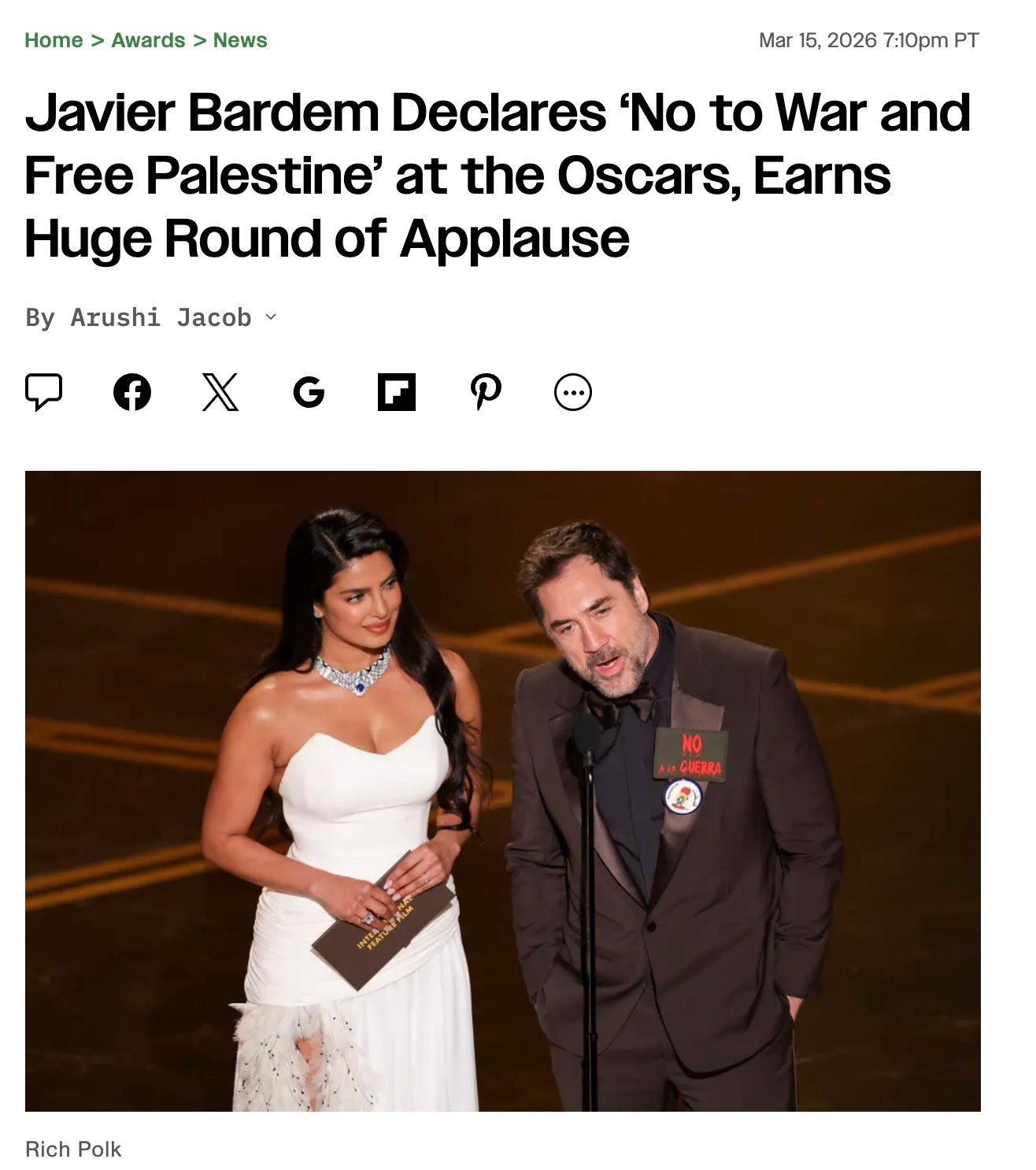
Whether one agrees with the causes or not, the effect is unmistakable. The Oscars used to sell escapism and glamour; now it often feels like a televised faculty meeting with better lighting.
And finally, there’s the simple fact that movies themselves no longer arrive in one shared cultural moment. There was a time when a handful of major releases dominated theaters and almost everyone saw them. People argued about the same performances, quoted the same lines, and had a clear sense of which films defined the year. Now the experience is fractured. Some nominees appear briefly in a few cities before migrating to streaming. Others debut quietly on platforms where they compete with thousands of other titles and an algorithm that would much rather steer you toward a true-crime documentary.
More and more, I find myself noticing how many awards are floating around out there, particularly in worlds that feel increasingly detached from the everyday concerns of the people supposedly watching. Whether it’s Klaus Schwab handing out “Global Citizen” trophies or industry groups inventing new honors for one another, there’s a growing sense of people in rarefied circles applauding themselves in increasingly elaborate ways. The more ceremonial the applause becomes, the harder it is to ignore the gap between the spectacle on stage and the problems occupying the average family at home. When the people giving the awards and the people receiving them all inhabit the same insulated orbit, the whole thing starts to feel less like recognition and more like a closed loop of mutual admiration.
The ceremony still treats itself like a cultural summit, when increasingly it looks like a room full of insiders congratulating one another while the broader audience wanders off to do something else.
The Oscars still behave as if they’re crowning the movie everyone just saw, but like other circle jerks, increasingly the attendees are the only ones who have seen them. More and more, the audience is like my friend, walking past a bar with the ceremony replaying on television, glancing up at the screen for a second, and saying with mild surprise, “Oh right. That was yesterday.”

QTR’s Disclaimer: Please read my full legal disclaimer on my About page here. This post represents my opinions only. In addition, please understand I am an idiot and often get things wrong and lose money. I may own or transact in any names mentioned in this piece at any time without warning. Contributor posts and aggregated posts have been hand selected by me, have not been fact checked and are the opinions of their authors. They are either submitted to QTR by their author, reprinted under a Creative Commons license with my best effort to uphold what the license asks, or with the permission of the author.
This is not a recommendation to buy or sell any stocks or securities, just my opinions. I often lose money on positions I trade/invest in. I may add any name mentioned in this article and sell any name mentioned in this piece at any time, without further warning. None of this is a solicitation to buy or sell securities. I may or may not own names I write about and are watching. Sometimes I’m bullish without owning things, sometimes I’m bearish and do own things. Just assume my positions could be exactly the opposite of what you think they are just in case. If I’m long I could quickly be short and vice versa. I won’t update my positions. All positions can change immediately as soon as I publish this, with or without notice and at any point I can be long, short or neutral on any position. You are on your own. Do not make decisions based on my blog. I exist on the fringe. If you see numbers and calculations of any sort, assume they are wrong and double check them. I failed Algebra in 8th grade and topped off my high school math accolades by getting a D- in remedial Calculus my senior year, before becoming an English major in college so I could bullshit my way through things easier.
The publisher does not guarantee the accuracy or completeness of the information provided in this page. These are not the opinions of any of my employers, partners, or associates. I did my best to be honest about my disclosures but can’t guarantee I am right; I write these posts after a couple beers sometimes. I edit after my posts are published because I’m impatient and lazy, so if you see a typo, check back in a half hour. Also, I just straight up get shit wrong a lot. I mention it twice because it’s that important.