Last week, Google released a new AI image generation model, gemini-3-pro-image-preview, more widely known as Nano Banana Pro.
The internet raved:
The highlight of Nano Banana Pro is its general intelligence, ability to follow instruction and create complex scenes, and its efficient use of tools. For example, it can look up data using Google Search, find directions through Google Maps, and use a chain of reasoning with “thought images” before rendering the final one.
It hallucinates less, is able to create long text consistently, has very strong specialized skills, and excels at following detailed instructions. Yet its intelligence remains uneven, with significant blind spots.
The new possibilities: infographics and maps
Nano Banana Pro has pushed the frontier of infographic generation. It feels like a mix of deep research and image generation. It pulls data and synthesizes it to get the best result.
Prompt: Create an infographic showcasing the last 30 years of economic growth in Poland.
Nano Banana Pro
GPT-5.1
FLUX.1 Kontext Pro
Human (me)
If an image is worth a thousand words, this feels like an excellent compression engine for human learning. It continues the Google focus on using AI to teach - as exemplified by NotebookLM.
Prompt: Create a colorful, cartoon-style illustrated map showing the route from San Francisco to Yosemite National Park.
Nano Banana Pro
GPT-5.1
FLUX.1 Kontext Pro
Human (me)
Finally, AI has mastered using maps during image generation. AI research capabilities are already widely used by parents to tell stories to keep kids engaged during long drives. Now we get entertaining visuals too, based on real data.
Great: detailed descriptions
Many commentators praised the ability to follow detailed instructions. Personally, I find it more an incremental improvement, especially when compared with FLUX.1 Kontext Pro by Black Forest.
Prompt: Create a photorealistic image of a serene European landscape centered around a small lake. Include these elements: Left foreground: A young girl standing and holding a bouquet of wildflowers. Right foreground: A teenage boy wading in the shallow water. Center of the lake: A mother duck swimming with her ducklings. Left background: A dense forest with lush green trees. Right background: A traditional windmill.
Nano Banana Pro
GPT-5.1
FLUX.1 Kontext Pro
Midjourney V7
It looks like Google stuck to its strengths in organizing world knowledge, leaving room for artistic AI models.
The gaps: circuit diagram
Nano Banana Pro might be good at creating diagrams. But don’t use it yet for designing electric wiring for your house.
Even with all its tools, Nano Banana Pro produces circuits that would trip a breaker. Tool use enables magic, but doesn’t replace domain expertise.
Prompt: Create an electrical circuit schematic showing one battery connected to three light bulbs in parallel, each with its own switch for independent control. Use standard electrical symbols with clear wire connections. Include annotations labeling all components (battery, switches, bulbs, wires) and a legend explaining the symbols used. Make the diagram professional and easy to understand.
Nano Banana Pro
GPT-5.1
FLUX.1 Kontext Pro
Human (me)
At last, human intelligence prevailed for another week. Even my one-minute effort of creating a circuit diagram beats the best frontier models!
On a sobering note, we will find online more and more misleading charts that from a distance look professional, even though they are clearly wrong.
Conclusion
I am in awe of the new gemini-3-pro-image-preview, widely known as Nano Banana Pro - and I am not the only one raving. The community, still exploring the power of the previous strongest model gemini-2.5-flash-image, received it with positive shock. As noted by others, Nano Banana can be prompt engineered for extremely nuanced AI image generation.
What are the main lessons:
It is a game changer
It makes a difference whether technology can do cherry-picked demos, or can be actually used in production beyond concept art. In the previous models, prompt following was often “meh” - requiring a lot of trial and error, if it worked at all - see the no-elephant example.
Nano Banana Pro is a game changer - both by delivering consistently good results and by enabling things that were not possible with the previous frontier image generation models. Right now most prompts deliver useful infographics. Before - it was impossible.
Tool use is the key
We were used to creating images with MidJourney-style content, without hope of having anything factually correct. Infographics were off-limits.
Now AI is able to move one step forward, creating factually-correct images. The new stage not only involves how well it can generate the graphics itself, but also how well it can digest the information, and query for the required data - with web search and so on.
I bet there is no way back.
Benchmarking has not caught up
As image-generation becomes production-ready, we need to think on how to measure that in practice. So far there is Text-to-Image Areana and manual checks for instruction following GenAI Image Showdown. I believe that at some point we will need a more automatic way to assess quality for your particular tasks.
And what are your spectacular successes, or failures, with Nano Banana?
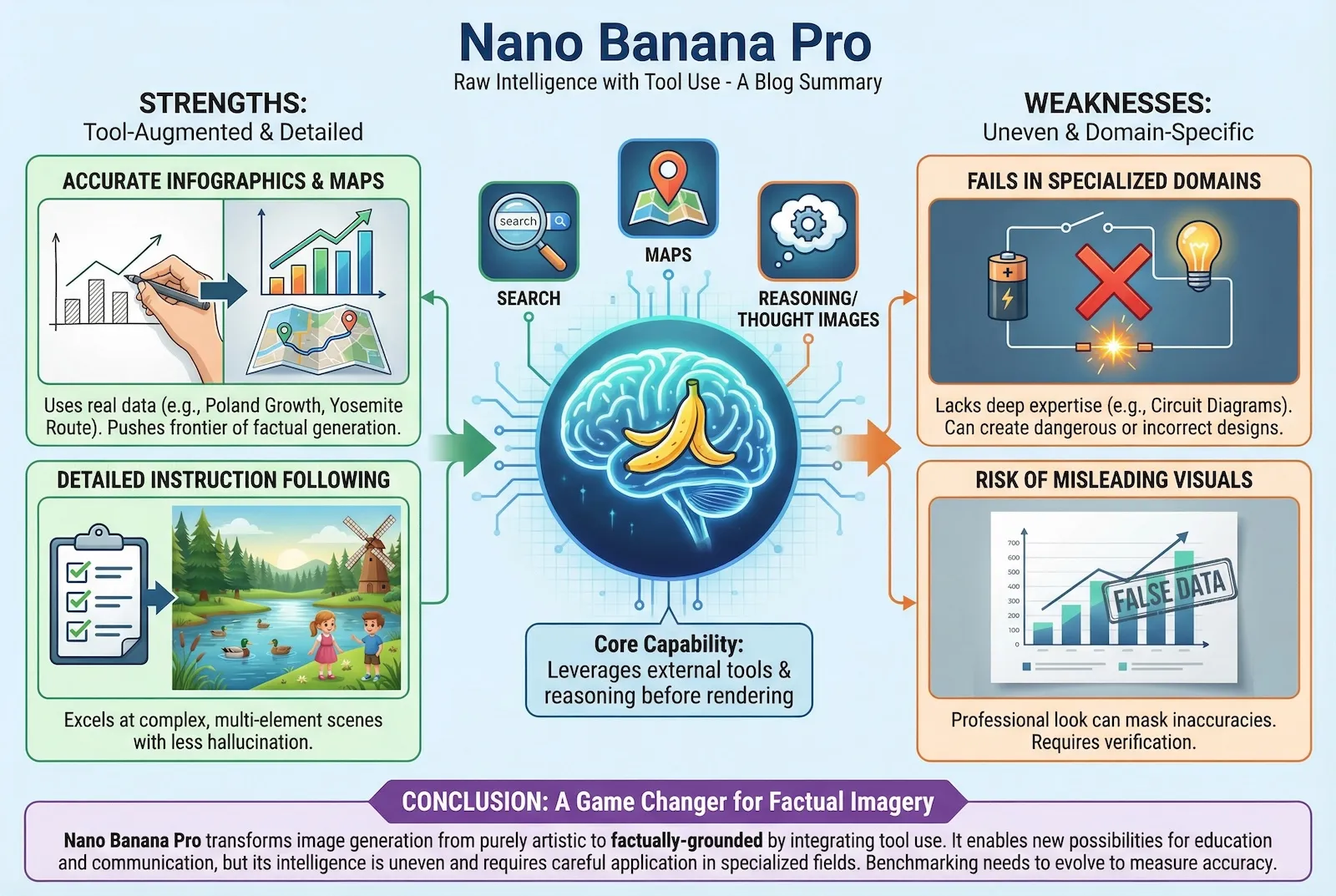
Prompt: “Create infographics for this blog:” and its full Markdown content.