Review
Beyond its Psychiatric Use: The Benefits of Low-dose Lithium Supplementation
Sophie I Hamstra et al. Curr Neuropharmacol. 2023.
Abstract
Lithium is most well-known for its mood-stabilizing effects in the treatment of bipolar disorder. Due to its narrow therapeutic window (0.5-1.2 mM serum concentration), there is a stigma associated with lithium treatment and the adverse effects that can occur at therapeutic doses. However, several studies have indicated that doses of lithium under the predetermined therapeutic dose used in bipolar disorder treatment may have beneficial effects not only in the brain but across the body. Currently, literature shows that low-dose lithium (≤0.5 mM) may be beneficial for cardiovascular, musculoskeletal, metabolic, and cognitive function, as well as inflammatory and antioxidant processes of the aging body. There is also some evidence of low-dose lithium exerting a similar and sometimes synergistic effect on these systems. This review summarizes these findings with a focus on low-dose lithium's potential benefits on the aging process and age-related diseases of these systems, such as cardiovascular disease, osteoporosis, sarcopenia, obesity and type 2 diabetes, Alzheimer's disease, and the chronic low-grade inflammatory state known as inflammaging. Although lithium's actions have been widely studied in the brain, the study of the potential benefits of lithium, particularly at a low dose, is still relatively novel. Therefore, this review aims to provide possible mechanistic insights for future research in this field.
Keywords: Alzheimer’s disease; Cardiovascular disease; diabetes; inflammaging; obesity; osteoporosis; oxidative stress; sarcopenia.
Copyright© Bentham Science Publishers; For any queries, please email at epub@benthamscience.net.
Conflict of interest statement
The authors declare no conflict of interest, financial or otherwise.
Figures
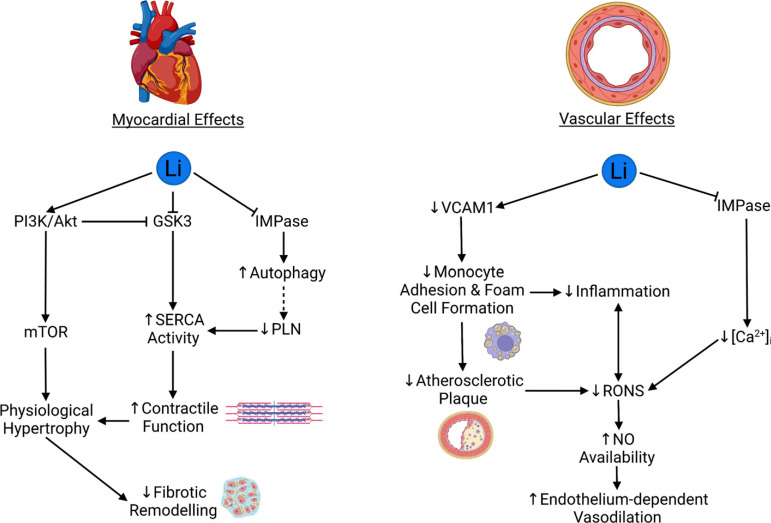
Low-dose lithium affects myocardial and vascular endothelial function. In the myocardium (left panel), low-dose Li has been shown to activate the PI3K/Akt signalling pathway to promote physiological hypertrophy by increasing mTOR signalling and inhibiting GSK3 activity. Low-dose Li can also inhibit GSK3 directly, which allows for increased function of the SERCA pump, potentially enhancing contractile function. Li can also inhibit IMPase, increasing autophagy and potentially reducing the expression of SERCA inhibitor PLN. In the vasculature (right panel), low-dose Li reduces expression of VCAM1, leading to reduced atherosclerotic plaque formation and its associated inflammation. The inhibition of IMPase by Li also regulates intracellular calcium ([Ca2+]i) levels, reducing reactive oxygen/nitrogen species (RONS) and increasing availability of nitric oxide (NO) to increase endothelium-dependent vasodilation.
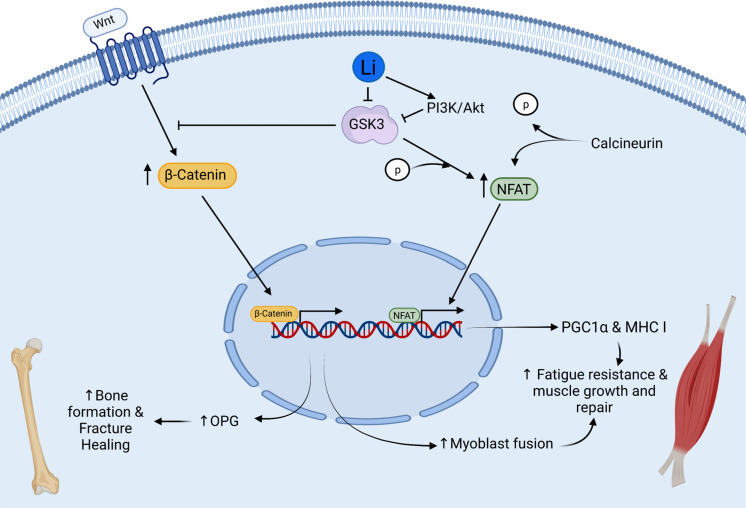
Potential benefits of low-dose lithium in bone and muscle. Low-dose Li directly and indirectly inhibits GSK3 activity to allow for Wnt signalling in bone and muscle, which promotes accumulation and translocation of β-catenin into the nucleus. Transcription of Wnt target genes increases the expression of osteoprotegerin in the bone to promote bone formation during growth and healing. Wnt signalling also promotes transcription of myogenic regulatory factors, which promote muscle growth and repair. The inhibition of GSK3 also enhances calcineurin signalling and the dephosphorylation of NFAT, which allows for its nuclear translocation and transcription of slow oxidative genes, ultimately promoting fatigue resistance in skeletal muscle.
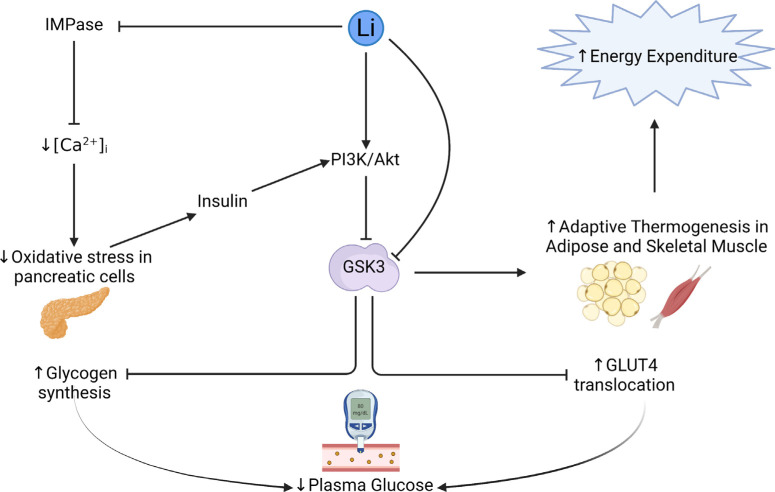
Effects of low-dose lithium on glucose regulation, energy expenditure, and the pancreas. Low-dose Li reduces plasma glucose levels and increases adaptive thermogenesis in skeletal muscle and adipose through its inhibition of GSK3 activity. By inhibiting IMPase, low-dose Li reduces intracellular calcium levels ([Ca2+]i]), relieving oxidative stress in pancreatic cells allowing for insulin production, and further, GSK3 inhibition.
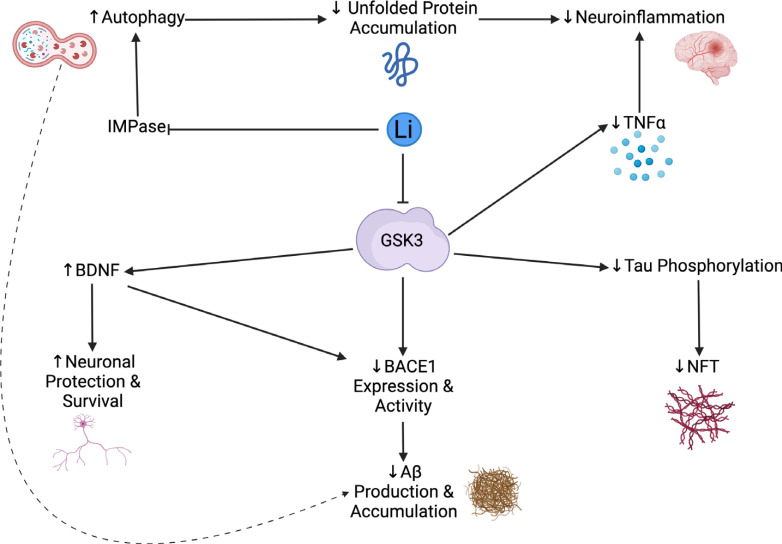
Neuroprotective effects of low-dose lithium treatment. By inhibiting GSK3 activity in the brain, low-dose Li reduces the formation of neurofibrillary tangles (NFT) and amyloid beta (Aβ) production and accumulation, while also reducing neuroinflammation and promoting expression of neuroprotective brain-derived neurotrophic factor (BDNF) to support neuronal function and survival. Low-dose Li also reduces neuroinflammation in a GSK3-independent manner by increasing autophagy and reducing the accumulation of unfolded proteins through inhibition of IMPase. Since autophagy also has a role in Aβ clearance, the enhancement of autophagy with Li may also help in lowering Aβ levels (dashed line).
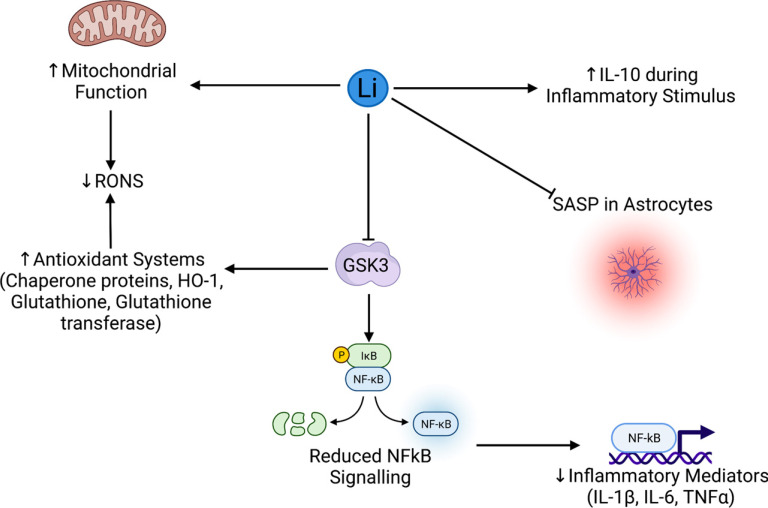
Anti-inflammatory and antioxidant effects of low-dose lithium. Low-dose Li reduces the production of reactive oxygen/nitrogen species (RONS) by promoting healthy mitochondrial function. Low-dose Li can also reduce the senescence-associated secretory phenotype (SASP) in astrocytes and increases expression of anti-inflammatory cytokine IL-10 in the presence of inflammatory stimuli. By inhibiting GSK3, low-dose Li also reduces the expression of pro-inflammatory mediators and promotes upregulation of antioxidant systems, further reducing levels of RONS damage.