Impact Protection Potential of Mammalian Hair: Testing the Pugilism Hypothesis for the Evolution of Human Facial Hair
E A Beseris et al. Integr Org Biol. .
Abstract
Because facial hair is one of the most sexually dimorphic features of humans (Homo sapiens) and is often perceived as an indicator of masculinity and social dominance, human facial hair has been suggested to play a role in male contest competition. Some authors have proposed that the beard may function similar to the long hair of a lion's mane, serving to protect vital areas like the throat and jaw from lethal attacks. This is consistent with the observation that the mandible, which is superficially covered by the beard, is one of the most commonly fractured facial bones in interpersonal violence. We hypothesized that beards protect the skin and bones of the face when human males fight by absorbing and dispersing the energy of a blunt impact. We tested this hypothesis by measuring impact force and energy absorbed by a fiber epoxy composite, which served as a bone analog, when it was covered with skin that had thick hair (referred to here as "furred") versus skin with no hair (referred to here as "sheared" and "plucked"). We covered the epoxy composite with segments of skin dissected from domestic sheep (Ovis aries), and used a drop weight impact tester affixed with a load cell to collect force versus time data. Tissue samples were prepared in three conditions: furred (n = 20), plucked (n = 20), and sheared (n = 20). We found that fully furred samples were capable of absorbing more energy than plucked and sheared samples. For example, peak force was 16% greater and total energy absorbed was 37% greater in the furred compared to the plucked samples. These differences were due in part to a longer time frame of force delivery in the furred samples. These data support the hypothesis that human beards protect vulnerable regions of the facial skeleton from damaging strikes.
© The Author(s) 2020. Published by Oxford University Press on behalf of the Society for Integrative and Comparative Biology.
Figures
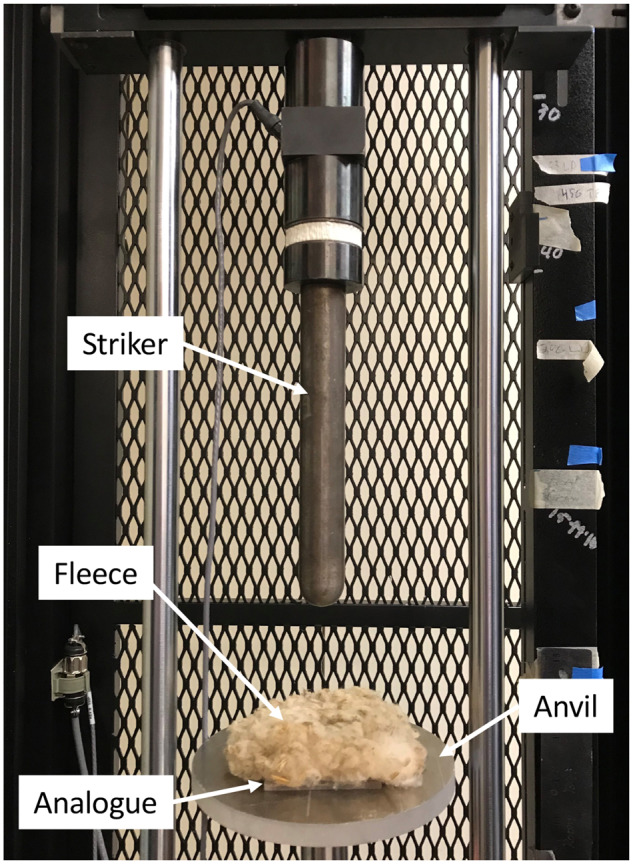
Photograph of the experimental setup using an Instron Dynatup 8250 drop weight impact tester.
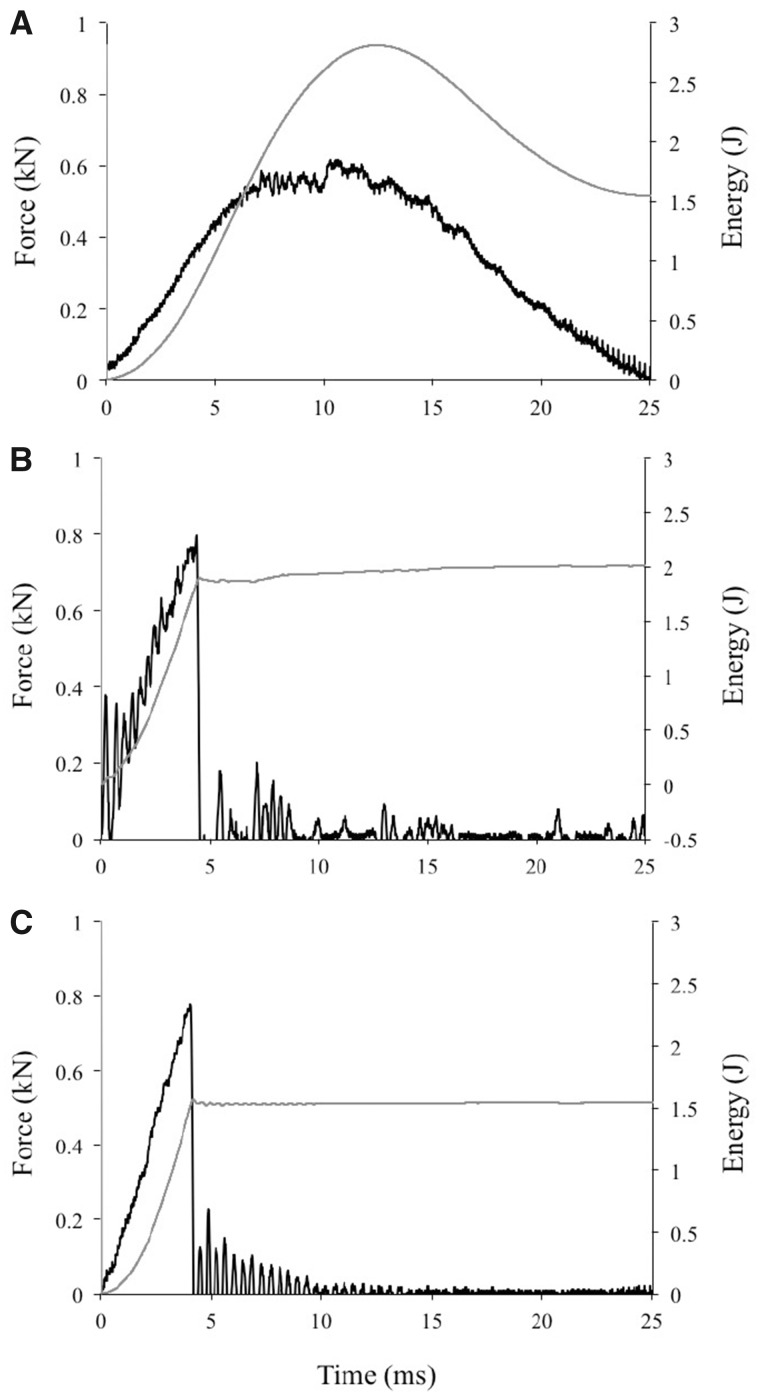
Representative graphs of impact force (black line) and energy (gray line) versus time for (A) a furred sample, (B) a sheared sample, and (C) a plucked sample.
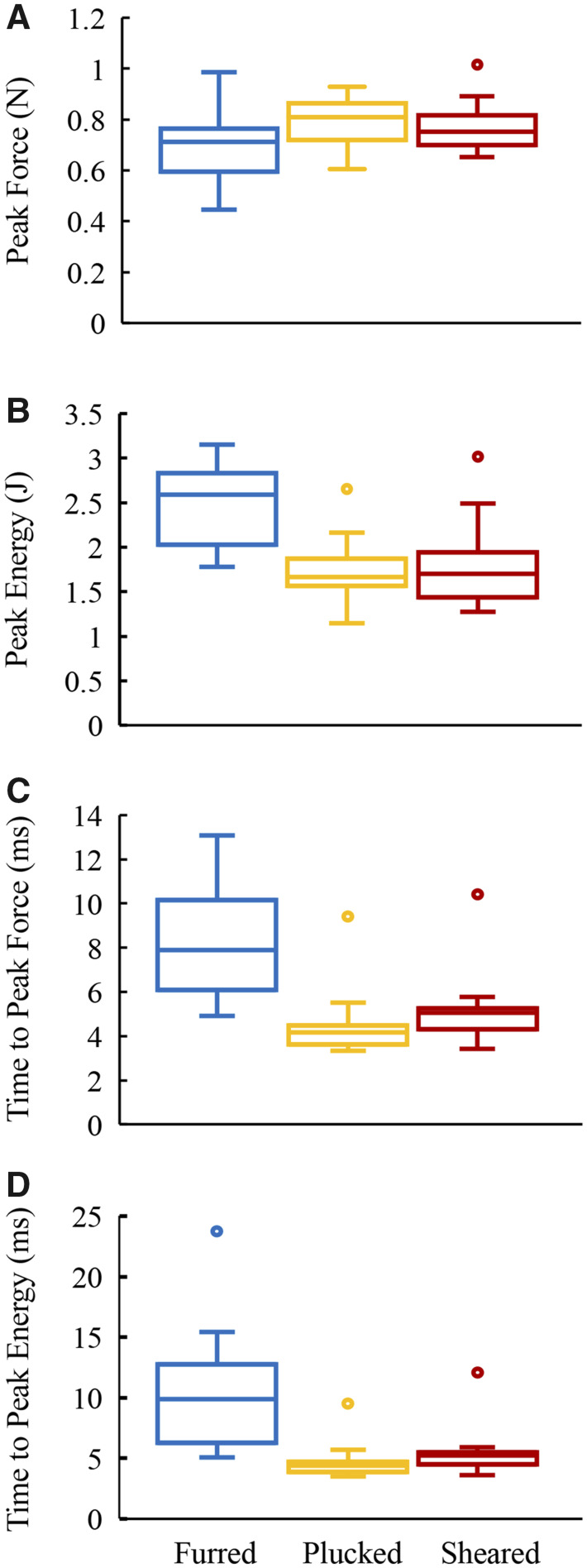
Box and whisker plots showing median, first and third quartiles, and minimum and maximum values of (A) peak force (kN), (B) peak energy (J), (C) time to peak force (ms), and (D) time to peak energy (ms) for each of the three conditions.
References
-
- Adams DB. 1983. Why there are so few women warriors. Behav Sci Res 18:196–212.
-
- Allareddy V, Allareddy V, Nalliah RP. 2011. Epidemiology of facial fracture injuries. J Oral Maxillofac Surg 69:2613–8. - PubMed
-
- Andersson M. 1994. Sexual Selection. Princeton (NJ: ): Princeton University Press.
-
- ASTM Standard D5420-16 2016. Standard test method for impact resistance of flat, rigid plastic specimen by means of a striker impacted by a falling weight (Gardner impact). West Conshohocken (PA): ASTM International.
-
- Barber N. 2001. Mustache fashion covaries with a good marriage market for women. J Nonverbal Behav 25:261–72.
LinkOut - more resources
Full Text Sources
Other Literature Sources