Long-term lithium treatment in bipolar disorder is associated with longer leukocyte telomeres
L Martinsson et al. Transl Psychiatry. .
Abstract
Telomere shortening is a hallmark of aging and has been associated with oxidative stress, inflammation and chronic somatic, as well as psychiatric disorders, including schizophrenia and depression. Additionally, antidepressants have been found to protect against telomere shortening. However, pharmacological telomere studies are lacking in bipolar disorder (BD). Therefore, the objective of this study was to explore telomere length (TL) in patients with BD in the context of lithium treatment. We determined TL by quantitative real-time PCR using peripheral blood leukocytes. Participants were outpatients diagnosed with BD type 1 or 2 (n=256) and healthy controls (n=139). Retrospective case-control and case-case study designs were applied. Lithium response (LiR) was scored using the Alda-Scale. Lithium-treated BD patients overall, as well as those on lithium monotherapy, had 35% longer telomeres compared with controls (P<0.0005, partial η(2)=0.13). TL correlated positively with lithium treatment duration of >30 months (P=0.031, R(2)=0.13) and was negatively associated with increasing number of depressive episodes (P<0.007). BD patients responding well to lithium treatment had longer telomeres than those not responding well. This is the first study to report a positive effect of long-term lithium treatment on TL. Importantly, longer TL was also associated with a better LiR in BD patients. These data suggest that lithium exerts a protective effect against telomere shortening especially when therapeutically efficacious. We hypothesize that induction of telomerase activity may be involved in LiR in BD.
Figures

Lymphocyte telomere length (LTL) was positively dependent on duration of lithium treatment among those exposed for more than 30 months (n=71, P=0.032, Spearman's ρ=0.24). Axes represent unstandardized residuals of regressing LTL on age and sex, and regressing duration of lithium treatment on age and sex.
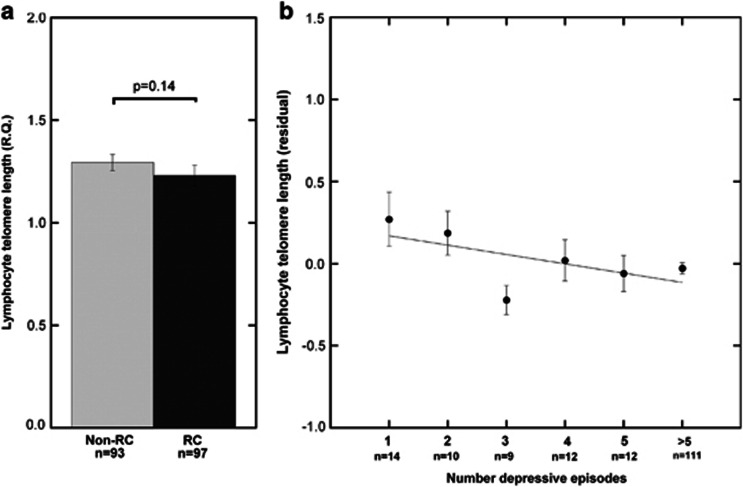
Lymphocyte telomere length (LTL) point estimate was reduced in those with rapid cycling (RC; P=0.14) (a), and LTL was significantly reduced with increasing number of depressive episodes (P=0.007) (b), with larger effect in males (P=0.006). The scatter plot data shown are from males and females. In (a), the y axis represents LTL relative quantity (RQ) values and patients in RC and non-RC groups are matched for age and sex. In (b), the y axis represents unstandardized residuals of regressing LTL (RQ) on age and sex. Bars and dots indicate the mean and error bars indicate standard error of the mean.

Lymphocyte telomere length (LTL) was increased in those responding well to lithium treatment compared with those not responding well to lithium treatment. LTL was increased in bipolar disorder (BD) patients, also in those on lithium monotherapy (BDLi-mono), compared with healthy controls with similar sex and age distribution. Not only the lithium responders, but also the non-lithium responders had longer LTL compared with healthy controls (P<0.0005). The y axis represents LTL relative quantity (RQ) values and patients in LiR and non-LiR groups are matched for age and sex. Bars indicate the mean and error bars indicate standard error of the mean.
References
-
- Bagalman E, Muser E, Choi JC, Durden E, Macfadden W, Haskins JT, et al. Health care resource utilization and costs in a commercially insured population of patients with bipolar disorder type I and frequent psychiatric interventions. Clin Ther. 2011;33:1381–1390 e4. - PubMed
-
- Osby U, Tiainen A, Backlund L, Edman G, Adler M, Hallgren J, et al. Psychiatric admissions and hospitalization costs in bipolar disorder in Sweden. J Affect Disord. 2009;115:315–322. - PubMed
-
- Goodwin FK, Jamison KR. Manic Depressive Illness: bipolar disorders and recurrent depression. Oxford University Press: Oxford; 2007.
-
- Bauer M, Beaulieu S, Dunner DL, Lafer B, Kupka R. Rapid cycling bipolar disorder—diagnostic concepts. Bipolar Disord. 2008;10 (1 Pt 2:153–162. - PubMed
-
- Baldessarini RJ, Tondo L, Hennen J.Treating the suicidal patient with bipolar disorder. Reducing suicide risk with lithium Ann N Y Acad Sci 200193224–38.discussion 39-43. - PubMed
Publication types
MeSH terms
Substances
LinkOut - more resources
Full Text Sources
Other Literature Sources
Medical
Miscellaneous