Randomized Controlled Trial
Testosterone administration reduces lying in men
Matthias Wibral et al. PLoS One. 2012.
Abstract
Lying is a pervasive phenomenon with important social and economic implications. However, despite substantial interest in the prevalence and determinants of lying, little is known about its biological foundations. Here we study a potential hormonal influence, focusing on the steroid hormone testosterone, which has been shown to play an important role in social behavior. In a double-blind placebo-controlled study, 91 healthy men (24.32±2.73 years) received a transdermal administration of 50 mg of testosterone (n=46) or a placebo (n=45). Subsequently, subjects participated in a simple task, in which their payoff depended on the self-reported outcome of a die-roll. Subjects could increase their payoff by lying without fear of being caught. Our results show that testosterone administration substantially decreases lying in men. Self-serving lying occurred in both groups, however, reported payoffs were significantly lower in the testosterone group (p<0.01). Our results contribute to the recent debate on the effect of testosterone on prosocial behavior and its underlying channels.
Conflict of interest statement
Figures
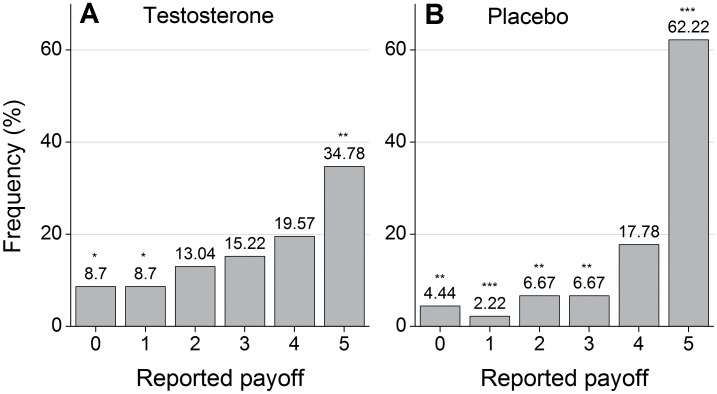
a. Distribution for subjects who received testosterone. b. Distribution for subjects who received placebo. The stars on top of the bars indicate that in the testosterone group 5s are reported significantly more frequently and 0s and 1s are reported significantly less frequently than expected. Likewise in the placebo group 5s are reported more often and 0s and 1s, 2s, and 3s are reported less frequently than expected (Binominal tests that the observed frequencies are smaller/larger than 16.7 percent, *, **, *** indicate significance at 1%, 5%, and 10% level respectively, Placebo: n = 45; Testosterone n = 46).
References
-
- Bok S (1978) Lying: Moral choice in public and private life. New York: Vintage Books. 326 p.
-
- DePaulo BM, Kashy DA, Kirkendol SE, Wyer MM, Epstein JA (1996) Lying in everyday life. J Pers Soc Psychol 70: 979–995. - PubMed
-
- Vrij A (2001) Detecting lies and deceit: The psychology of lying and the implications for professional practice. Hoboken: John Wiley & Sons. 254 p.
-
- Archer J (2006) Testosterone and human aggression: an evaluation of the challenge hypothesis. Neurosci Biobehav Rev 30: 319–345. - PubMed
-
- Carre J M, McCormick C, Hariri A (2011) The social neuroendocrinology of human aggression. Psychoneuroendocrino 36 935–944. - PubMed
Publication types
MeSH terms
Substances
LinkOut - more resources
Full Text Sources
Other Literature Sources
Molecular Biology Databases