Hey,
Pasha here with a year recap of Uncloud — a simpler Kubernetes alternative for small teams and solo developers.
This is my very first newsletter after more than a year of development. Let me share what happened, where we are now, and what to expect in 2026.
When I started designing Uncloud, I was dreaming of one thing: a single command to go from source code to a running app across multiple machines. No container registry to set up or complex orchestration.
Now after putting together all the foundation pieces, you can finally do this!
“uc deploy” builds your code into a Docker image, pushes it directly to your machines (no registry needed), and rolls out app containers without downtime. All configured with a familiar Docker Compose file.
Think of Uncloud as multi-machine Docker Compose for production.
Here is a short demo (from docs):
To make the dream deployment workflow possible, I believed there had to be a way to push images directly to machines without a registry.
That’s how Unregistry was born. An API service that exposes Docker’s internal image store via the standard registry protocol. It took me a few weeks to build it.
I figured it’d be useful as a standalone project so I also implemented a docker pussh plugin (extra “s” for SSH) that lets you push images directly to remote Docker daemons over SSH.
Posted on Hacker News and reached #1 on the front page in under an hour.
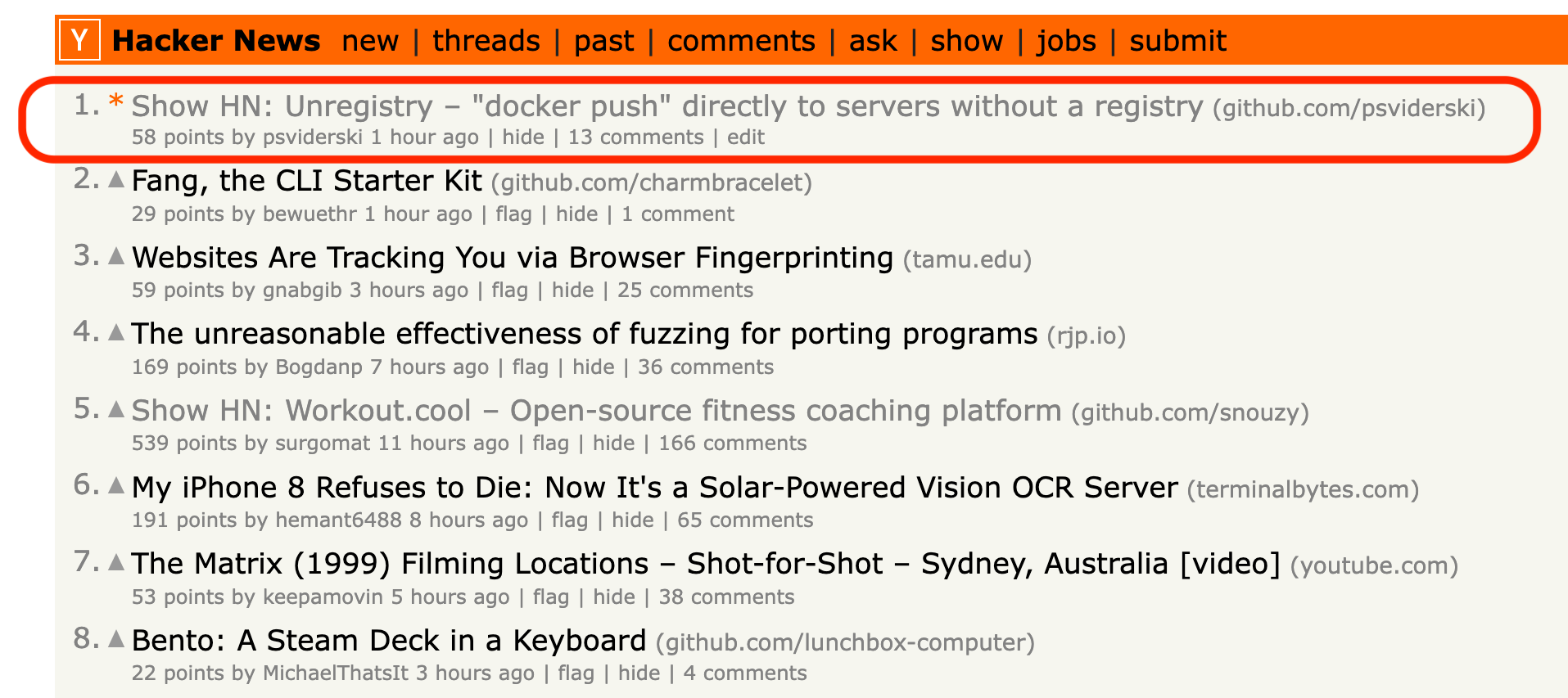
The top comment: “Docker creator here. I love this. …”
That moment was probably the highlight of my entire career. I tweeted about it and got almost a thousand followers overnight. Crazy.

Pasha Sviderski@psviderski
Career highlight unlocked: Docker creator loves my Docker tool. Thank you @solomonstre and for sharing your ideas as well

4:53 AM · Jun 21, 2025 · 87.9K Views
13 Replies · 21 Reposts · 1.03K Likes
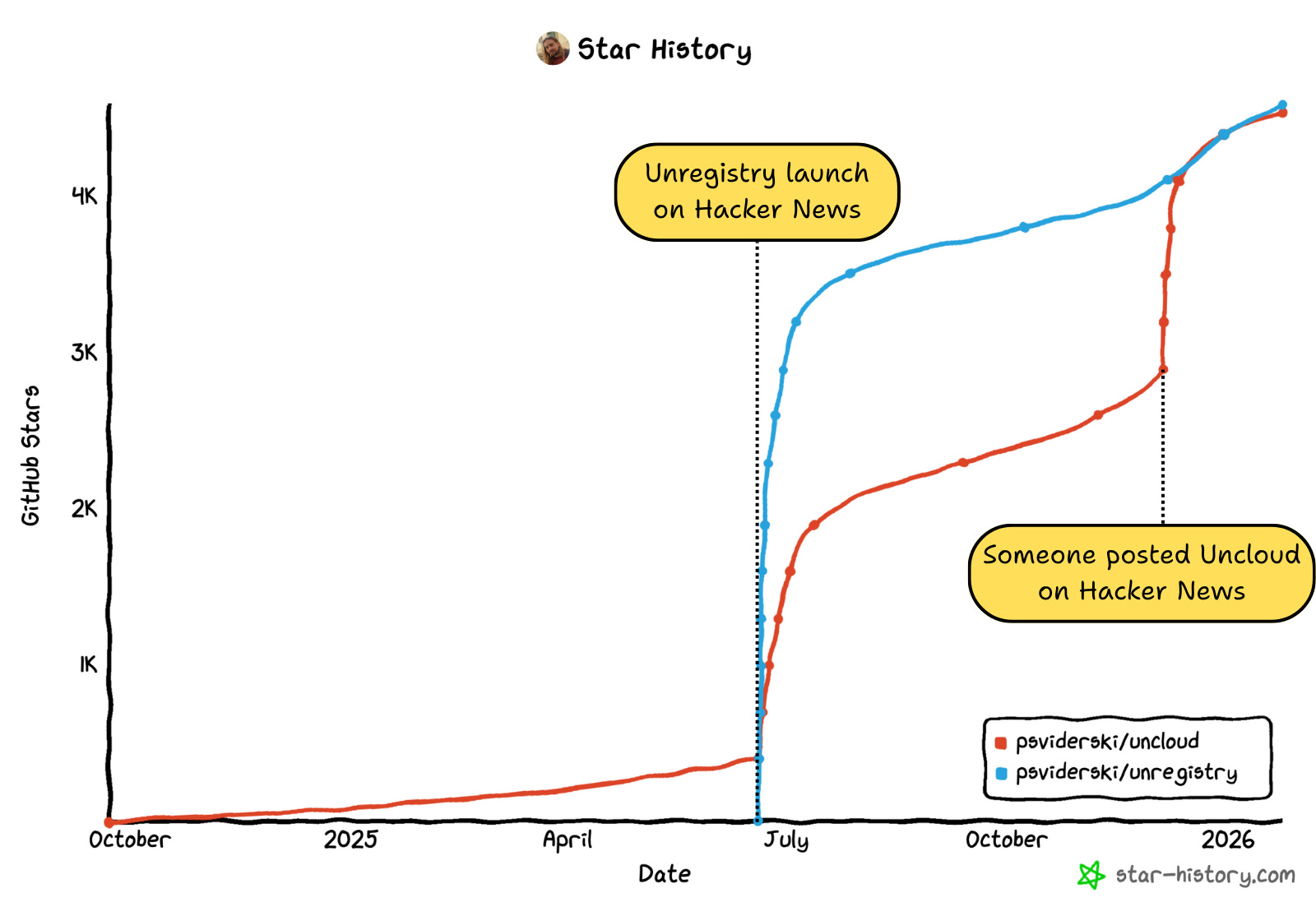
The successful release of Unregistry brought attention to Uncloud as well, exactly what I was hoping for. Another wave came at the end of the year when someone posted Uncloud on HN and it made the front page again.
The attention and comments in both threads were a good signal: people have appetite for tools that make deploying to their own servers really simple.
Early on I set a humble goal for Uncloud to either hit 1K stars on GitHub in 2025 to indicate it has potential or perhaps give up otherwise. This was achieved halfway through the year which motivated me to keep going and take things really seriously.
Yes, please do! A few people, including myself, are already using Uncloud in production at small scale. The core build, push, deploy workflows are stable. Most of the heavy lifting at runtime is done by battle-tested projects such as Docker, Caddy, WireGuard, Corrosion.
Here’s the recent testimonial that captures the user experience well:
For me the biggest benefit of Uncloud is that it’s all built on top of simple and familiar technologies. Before Uncloud, I was already using Wireguard, Caddy and docker-compose. Now I just have a simpler way to set it up and have it all be almost-automatically managed, plus I get DNS resolution for microservices for free.
This gives me confidence that if something goes wrong, or even if the entire project goes under, I will be able to debug myself. I cannot say the same for SwarmKit or etcd.
I also like that it doesn’t try to do too much. After reading the docs alone I knew 90% of what there was to know about the project.
A few community members have also shared their migration stories: Nomad to Uncloud (in French) by Frédéric Logier and Swarmpit to Uncloud by David Parry.
That said, I still can’t confidently say it’s production-ready for everyone. The lack of certain capabilities such as automated rollbacks can be a deal-breaker for some use cases. So it depends on your requirements.
We’re currently working towards stabilising the project (here’s what’s left), prioritising bug fixes over new features.
Interested in trying it? My suggestion is to start with a dev or staging environment and learn how everything works, which isn’t much if you’re already familiar with Docker Compose and basic infra concepts.
This interactive intro tutorial by Anton Ovchinnikov will get you started quickly.
If something breaks or you have questions, hop on our cozy Discord and someone will help you out. I try to answer all questions there but the community is growing and people start helping each other too. That’s honestly heartwarming to see.
So far, Uncloud has attracted early adopters and enthusiasts, typically building homelabs and hosting side projects. This is one of the itches I’m scratching myself too and clearly I’m not alone.
But I want to go further and target developers and teams with real production needs. And frankly that doesn’t feel too far off.
However, to keep things rolling, working out a sustainable business model is essential. Other businesses should be able to depend on Uncloud and be confident they’ll get the support they need. I’m working on Uncloud full-time now and it’s truly my dream job. I’m committed to making it sustainable so everyone can benefit.
Nah, “Uncloud cloud” sounds terrible. But I’m planning to build a self-hosted control center and web UI for managing clusters and apps, with PaaS features that are impractical to implement in the clusters themselves.
The hosted managed option (bring your own machines) will be a paid offering that helps with Day 2 operations: observability, monitoring, alerts, backups and recovery. The critical and time-consuming stuff that becomes painfully obvious only when things go wrong.
Getting logs, metrics, and alerts out of the box that stay available even when your infra goes down is what I believe will nicely complement Uncloud’s self-hosted nature. Self-hosting everything will remain possible if you have the expertise and capacity, or this is required for compliance reasons.
Some other big topics I’m thinking about for 2026:
Self-managed databases as the first-class citizen (taking inspiration from Fly.io’s Postgres support)
Modern persistent volumes with snapshots, incremental backups, and replication
But honestly, I’m still figuring out what matters most. If you have opinions on what would make your life easier, reply to this email or tell me on Discord.
My theme for 2026 is “write”. Inspired by Nik’s post on setting a theme instead of
goals.
I have plenty of ideas in my head and I’m skilled enough to implement most of them. But ideas in my head or code in a repo nobody knows about don’t matter. I believe writing and communication is the missing ingredient that will allow me to take things to the next level.
That’s also why I’m writing this newsletter.
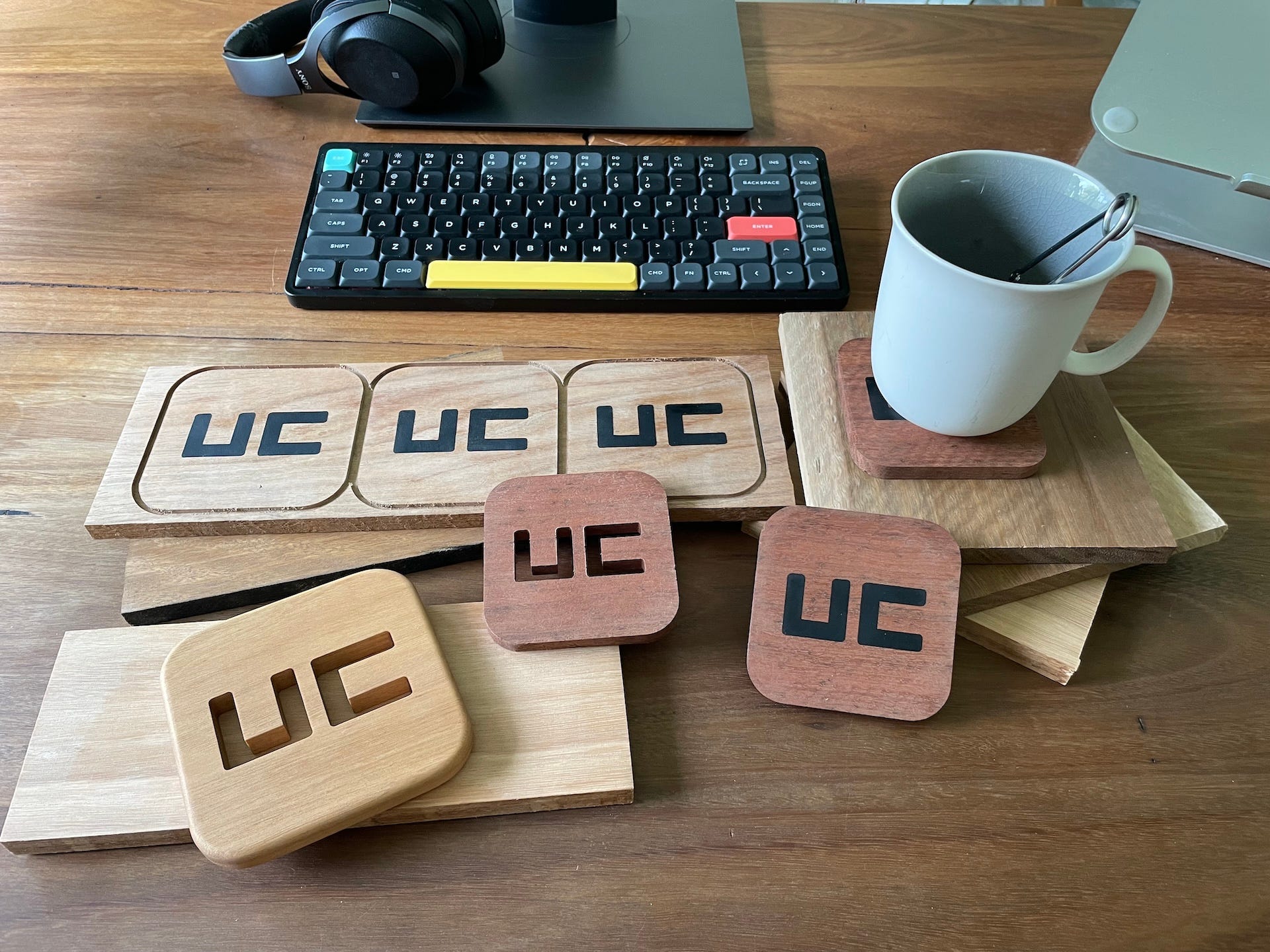
When I need a mental reset, I like to do woodworking in my garage workshop. It’s pure joy to stay away from screens and make something tangible with my hands.
I’ve been experimenting with making wooden coasters with the Uncloud (uc) logo from recycled Australian timber (mainly eucalypts). If you want one:
Become a GitHub sponsor
Or make a meaningful contribution (fix a bug or implement a planned feature)
Then let me know and I’ll post one to you. Seriously.
None of this happens alone. Thank you for being part of this journey. Special thanks to Anton Ovchinnikov (my partner in crime since day zero), 14 contributors,
13 sponsors, and 300+ community members on Discord who make this possible.
I’ve never felt so proud of what we’re building together ❤️
Now back to shipping something delightful to make your deployments more fun.
P.S. Don’t be a stranger. Just hit that “reply” button and say hi! Would love to hear from you.