Schedule What Happens Later.
Reminders, follow-ups, notifications, and expirations. One API call, with retries, tracking, and alerting built in.

Posthook
Scheduled Request Delivering...
Endpoint /api/send-reminder
Created at Yesterday at 2:30 PM
Scheduled for Today at 3:45 PM
Payload { reminderId: "rem_abc123" }
What You'll Build
Common patterns for reminders, drips, and expirations. Each with a guide, code examples, and a DIY comparison.
Also used for status polling, delayed system checks, and scheduled content publishing.
How It Works
1
Schedule a Webhook
Install the SDK and schedule a webhook with your target path, delivery time, and custom payload.
2
Handle the Callback
When the time arrives, we POST to your endpoint with a signed payload. Verify and handle it.
Need more time? Return a 202 and call back with ack/nack when processing completes, up to 3 hours.
Test locally first. Use our CLI to receive webhooks on your machine during development.
Why Not Just Use Cron?
Cron runs on a fixed cadence. Per-user, per-event timing like "remind this user in 24 hours" or "expire this hold in 30 minutes" needs something else.
Your first cron job is easy. Your fifth is a maintenance burden. Posthook handles all of them with one integration.
What's Included
Scheduling, delivery, and monitoring. Everything you need to stop thinking about whether things happened when expected.
Smart Notifications
Anomaly detection against baseline failure rates. Tells you which endpoints failed and why. Alerts via Email, Slack, or webhook.
Rich Dashboard
Real-time delivery tracking, payload inspection, and aggregate health by endpoint. 7 to 90 days of log retention by plan.
Flexible Retries
Fixed or exponential backoff with jitter. Override per-hook. Retries don't count toward your quota.
Async Hooks
Return a 202 and call back with ack/nack when processing completes, up to 3 hours. Long-running jobs without workarounds.
Official SDKs
TypeScript, Python, and Go. Handles auth, pagination, retries, and signature verification.
Local Development
Receive webhooks on localhost with the CLI. No tunnels needed. Also works for private networks in production.
Config-as-Code
Manage recurring schedules in version-controlled TOML. Diff, validate, and deploy from your terminal.
Architected for Reliability
Multi-zone deployment with durable message queues, synchronous replication, and automatic failover. 99.98% uptime since 2018.
Secure by Default
HTTPS-only delivery with HMAC-SHA256 signatures. Built-in replay protection and key rotation.
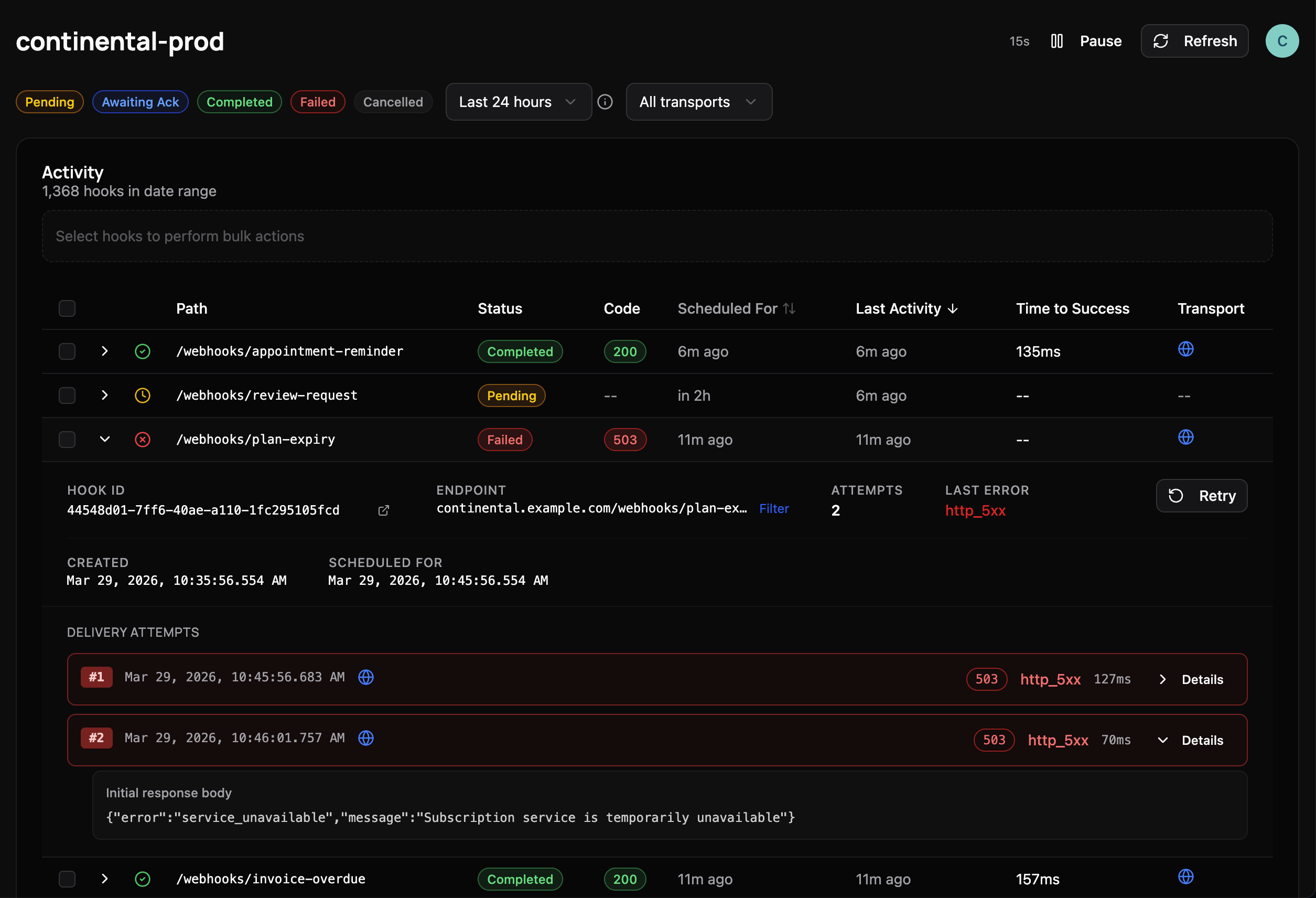
Full Visibility into Every Delivery
Filter by status, endpoint, or time range. Expand any hook to inspect payloads, response bodies, and individual delivery attempts.
Built for Production
Also Supports Recurring Schedules
Keep all your scheduling in one place. Define daily, weekly, or monthly schedules in version-controlled config. No separate cron infrastructure to maintain.
America/New_York · Next run in 2 days
Hourly, daily, weekly, and monthly frequencies
Automatic DST handling for spring-forward and fall-back
Chained recurring steps with ordering
Check into git. Diff, validate, and deploy with npx posthook apply.
Simple, Predictable Pricing
Choose the plan that matches your production workflows and volume. Only scheduling counts — retries, deliveries, and API calls are always included.
Launch
$39 /month
20,000 hooks/month
- 5 projects
- 30-day log retention
- 5-min alerts
- Email & Slack alerts
Growth
$99 /month
100,000 hooks/month
- 15 projects
- 60-day log retention
- 2-min alerts
- Email & Slack alerts
- Bulk actions
Scale
$249 /month
500,000 hooks/month
- 50 projects
- 90-day log retention
- 30-sec alerts
- Email, Slack & Webhook alerts
- Bulk actions
- Priority support
Don't Build Your Own Scheduling System.
Start free and schedule your first webhook in minutes. No credit card required.
1,000 free hooks per month included