I sent a photo of the Margalla Hills in Islamabad to a friend in Australia who I went to school in USA with and his immediate response was how much better the roads are. I told him that well, our grades in reading and mathematics are bad, so choose carefully how you spend the money. But then that made me think just how bad are the grades?Thankfully, we have a measure of objective assessment of children’s learning attainment through ASER reports. Interestingly, these reports are published both for India and Pakistan and can provide a way to compare the students in two countries12. The reports in India only are developed for rural areas so we focus on the same in Pakistan.
There are many measures in these reports that you can compare the students on. I focus on attainment in arithmetic and in particular, an ability to do division for Grade 5 students.
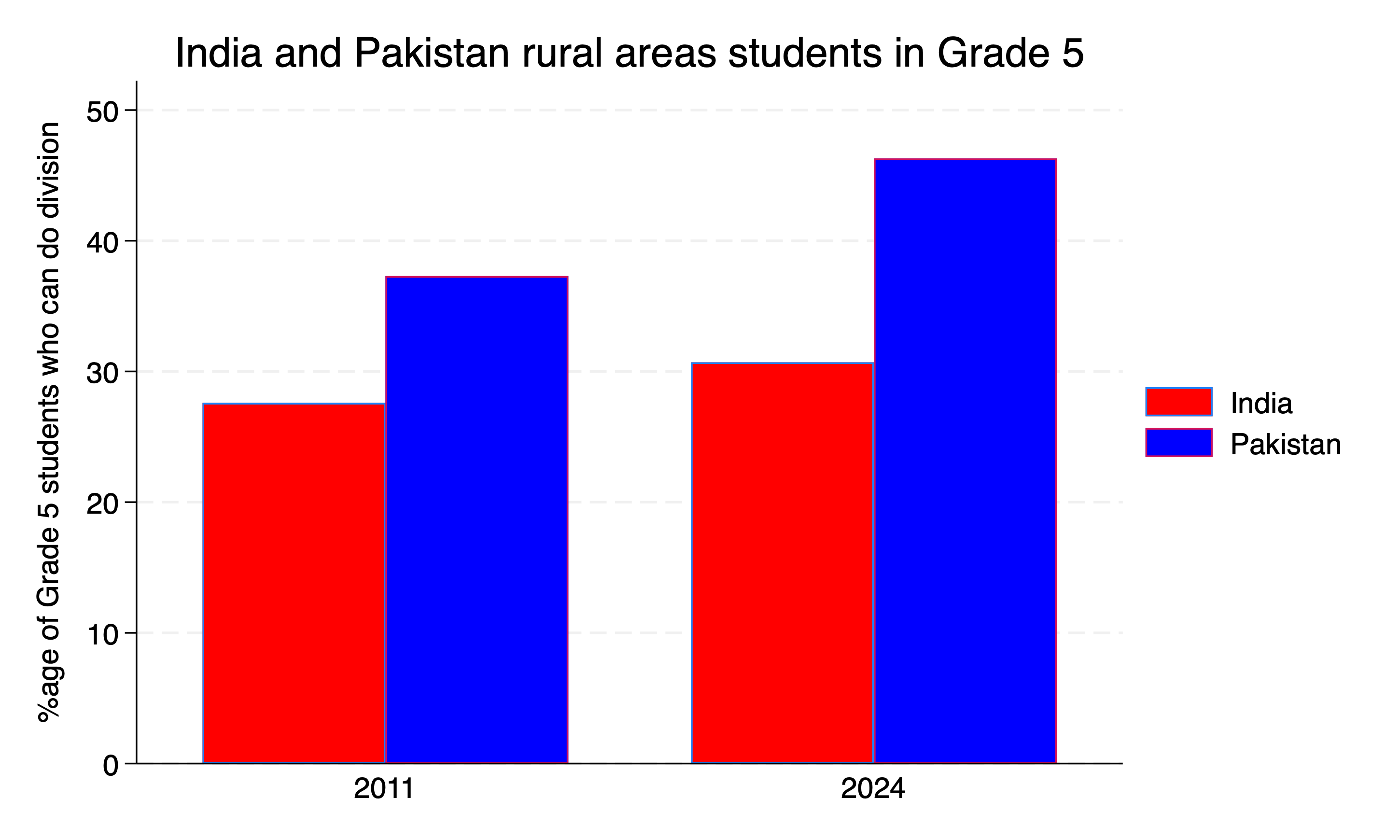
I find it very interesting that at the national level, at grade 5, kids in the rural areas in Pakistan do better in division as compared to those in India. They did better in 2011 and in 2024. Even more, while Pakistan got kids to improve a lot more, Indian kids have lagged.
I also was intrigued about the provinces so I compared Indian and Pakistani Punjab and Sindh and Maharashtra.
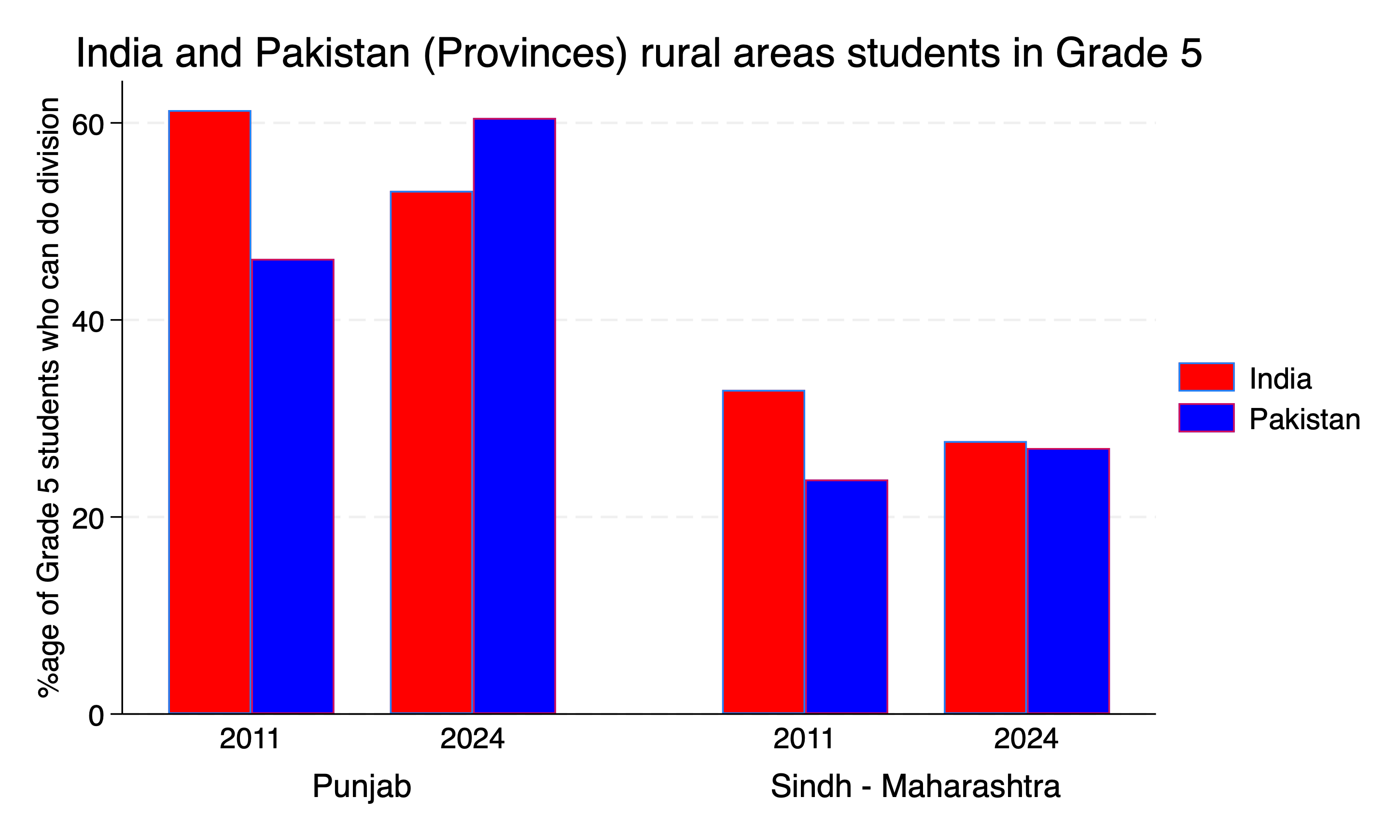
Well, even more surprise. While Pakistani Punjab was behind India in 2011 in the percentage of students who can do division in grade 5, it has now raced ahead while Indian Punjab has slipped. Moreover, Sindh was behind Maharashtra in 2011, while today it has caught up with Maharashtra. Although, Maharashtra has lost steam.
These are remarkable primarily because India has a history of excellence in Engineering. You would think that would translate into achievement at primary level too. However, I have been listening to a lot of discussions on education policy in India over the last year, and one thing I often hear is that the focus is a lot on selection instead of learning per se (It is really hard to get into IITs for example).
I am though intrigued what can Pakistan do with this information? Of course, we want more kids in our schools, and want them to do even better.
But how can we innovate around this achievement to ensure that our kids can perform at the 80th percentile of PISA scores, which test students globally across mathematics, reading and reasoning skills at grade 8? That is the important question. And this may sound ambitious but if rural Pakistani kids can outpace their Indian counterparts on division, why not?