Mars is a constant source of fascination in space science because it is so close and yet so far from being an attractive place for human civilization. By cosmic standards, Mars is a similar size to Earth, relatively nearby, and has abundant water and sunlight. The big differences are the low temperature and thin atmosphere, which are also the largest challenges for habitation. To terraform Mars, you need to warm it by at least 35°C1 and generate enough oxygen for humans to breathe unaided. Both temperature and atmosphere are big, genuinely difficult differences between Earth and Mars, but neither seems physically impossible to change with modern technology2.
There is also a third big difference: Mars lacks a magnetic field. Mars' core cooled 4 billion years ago3, which turned off its magnetic field and allowed solar wind to erode the atmosphere. Don’t we need to restart or create a magnetic field to make Mars livable? If so, terraforming Mars may not be possible with today’s technology because restarting convection within a planetary core is something that nobody has a serious proposal for, and building an artificial magnetosphere would require enormous investment4.
Surprisingly, no, you don’t need a magnetic field to live outside on a terraformed Mars. Atmospheric loss is extremely slow, and other problems like radiation are more easily solved in other ways. There are many reasons why terraforming Mars would be difficult, but the lack of a magnetic field isn’t one of them!
Without a magnetic field, Mars ‘leaks’ atmosphere to space very slowly. Fortunately, it leaks so slowly that it probably doesn’t matter.
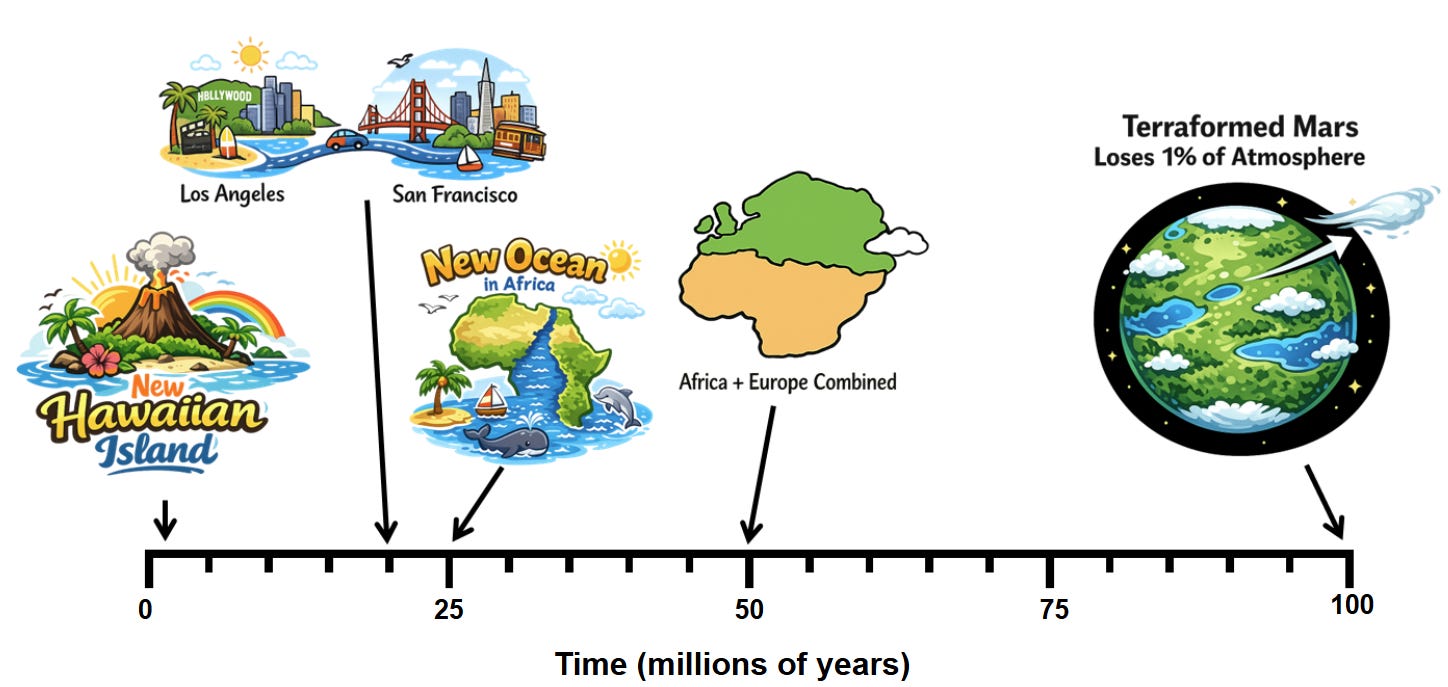
One possible endstate for a terraformed Mars5 is to have a thin, breathable, oxygen-rich atmosphere that weighs about 6 × 10¹⁷ kg. Mars loses about 1 kg of atmosphere per second6. That means it would take 100 million years to lose about 1% of your terraformed Mars’ atmosphere7.
To put that in perspective, here are some things that will happen faster:
100,000 years - The next Hawaiian Island breaches the surface8
20 million years - Faultlines move Los Angeles adjacent to San Francisco9
25 million years - The East African rift opens up into a new ocean10
50 million years - The Mediterranean Sea disappears as Africa merges with Europe11
Why is this so slow? The young sun produced much more solar wind and high-energy radiation than it does today12, and still took hundreds of millions of years to strip the atmosphere. Today’s sun is much calmer. The engine that drove ancient atmospheric loss has largely switched off.
If we terraform Mars, the atmosphere loss levels would change, but not because of increased pressure. Atmospheric loss scales with the cross-section of the planet, or (r + z)², where r is the planetary radius, and z is the effective atmospheric thickness13. A thicker atmosphere adds negligibly to Mars’ 3,390 km radius. The solar wind doesn’t strip noticeably more from a thick atmosphere than from the thin one Mars has today.
It is true that changes in the composition of Mars’ atmosphere might significantly alter the loss rate. A warmer Mars would have more water vapor in the atmosphere, and ultraviolet light splits water to release hydrogen, which escapes much more easily than heavier atoms. As far as we’re aware, nobody has modeled hydrogen escape from a warm, oxygenated Mars. The rate would depend on details like cloud formation, which is also poorly understood and would benefit from further study. But even pessimistic estimates of the loss rate from a wetter, warmer atmosphere are in the range of kilograms per second, and the resulting water depletion would still only matter on geologic timescales, not human ones.
These timelines are so long that it is difficult to project what humanity’s technology might look like, and how small a problem atmospheric leakage might be. Once in-orbit refueling is possible, a Starship will be able to take 100,000kg to Mars, meaning we could restore the 1kg/s with about one Starship a day, a large but not unreasonable number of flights with a reusable rocket. “Topping up” Mars’ atmosphere, if we care to do so, will just get easier as technology advances.
A planetary magnetic field protects you from radiation. But it’s not the only way to do so. The atmosphere itself is good at blocking radiation because it puts a lot of mass between the surface and space. Quite modest increases in Mars’ atmospheric pressure are likely sufficient to block most radiation.
The amount of shielding you need depends on the type of radiation.
Solar energetic particles, which are the acute radiation hazard during solar storms, are effectively blocked by any atmosphere with surface pressure above about 12 mbar14. Mars’ low-elevation regions already have 12 mBar, and any proposed terraforming would push surface pressure well beyond it.
Ultraviolet (UV) radiation in an oxygen-rich atmosphere would generate an ozone layer through photochemistry, just as Earth’s atmosphere does. How much shielding you’d get from different levels of oxygen is not well understood, but Earth atmospheric models suggest that even 20 mbar of oxygen would be enough for most of the UV shielding15. This is a topic that would benefit from more research, since the Mars ozone layer doesn’t behave like the Earth ozone layer16. UV radiation can also be easily blocked by other kinds of shielding, and small amounts of water or soil reduce it to biologically trivial levels17.
The most challenging form of radiation to block are Galactic cosmic rays (GCRs). The proposed18 thin, breathable, oxygen-rich atmosphere would reduce GCRs to roughly ISS-interior levels19. That’s still more than on Earth, but GCRs are only 20% of the radiation exposure of ISS astronauts20. That’s still above Earth-surface background, but well within the range addressable by modest additional shielding or biological interventions.
There remain significant unknowns that might make terraforming Mars impossible. But the lack of a magnetic field is not one of them. Here are some of the outstanding possible showstoppers we’ve identified.
The amount of nitrogen on Mars is limited, and biological nitrogen fixation would have to adapt to lower nitrogen concentrations to sustain a nitrogen cycle.
There might not be enough electron acceptors on Mars to sink all of the hydrogen necessary to sustain a biologically generated oxygen atmosphere.
Liquid water may migrate into the deep subsurface or high-altitude, though recent work suggests this is less of a concern21!
A warmer and denser atmosphere might kick up more dust, blocking sunlight and cooling the planet.
Want to help us write a more formal paper on this topic? We’re using this blog post as a way to find our future co-authors! If you want to help us write this up, let us know. Email us magneticfield [ at ] pioneer-labs.org or comment below.
We’re especially interested to hear from you if: 1) You disagree with us! Let’s get it right. 2) You are well positioned to do more detailed ozone modeling or 3) you are well positioned to do hydrogen escape calculations or 4) there’s something else obviously missing you’d like to contribute to. Let us know!