I’ve been wondering about the nature of newness, of modernity, and how the experience of the new does not come about through technological change, but through personal change. How external differences, changes in speed, which we are experiencing in startling ways today, never rise to the level of real change.
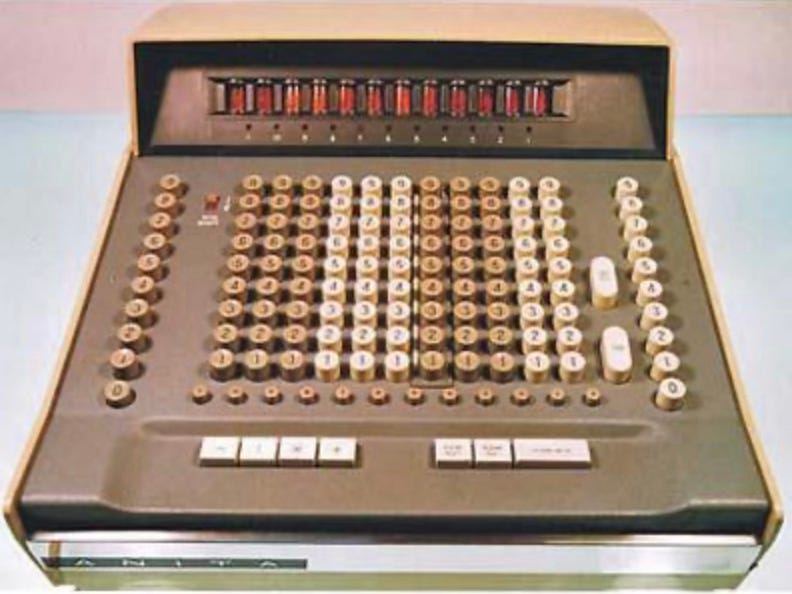
When I was in elementary school, someone brought a machine into the auditorium. It was large and mostly flat, about the size of a small television. The students gathered around it, along with the teachers, as if something miraculous were about to occur.
What we were looking at was a calculator.
You could type in 5 times 5, and it would display 25. That was it. And yet, at the time, it felt like a visitation from the future. The thing was so valuable it might as well have been under armed guard. We stood there in awe, convinced that we were living in a moment unlike any that had come before.
Of course, today every phone has a calculator, and nobody cares.
But that’s the point.
In 1402, someone devised a better way to gather water, or to shape metal, or to measure distance. I’m certain that invention, whatever it was, inspired the same sense of astonishment. The same conviction: we are the people of today, standing at the threshold of something entirely new.
Then came the 1600s—improved navigation, new cannons, new forms of architecture—advances that must have seemed to confirm that history itself was accelerating toward some higher state.
And now it’s 2026, and we tell ourselves the same story.
We imagine that we have outgrown the past, that we have shed its superstitions, its crude moral frameworks, its religious obsessions. We speak as if we are the first people to think clearly, the first to see the world as it is.
But look around.
We are still living inside the same human drama.
People love their children as they always have. They grieve in the same way. They are stirred by beauty—by the sky at dawn, by rainbows, by music, by a beautiful face, by memories of experiences both traumatic and triumphal. Irony still moves us to laughter. Desire still overtakes reason. We still wonder what happens after we die.
And whether we use the words or not, we still divide the world into good and evil.
That language embarrasses some of us. We are modern people, after all. Who’s to say what’s good and what is evil? Who are we to judge? There are those with a strong preference for more sanitary terms: systems, frameworks, historical forces. But the underlying reality has not disappeared simply because we’ve changed the vocabulary.
If anything, recent events have made that harder to deny.
We live in a time when ancient hatreds reappear with startling clarity. When acts occur that belong not to some distant, primitive past, but to the present moment—broadcast in real time, explained away in real time, absorbed and forgotten in real time.
We point to our technologies, our speed, our access to information as evidence that we have advanced beyond the people who came before us.
But have we?
Look at the pyramids. Look at the great cathedrals of Europe. Look at the music of Mozart, the paintings of Rembrandt, the literature of Shakespeare, and the teachings of the Talmud—the enduring works of mind and spirit that continue to shape us whether we acknowledge them or not. These were not produced by lesser beings.
As Thomas Sowell, the American economist and social theorist, has written, “There are no solutions, only trade-offs.” In other words, we do not transcend the human condition simply by advancing our tools. And underlying much of his work is a deeper point: the accumulated wisdom of generations is not something to be casually dismissed.
And yet we often behave as if we are the first to arrive at clarity, the first to escape the limitations of those who came before.
The truth may be less flattering.
We have new instruments. Faster ones. More powerful ones.
But the hands that hold them, the minds that experience what they can accomplish—the fears, the longings, the loves, the resentments, the moral intuitions and confusions—those remain much the same.
The calculator in that auditorium felt like the future.
In a sense, it was.
But it did not make us new.
Newness is something we make for ourselves. The only real newness is the awakening of the self to the miracle of the ordinary, the splendor of the prosaic. This, I think, is the work of those who truly long to be “up to the moment”—to perceive the miracle of one’s own existence.
Some might say this is a useless pursuit. I think otherwise.
Think back to a time when you held your infant daughter for the first time, or said goodbye forever to a loved one. Recall how your mind leapt out of its smallness, how the world suddenly exceeded your ordinary sense of it.
If the world were filled with people who lived in that awareness—who understood their own significance, and that of every other person on the planet—we might begin to see something genuinely new. A different kind of modernity.
In newness of this sort, no one would feel the need to wage war.
Peace, the thing everyone, in their own way, craves, would no longer seem so distant, but something closer to what it has always been: a human possibility, waiting to be remembered.
Even now I think back to that calculator. Not the invention itself, which hardly matters, but the state of wonder we were enfolded in as grade-schoolers. As if the world had paused, and all the little things we were concerned with, all the petty struggles and worries, all the gloating and fear and antagonisms, both felt and delivered, had, for a minute or two, disappeared.
What was left were wide eyes, smiles, a shared sense of awe. Not only for us kids, but for the adults too—the teachers, the principal, the janitors, the kitchen staff—everyone who had come to observe this new marvel.
It isn’t the calculator, but the feeling of wonder that machine engendered—the memory of it, the sensation embedded in my mind—that is what I hold most dearly. It’s that kind of newness I seek in myself these days.
The quest alone has begun to shape my work, my relationships, and my prayers. My wish is that you find it as well.