Many years ago, I made an enormous amount of money.
I joined a real, no-kidding Silicon Valley startup at exactly the right time, with exactly the right product, team, market and timing. I owned around thirty thousand shares of a company that, thanks to the Internet boom, was worth around $750 million. I sold a lot of my stock, and when I did, my stockbroker at the time asked me if I was sitting down before she told me how much I was now worth.
The next day, I remember walking down Fillmore Street, in San Francisco’s Pacific Heights neighborhood. I looked at the Porsches and BMWs parked along the curb, the restaurants, the stores, everything, and thought — I’m not making this up — “I could buy that. I could buy that. I could buy that.” I now had a lot of fucking money, and short of the actual buildings, I literally could not see anything I couldn’t own, easily, if I felt like it. I was now that guy.

I had done it. I had accomplished something everyone approved of very much. I had won. I was successful. I was really, really successful. I was a member of the founding team of an Internet startup that had been taken public.
Not only had I won, but I had also created a no-kidding, big-deal career in a brand-new, white-hot industry. I was perfectly positioned to repeat my success, to bank my winnings and keep ascending. It didn’t work out that way, of course — life is like that — but for an intoxicating few years, I publicly had the word “Winner” on my forehead.
Interestingly, though, my internal landscape didn’t match the external one. The floating, surreal, wonderful, intoxicating sensation of having accomplished all this and having all this money lasted for about two days. After that, I was still the exact same person. All my dreams had come true, and it didn’t really make much difference.
It took a while to figure out how to handle that.
A few weeks ago, my friend and colleague from those days, Sukumar Ramanathan, killed himself. I heard that he did it by walking in front of a moving train. Caltrain, the commuter train line that connects Silicon Valley with San Francisco, blasts right through the middle of what’s now some fairly crowded real estate. If you want to, it’s not hard to simply step off a platform and right in front of a train. The locomotives are named for cities on the line, so you can be torn into unrecognizable pieces by the San Bruno, or the Palo Alto, or the Atherton. The physics of what happens when a 130-ton locomotive traveling at 50 miles an hour hits a human body are not pretty. I hope it was quick.
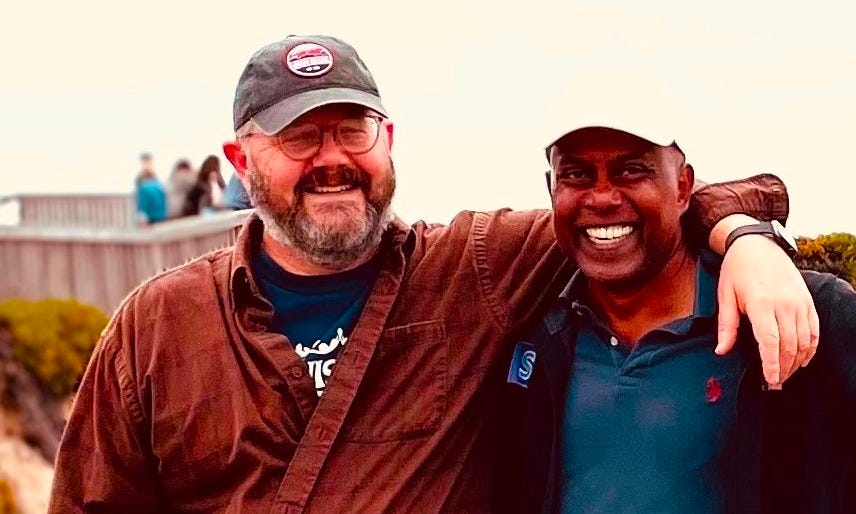
Suku was 63. I’d seen him for an afternoon about a year ago. We spent six hours walking along West Cliff Drive in Santa Cruz, where I lived. He’d driven over the hill from Menlo Park, in Silicon Valley, where he lived. We’d spent a wonderful day together catching up, chatting and as always, reveling in one another’s company. And less than a year later, he was dead, by his own hand. I wonder now if, in a way, when he came to see me he was checking in and kind of saying goodbye.
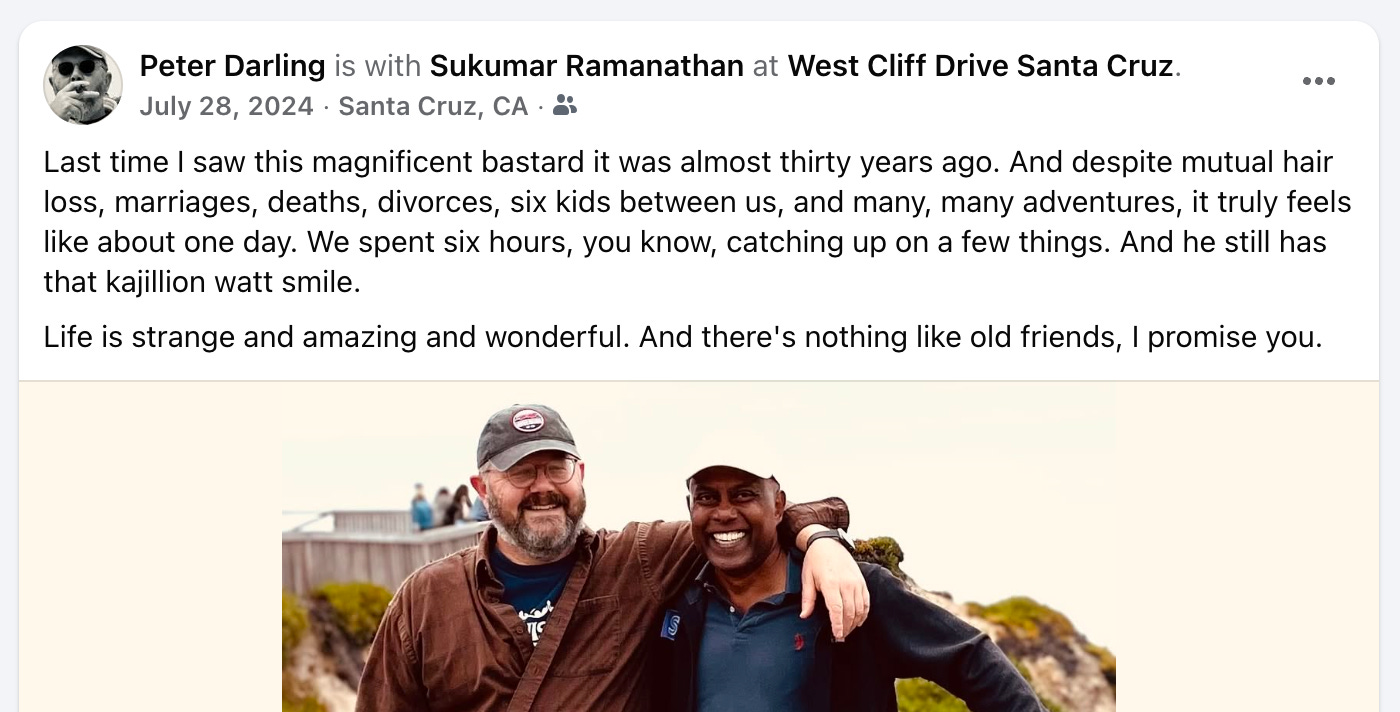
Every time someone dies in a way that makes people uncomfortable, they’re always described as being special, magical, unique, whatever. The kid who was a criminal and a thug is described as a churchgoing honor student. I suspect this is to add a layer of mystical sparkle and meaning to something really awful and especially pointless. But Suku really was special. He was, for one thing, a huge supporter of this Substack, and of my writing in general.
He was also intensely alive. He had a huge, bright smile, an infectious sense of humor, and a spirit that reminded you of how fun and special you and your life were. He was one of a handful of people I have known in my life — and at my age, I’ve known a LOT of people — who really burned brightly, and who you could warm yourself by.
One of his best bits, I thought, was the Paperweight Rant. He would begin by complaining about how sick he was of selling complicated, cutting-edge technology to customers who didn’t understand what it did, and thus required endless explanation. He wanted to sell something simple. He wanted to sell paperweights. “Everyone knows how a paperweight works. The demos are simple. Here. See those papers on your desk? Bonk. Now there’s a paperweight holding them there. That’s what it does. It holds papers down. How many do you want?”
Like everyone else, I could not (and cannot, and never will) really understand why he killed himself. The internal landscape, after all, is explored by only one person, and they get lost a lot. I had a friend in California who used to like to say that “Why” is the booby prize, and she was right. In many respects, trying to understand why someone unalives themself is a completely futile pursuit. But I’ve engaged in it, and I think that Suku, in the end, was fed into the furnace by ambition.
Ambition, like sex and money and a lot of other interesting things, is a topic nobody discusses but everybody cares about. When I sit back and try to go through the broken pieces of Suku’s life, I keep coming back to the price of his ambition, again and again. I think it killed him. There really is no such thing as a free lunch.
Suku was the absolute last word in Indian-American success. Silicon Valley is absolutely packed with Indians — they’ve built, or helped build, a lot of the biggest tech companies in the world. Suku was in good company professionally. When I saw him, he had just been hired as Chief Revenue Officer at a startup called Parafin. He was excited, and happy. Today, the company is still doing great. Suku’s home is worth several million dollars. His wife is some kind of high-achieving doctor at Stanford. He had three kids, two daughters and a son. And by killing himself, of course, he blew all of that into a thousand tiny pieces.
I understand a little of what he was grappling with. Like Suku in many ways, I grew up being spoon-fed ambition. I got this from both sides. To distill complex people down into sentences, my father was absolutely driven to escape Williamstown, Massachusetts in the Depression and on a deeper level, compensate for the death of his mother in surgery when he was a boy. My mother was, I think, locked in an unconscious battle for small-town status, and fighting for an emotional role with her own father.
My brothers and sisters and I, growing up, shared our house with the endless, unspoken, impossible questions ambition always asks — What are you going to accomplish? How high can you rise? Did you win? Are you valid? Can you prove it? The demands weren’t ever discussed, or justified. They were just there, in the air, always. I thought that was just how life worked.
Note, by the way, that there were never any questions about whether or how you should win. Or how other people could help you win. Or even why winning mattered. You just had to win. If you didn’t win, you lost, and that was really not good. The result was an endless conveyor belt of achievement, emphasis on endless, and a group of people who had to adapt and mature, if they could, utterly on their own. I can’t ever remember, once, any of my brothers or sisters talking about being afraid, or confused, or sad. Especially sad. It took a solid year of therapy with an endlessly patient, persistent psychiatrist before I could even acknowledge I had feelings. Thanks, achievement.
The inconvenient thing about achievement, interestingly, is that it’s necessarily attached to a human being. Humans have emotions, needs, insecurities, beliefs. Being a person means being a complex, vulnerable creature who can’t always, or usually, simply shut off their humanity in the service of their goals. Or if they can, or do, the result is a person who is simply monstrous. Some of the most driven people I knew in law school were also frighteningly repressed, angry and machinelike. Sometimes they were flat-out cruel, to no discernable end. A lot of them now run big law firms.
So, the invisible challenge ambition presents, when it collides with the inconvenient fact of being human, is that you have to figure out how to live with it. Ambition does not give one single shit about your feelings, your longings, your weaknesses, your needs. You have to fit a soft, fragile creature into a mold with lots of tight corners and difficult angles. Suku couldn’t, and now he’s no more. I learned to, which is why I’m still alive.
Ambition is the state of wanting something — the job, the woman, the house, the life, the Porsche. It’s the acknowledgement that you are not who you want to be, or where, or how, and further, that you’re going to do what it takes to obtain it. There is a certain degree of looniness in this sometimes, when people want something for weird reasons, or want it because they’re transparently lacking something in themselves. Ambition demands that you change to suit it. Ambition doesn’t compromise.
God money, I'll do anything for you
God money, just tell me what you want me to
God money, nail me up against the wall
God money, don't want everything, he wants it all
-”Head Like a Hole” by Nine Inch Nails
More specifically, what you’re ambitious for is not the thing — the money, the big house, the girl, the whatever. What you’re ambitious for, what you actually long for, is how you believe those achievements will make you feel. When you achieve, what will your life, your identity, be like? You imagine a certain life, and that imagined reality pulls you forward. To do what Suku did, you have to really, really believe in that dream. It has to be everything. You can’t kind of want it. It has to own you. You have to allow that.
After I made my pile o’ money, I decided to get a BMW. I could easily afford it, and wasn’t dumb enough to get a new one (depreciation) so I went out to Weatherford BMW in Oakland, seeking to buy a used BMW. I didn’t want to finance it, or any of that bullshit. I just wanted to write a big check and have the car. They were happy to oblige, and the next day, I was the owner of a BMW 528i sedan.
When you put your foot down in a BMW, the car absolutely leaps forward. It wants to go fast. It was designed for the German autobahn, and will easily cruise all day at insanely high speeds. That sensation, the feeling of performance, of power, of luxury, of being bigger and faster and more formidable than I’d ever felt before while driving, is really what I was paying for. The car delivered.
But eventually I regressed to the emotional mean, and learned some other things about this car. The electrical system was for shit, and constantly gave me expensive problems. Getting anything fixed was a thousand bucks, easily. It was a real gas hog, weighed a ton, and on and on and on. It was fun, but eventually the shine wore off. That’s how achievement works. It’s a fun game to play, but in the end, if you don’t internalize the fact that it’s a game, you end up like Suku.
Suku’s experience, of course, made my dance with ambition look like comparing the candles on a birthday cake to a forest fire. While my parents certainly suffered, I didn’t grow up in a third-world country. Achievement wasn’t life-or-death. It was for him, I suspect. I have talked to Indian friends who have moved to the US about this, and from what I understand, the pressure to rise is relentless, universal and brutal.
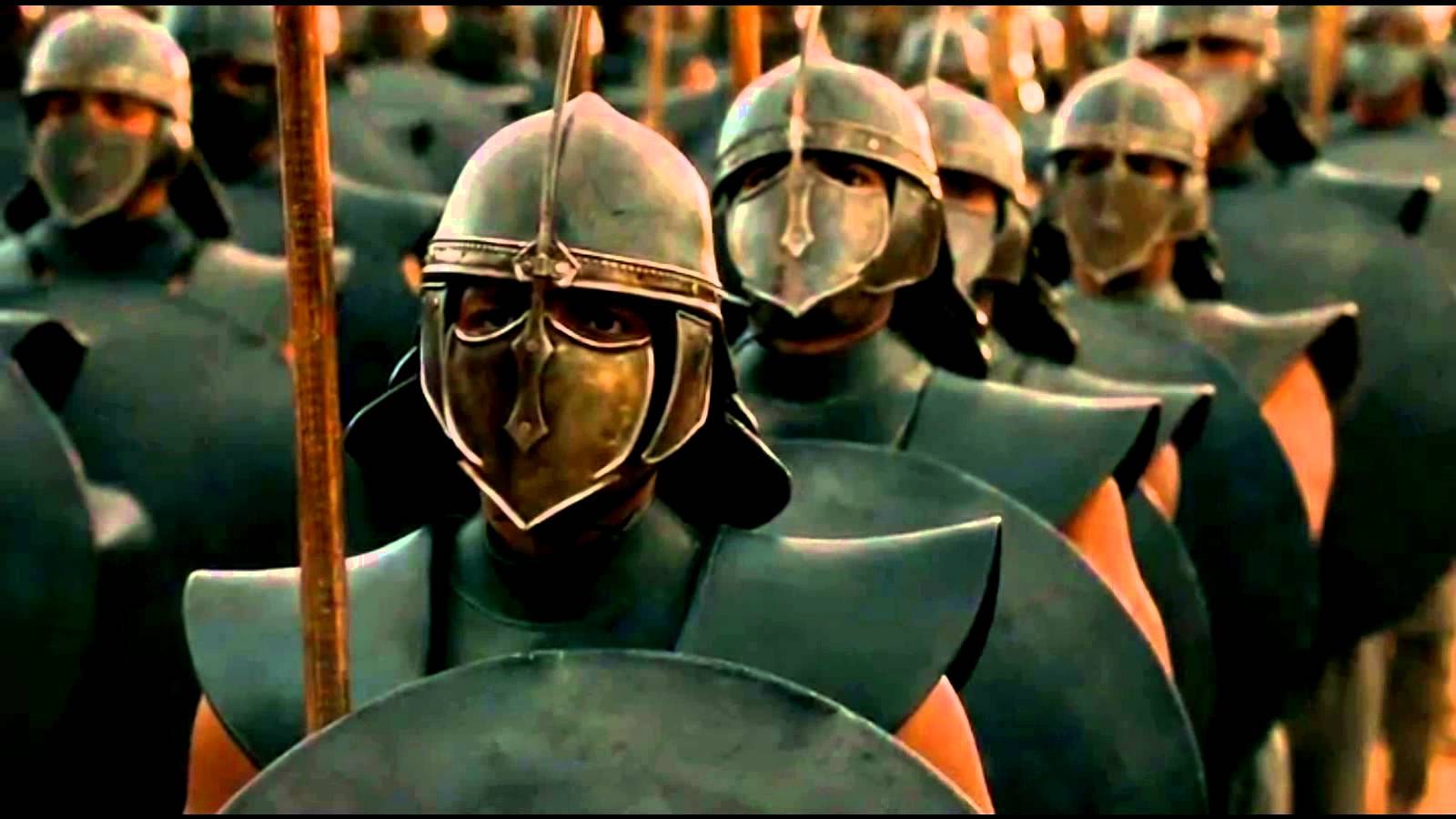
Unsullied begin as young male slaves chosen for their size, speed, and strength. Every day they choose new names at random by drawing tokens from a bucket, each consisting of a color and a type of vermin, such as "Grey Worm".
Their training starts at age five and is from dawn to dusk. It is brutal, designed not only to teach them how to fight, but to strip away all individuality, empathy, and self-worth. Slaves that fail any aspect of their training are killed. Only a third of the slaves to enter training survive to become Unsullied.
To get from India to Silicon Valley, first you have to fight your way into a good school, ideally IIT, in direct, grade-driven competition with millions of other students. You have to excel in school. You have to get a good job, and excel there. I have known Indians who were trained to work until they literally dropped. And it’s another version of Fight Club. You don’t ever talk about what’s happening. This goes on and on, job after job, promotion after promotion, an endless, ever-steepening treadmill with everyone watching.
Until, of course, the costs of this endless struggle rises up and eats you. It ate Suku.
The thing that makes this especially, super-awful, is that so many people, including me, loved him. All he would have had to do is raise his hand and ask for help, and dozens of people would have been there in an hour. He didn’t. He couldn’t, I guess.
I believe Suku killed himself because he literally could not envision a different life. When something went wrong in his career, or perhaps just inside his head, he literally couldn’t comprehend an alternate path, or perhaps a compromise or a reset. Of all the things I’ve read about what happened to Suku, I believe that he was running into trouble with his job, maybe even got fired. I also believe that decades on the ambition treadmill had eliminated his resilience, and the only path he could see was over the edge.
After he died, there was the usual, hideous reaction. All kinds of anguished posts, including by me, on Facebook. A heartbreaking message from his son. A memorial service that involved hiking up the hill to the Stanford University Dish, to Suku’s favorite tree. Someone had to break the news to his elderly father. And finally, cremation, dealing with his ashes, and a widow who now has to carry on alone, somehow.
And that’s it. Life goes on, the world goes on, and Suku is no longer part of it. It’s Labor Day weekend. Fall is knocking on the door — the nights are now down into the 40s, I’m grateful for the big down comforter under which I sleep and the Farmer’s Almanac predicts a lot of snow this winter, which Koda will love. The afternoon is drawing to a close, and while there’s still light, I’m going to grab my fly rod and head to the river.

There’s a place I found where a stream empties into the river, creating a nice hole for bass. Although I have had very limited success there, I’m still going to park my car, rig up, wade in, and spend a couple of hours going after it, waist deep in water. I will see deer, and enormous, ancient Canada geese racing upriver, just above the water. I’ll light a cigar, and when it gets dark, make my way back to the car, and drive up to Junior’s Log Cabin. I’ll have a beer or two, eat a hamburger, and watch the crowd in this roadhouse on a Saturday night. I don’t feel like talking, but I do want to be around people. Tomorrow morning, I’m driving to Manhattan, and Monday I’m going to watch a day of tennis at the U.S. Open.
And Suku will still be gone. He’s never coming back. I always thought he’d ripen into one of those elderly, tough, smart Indian guys in Cupertino or somewhere, who have seen and done it all and sit outside enjoying the sunshine and bragging about their grandchildren. Nope. Godspeed, my old friend, and traveling mercies. The demons won. This really hurts. And I have lived long enough to understand that it always will. I am so fucking sorry. I had no idea. That’s the only excuse I have.
Afterword
I made it onto the river just as darkness was gathering. I threw about ten fairly sloppy casts right into the deep part of the hole, where the stream pours into the river, which eventually flows into the Susquehanna, Chesapeake Bay and the unimaginable expanse of the Atlantic. I paused to search through my pockets for my lighter. While I did, I let the fly just sit there for a minute or so, in the water. And while I was standing there being careless, the single biggest fish I have ever bagged on a fly rod hit my fly. It felt like I’d hooked an engine block. I waded to shore, horsed him in with some effort, got a picture, removed the hook, and tossed him back in. He took off like a rocket, and was instantly gone, headed for the deep part of the channel.