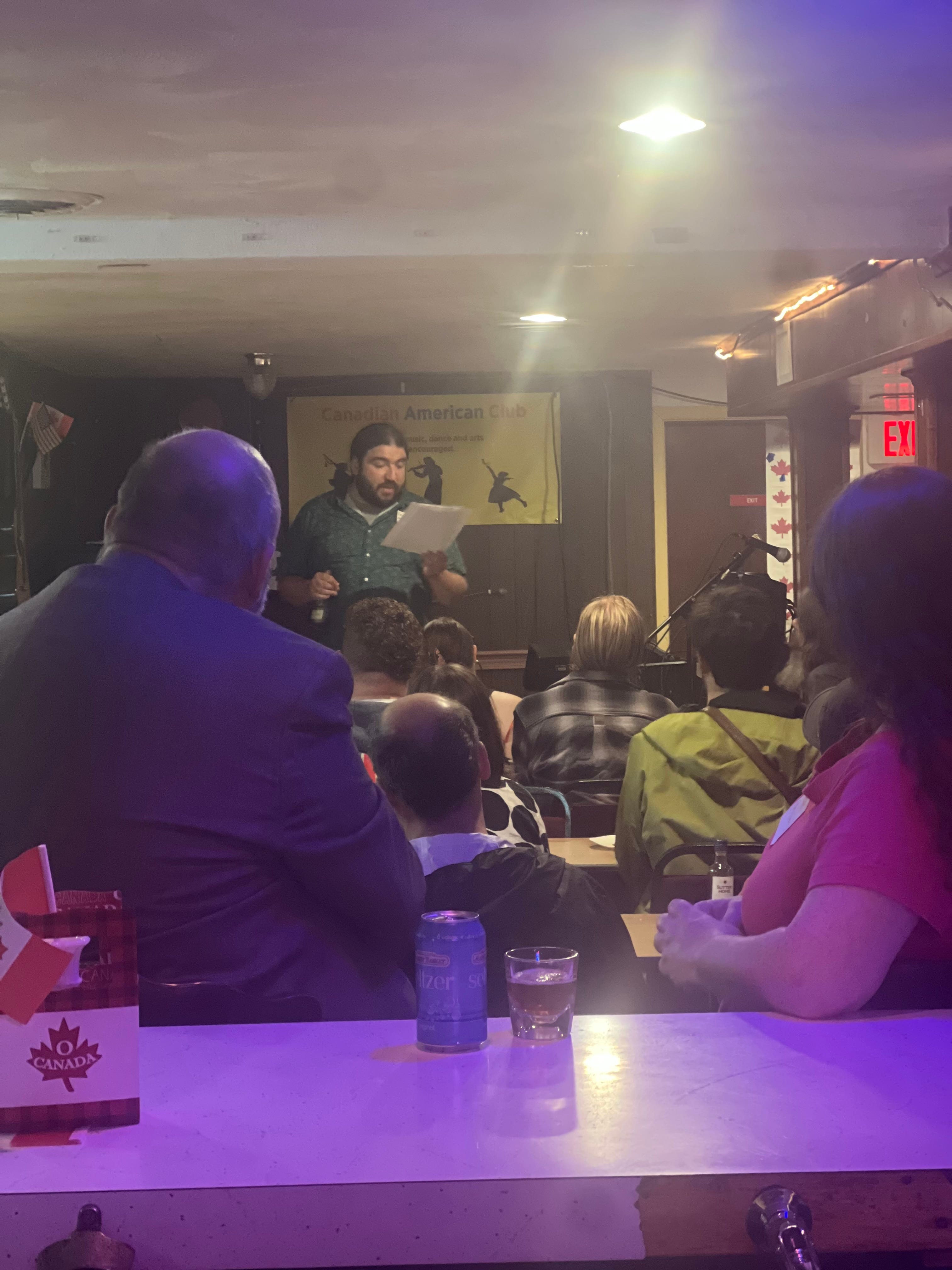
As many of you know, I write and give a lecture at my birthday party every year (and have done this since 2012 or so). Here’s the one I did this year. It’s written to be read aloud (to an indulgent audience), so keep that in mind. Enjoy!
In the early 1930s, the famous and well-regarded German author Hermann Hesse had many of the familiar problems of middle age. He was on his third marriage, and he didn’t get along very well with his wife. A lifelong hypochondriac, his health wasn’t great. In his writings, Hesse channeled the internal struggles that he felt his whole life — between spiritual transcendence and earthly pleasures, between his desire to follow a righteous path and his independence of spirit, his serenity and his rebelliousness — into beloved works like Siddhartha and Steppenwolf, but these same struggles, as they played out in everyday life, made him into a pretty ordinary cranky man who had a hard time being happy. He took a course of Jungian psychoanalysis and while this process of self-discovery gave some marvelous additional color to his work, it’s hard to say if it made him much happier.
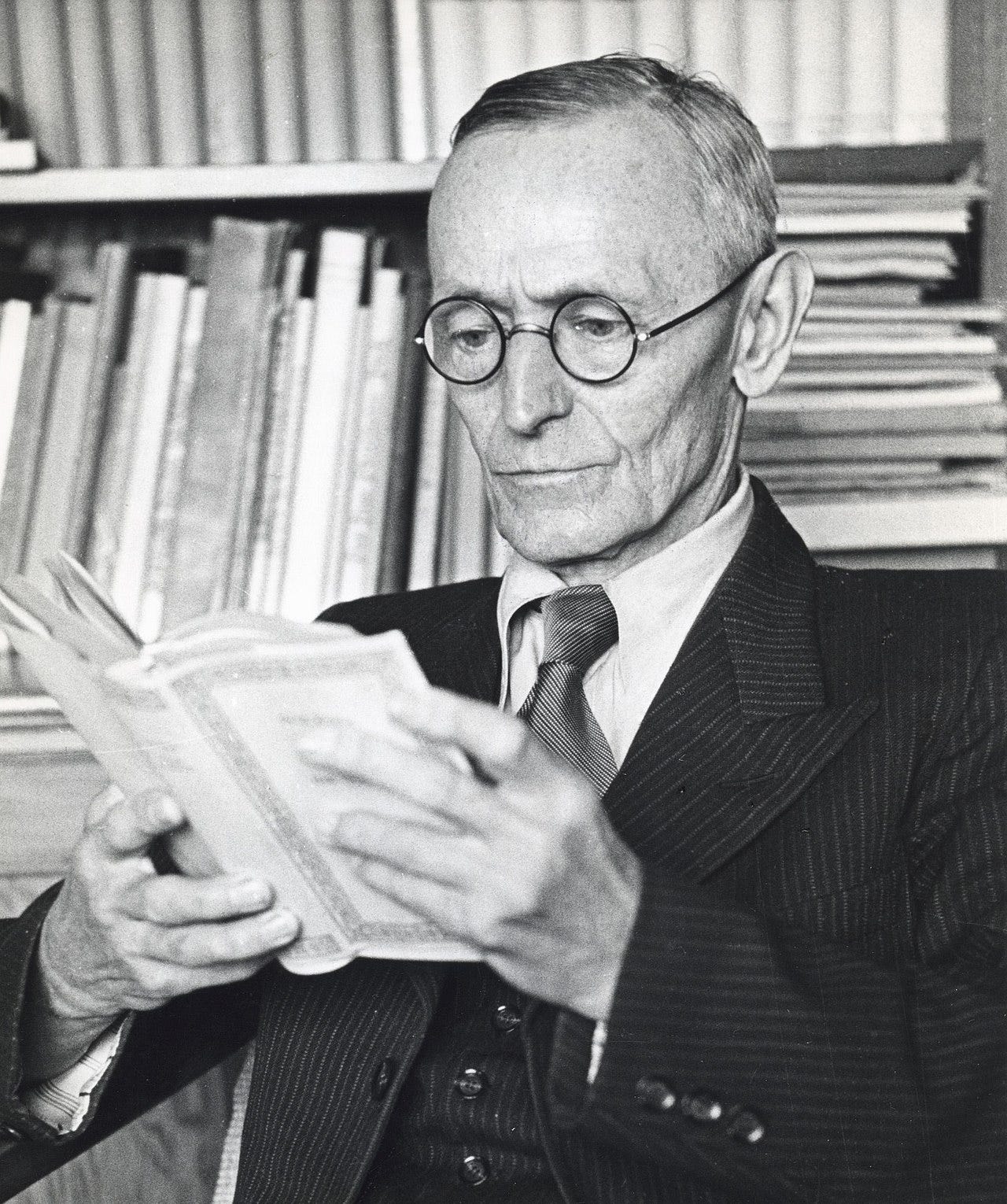
And then, the Nazis took over Germany. Hesse, born in Germany in 1877, had lived in Switzerland for decades by that time. One of the things he liked about Switzerland was its policy of neutrality. Hesse hated politics. In his many letters to other readers and writers, he made clear that his sympathies were broadly on the left. But he was unwilling to join any kind of political movement, and especially none that demanded commitment to a party line or had internal authority structures which might try to dictate what and how he wrote. As emigres from the Nazi crackdown on dissent fled Germany, he hosted many of them in his house in Switzerland. He was willing to help materially, but not artistically- he had no interest in “making a statement.”
Eventually, because Hesse praised Jewish and anti-Nazi writers in book reviews, his work was banned in Germany itself… which increased the writer’s money woes by cutting him off from his main market. He was stung when leftist emigres condemned him for not speaking out more. Perhaps his analyst might have told Hesse that he was playing out an old pattern, of feeling isolated for following the demands of his conscience (and ego), martyred by misunderstanding from all sides- he had been there before in his personal life.
Hesse wasn’t so cut off from the times that his concerns were purely selfish. Hesse hated politics in large part because he hated violence and war- another reason why Switzerland appealed to him. Pacifism ran deep in him. It wasn’t just the toll in lives that Hesse abhorred- it was the cultural effects of war, too. In the short term, this meant the ignorance, conformism, and bombast of militarism. Longer term, Hesse, and people invested in culture all over the world, feared deeply that if the cycle of wars went on, that the survivors would be brutalized. The strains of total war would burn away the conditions for any culture beyond propaganda and maybe cheap, mass produced entertainment. Anything with human spirit or even charm to it, from folk art to the most abstract philosophy, would become surplus to requirements - eventually, people wouldn’t even know to miss it. The very idea that people can be something more than fuel for an inhuman machine could be lost.
From these big questions, and from his personal vexations, and from the many feelings both provoked, Hermann Hesse wrote his magnum opus, a novel called, in English, The Glass Bead Game. He worked on it from 1932 to 1942, when fears that European civilization had entered an abyss from which it could never return were at their height. This work, along with a little help from his friend Thomas Mann, is likely what secured Hesse the Nobel Prize in 1946.
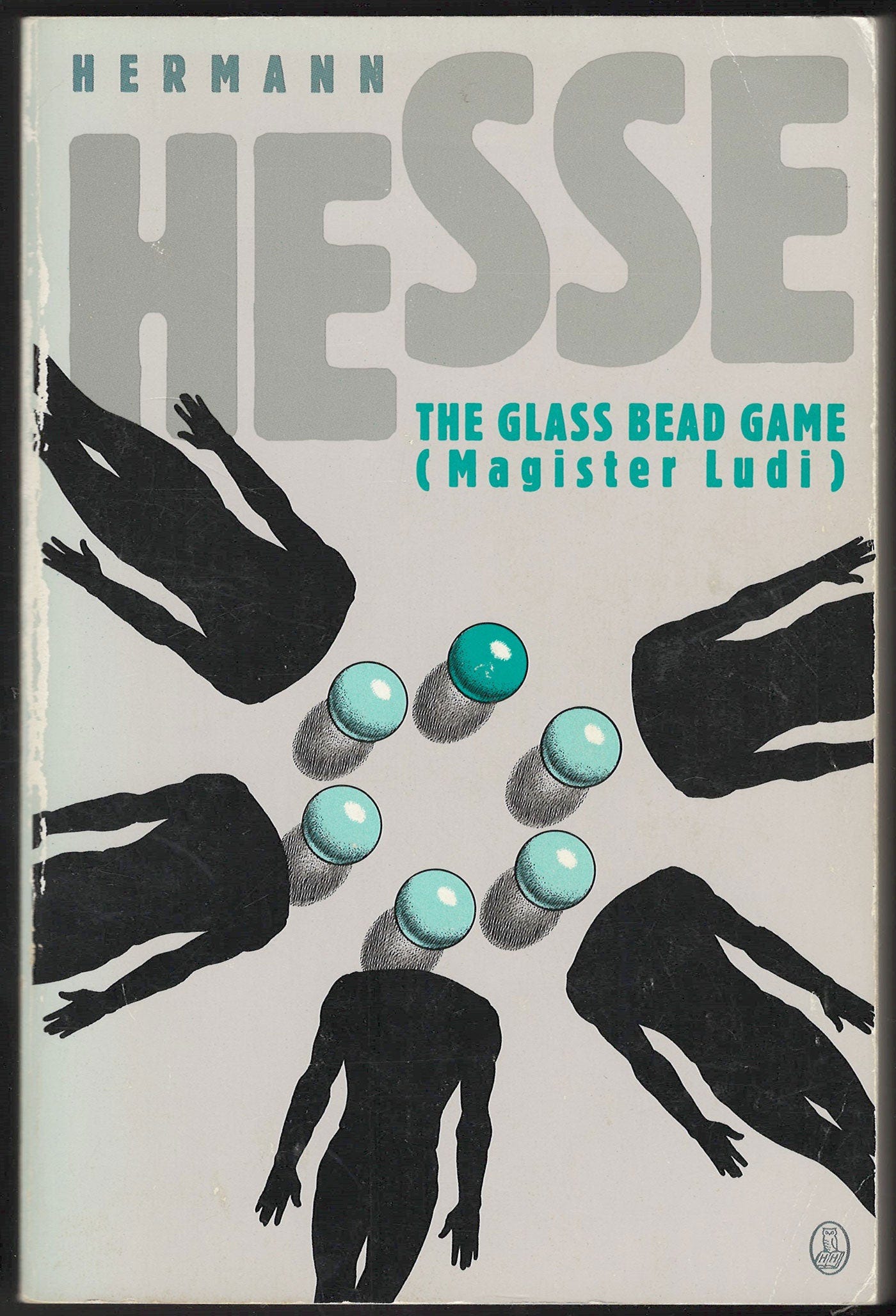
Somewhat uncharacteristic of Hesse’s major novels, The Glass Bead Game could be called speculative fiction, even science fiction. The bulk of book is made up of a biography of a man named Joseph Knecht. Knecht lives about two hundred years in the future- his biographer is writing from further into the future than that.
In Hesse’s future Europe — implied to be the more or less peaceful product of the exhaustion following a century of war — there’s a province called Castalia. They call it “the pedagogical province” and it is solely dedicated to the life of the mind. Gifted children are sent there to be raised up to think especially about abstract subjects- mathematics, philosophy, music, poetry — free from the distractions of quotidian reality. Castalia trains teachers for the rest of the realm, and sometimes people go there for schooling. But there’s a core of permanent Castalians, and their highest pursuit is the titular Glass Bead Game. Despite (or because of) its centrality to the story, Hesse never describes the mechanics of the game. We’re told it involves arranging highly abstract analogies between patterns of thought across diverse fields of knowledge. Whatever else it is, it’s a metaphor for intellectual life, especially as pursued in an un-self-interested manner, for its own sake.
Castalia, for Hesse, was a lot of things. Probably most importantly for him, it was a staging ground for a drama of self-discovery for his main character, the sort of story he specialized in, but that’s not what I’m focusing on tonight, for better and for worse. It was a fantasy of a world of thought and art separated entirely from worldly concerns like money and politics, especially appealing to an apolitical man in the thirties and forties. But it was also Hesse’s speculative answer to a question we would likely call political- what might preserve humanistic learning and culture in a future stemming from a present where these things seem endangered, possibly to the point of extinction? What sort of communities might arise out of the task of preserving the capacity for rigorous abstract thought?
The Glass Bead Game is one of three books I want to talk about tonight that ask some of the same questions. The other two are Walter Miller’s A Canticle for Leibowitz, published as a novel in 1959, and Neal Stephenson’s Anathem, from 2008. I’m interested in how these three writers thought about what was needed to preserve and advance learning in situations inimical to it. None of the three thought of themselves as being especially “political” writers — indeed, two of them averred a disdain for politics in general — but all three put some degree of thought into what a community dedicated to preserving humanity’s culture-producing capacity might look like. These, in turn, were influenced by how the three authors understood what, exactly, the threat to culture was.
In all three of these books, the communities in question are, to one degree or another, cloistered- intentionally removed, socially and geographically, from the rest of the world. Their degrees of isolation vary, but all of them emphasize their mission via a physical separation from others.
In this, all three recapitulate an important historical story. Most of us are familiar with the idea that for hundreds of years, Christian monks preserved texts from classical antiquity, portions of the immense learning of Greece and Rome, from the social, political, and economic breakdown that went along with the fall of the western Roman Empire. These texts, and some practices of learning that monks preserved or created in their cloistered spaces, in turn allowed the Renaissance and scientific revolution to flourish.
There are many complicating factors to this story. A lot of them have to do with larger narratives that the story has been woven into- was it really preserved classical knowledge that gave Western Europe a leg up in scientific progress, or was it the massive sack of loot they sat on after stumbling into and savagely exploiting the new world? Were the monasteries a light in a dark age, or was the post-Roman period only dark because self-serving philosophers centuries later wanted to make their time look better? How many classical ideas were transmitted from monasteries versus came to the once-marginal lands of Western Europe as the result of interactions with the Byzantine and Islamic world, that did not see a collapse in institutions like you got in the west?
All of those caveats duly registered, the story that says “monks preserved old texts, encouraged learning (at least some of the time), and their work was important for cultural transmission” does seem to basically hold up, if not necessarily sustaining the weight of extra interpretative baggage. It is an important thread in the tapestry of history, and more than that it has become a legend, a symbol, that is, the stuff that makes up speculative fiction.
Mention speculative fiction and institutions protecting knowledge in a dark age, and inevitably someone will mention a book that I specifically excluded from my three topics. Let me then dispense with a work I’m sure you’d ask me about if I didn’t address: Isaac Asimov’s Foundation series, which drew directly on Gibbon’s Decline and Fall of the Roman Empire to tell a story of a select body of scientists who predict a galactic dark age, preserve scientific learning, and help lead humanity back to glory. I honestly don’t care for it.
Across the three books in the original series, whenever the Foundation looks like it’s in trouble, like a bad guy is going to thwart its noble plan, it turns out that by using “psychohistory,” they had predicted almost every move the enemy makes centuries in advance. Classic scifi is usually about intelligence winning out over adversity, but in the case of many of the series characters, they don’t really overcome anything- they follow a script set up by a genius a long time ago and then they win. It takes a lot of the fun out of things.
Not just fun- a lot of the interest in such stories, for me, is lacking in Foundation. To me, the knowledge monasteries are interesting precisely because they aren’t all powerful. They don’t dominate the worlds in which they live. The people in them can’t be confident that the knowledge they’re preserving will redound to any benefit beyond knowledge for its own sake. They have to grapple with dilemmas. They can reflect on fundamental questions about what valuing knowledge means. And Foundation has very little interesting to say about threats to culture- the galactic empire just got too big and corrupt and as it collapsed, people stopped caring about science. That was about it. Foundation is about scientific progress temporarily inconvenienced — though really it had everything handled. I’m interested in stories where the frame is a threat to the concept of humanistic learning in general, science very much included.
I could lead off this lecture with a description of what Hermann Hesse’s life was like while he was conceiving of The Glass Bead Game because he’s had a lot of criticism and multiple biographies written of him. He was a Nobel laureate who was very popular in Germany and who enjoyed a revival in the US after his death in 1963, when he was taken up by the counterculture and other spiritual seekers (including my father- I had Hesse’s books in my house growing up). He also wrote volumes of letters and journals, the sort of things historians love to use as sources.
Walter Miller won the Hugo for A Canticle for Leibowitz after it was published in 1959. But he lived in a time when science fiction was little esteemed- no Nobel for him. He was also an intensely private man. Among devotees of his work, there’s a sort of litany of known facts about him that taken together form a tableau of tragedy and irony. We know he was in the Army Air Force during World War II, and took part in bombing and destroying Monte Cassino, the oldest monastery in Western Europe, where Nazi troops had holed up during the Italy campaign. This, we’re told, impelled him to learn more about monasticism and to convert to Catholicism after the war. He wrote a few dozen stories for the scifi pulps in the fifties, including some that would be woven together into A Canticle for Leibowitz. The novel was an instant success and something of a crossover hit, garnering mainstream praise.

A Canticle for Leibowitz starts with the world plunged into a new dark age by a nuclear war that wiped out most of humanity six centuries prior. In the wake of the war, people turned furiously against the scientists who made the weapons possible, and eventually on literacy (and the literate) themselves. The novel concerns the Albertian Order of Leibowitz, a Catholic monastic order based in the New Mexico desert. Founded by repentant weapon designer Isaac Leibowitz in the aftermath of the war, the order dedicates itself to preserving what it can of mankind’s knowledge from the flames of the mobs and from the neglect of a shattered world.
The first third of the book depicts post-apocalyptic North America as being roughly like early medieval Europe- I’m told “dark ages” is a term we don’t use anymore, but it would have been current in Miller’s day and that’s what he was going for. The second third takes place six hundred years later, and the continent is undergoing something of a renaissance, including increased interest in the old scientific documents that the Abbey holds. The final portion, another six hundred or so years later, shows civilization back to space age technology… but seemingly not having learned much about how to live peaceably. Another catastrophe is in the works.
Through it all, the brothers of Saint Leibowitz carry on with preserving the memorabilia of the lost civilization of the 20th century, along with the usual tasks of a Catholic monastic order. While there are memorable characters in the book, the real driving force in A Canticle for Leibowitz comes from its considerations of human fallibility, time, and the commitments we make that seek to transcend both, but inevitably get entangled in them. The Leibowitz monks are always faced with the question of whether what they’re doing is worth it- whether anyone cares about what they’re preserving, or if anyone will do anything good with it if they do care.
Keeping going in the face of existential doubt is a major theme in Canticle, which makes the author’s life after writing the book all the more poignant. Miller never published anything else in his lifetime. He became a recluse in his Florida home. His literary agent never met him in person. In the nineties, his agent contracted the scifi author Terry Bisson to ghostwrite a sequel to A Canticle for Leibowitz, based off of some writings Miller had been toying with for years. Bisson never had the chance to meet Miller, either. Shortly after his wife died, Miller shot himself. Bisson finished a sequel, Saint Leibowitz and the Wild Horse Woman, published in 1997, which deals with altogether different themes than Miller’s original novel.
Miller’s death is especially sad given that the last third of Canticle is a deeply felt cri de coeur against giving up on life. Even as everything the Leibowitz monks have been doing for eighteen hundred years seems to have all led up to humanity just repeating its worst mistakes, even in the face of terrible and inevitable suffering and death, Miller depicts soldiering on as the highest moral imperative. For me, some of it was noble — the Leibowitz monks packing away its archives to take somewhere safe — and a lot of it is questionable, like a monk counseling people dying of radiation poisoning about the evils of assisted suicide, but all of it was clearly deeply felt.
Rather than dwell on the painful irony here, I think it’s worth establishing what Miller was doing in Canticle in terms of presenting the task of preserving knowledge and culture. Canticle is the most directly religious of the three novels. There are more than a few religious overtones in The Glass Bead Game and Anathem, but Canticle is the only one where the culture-preserving order is actually religious, and via a religion that actually exists. Preserving the memorabilia is a way of remembering the dead and honoring knowledge, as a way of glorifying god. It wasn’t there, necessarily, to spur a technological revolution. The middle third of the book is about conflicts the monks face when some secular scholars researching at their archives become scientific advisers to emerging states with imperial ambitions. The cloistered orders in the three books aren’t anti-technology — far from it, the Leibowitz monks are often tinkering with devices inspired by the archive — but the point of what they’re doing isn’t strictly practical. They want to preserve thought for its own sake.
About ten years after Miller’s death, in 2008, Neal Stephenson published Anathem, our third subject. There’s a few extra-textual differences between Anathem and the other two books that we ought to address at the start. Hesse and Miller are dead- Stephenson is very much alive and writing. While the other two were pretty successful writers in their lifetimes, Stephenson is a contemporary bestseller. This means there’s a lot of promotional fluff out there about him and his work. The favor he’s found in Silicon Valley — he was the first hire at Blue Origin, Jeff Bezos’ space company, and early novels like Snow Crash and The Diamond Age are widely beloved by nerds — hasn’t helped increase the signal to noise ratio in the interviews, criticism, and such around his work. A last thing to note is that Anathem is longer, by a comfortable margin, than The Glass Bead Game and A Canticle for Leibowitz combined.
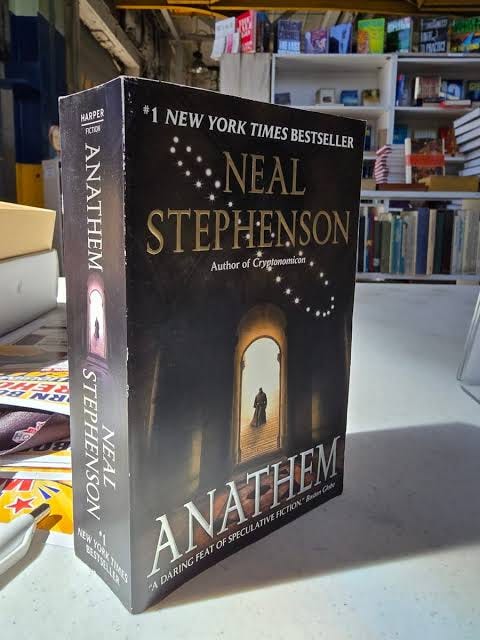
That means there’s a lot of Anathem to potentially discuss, which in turn means there’s a lot I’m not going to talk about. Suffice it to say that, like the other two, a cloistered order dedicated to preserving knowledge and ways of thinking stands at the center of the story. In the world of the book — for much of the novel, it’s unclear whether this is another planet or the earth in the future — most philosophers and scientists live in cloisters called “maths.” The Maths enforce varying degrees of isolation from the Saecular world around it — some parts of some maths act, essentially, like universities, with plenty of interaction with the outside, and some are so profoundly isolated that their doors only open to the saecular world once every thousand years.
As that implies, this state of affairs has gone on for millennia, depending on how one interprets some of the in-world information Stephenson liberally doles out through this long long book. We learn that advanced industrial civilization has risen and fallen at least twice in the world’s history, and that the Mathic system as we know it grew up in response to one of these downfalls.
In all three of our novels, protagonists have to leave the cloister and venture out into the rough and tumble world. When Anathem’s characters leave the walls, they encounter a world that seems to be similar to that obtaining in the US in the early aughts, described through the eyes of deeply cloistered vaguely-Platonist science monks. Or, maybe early aughts America with a dash of Idiocracy thrown in. That’s not entirely fair. Yes, the landscape is largely made up of casinos and fast food restaurants. But Stephenson — not an author, historically, who’s above stereotype and cheap shots — doesn’t make the saeculars stupid and the mathic smart. It’s not even really that the saeculars are crude but practical and the mathic are sophisticated but unworldly, though there’s some of that.
Really, it’s more a reflection of different types of thought, encouraged by different social and cultural arrangements. Much like Castalia, much is made about how the isolation of the Maths allows the avout — as the monk-like inhabitants are called — to focus solely on things that are capital-T True and unchanging, not the contingent, ever-changing swirl of truth and bullshit that characterizes the outside world, regardless of what societal level obtains there. Not all of them are believe in something much like Platonism, but the protagonists all do, and are guided by the idea that truths like the Pythagorean theorem or classical mechanics are true in an existential sense and that there’s probably something like a world of ideal forms that these truths come from. The maths are an attempt to create a world where these truths are the focus of life by minimizing potential distractions.
Presumably, hiving off the philosophically-minded into weird science monasteries for thousands of years has encouraged a certain emphasis on the contingent and practical in the Saecular world, and Stephenson isn’t shy about saying that such worldly outlooks can lead to a world of casinos, big box stores, and an inability to pay sustained attention. Here, it’s worth noting two things about the mathic world- unlike Castalia and the Leibowitz abbey, the mathic world includes women and men both… but they also don’t reproduce sexually. Sex and relationships are allowed, but everyone is on birth control- they aren’t allowed to have kids. They adopt orphans, and sometimes people volunteer to join.
All of this, and a lot more worldbuilding aside, is set up for a great big philosophical scifi thriller plot that I won’t even go into here. I will say that the big adventure in the book helps answer a question that might linger in a reader’s mind about the relationship between the mathic and saecular worlds- what good are the avout? In the usual economy of scifi thrillers, whether in book, movie, tv, or video game format, the brainiacs are around to come up with technology for heroes and villains to use. But the saecular world doesn’t need the mathic world for technology- in fact, there are numerous technologies the avout aren’t allowed to use for various reasons. Of course, the avout in the novel go on to be all kinds of useful in various adventures once they get their feet under them, but the main thing the mathic world is good for is thinking - thinking deeply and systematically, thinking beyond convention, cliche, and short term means-ends rationality. It’s not as though the saecular people can’t think that way, but most of them don’t, and none of their social institutions or customs are built for it. The mathic world is.
The first decade of the 21st century is an interesting time for this book to appear. The culture at large was much more optimistic about technology, in a more innocent way, than you see these days- pre-Snowden, pre-Trump, pre-most Internet outrages you could care to name. But here is an author who many in Silicon Valley see as inspirational making a loving portrait of a society withdrawing not just from technology — information technology in specific is a type the avout are instructed to avoid — but from the world as a whole, and especially anything that would be thought of at the time as “innovation.” In some of his books after Anathem, Stephenson is even more emphatic about what he sees as the cultural and even cognitive risks of the ways we use information technology, including some prescient writings on generative AI helping to make the internet so full of slop that it’s borderline useless, or malignant.
Even in tech circles, he’s not alone in this pessimism. As many of us on the sidelines of the spectacle of a handful of overfunded, undersocialized nerds deciding what the future will be have observed, people in the generative AI field in particular predict both utopia and apocalypse as a result of the adoption of their products, sometimes seemingly in the same breath. To put it more concretely, as Stephenson and others caution us- it’s not the technology, it’s the people using it and the incentives they respond to that count, and clearly, those incentives don’t always direct people down good paths. Tech uses that as an alibi, but that doesn’t mean it’s wrong.
People in this room mostly don’t need to be told this, however disdainful of generative AI or other tech products they may be. Most people here would call that set of incentives Stephenson understands as driving tech into the dystopian scenarios he lays out “capitalism” - some wouldn’t, some would equivocate, but I think most of us would agree that there’s some deep structural flaws in how we as a society, or a species even, are going about things.
But what else is new, right? Every generation predicts doom, especially as it starts getting older and can start to see its own mortality more clearly. People always freak out over social, cultural, and technological change. Plato thought that the youth of Athens were being corrupted by that insidious new art form, the drama. That’s how far back the “old man yells at cloud” genre goes. Look at the books we’ve been talking about- the wars Hesse and Miller saw as necessitating Castalia and the Leibowitz Abbey never happened, did they? The world didn’t end.
Given the strength and omnipresence of cliche in online discourse, it’s good to consider how the cliches of decline, especially as tied to new creative forms, are often just that. But the “old man yells at cloud/Plato thought the theater would kill philosophy” thing is also a cliche now, itself. Taken to an extreme, it compresses history into a static flux defined by superficial change and equally superficial resistance.
And here’s the thing: the world has ended. The world has ended billions of time for billions of people, and I’m not even talking about the inevitable end of one’s personal world i.e. death. The basic structures of how people have lived their lives have been yanked down around them countless times- that seems to be the threshold for “the end of a world” per speculative fiction. The introduction of the drama to Greek civilization has had profound effects on western culture ramifying down the millennia, if not the exact effects that worried Plato. The pre-drama Athenian world did end and life was not the same on the other side of the change. You can say that European civilization pulled back from the brink with the defeat of the Nazis in 1945, and for the most part you’d be right- but civilization as Hermann Hesse and Thomas Mann understood it didn’t survive. People, even educated Germans, don’t live, talk, write, or think like them anymore, and if you read enough old books the differences are clear in a thousand ways big and small.
To me, the question should be- what can grow out of the ending of a given world? Most of the time, the answer is at least “something new and interesting.” That doesn’t mean newer is always better, or that we can’t mourn or lament the passing of a world even if a new one takes its place. It means the story can continue, and possibilities can multiply.
Before we get carried away with the beauties of cultural continuity- I am a materialist. The soil from which sophisticated thought grows — in our realm, anyway, even if there is a realm of pure thought out there — is society, is the meeting of people to exchange ideas. Culture, even at the abstract heights of thought, is a way of being social. It means little in isolation. In all of the stories I talked about here — The Glass Bead Game, A Canticle for Leibowitz, Anathem, the history and the legend of the monks of the Middle Ages, and yes, even Foundation — the crisis to which they respond is a crisis of the social production and reproduction of thought. Their societies had reached a point where it looked like there might not be any space for important kinds of thought — or even just literacy — to grow. If the story was going to go on, and not just become an endless brutal slog, someone needed to act to preserve not just books, not just rational thought, but thinking together in community because the community understands this as an essential thing for humans to do.
I think we are in an age where the social production and reproduction of thought is in severe danger. Here, the risks are less those of war or totalitarianism — though both are definitely factors — and more those of the particularly nihilistic and totalizing variety of capitalism with which we live, empowered by technological advancement. To be brief, there is too much power in too few hands and those hands don’t generally like people or care for their flourishing. Some of the ones who insist they do are actually the most anti-human of all. And they have a degree of power to force vast swathes of the population into the walled gardens made by their monopolies and incentive structures. They can strangle anything outside of it, through force or neglect, and the logic of their system insists that in the end, everything goes into the feed.
I don’t think anyone is going to burn your books, though we could easily see some of that under the guise of “protecting children” or something, or an AI company might buy up every copy of a book and “destructively scan” them to ensure you can only access it through them. I think no matter what happens, people can and will have new ideas and imagine different ways of being. But, characteristic of our current stage of capitalism, it’s a numbers game, and the house generally wins. Especially given how much technology has been dedicated to capturing attention and mental energy and retaining it for profit, the walls of the garden or pen we are being corralled into seem high indeed. If it’s hard enough to leave the walled garden, and people within it are run ragged by the demands of survival, and the outside is a confusing, neglected wasteland, you can wind up in a situation where cultural continuity is hard, and thinking along any lines other than the directives of the owners of the walled garden is harder.
So, obviously, all of us — you, and me, and the person sitting next to you, and all the people who said they’d come to the party but couldn’t — should move to a compound, adopt very strict rules about phones, all read a lot of Plato, start wearing robes, and begin growing our own crops so as to minimize interactions with the filthy TikTok addicts outside!
I mean, obviously, no. I’m a socialist. I’ve organized unions, I’ve knocked doors for candidates, I’ve led campaigns to discourage fascists. I’ve educated and agitated, to replace the systems that hold us down with something better. I plan to continue to do so.
But… but. What if we’re at the point where enough people — a critical combination of a sociopathic elite and beaten down masses — can’t or won’t leave their walled gardens, can’t or won’t think in a deliberative, continuous way, so as to render meaningful, purposeful change impossible? Cultural change can become material reality, especially when these changes are so deeply intertwined with patterns of production, reproduction, consumption and so on. Structures can cease to exist, people can lose capacities. Medieval peasants could, and did, revolt against their lords, but they couldn’t accomplish a revolution — they couldn’t permanently change their living conditions or the social and political structure — because the material conditions weren’t there, including the idea that a better world, here on earth as opposed to in heaven, was possible. I think we could wind up in a situation where incapacities in thought become a material condition preventing any kind of positive change in much the same way.
I don’t think this just concerns socialists, either. It concerns pretty much anybody whose idea of a better future isn’t “right now, 2026, the MAGA-grifter-Dubai-Labubu-Netanyahu-wildfire present, but more so.” If you want Liz Warren style progressivism or “classical liberalism” as something other than a fig leaf for fascism or even meaningful scientific progress not subject to the whims of tyrants and billionaires, then I think you need to think about where we are culturally and even cognitively and what that means. It’s true socialists generally rely more on mass involvement, and other ideologies can try to establish themselves on the social basis of an elite who get the vision even if the hoi polloi don’t. But honest liberals, conservatives, and so on surely haven’t missed how compromised elite institutions have been by these same dynamics- in many respects, their brains are rotted even worse than those of normal people. What’s more, at this point, it’s not just hifalutin philosophical thought we’re at risk of losing or massively reducing- basic understandings of science and technology are also at risk. The cloister would need to preserve philosophy, but would also need to preserve having any idea how to change an oil filter, because both are at risk of becoming lost knowledge.
I’m enough of a nerd that I have gamed out in my head a little what a withdrawal from the anti-culture that increasingly dominates our collective life might look like. Anathem is probably closer to a model than Leibowitz Abbey (too Christian, no women) or Castalia (nice, but also no women and dependent on the goodwill of whatever rando is in charge out there), but there’s a lot of weird shit in Anathem and, let’s be real- the likelihood that some kind of deliberative thought intentional community would degenerate into a cult is very high. And I don’t want to abandon the fight for something better for all of us, though, increasingly, it feels tiresome and not especially hopeful, and just having to maintain an awareness of how absurd things have gotten is demoralizing.
I suppose to end, I’ll say if we split the difference we can make an effort to reproduce the sociality of thought with purpose and rigor in our own lives. This is probably the largest group of people in one room in Middlesex County tonight who probably needs to be told this the least- a room full of people who think seriously and passionately and apply what they know to the world around them, readers, teachers, organizers - my people. Maybe the real preserve for thought is the friends we make along the way. Among other things, maintaining sociality of thought will be helpful if we ever do reach the point where we have to gather up all our books and start pricing out rural real estate and robes.