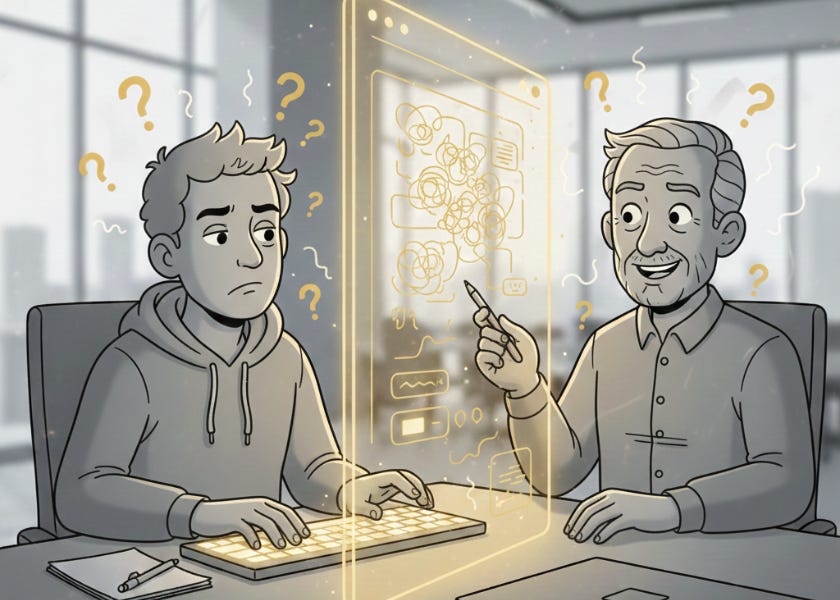
Picture this: you’re on a Zoom call watching one of your senior engineers completely shut down. You keep asking, “What do you think the best approach is here?” and “How would you solve this?” His face gets tighter with each question. Finally, he says, “I don’t know. That’s precisely why I’m on this call.”
As his manager, you thought you were being a good coach. However, it turns out that he just needed someone to just tell him which API to use.
In a physical office, you might have caught this kind of mismatch in thirty seconds. You’d have likely seen the stress on someone’s face, or noticed them frantically scribbling notes instead of nodding along. On a video call, these signals can be muffled or not show up at all.
In high-performing remote organizations, this kind of mismatch is a drain on both productivity and morale.
Every professional conversation operates in one of four modes. The friction happens when you’re in one mode and the other person needs you to be in another.
Telling is direct instruction. “Please use the staging environment for this test.” or “This needs to go live Friday at 9am.” It’s the fastest mode, but it’s one-directional.
Teaching is transferring a specific skill or piece of knowledge. This is the screen-share where you walk someone through a new tool, or the Loom video explaining your testing workflow. You’re the expert closing a knowledge gap. The other person doesn’t need to figure it out. They need you to show them and then it’s up to them to decide how to apply what they’ve learned.
Mentoring is sharing your own experience as a map. “When I was leading a similar migration, here’s what I wish I’d known about stakeholder communication.” You’re offering pattern recognition from your own career, but you’re not pretending your path is their path. They still have to do the driving. You might also consider ‘modeling’ as part of the mentoring; doing something with them ‘looking over your shoulder’ to see how you handle it in practice.
Coaching is the most powerful and often most underused mode for teams. It’s purely inquiry-based. You’re not giving answers. You’re asking questions that help someone find their own answers. “What’s the trade-off you’re most worried about?” or “What would success look like here?” It develops judgment and helps the other person find their own solution (and grow).
Most real conversations are a mix of these modes. The majority of successful leaders blend these modes fluidly and seamlessly. This blending requires mindfulness, self-awareness and active listening along with the relevant domain expertise.
Consider two common examples of mode-mismatch…
The Frustrated Expert: You’re stuck on a complex strategic decision. You have the context, you understand the trade-offs, you just need to think out loud with someone who asks good questions. Instead, your colleague jumps straight to solutions. “Just do X.” “Why don’t you try Y?” They’re problem-solving before they’ve understood the problem. You leave the call feeling unheard and more overwhelmed than when you started.
The Stranded Junior: You need concrete guidance on something you’ve never done before. You don’t have enough context even to know what questions to ask. But the person you’re talking to stays in coaching mode: “What do you think we should do?” “How would you approach this?” It feels like a test you’re failing. You need a map, and they’re handing you a compass.
The fix in both cases is deceptively simple:
State out loud what kind of conversation you’re aiming to have.
High-performing remote teams do this explicitly at the start of calls. You might hear them say things like…
“I’m coming to you because I need some mentoring on how to handle this stakeholder. Can you share how you’ve navigated something similar?”
“I’d like to coach you through this roadblock rather than just giving you the answer. Does that work for you, or do we need to move faster right now?”
“I’m going to be in teaching mode for the first ten minutes. Let me walk you through this workflow, then we can discuss how you’d adapt it.”
The key quality that is fostered by these kinds of phrases is consent. Coaching someone who wants to be told what to do feels like an interrogation. Teaching someone who needs to be coached feels patronizing. But if you’ve agreed on the need and the mode upfront, both people can relax into the conversation.
Naturally, this doesn’t mean conversations can’t shift modes. Sometimes you start coaching and realize the person genuinely lacks information, so you switch to teaching for a moment. The point isn’t rigidity; it’s awareness…
Telling typically fails when the person needs to build judgment for future similar situations. You’ve solved today’s problem, but you’ll get the same question next week.
Teaching usually fails when they already have the knowledge but lack confidence to apply it. Walking them through the steps again won’t help. They need you to trust that they can figure it out.
Mentoring often fails when contexts are too different (your path isn’t their path). Your war stories from scaling a B2B SaaS product won’t help someone launching a consumer mobile app. The principles might transfer, but the specifics won’t.
Coaching typically fails when there’s a genuine knowledge gap or time pressure. Asking “What do you think we should do?” when they’ve never done it before just wastes time and erodes trust. And during an incident, nobody needs Socratic questioning.
As a manager, you need some baseline assumptions around which mode to suggest when you’re about to jump on a call or respond to a message. Ask yourself…
Is this urgent and time-sensitive? Tell. Don’t workshop the solution during an outage. “Database is down. Switch to backup server B. Now.”
Do they lack a specific skill or piece of knowledge? Teach. They can’t figure out what they don’t know exists. “Let me walk you through the CI/CD pipeline. Open the guide doc so you can follow along.”
Are they capable but need perspective on a challenge? Mentor. Your experience is the shortcut. “When I had to deliver bad news to that client last year, here’s what I learned about timing the conversation...”
Do they have the knowledge but need to develop their own judgment? Coach. “You’ve handled three similar migrations. What’s different about this one that’s making you hesitate?”
You’ll know your team is getting this right when managers spend less time being pinged for decisions, people stop hoarding information for fear of being quizzed on it, and 1:1s feel like actual conversations instead of status updates.
The next time you open a Zoom link, pause for five seconds and ask yourself…
What kind of conversation does this need to be?
And does the other person know/consent?
That small act of labeling, of making the invisible structure visible, might be the highest-leverage thing you do all month.
As always we’d love to help you out with this topic or indeed any of your workplace culture, communication or collaboration challenges. In particular you might like to offer your team our Coaching Fundamentals workshop.