Rust extensions started landing PostgreSQL RPM repository
After trying not to add any Rust packages to the PostgreSQL RPM repository, I finally bit the bullet and pushed pgrx and postgresql_anonymizer to the RPM repos, along with packaging guidelines:
https://github.com/pgdg-packaging/pgdg-rpms/wiki/Packaging-Rust-extensions-(pgrx
Some limitations exist for now:
https://github.com/pgdg-packaging/pgdg-rpms/wiki/Packaging-Rust-extensions-(pgrx)#supported-distributions
Hoping to add RHEL 10.3 and 9.9 support in November.
Enjoy!
Using the PGDG RPM repositories are now way easier!
yum.postgresql.org and zypp.postgresql.org have a new look!
Users no longer have to navigate through pages on the website. Instead, the front page has a clear layout and easy-to-follow instructions. Just select your OS, version, architecture, and PostgreSQL version, and you'll see instructions that you can copy and paste. There is also a new "copy link" option that you can customize as needed, share in your blog posts, or parse in your automation systems. We now also provide easy installation instructions for the extra packages repository and the non-free repository.
Enjoy!
RHEL / Rocky Linux / AlmaLinux repository RPMs now follow the OS minor version
Since I started building packages separately on each supported RHEL minor version, there has been a repository RPM for each minor version (9.6, 9.7, 9.8, 10.0, ...) in addition to the one for the major versio (9, 10). All of them share the same package name, and the minor version specific ones are also published in the repository of the latest minor version. As a result, dnf update replaced the major version repository RPM with the one of the latest minor version at that time, which then stayed on that minor version forever, even after the OS moved to a newer one.
I just fixed that issue. Please update the repo RPMs at your earliest convenience. Read the details here:
https://yum.postgresql.org/news/repo-rpms-follow-os-minor-version/
Issue detail: https://github.com/pgdg-packaging/pgdg-rpms/issues/215
I'd like to thank Daryl Herzmann for the report, analysis and testing.
PostgreSQL RPM repo comes to Amazon Linux 2023!
If you run PostgreSQL on EC2, you've had two real choices until now: build from source, or fall back to whatever version Amazon Linux itself carries in its base repos. Neither matches what the rest of the PostgreSQL community gets from yum.postgresql.org — the full extension ecosystem, day-one minor releases, and a consistent layout across distributions.
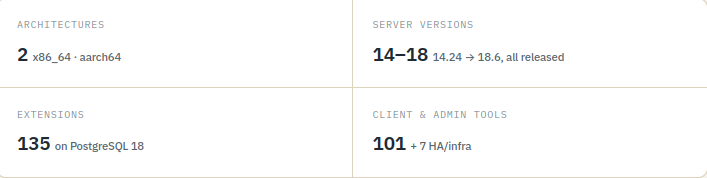
That gap is closed. Amazon Linux 2023 is now a first-class target of the PGDG YUM repository, with its own build root and its own package tree, right next to Enterprise Linux, Fedora, and SUSE.
Summary first:
Inaugural PostgreSQL Istanbul Meetup was a blast!
We had our first meetup on Thursday, July 2nd, organized by the community people for the community people. Bilge Korkmaz Erdim, Gülçin Yıldırım Jelínek, and I had been working on the meetup idea for a long time, and it finally came together — hosted by Microsoft Turkey at their Levent office. A big thank you to Bilge for helping organize the venue, taking care of food and drinks, and being a great host.
Announcing openSUSE Leap 16.0 Support in the PostgreSQL RPM Repository
Today I added openSUSE Leap 16.0 support to the PostgreSQL RPM repository. Please find all details here:
https://zypp.postgresql.org/
You can find the repository RPM here: https://zypp.postgresql.org/repopackages/
This release includes all packages, including the "extras" repository.
Report any issues here: https://github.com/pgdg-packaging/pgdg-rpms/issues/new
What happened?
This is an incident report, a post-mortem writeup and detailed info how we started supporting multiple RHEL minor versions.
Last month PostgreSQL RPM repos were broken for Rocky Linux and AlmaLinux 9 and 10 users due to an OpenSSL update that Red Hat pushed to versions 10.1 and 9.7, which broke backward compatibility. Actually I broke the repos.
Installing PostgreSQL on SLES 15 just got easier – and better!
The PostgreSQL RPM repository for SuSE Enterprise Linux has supported SLES for quite some time. We followed the usual conventions and used zypper addrepo … to add the repositories.
Improved aarch64 (arm64) support is available in the PostgreSQL RPM repository.
The PostgreSQL RPM repository has included aarch64 support for a couple of years, however it was limited (like lack of packages, maintenance issues, etc).
Thanks to the PostgreSQL.org sysadmins team, along with the new and shiny build servers, aarch64 support is now improved. Here are the changes:
Pagila 3.0.0 is out with shiny new features and bugfixes
I just released Pagila 3.0.0, with some new shiny features:
How to install PostgreSQL and PostGIS on Rocky Linux 9
Rocky Linux 9 is finally out. Some repo names changed, so here is a short guide about installing PostgreSQL and PostGIS on Rocky Linux 9:
How To Build Your Own PostgreSQL (and related software) RPMs on RHEL/Rocky/Fedora
Even though there is a wide range of RPMs for PostgreSQL and related projects in the repositories, some people don't want to use prebuilt options, or may apply some extra specific patches. Also, some companies prefer to build their packages from srpms, per their IT policy -- so they maintain their own packages.
This is very easy if you use the PostgreSQL RPM Repository infrastructure. Now, I will go over the details for it.
New repo: Extra packages for PostgreSQL RPM repo
Recently I added consul and haproxy packages to PostgreSQL RPM repository to support Patroni installations. The main motivation is to provide latest and greatest versions of these packages. However, these packages may break existing installations, like HAProxy 1.8.4 RPM on RHEL 8, where we provide 2.5.4 as of now.
So, in order not to break some users' environment, I added new repos:
Installing PostgreSQL 14 beta/RC on RHEL / Rocky Linux / Fedora and SLES
PostgreSQL 14 beta 2 is released. As written in the announcement, "In the spirit of the open source PostgreSQL community, we strongly encourage you to test the new features of PostgreSQL 14 in your systems to help us eliminate bugs or other issues that may exist."
So, let's install it!