Introduction
In 2026, the role of the public library as an essential democratic institution is in profound jeopardy. Across the United States, efforts to pressure and censor libraries continue to erupt with great frequency, as local citizens, pressure groups, and elected officials try to dictate what ideas and books are readily accessible to the public. As with schools, universities, and other institutions committed to the free exchange of ideas, attacks on public libraries have been worsening and proliferating in recent years, threatening freedoms that form the bedrock of American society.
There is nothing quite like public libraries: institutions whose core purpose is to facilitate the informed citizenry that sustains a democracy. Since the idea for such publicly funded institutions emerged in the United States, libraries have served as bastions of independent thought and intellectual freedom, predicated on the rights of all people—patrons of all ages, races, and socioeconomic backgrounds—to access information, ideas, literature, and art, all free of cost. Rising threats against that mission jeopardize something vital to American society. As Benjamin Franklin put it in 1771, forty years after he established the first public library in the country, thanks to early libraries, “the common tradesmen and farmers” in the colonies were “as intelligent as most gentlemen from other countries.”
As pillars of civil society, public libraries are places of voluntary inquiry and should serve as unfettered gateways to the universe of knowledge. But since 2021, they have faced significant pressure to restrict access to information about race, sexuality, and gender as part of a larger movement that is chilling the freedom to read, learn, and think in public institutions through legislation and intimidation (previously dubbed the “Ed Scare” by PEN America). This attack on knowledge, ideas, art, and books has never been just about books; it is a mechanism being used to influence who gets to be part of the American story—our collective sense of history, identity, and culture—and who is excluded from it.
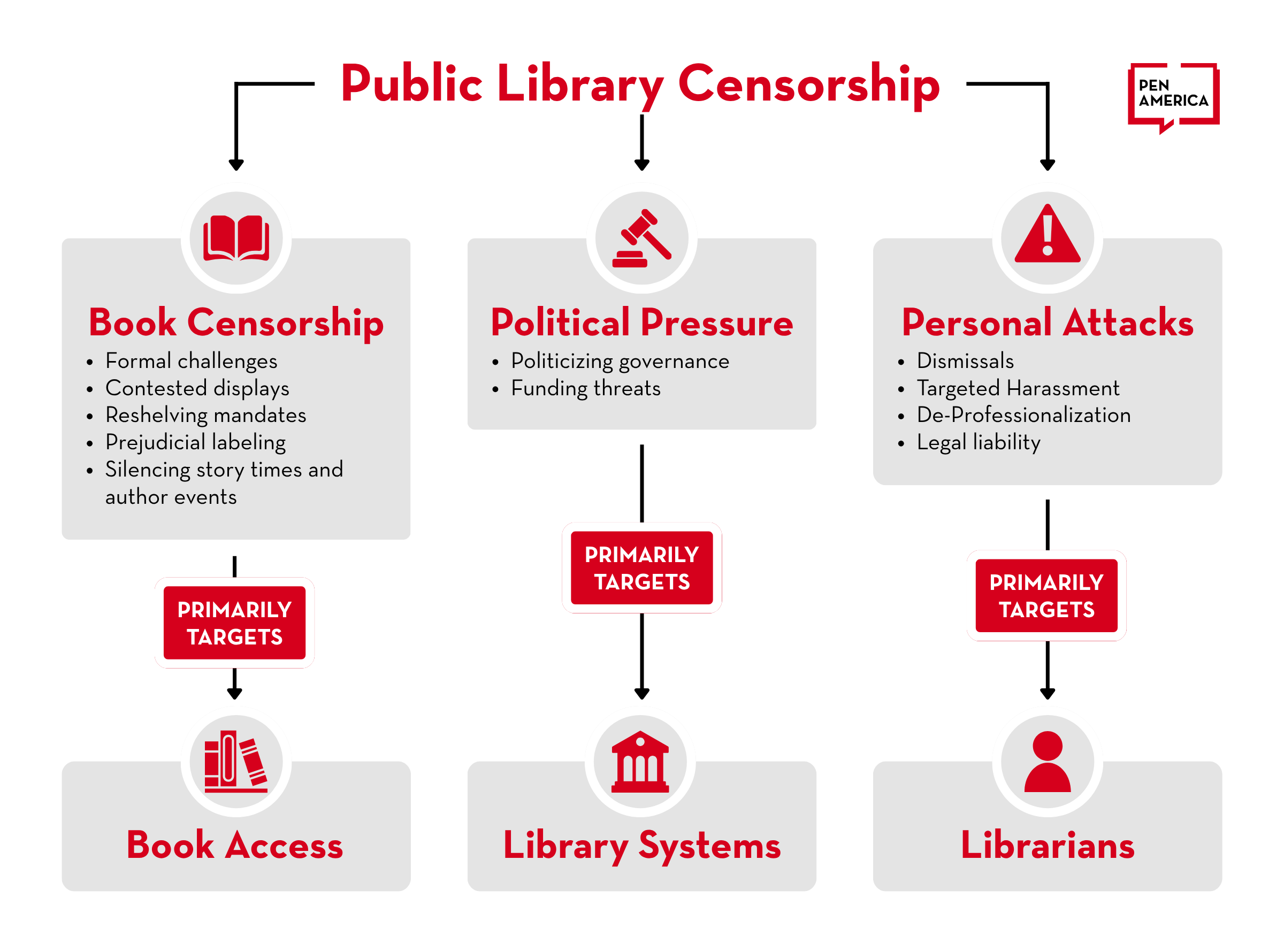
Today, as pressure campaigns have evolved, libraries are facing not solely demands to censor books but efforts to control multiple facets of their operation. Taken together, this is nothing less than an attack on the idea of the library as a public institution and the principle of a diverse democratic society it represents. It’s an attack on bedrock American values, among them freedom of speech, individual liberty, and equality. With mounting pressures to censor their collections, police their programs, and narrow their ability to facilitate ready access to a broad range of ideas, libraries feel like they are reaching a breaking point.
As pillars of civil society, public libraries are places of voluntary inquiry and should serve as unfettered gateways to the universe of knowledge.
This report offers a summative analysis of the worsening trends to censor and pressure public libraries that have been expanding since 2021. We focus on the expanding censorship of library books and programs, political threats that are eroding library systems, and the worsening harassment and intimidation of librarians. There are many parallels with the tactics PEN America has documented as driving book bans in public schools; but there are some vectors of censorship that are becoming more common in public libraries. While some actions, like formally challenging books to demand their removal, were already common in libraries and have become more so, in recent years we have seen rising pressure to improperly reshelve books through prejudicial labeling (“aging up” or stigmatizing books with certain topics), as well as public campaigns against book displays or efforts to cancel events for overtly political reasons. Governance and funding of libraries, from the local to the national level, have also become tools to either compel ideological compliance or oppose the basic concept of a public library. Librarians are being threatened, harassed, and in some cases driven from their jobs—another source of censorship pressure. One thing is clear: Public libraries need their supporters now more than ever.
Expanding Censorship in Public Libraries
Book Removals
Much like school libraries, public libraries have faced a coordinated movement to suppress certain kinds of content on shelves over the last several years. In 2025, the American Library Association (ALA) reported that 51% of ALA’s documented book ban attempts occurred in public libraries. These censorship attempts have been driven largely by organized groups, whose efforts are then picked up and amplified by elected or appointed government leaders. Often these groups or government officials use rhetoric related to protecting “parental rights” to justify their attacks on books, or they claim that material is “pornographic,” “sexually explicit,” “harmful,” or “inappropriate.”
These stated reasons for book bans also tend to conceal their actual effect. Much like in public schools, book bans in public libraries disproportionately limit representation of historically marginalized groups, especially people of color and LGBTQ+ people. Of ALA’s 15 most-challenged books in public libraries in 2025 (distinct from ALA’s list for school libraries), 14 prominently address sexual orientation and/or gender identity. The 15th is Our Skin: A First Conversation About Race.
What is a book ban in a public library?
PEN America’s definition of a book ban applies in both public school libraries and public libraries. We define a book ban as any action taken against a book based on its content—and as a result of community challenges or administrative decisions, or in response to direct or threatened action by lawmakers or other government officials—that leads to either the complete removal of a book’s availability for library users or restricted or diminished access to a book. Diminished access is a form of censorship and has implications that extend beyond a title’s removal. Accessibility forms the core of PEN America’s definition of a book ban and emphasizes the multiple ways book bans infringe on the rights of communities, professional librarians, and authors.
An igniting case in the current wave of censorship efforts in public libraries occurred in Llano County, Texas, in 2021. Suzette Baker, then a librarian at the Llano County Library System’s Kingsland Branch, resisted efforts by her boss to remove books from the shelves and restrict certain titles, such as a book about critical race theory, behind a counter. When Baker ultimately ignored or resisted these requests and protested other book removals, she was fired for “insubordination,” “creating a disturbance,” and “failure to follow instructions.”
Llano County Library System would go on to remove 17 books that ranged widely in subject matter, including Maurice Sendak’s In the Night Kitchen and a series of children’s “butts and fart books,” like Larry the Farting Leprechaun by Jane Bexley, alongside books about race and racism, sexuality, and gender, such as Caste: The Origins of Our Discontents by Isabel Wilkerson, They Called Themselves the K.K.K.: The Birth of an American Terrorist Group by Susan Campbell Bartoletti, and Being Jazz: My Life as a (Transgender) Teen by Jazz Jennings.
In 2022, a group of library patrons challenged the book removals in Llano, culminating in a decision by the federal appeals court that covers Texas, Mississippi, and Louisiana, which refused to apply to public library removals the First Amendment right to receive information, and held that library book curation is “government speech.”
That unfortunate decision, coupled with the general series of events in Llano, was a harbinger of events to come. Since 2021, public libraries across the country have faced heightened book challenges and removals. These attacks on books, commonly based on misleading terms concealing bias against marginalized groups, too often escalate or manifest into other detrimental effects: dismissed librarians, a weakened library system, and reduced access to books for the general public.
Contested Displays
In addition to books themselves, book displays have been vulnerable to organized censorship campaigns. Displays themed on topics perceived as “political” or “divisive” have been taken down or prohibited, often a result of the targeted efforts of individuals, groups, or government officials. Attacks on book displays occur for many of the same reasons that individual books are targeted: representation of identities and perspectives some would rather have hidden or silenced. Librarians have been ordered to remove displays related to Banned Books Week and Pride Month, and seen bans on displays for events that recognize specific groups, such as Black History Month and Women’s History Month.
In 2022, CatholicVote launched an effort called “Hide the Pride” to remove children’s books from Pride displays. The purpose was not to express a perspective but to remove a perspective: Organizers stressed that “it is not a debate,” instructing participants “not to make [their] case or get into arguments” but merely to check out as many books as possible to keep them inaccessible, going through multiple library users, if possible.
In 2023, five titles (mostly children’s books) were removed from the New York Public Library’s Roosevelt Island branch after being arranged in a display for “Read Palestine Week.” The books, primarily by Palestinian authors, including Aya Ghanameh, Reem Kassis, and Hannah Moushabeck, had been assembled in an “Indigenous People’s” display, alongside books about Native Americans. An adult couple checked the books out “indefinitely,” claiming the need to “prevent the indoctrination of children.”
What begins as a pressure campaign too often ends with politicians—not librarians or communities—deciding what books people can discover through displays. In 2025 in Memphis, Tennessee, for instance, the city government implemented a display approval system for Memphis Public Library’s 18 locations, instructing librarians to pull displays that didn’t meet their new criteria and requiring regional managers’ approval for them to be restored. The policy coincided with Banned Books Week, resulting in empty displays and robbing the community of a chance to discover new books.
Public pressure campaigns also target events and story times, which can force libraries to cancel already-scheduled events or decline events that would otherwise be in their purview. Like displays, story times and author events serve a crucial function for library users and the literary ecosystem. Author events bring literature to life, creating space for conversation and the exchange of perspectives and helping readers encounter new books and authors.
Story times and author events are most likely to be censored if they touch on certain political themes or if the authors espouse certain political positions. In PEN America’s review of public reporting on these incidents, we noted multiple instances of censorship of Palestinian or pro-Palestinian perspectives. For example, in 2024, the New Rochelle Public Library canceled an event with Anthony Arnove and Haley Pessin discussing their book Voices of a People’s History of the United States in the 21st Century: Documents of Hope and Resistance in response to complaints over the authors’ pro-Palestinian beliefs. The event was reinstated only after counterpressure from the book’s supporters. In December 2025, the Los Angeles Public Library canceled an author talk between Palestinian author Jenan Matari and Jewish American author Nora Lester Murad over social media posts by one of the authors; over 100 library staff signed a letter demanding the event be reinstated.
Another frequent target has been Drag Story Hour events—family-friendly readings of books conducted by drag performers—or events focused on celebrating LGBTQ+ titles. Examples include:
- In December 2022, protesters in the Chelsea neighborhood of New York City attempted to shut down a Drag Story Hour event at a New York Public Library branch.
- In March and October 2024, two public libraries in Lancaster, Pennsylvania, and Somerville, Massachusetts, canceled their Drag Story Time after receiving bomb threats.
- In July 2024, Drag Story Hour was canceled in Washoe County, Nevada, after a librarian was injured by an activist who tried to force their way into a Drag Story Hour in one of the system’s library branches.
Libraries have faced protests, pressure from government officials, and even threats of violence for hosting these kinds of events.
Reshelving Mandates
As resistance to book bans has become more effective and better organized, would-be censors have sometimes changed tactics in their efforts to silence. The strategy of reclassifying instead of (or in addition to) removing titles is becoming more common. This typically involves reshelving children’s books in young adult sections, or moving middle grade titles to adult sections. These decisions restrict access to literature based on the content of books, often in direct contravention of a book’s intended readership set by authors and publishers, as well as the expertise of librarians who curate library collections.
The kinds of books targeted with this tactic mirror those that PEN America has seen targeted in public schools—books that touch on race and racism, LGBTQ+ identities, and sex. In particular, books that are being reshelved in this manner tend to contain LGBTQ+ representation, stemming from the misguided view that these titles, much like books with sexual experiences, are “too adult” for younger readers, even if they do not discuss sexual activity. Just as in public schools, these efforts often include claims about “sexual content” in books that are often misleading.
These decisions restrict access to literature based on the content of books, often in direct contravention of a book’s intended readership set by authors and publishers, as well as the expertise of librarians who curate library collections.
The example of Rutherford County, Tennessee, is particularly representative in its combination of book removals and reshelving, political interference in librarians’ curatorial role, and the repercussions for librarians who resist or question demands to censor. Outright book removals began in March 2025, when the board voted to remove trans-inclusive books. The following November, the library shut down entirely for a period to comply with a letter from Tennessee Secretary of State Tre Hargett demanding compliance with a White House executive order on “gender ideology” (discussed further below). Then in March 2026, two board members of the Rutherford County Library System ordered 132 books be reclassified from the children section to the adult section, claiming the titles “promote gender confusion” or include “mature themes about gender.” Titles included picture books like Bodies Are Cool by Tyler Feder and My Rainbow by DeShanna Neal and Trinity Neal.
In response, librarian Luanne James stood up for the principles of librarianship and the First Amendment. When the board ordered her to improperly reshelve the 132 books, she responded in a letter stating: “I will not comply with the Board’s decision to relocate these books. Doing so would violate the First Amendment right of all citizens of Rutherford County and myself. Consequently, I would compromise my professional obligation to oppose government-mandated viewpoint discrimination.” James was subsequently dismissed from her role.
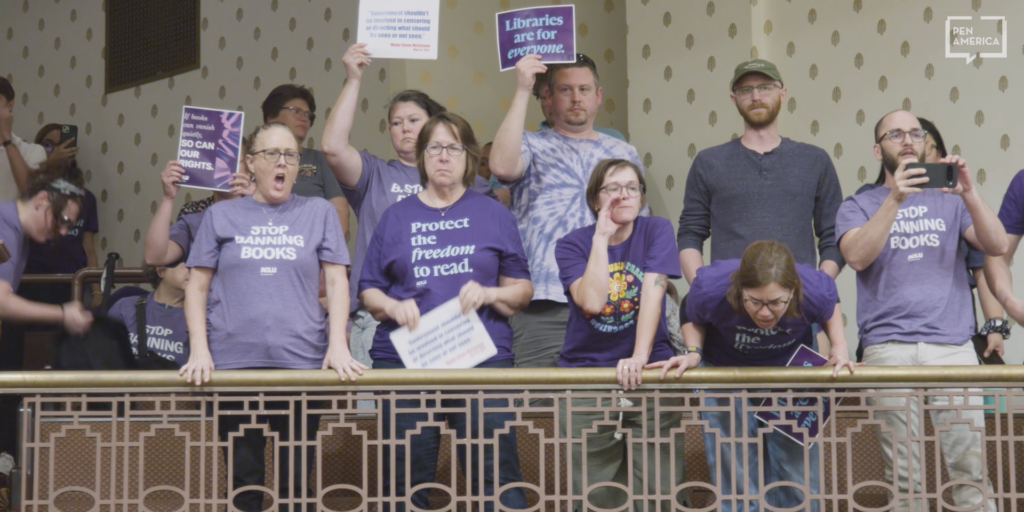
James in the Rutherford County, TN.
Other examples of reshelving mandates like this include:
- In October 2025, in addition to removing titles, the Victoria Public Library in Texas reshelved a list of books to the young adult section (typically serving readers aged 12–18) even though some of the books had a target audience of readers as young as 7. Reshelved books disproportionately included titles with LGBTQ+ content and children’s books on health, like You-ology: A Puberty Guide for Every Body—a book published by the American Academy of Pediatrics.
- In October 2025, Kentucky’s Daviess County Public Library reclassified titles from the young adult section to the adult section, citing concerns of “sexually explicit” material. These moves came after pressure from a local group targeting 248 books, including books on anti-racism. Titles reshelved included frequently banned books This Book Is Gay by Juno Dawson and Flamer by Mike Curato, both written for teenage audiences.
- In July 2026, the board of trustees of Michigan’s Cromaine District Library voted to reclassify 148 titles from the children’s and young adult section to the adult section after receiving over 200 formal book challenges the year prior, in March 2025. Many of the titles contain LGBTQ+ content, or are about racism, gender identity, or sex, including Whose Right Is It? The Fourteenth Amendment and the Fight for Equality and Can We Talk About Consent?’
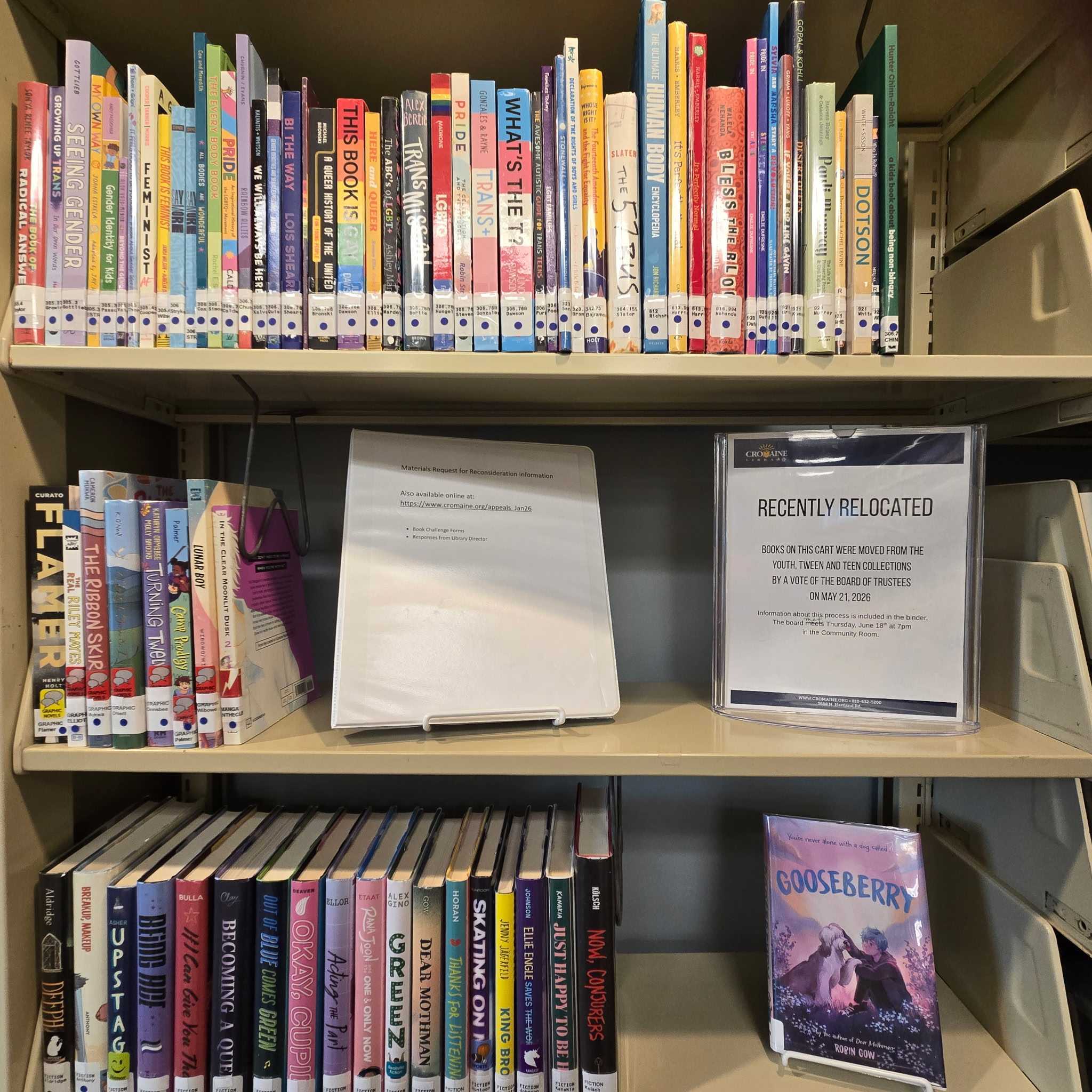
Where children’s and young adult titles that include LGBTQ+ identities or discuss race, racism, sex, and health are barred to adult sections on the basis of that content, these reclassifications set a dangerous precedent for future book challenges and the ability of libraries to effectively serve all patrons. These actions also stigmatize these topics, putting up barriers to young people finding books on issues they are confronting in their lives.
Prejudicial Labeling
Recent years have also seen an increase in attempts to mandate stickers and warning labels for books in public libraries if they contain certain content. The American Library Association distinguishes labels that serve as “directional aids” from “prejudicial labels”:
Prejudicial labels are designed to restrict access, based on a value judgment that the content, language, or themes of the resource, or the background or views of the creator(s) of the resource, render it inappropriate or offensive for all or certain groups of users. The prejudicial label is used to warn, discourage, or prohibit users or certain groups of users from accessing the resource. Such labels sometimes are used to place materials in restricted locations where access depends on staff intervention.
Illustrative examples of such prejudicial labeling include:
- In October 2024, the board president of Missouri’s Christian County Library resigned partially in protest of the board’s intention to label LGBTQ+ books along with books deemed to have “adult” content. The measure did not ultimately succeed.
- In April 2025, Alamance County Libraries in North Carolina approved a system for labeling titles. The “parental guidance” stickers aim to identify books with content deemed sexually explicit or titles with “depictions of substance abuse, references to suicide, underage drinking, graphic violence and profanity.” Local advocates have worried the stickers will be used prejudicially; as the group Read Free NC noted at the time, policies like these are “supposedly to stop children and parents from being exposed to things beyond their understanding, but it mostly targets items that are about the LGBTQIA+ community, people of color, women, and other minorities.”
- In 2026, Wisconsin advanced a state bill to make distributors label books with “explicit content.” One Madison-based literacy advocate shared her skepticism about where the impetus for the law was coming from, saying, “We always look at who is trying to police books, whether they are for adults or teenagers, kids. That’s always concerning . . . who is trying to make those rules and what is their background. Are they education-based or not?” Though it was ultimately defeated, the proposed law would have mandated labels be applied when books are distributed, impacting public libraries as well as school libraries and bookstores.
Whether a book is targeted for removal, stickered, improperly reclassified, or excluded from displays and event calendars, this censorship sends a chilling message: that certain voices, identities, and stories are not acceptable in the public forum.
Disrupt, Defund, and Dismantle: Eroding Library Systems
Just as public libraries have faced efforts to censor more than just their books, they have also been confronted with attempts to dismantle and disrupt broader library systems. This has included changes to governance structures as well as direct funding cuts and, in some cases, procedures or public pressures to create new—and often political—leverage over the curation of library collections and events. In some cases, the motives behind this may lie in a small-government ideology, aiming to minimize or eliminate public libraries entirely from state and federal budgets.
Politicizing Governance
Public libraries can be a foundational democratic institution only if they can speak to everyone and only if librarians’ curation decisions can occur free from partisan pressure or restriction. However, ongoing political and public pressures are challenging these very principles. The ALA’s Library Bill of Rights provides a guiding light on this issue: “Libraries should provide materials and information presenting all points of view on current and historical issues. Materials should not be proscribed or removed because of partisan or doctrinal disapproval.”
State and local policies vary widely on library governance, with some library boards appointed by elected officials and others directly elected. Regardless of structure, though, the governance of a library cannot reliably support free expression if it is manipulated to restrict what ideas can be presented in a library. Unfortunately, in several instances over the last several years, changes in library governance have sought to manipulate the compositions of boards to achieve specific ideological ends.
These dramatic changes in governance often come with increased politicization and, sometimes, direct political interference in collection decisions.
This vulnerability to politicization is even greater for appointed boards than for democratically elected boards, particularly if members are appointed because of their stances on certain issues and are willing—or eager—to impose their viewpoints on a public institution. In Sumner County, Tennessee, in October 2025, that’s exactly what happened. That month, the Sumner County library board voted for the third time to reject a proposed curation policy that would ban material “containing transgender or gender confusion ideology” from children’s and young adult sections. Less than a week later, county commissioners appointed conservative activist Riley Gaines to the library board. The day of her appointment, Gaines posted to social media the cover of the book Fred Gets Dressed—a children’s book by Peter Brown about a kid playing dress-up in his parents’ closet—decrying “woke gender ideology” and demanding, “Remove this filth from our libraries!” In the time since, the library board has submitted at least 55 more books for possible removal.
In other cases, more drastic efforts at remaking library governance have centralized decision-making power and limited library independence. For example, in 2026, Idaho passed a law that allows city councils to hire and fire library directors, discretion that was previously granted to their appointed library boards. The same year, a similar bill proposed in Alabama would have allowed local governments to remove library board members at will, without cause.
These dramatic changes in governance often come with increased politicization and, sometimes, direct political interference in collection decisions. In an extreme example, in 2025 in Randolph County, North Carolina, county commissioners went so far as to dissolve their county’s library board after the library board voted to retain Call Me Max by Kyle Lukoff, a challenged book about a transgender child.
Where the ALA’s Library Bill of Rights urges libraries to refrain from censorship based on “partisan or doctrinal disapproval,” changes to governance structures are sometimes causing the opposite.
Funding Threats
Failure to force ideological compliance at the local level is also increasingly leading to damaging actions at the state, or even federal, level. In many states, the threatened or actual withholding of funding has been used to demand compliance with narrow ideological preferences.
Funding cuts to libraries are overwhelmingly opposed by Americans. A recent 2026 Knight Foundation / NORC survey on public libraries found that 93% of Americans feel cuts to local public library services would impact their community.
In September 2023, for example, a group advocating for censorship in Alabama began a campaign to remove a number of young adult books from the Fairhope Public Library’s teen section. Per the Alabama Reflector, the “movement rapidly spread to the state government”: The following month, Governor Kay Ivey urged the Alabama Public Library Service (APLS) to tie library funding to book collections to protect children from “inappropriate content,” and APLS did so in spring 2024, deeming any mention of “gender ideology, or the concept of more than two biological genders,” inappropriate.
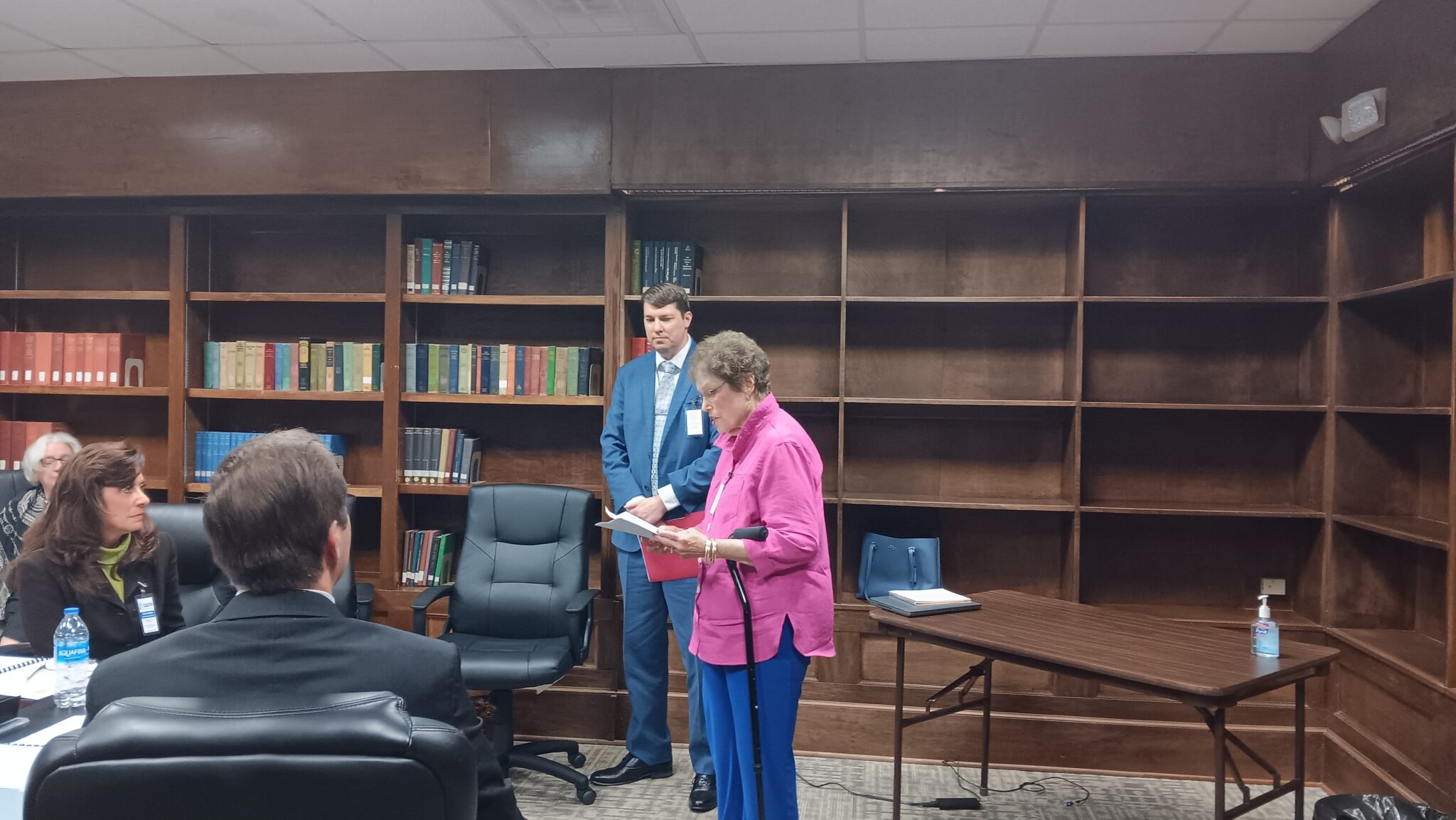
The policy change had consequences for the Fairhope Public Library and its patrons. In 2025, following the library’s refusal to reshelve books based on the new policy, APLS withheld over $20,000 in state funding. And in 2026, APLS continued to withhold funding from that library, citing 10 titles it says must be reshelved from the teen section to the adult section to be in compliance with the state library code. The titles, all deemed “sexually explicit” by APLS, include The Hate U Give by Angie Thomas and Shine by Lauren Myracle, both young adult books, as well as Doing It by Hannah Witton, a sex education resource for teens.
In another case, in fall 2025, Tennessee Secretary of State Tre Hargett issued letters to each of Tennessee’s 181 library branches and directors, threatening public funding and urging them to comply with an executive order on “gender ideology” on the grounds that the libraries receive federal grants.
More recently, in July 2026, Missouri’s secretary of state and attorney general threatened to cut state funding for a public library after it held a story time featuring two titles, Rainbowsaurus, which follows a family in search of a rainbow dinosaur, and Big Wig, which tells the story of a young child who dresses up in drag for a costume contest. This recent threat follows a 2023 proposal by Missouri’s Republican-led House to eliminate all funding for public libraries from the state budget.
The federal government and the executive and legislative branches have also joined in funding threats. During the Department of Government Efficiency’s funding cut spree in 2025, Institute of Museum and Library Services grants—an irreplaceable source of public library funding—were halted following an executive order that aimed to eliminate IMLS entirely. The funds have since been reinstated, but the Trump administration once again zeroed out IMLS funding in the 2027 budget. (IMLS funding is included in the budget as of the time of writing.)
Governance and funding fights often go under the radar because they can be hard to understand, but the stakes are high. Meanwhile, pressure campaigns that foment public mistrust and challenge the functions and purposes of public libraries create the conditions to legitimize these politicized actions. Free expression cannot exist in a climate of fear of government takeovers or fear of funding loss over ideological differences. Operating in tandem, these measures are undermining the ability of public libraries to be beacons of intellectual freedom for our diverse democratic society.
Attacks on Librarians
Proponents of book bans are going after not only public libraries but the professionals who work for and defend these critical institutions. For much of the last decade, librarians have faced threats to their safety simply for doing their jobs and for striving to reflect the full diversity of their communities on their shelves.
Librarian Dismissals
In 2025, President Trump dismissed Dr. Carla Hayden from her role as Librarian of Congress after 10 years of service. When asked to explain the termination, White House press secretary Karoline Leavitt responded, “We felt she did not fit the needs of the American people. There were quite concerning things that she had done at the Library of Congress in the pursuit of DEI and putting inappropriate books in the library for children, and we don’t believe that she was serving the interests of the American taxpayer well, so she has been removed from her position and the president is well within his rights to do that.”
Dr. Hayden’s dismissal as a Senate-confirmed federal employee is distinctly different from the situation of most public librarians. Yet the rhetoric used to justify her dismissal, particularly given the lack of supporting evidence, is all too familiar to public librarians who have been fired after facing similar accusations.
In 2025, Suzette Baker filed a wrongful termination suit against Llano County, Texas, which (as discussed above) she said had fired her because she refused to reshelve books on issues related to race and LGBTQ+ themes. The same year, the former director of the Montgomery County library system in Texas sued the county for retaliation for the same reason. In Wyoming, the former director of Campbell County Public Library sued her county as well, alleging in the initial complaint that the defendants “ultimately terminated her because she refused to remove the books that a narrow subset of residents challenged for their LGBTQ+ themes.” In all three cases, the defendants settled, the terms of which included financial payouts to these former librarians.
Supporting free expression should be a core part of a librarian’s job, not a professional liability. But too often, taking a principled stance is rewarded with termination.
Targeted Harassment
Across the country, library workers have faced harassment, intimidation, and violence, pressure tactics that are particularly nefarious because they can be led by determined individuals who may not face any consequences.
A 2024 survey found that library workers across the United States had experienced more than 8,000 trauma incidents, with the concentration of incidents suggesting the rate was increasing. The most frequently reported incidents included verbal abuse and physical assault. Library workers also cited additional stressors that made their jobs more difficult, such as “conflicts with library administrators” and “the fallout over book bans.” Library workers have been harassed and threatened over the phone, on social media pages, and in person at public events and library board meetings as well as in the course of their regular work. Many report facing invasive, personal, and intimidating questioning about their personal identities, political views, or opinions toward books available in their libraries.
Library workers have also been singled out by name or by identifying characteristics in local library board or council meetings, on social media, or in media. In extreme cases, they have been doxed—that is, their private information, such as their home address or personal cell phone number, is published online without consent in order to harass, abuse, or intimidate. Librarians have also shared how their patrons have stolen and defaced books or displays.
Sometimes interactions between activists and librarians are filmed or recorded and posted on social media or sent to local officials. For years, certain activists have described their actions as a “First Amendment audit”—a practice in which “auditors” attempt to instigate confrontations with a librarian to bait the librarian into asking the activists to stop filming or into having them removed. In many cases, the content the activists create is monetized on social media platforms, incentivizing them to provoke disruptive interactions that could go viral.
The description of harassment offered above is not meant to be exhaustive. Many of these attacks were documented in the 2024 film from Kim A. Snyder, The Librarians. These experiences have impacted librarians’ digital and physical safety, financial stability, personal property, reputations, careers, and psychological well-being. The effects of such attacks are felt by targeted librarians, but also their colleagues, friends, and wider professional networks who witness the harassment and intimidation. Librarians are being made to feel unsafe at work, at home, or in their local community.
Harassment with the intent to silence occurs in a context already rife with harassment, including sexual harassment. Of note, women make up over 80% of librarians as of 2024, according to US Census information. A 2022 survey of public library workers found that nearly 90% of respondents reported experiencing harassing behavior, examples of which included gender harassment, sexual imposition, and bribery or coercion. The survey also found that trans and nonbinary librarians reported the highest rates of unwanted “seductive behavior,” with 93% of the noncisgender respondents reporting this type of sexual harassment, compared to 77% of the cisgender respondents.
The impacts of harassment on librarians’ mental health, combined with other structural pressures on libraries and librarians, are profound. Many librarians report stress, anxiety, overwork and burnout as a result of safety concerns, the sense that censorship is inevitable, and the feeling of being “sitting ducks.” The impact of this harassment can be psychological and goes far beyond the bounds of what a librarian should be expected to endure. “Sometimes, people will say stuff like, ‘I’m going to find you,’ and you do have to take that seriously,” a librarian from Texas told PEN America at a recent conference. “It takes a toll on your mental health.”
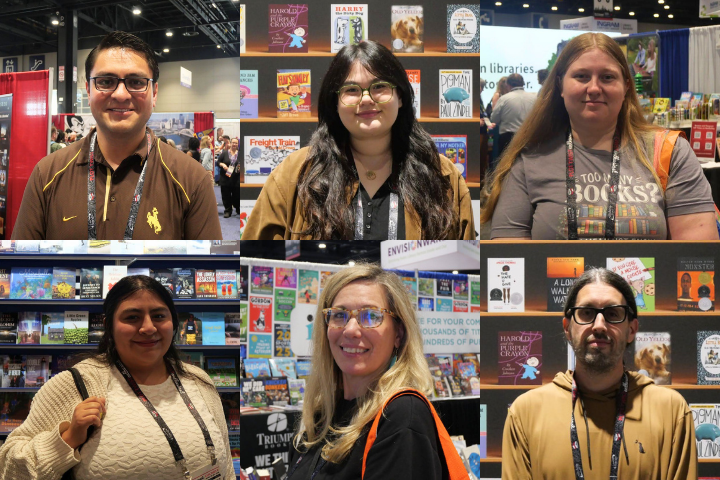
From book bans to verbal harassment, public librarians nationwide are reaching a breaking point. We spoke to more than a dozen public librarians and support staff at public libraries about the ways individuals, organized groups, and government officials have questioned and villainized their work.
De-Professionalization
The wider professional infrastructure of librarianship is also under concerted attack. The most impactful source of professional development for public librarians, the American Library Association, is frequently targeted by elected officials over accusations of being “woke” or otherwise having a progressive agenda. Some states have gone so far as to propose laws that prohibit or sanction libraries or librarians who are associated with ALA. An extreme example is from Louisiana, where a 2024 bill, HB 777, proposed that if a Louisiana librarian attended a conference cosponsored by the ALA, they could be fined $1,000 and/or incarcerated for up to two years. (The bill did not pass into law.) Other states have gone outside of legislation to formally cut their states’ ties with ALA, such as South Carolina, Florida, Texas, and others, by forbidding ALA grants and ending ALA membership. These measures are disrupting the field, prohibiting individuals and groups from participating in the country’s main association for the profession.
Legislating Liability
Several states, including Mississippi, Iowa, Arkansas, and West Virginia, have also gone so far as to pass legislation that opens librarians to criminal prosecution if they are deemed to have provided “obscene” or “harmful” (in the case of Arkansas) materials to young people. These laws remove exemptions that have long protected librarians as bona fide professionals from nuisance suits and other forms of lawfare that they cannot afford to endure. The effects of these and other state laws have been profound, leading some librarians to leave their jobs and causing some decision-makers to encourage librarians to overcomply with vague legislation, rather than risk facing legal consequences.
On the whole, these personal attacks or structural intimidation against librarians cannot be separated from the broader movement to chill the open exchange of knowledge and ideas in one of the last free public spaces where anyone can come to read, write, learn, find community, or get access to essential services. The experience or fear of being harassed, threatened, criminally prosecuted, or fired can create significant pressures on librarians to censor the books that they make available, the programming that they organize, or the displays that they curate. In sum, it is not just the librarians of the present who are under threat; mounting harassment and intimidation efforts, alongside these efforts at de-professionalization, are jeopardizing the future of librarianship as a field.
Conclusion
Libraries in America are cornerstones of the communities they serve. Free access to books, ideas, resources, and information in America’s libraries is imperative for education, employment, enjoyment, and self-government.
American Library Association, “Libraries: An American Value,” 1999
Threats to public libraries, the librarians who run them, and the books they contain are, fundamentally, attacks on our communities and on freedom of expression. When a book disappears, people who may need it lose access to it—and not everyone can simply go to a store and buy it. When a librarian is hounded out of their job, library patrons lose an invaluable literary guide. And when a library system is defunded or loses its independence, an entire community loses a lifeline to reliable information and important public services.
Pressure to censor and exert ideological control over the circulation of ideas takes different forms, from formal book challenges to doxing to executive orders. But at the center of all this is harm to people. Authors, illustrators, editors, and more are seeing their voices invalidated and their work dismissed on false pretenses. Library patrons and communities—including both children and adults—are losing vital spaces and lifelines to information, programming, and a sense of belonging. Linking them all is an overarching attack on democracy through a narrowing of who ought to be represented in the public sphere, or what ideas we should all have equal opportunity to access.
Citizens and communities can stand up for their freedom to read, and when they do, they can win. In Huntington Beach, California, residents fought for years against a politically motivated attempt to ban books and privatize the public library. In 2025, three residents sued, challenging the policy that led to the book bans, winning in a state court that September. And at long last, in 2026, they stopped the privatization, preserving essential public input and transparent processes that otherwise might have disappeared. When censorship attempts fail, it is almost always because of the tireless work of freedom-to-read advocates.
Everyone has a voice in the fight against public library censorship because it impacts everyone. Understanding the spread of censorship is the first step. The next step is resisting it.
Acknowledgments
This report was written by PEN America’s Freedom to Read Program experts Philomena Polefrone, senior manager; McKenna Samson, program manager; and Madison Markham, program coordinator, as well as by beck haberstroh, PEN America’s senior manager of Safety Training & Education. Data analysis and additional support was provided by Freedom to Read Program experts Tasslyn Magnusson, senior advisor, and Yuliana Tamayo Latorre, program assistant. Strategic direction and oversight came from Kasey Meehan, director, Freedom to Read. The report was reviewed and edited by Viktorya Vilk, senior director, Safety, U.S. Journalism & Free Expression, and Jonathan Friedman, Sy Syms managing director, U.S. Free Expression Programs.
This work is deeply informed by Censorship News Reports from Kelly Jensen at Book Riot. We also thank key partners in this work, including Authors Against Book Bans, EveryLibrary and EveryLibrary Institute, and the American Library Association.
Finally, we are profoundly grateful for and inspired by the state- and local-level advocates nationwide who expose threats to public libraries and galvanize communities in defending the freedom to read. We send deep appreciation to the Florida Freedom to Read Project, Let Utah Read, Texas Freedom to Read Project, FReadom Fighters, Read Freely Alabama, Rutherford County Library Alliance, Read Free NC, and the advocacy groups and individuals from Sumner County, Tennessee; Randolph, North Carolina; and more.