Nearly 12,000 (11,982) books were banned in public schools during the 2025-2026 school year, according to PEN America’s Index of School Book Bans.
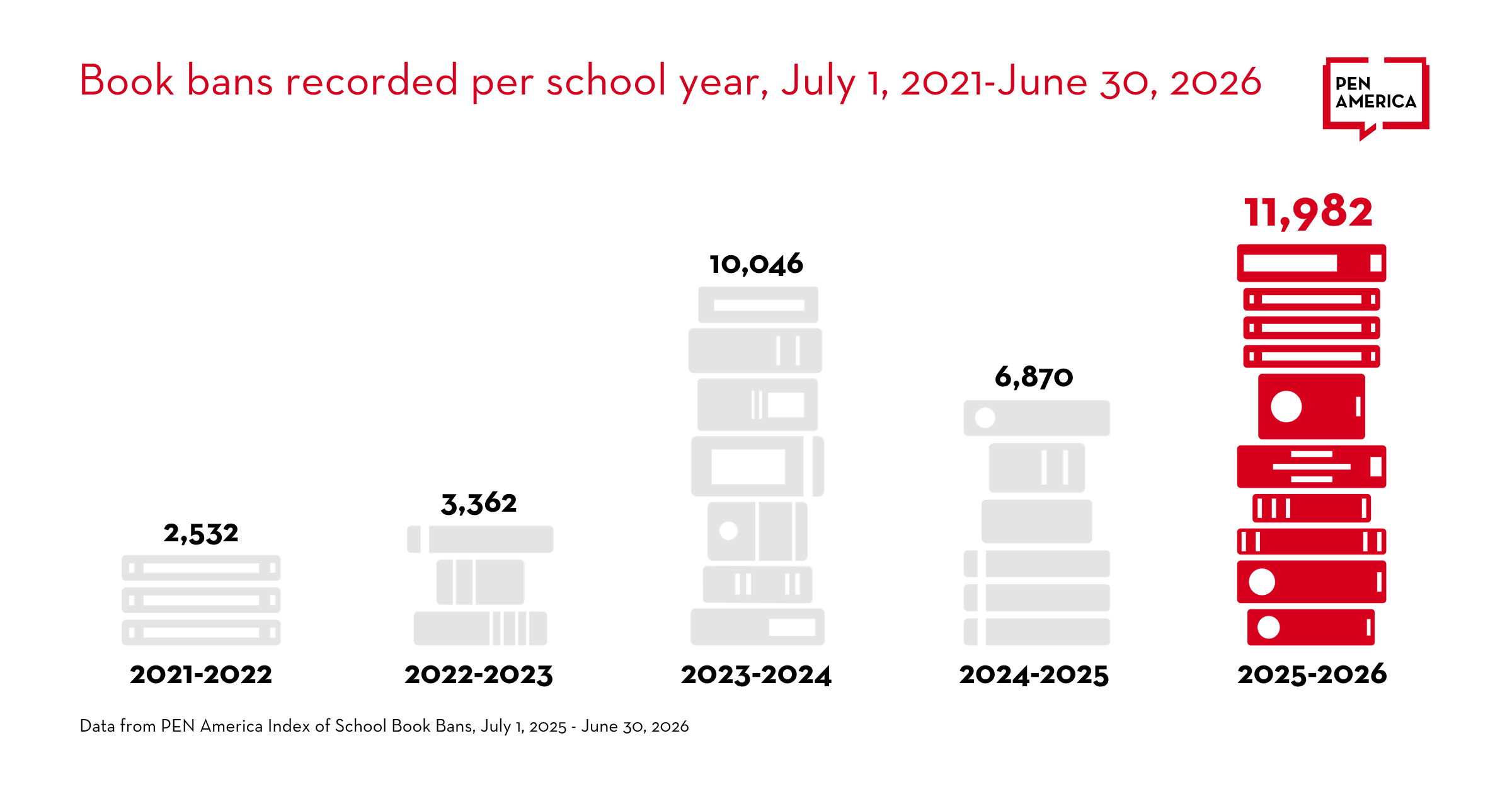
This is the highest number of recorded bans in a single year since PEN America began tracking book bans in 2021.
Key Findings
7370
unique titles banned in public schools, 2025-26 school year
This year saw a record number of unique titles banned — 7,370 titles — impacting the creative works of over 4,000 authors, illustrators and translators. Over 4,500 of these were titles not previously recorded in PEN America’s Index of School Book Bans, the most new titles added to the index in a single year, illustrating the continued expansion of the book banning crisis. This school year also saw the highest number of school districts (114) banning books in a single school year.
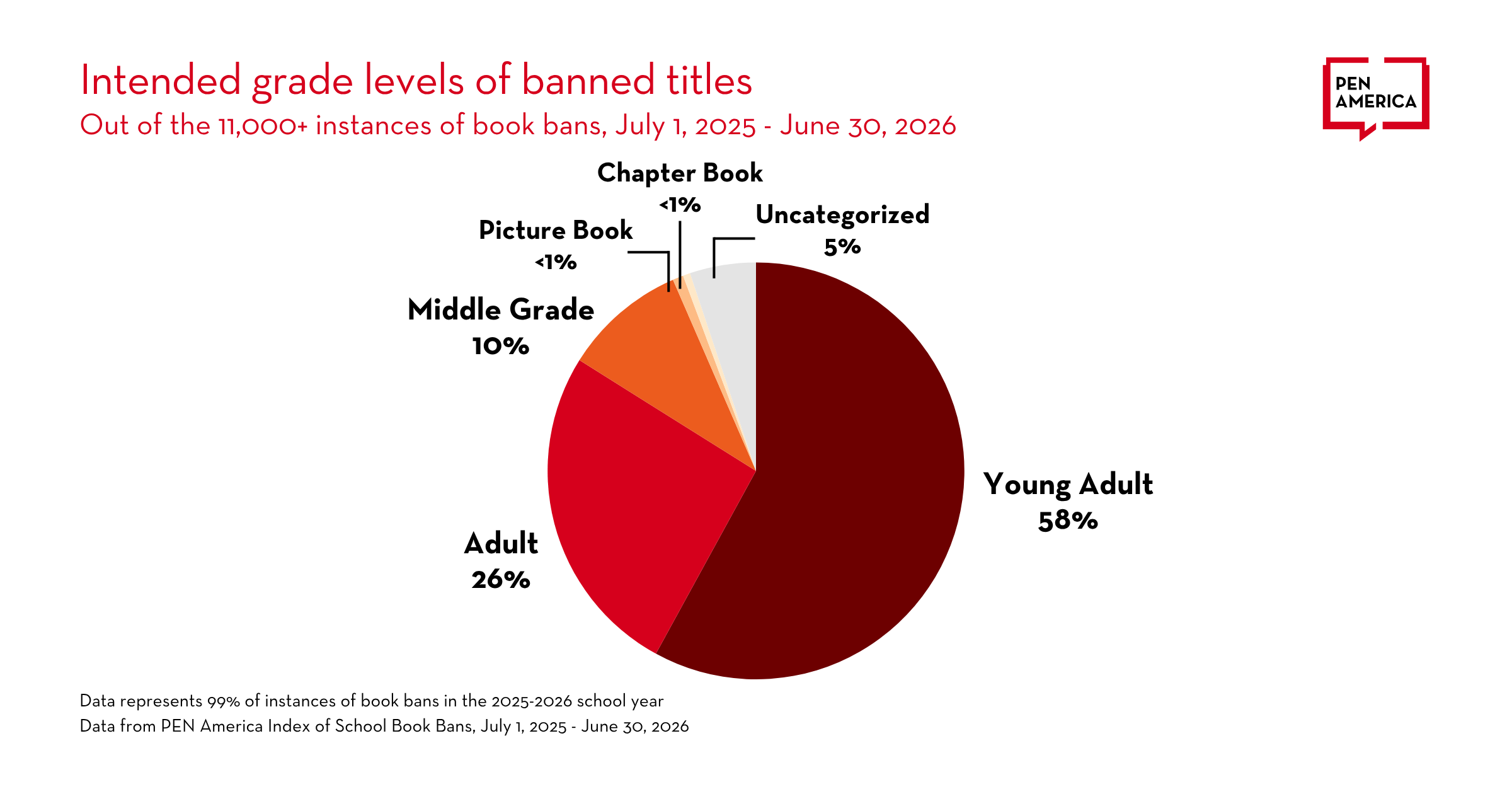
Following trends from previous years, YA books were the majority of removed titles (more than half of all bans) and fiction was the prevailing type of book most commonly banned (more than 80% of all bans). Notably, these two trends also converge. More than 90% of Young Adult titles banned during the 2025-2026 school were fiction, stripping young readers away from the books that help them fall in love with reading.
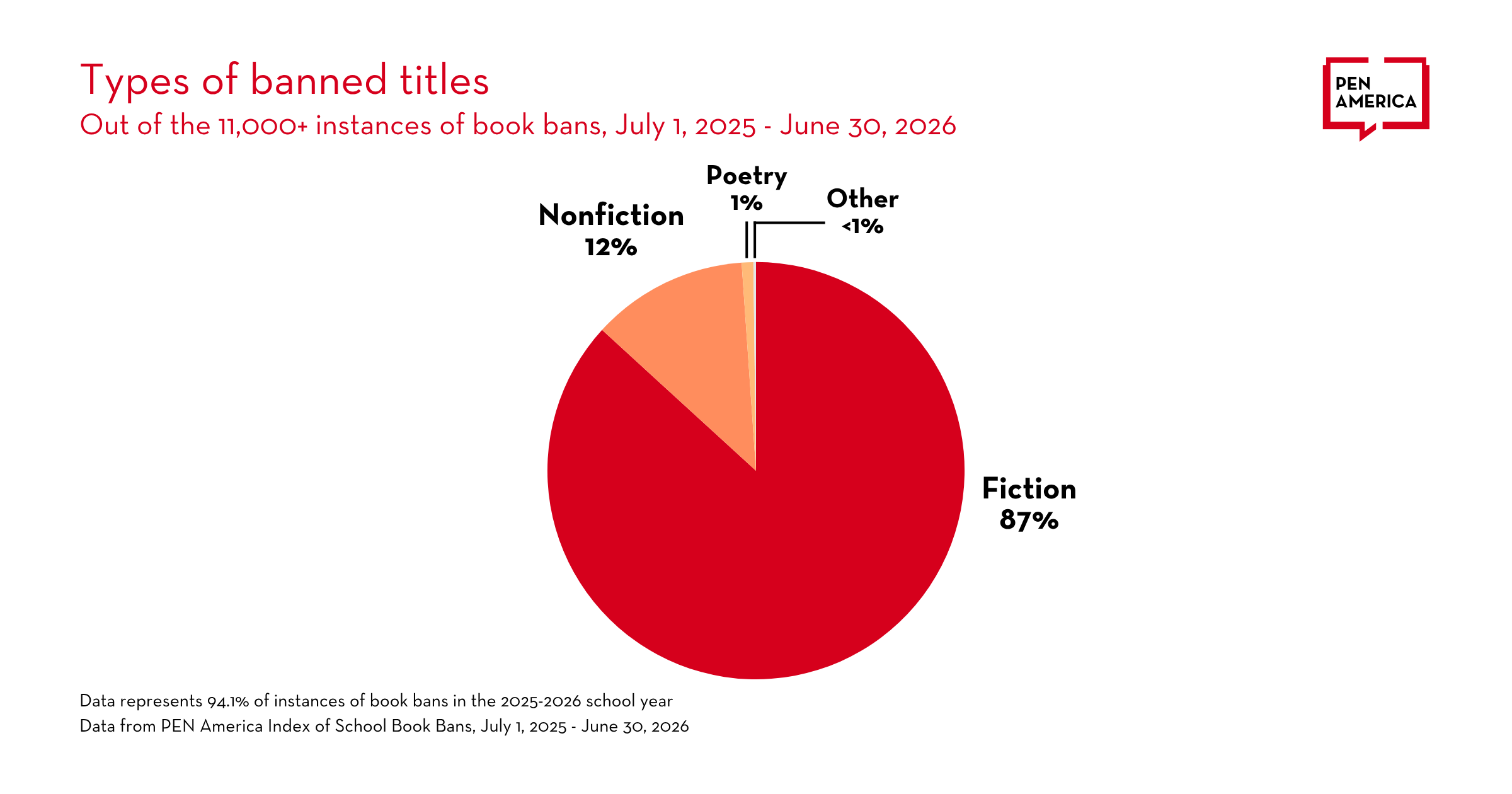
2025-2026 Instances of School Book Bans by State
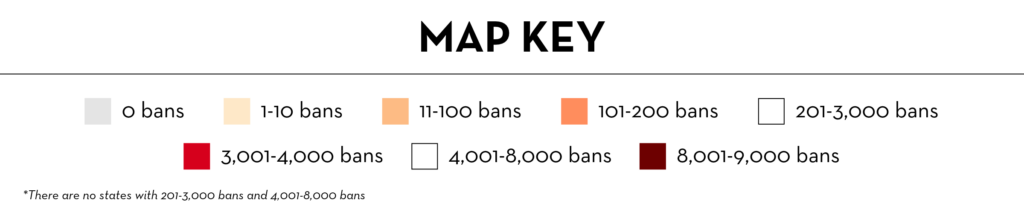
The vast majority of recorded book bans this school year came from just two states: Texas and Florida. Both states have become blueprints for educational censorship, where special interest groups, state laws, and politicians have converged to pressure school districts to restrict and remove access to books. These states also have by far the most complete record of book bans, owing to public records requests from grassroots organizations, the Florida Freedom to Read Project and the Texas Freedom to Read Project.
Additional Trends
Political Pressure
As in recent years, two key pressures continue to drive the school book ban movement: state legislation and the influence of organized groups. The campaign has also continued to be picked up and amplified by elected or appointed government leaders, who are having an outsized impact on access to literature in schools.
In Texas, the effects of SB 13, a book ban law passed in 2025, are clearly visible, and made Texas the state with the most bans, at more than 8,000 according to PEN America’s analysis. Across all states, bans in 72% of districts we tracked can be attributed to state legislation, either because school book review policies cite state law, books were banned by committees like those mandated by SB 13, or because a district’s rationale for a ban specifically cited state legislation.
Political pressure goes beyond legislation, too: politicians increasingly pressure districts to ban books by sending threatening letters, putting administrators through hearings, or other measures that lead to overcompliance. In Florida in May 2025, for example, two political appointees, the Attorney General and Education Commissioner, accused Hillsborough County Public Schools of violating state law, and instructed the district superintendent to appear before the state Board of Education. The subsequent hearing the following month included a board member claiming that the district’s media specialists were “child abusers.” The chilling hearing led to immediate book removals from the district.
In the ensuing months, the impact of the hearing widened, triggering book bans across the state. Several other Florida districts followed suit in removing the same list of 55 titles Hillsborough was pressured to remove.These officials’ pressure campaign against one district served as a broader warning to all districts to remove titles, so as to not face the same scrutiny. In July 2025, books on the Hillsborough list had been removed at least 40 times across 10 districts. By June 2026, a year after the hearing, that figure increased to at least 165 bans across 18 districts, according to research and analysis by PEN America.
Given the obvious success of these intimidation campaigns, officials in Florida and Texas have doubled down on them in recent months.
AI Choosing Books to Ban
This year, another notable trend has been the role of AI in accelerating book bans. This isn’t entirely new, but is becoming more common. As districts respond to vague and unclear directives from state departments of education and state legislation, district administrators are increasingly turning to AI to evaluate books for removal.
Public records requests obtained by the Texas Freedom to Read Project and shared with PEN America demonstrate what happens when AI is consulted instead of experts. These records show that generative AI/generative AI chatbots repeatedly recommend removing books, not because those books are obscene under the prevailing legal standard, but instead because other districts have banned them. This phenomenon of using AI to guide removals will worsen the snowball effect of book bans that has already gone much too far.
AI prompts provided as examples by McAllen Independent School District in Texas in response to a public records request:

Two examples of AI outputs when asked to ban books:
By using key word and web searches for commonly banned books, AI tools scrape lists of titles without consideration for nuance, context, or intent, speeding up censorship. This was the case in Texas as multiple districts attempted to comply with SB 13, which mandated bans on materials with “indecent” or “profane” content. Several districts responded with large contracts to Bookmarked, a “book intelligence company” to help districts “stop managing risk” — that is, they outsourced decisions about access to literature that are supposed to be based on the needs and values of their communities.
Removals of Manga and Graphic Novels
A third trend this school year is the pervasive banning of graphic novels, specifically manga titles. Manga, a Japanese form of graphic novel, are highly accessible and increasingly popular books. Much like books with diverse characters and identities, the sea change in manga’s popularity has been met with backlash from would-be book banners. And as with graphic novels and other illustrated texts, visual panels in manga books are often taken out of context with challenges often targeting visual depictions of sex, violence, and gender identity. “Context stripping,” or examining panels or images without any regard to the book as a whole, is a common tactic in misinformation campaigns against manga titles, with censorship advocates deeming them “inappropriate” or “explicit.”
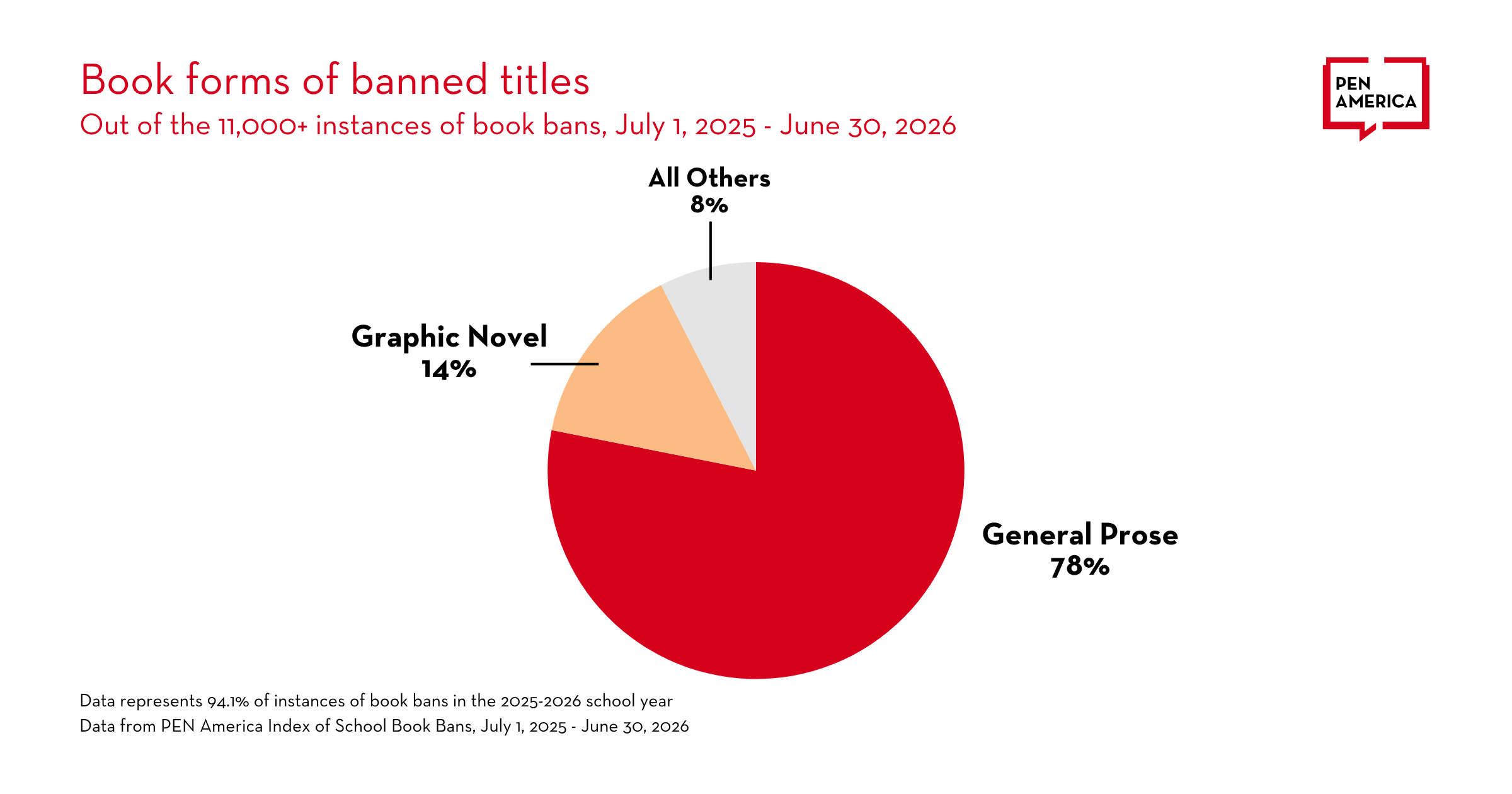
Japanese manga artists Atsushi Ohkubo (Fire Force and Soul Eater series), Hajime Isayama (Attack on Titan series), Rumiko Takahashi (Inuyasha, Inuyasha Ani-Manga, and Ranma 1/2 series) and Yusei Matsui (Assassination Classroom series) all appear in PEN America’s list of most commonly banned authors. These authors’ works are often targeted for removal as entire series, meaning that all volumes in a series are removed at once — in some cases impacting upwards of 20 or 50 unique titles.
Data Notes
In the 2025-2026 school year, Texas and Florida saw the largest number of bans, but also provided the most comprehensive data, owing to the filing of public records requests by Texas and Florida Freedom to Read Projects. In all states, however, our numbers are an undercount, as instances of book bans often go unreported and are increasingly difficult to demonstrate without transparency from school districts. These numbers also do not account for the many reports of quiet censorship, including restrictions of school book purchases and targeted “weeding” of titles that have not received complaints.
Titles Banned for the First Time
Several titles appear in PEN America’s Index of School Book Bans for the first time during the 2025-2026 school year, including classic novels, gamebook adaptations, popular fiction and coming-of-age young adult stories, manga, and an anthology on feminism:
- Here We Are: Feminism for the Real World by Kelly Jensen
- Romeo and/or Juliet: A Chooseable Path Adventure by Ryan North
- Be More Chill by Ned Vizzini
- Tokyo Ghoul by Sui Ishida
- The Brightest Night by Jennifer L. Armentrout
- The Beet Fields: Memories of a Sixteenth Summer by Gary Paulsen
- Rabbit and Robot by Andrew Smith
- Lore by Alexandra Bracken
- Lessons in Chemistry by Bonnie Garmus
- Jane Eyre by Charlotte Brontë
- Attack on Titan, Volume 34 by Hajime Isayama
The 2025-2026 school year also includes many books and authors that have been repeatedly banned over the last five years.
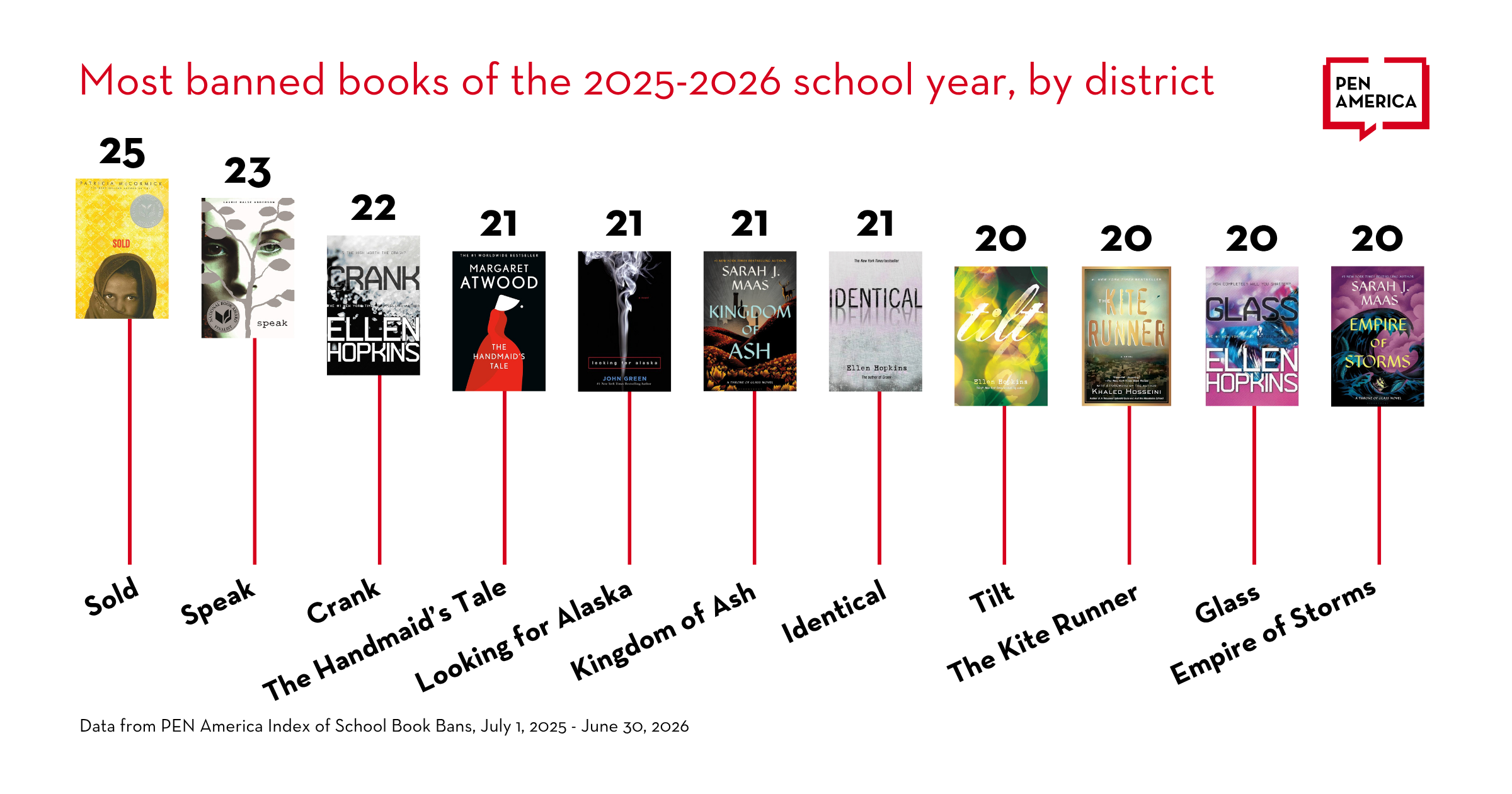
The most commonly banned book list for the 2025-2026 school year includes many notable repeat titles: Sold by Patricia McCormick; Speak by Laurie Halse Anderson; several titles by Ellen Hopkins like Crank and Identical; The Handmaid’s Tale by Margaret Atwood; and Looking for Alaska by John Green.
Several authors continue to experience the “Scarlet Letter” effect in which their back catalogs are targeted after experiencing a ban on a specific title, including Stephen King, Sarah J. Maas, Jodi Picoult, Tiffany D. Jackson, Alice Oseman, Angie Thomas, manga authors Atsushi Ohkubo and Hajime Isayama, and many others.
As presented in our last report, our analysis of thousands of books banned over the past five years consistently highlights that efforts to purge stories and books from schools have overwhelmingly targeted books about race and racism, LGBTQ+ people or characters, people or characters of color, and sex.
School libraries make knowledge and ideas available, ensure books remain available for all regardless of personal or political ideologies, and open gateways to stories that inform, challenge, and reflect the realities of the world back to readers. Book bans impede the freedom to read, cutting students’ access to a diversity of views, voices, perspectives, and literature they deserve to encounter. This report raises awareness of escalating and evolving trends behind the book banning movement so that we can better resist these efforts.
Acknowledgements
This report was written by the Freedom to Read Program experts Philomena Polefrone, PhD, senior manager and Kasey Meehan, director. This report is informed by our Indexes of School Book Bans which is not possible without support from several PEN America colleagues and external consultants. Data collection and analysis was led and completed by Tasslyn Magnusson, PhD, senior advisor and Yuliana Tamayo Latorre, program assistant with essential support from McKenna Samson, manager; Madison Markham, program coordinator; Daniel Cruz, special assistant for U.S. Free Expression Programs and several external consultants: Sanobar Chagani and Nat Gove. The report was reviewed and edited by Jonathan Friedman, Sy Syms managing director, U.S. Free Expression Programs.
We also thank key partners in this work. Public records requests and information from the Florida Freedom to Read Project and the Texas Freedom to Read Project uncovered thousands of book bans in their states. Freedom to Read Projects in Texas and Florida, alongside Annie’s Foundation, Let Utah Read, Censorship News Reports by Kelly Jensen, deeply inspired and informed this report.
PEN America is grateful for support from the Endeavor Foundation, Henry Luce Foundation, Spencer Foundation, and the Long Ridge Foundation, which made this report possible.
Finally, we extend our gratitude to the many authors, teachers, librarians, parents, students, and citizens who are fighting book bans, speaking out in their communities, and raising attention to these issues. We are proud to stand with you in defending the freedom to read.
About PEN America
PEN America stands at the intersection of literature and human rights to protect free expression in the United States and worldwide. We champion the freedom to write, recognizing the power of the word to transform the world. Our mission is to unite writers and their allies to celebrate creative expression and defend the liberties that make it possible. Learn more at pen.org.