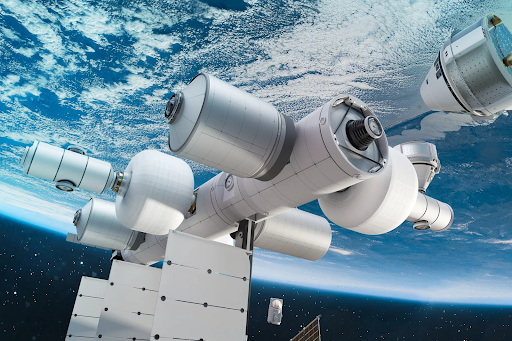
A new space station has moved one step closer to reality. Yesterday, Blue Origin and Sierra Space announced that their Orbital Reef project has passed its system definition review for NASA. The orbital outpost is now ready to enter the design phase.
Orbital Reef 101
The ISS is destined for a watery grave in 2030—or even before that—and NASA is working with space agencies and a handful of industry partners to ensure the US doesn’t lose its sustained access to LEO.
Led by Blue and Sierra, Orbital Reef is one of three space station concepts that NASA has funded through its Commercial LEO Destinations (CLD) program. Amazon Supply Chain, Amazon Web Services, Arizona State University, Boeing, Genesis Engineering Solutions and Redwire Space are also working on the project.
- Space agency funding helps, but doesn’t fully finance the hefty costs of building out a commercial space station.
- Since CLD developers have skin in the game, program delays or cost overruns could have a real impact on companies’ ability to remain a going concern.
The planned station is billed as a “mixed-use business park” for research, industry, and tourism. It has a modular design so it can expand to accommodate larger crews. In a major shift from space stations of the past and present, Orbital Reef will be fully owned and operated by the commercial space companies, rather than by NASA.
System definitions: This NASA review falls under the agency’s requirements for the $130M Space Act CLD award the Orbital Reef team received late last year. Now that NASA has verified that Orbital Reef meets the agency’s performance requirements, the design phase can begin.
The timeline: “We start launching the first elements of Orbital Reef in ‘26,” Sierra CEO Tom Vice told us on Pathfinder #0007. “We’ve got about six New Glenn launches, Dream Chasers are taking cargo and crew up, and then we build out the components,” Vice said, with the north star of an on-orbit, fully operational Orbital Reef by 2027.
More Stories

Today’s Pathfinder takes us back and forth across the Kármán line plenty of times.
Our guest is Giuseppe Santangelo, president at Red Cat Holdings ($RCAT) and founder of Skypersonic. The company develops drones that can be remotely piloted from thousands of miles away, and operated in high-risk, confined, and GPS-denied locations.
Martian tests: Skypersonic recently completed a 15-day test of its drone hardware and software at Mt. Etna, an Italian volcano with Martian-esque terrain. Pilots in Houston controlled Skypersonic’s drones, validating long-distance, low-latency flight technology (with Starlink terminals) and testing operations in a Mars-like environment.