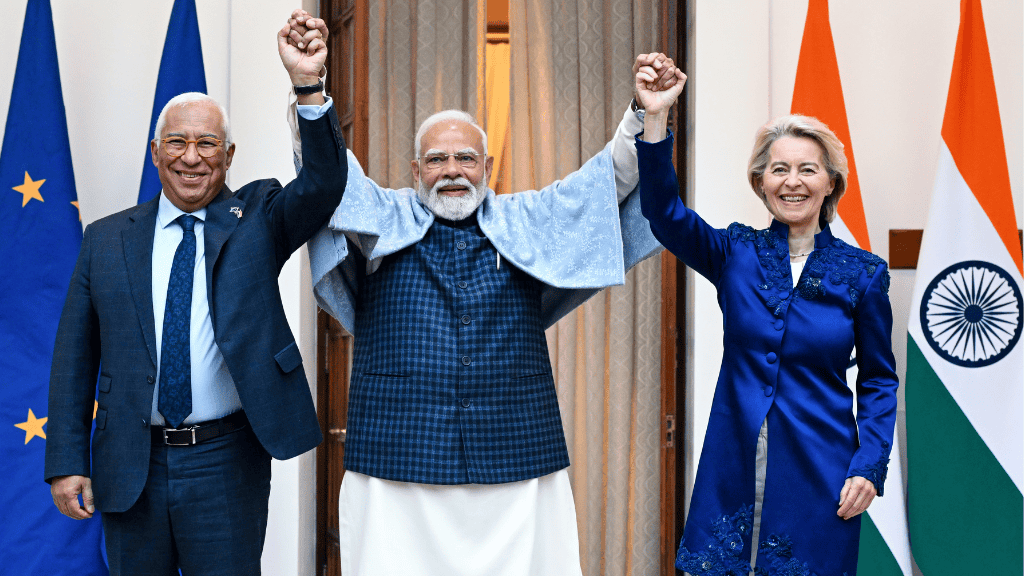
On Monday India and the European Union concluded negotiations on a breakthrough free trade agreement. Ursula von der Leyen, the president of the European Commission — the EU’s executive branch — called it “the mother of all deals.” That description is somewhat over the top. Yet the agreement is in fact historic and important in ways that go beyond economics. For it shows that the world is becoming ever more estranged from an erratic, abusive United States. In other words, other countries are moving, step by step, toward an economic divorce from America.
Unlike Donald Trump, who thinks of international trade as a zero-sum game, the Europeans and the Indians understand that a free trade agreement between them is a very good deal for both parties. They are two very big economies. Although Trump administration officials like to sneer at European economic performance, the economy of the European Union is roughly the same size as ours. And India, which a few decades ago had a huge population but a small economy, has made massive economic strides and is now a major player on the world economic scene:
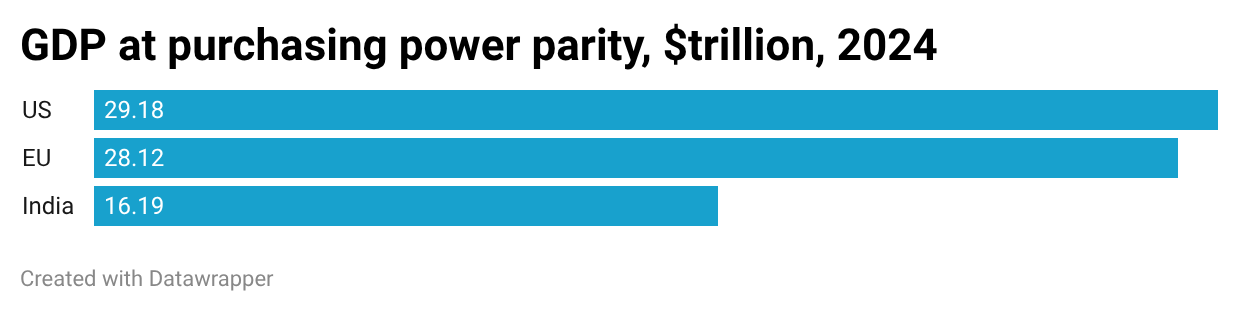
Source: World Bank
And the two economies complement one another. Europe will face much lower tariffs on its exports to India of goods ranging from cars to olive oil. India will gain access to the European market for its exports of labor-intensive products:
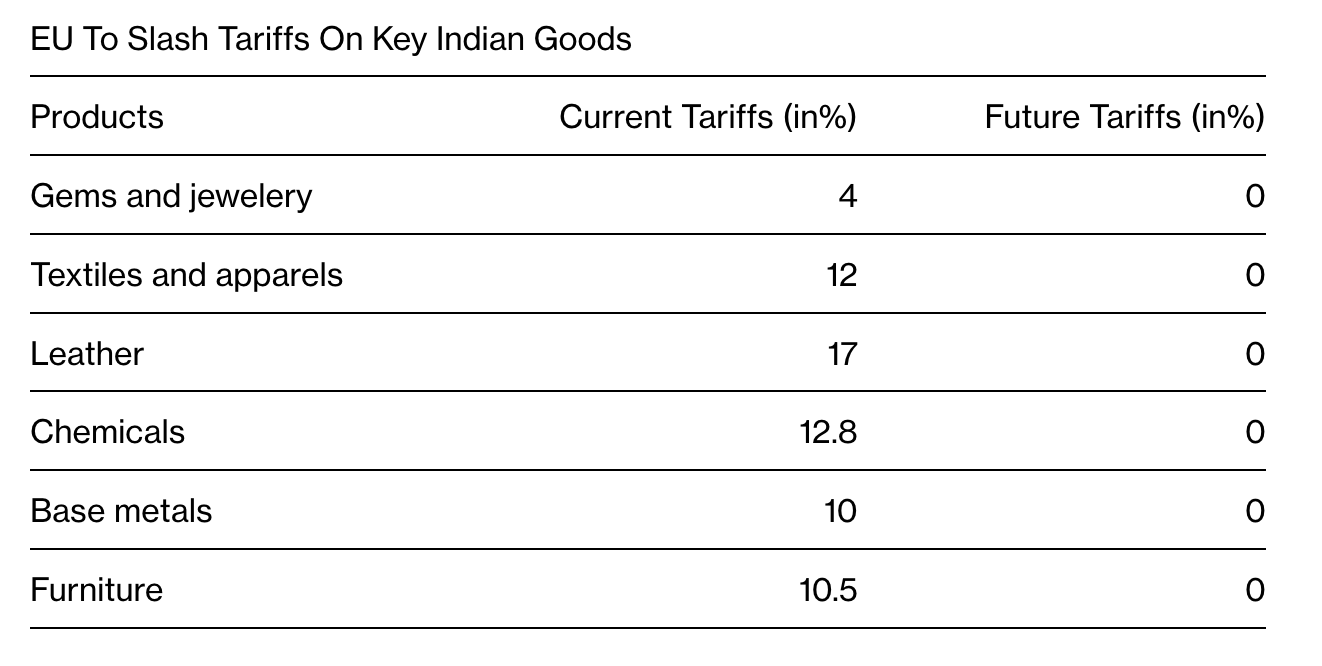
Source: Bloomberg
Furthermore, this is a real trade deal, not some vague expression of intent. It involves measurable, enforceable reductions in tariff rates, regulation of services, and more. This is in striking contrast with the fantasy international “deals” Donald Trump claims to have negotiated. In the Trump deals, other countries have offered vague promises to invest in America – promises that few observers expect to be fulfilled – in return for Trump’s promise not to impose destructive tariffs. Tariffs, I should say, that American consumers, American businesses, and American investors will pay and are overwhelmingly against.
Let me take a minute to walk you through Trump’s fantasy deals. Trump claims that other nations have committed to invest $18 trillion in the U.S., repeating that claim in the economy speech he gave in Iowa Wednesday. Nobody knows where he got that figure. A new brief from economists at the Peterson Institute for International Economics concludes that the announced promises sum up to about $5.7 trillion, less than a third of Trump’s number.
Furthermore, when you dig into these promises, there’s a definite whiff of smoke and mirrors. Roughly two-thirds of the total pledged comes from Gulf oil states, countries that are perennial Trump enablers. As the Peterson economists note, it’s hard to see how these governments can make good on their promises, since “the [Gulf] countries are not currently major investors in the United States, and they do not trade extensively with it.”
The pledges from the non-Gulf oil countries are vague, with no clear mechanism for delivering on the promises. The EU’s pledge of $600 billion, in particular, is almost pure vaporware. This is in stark contrast to the EU-India deal, which is a proper, detailed trade agreement with all the i’s dotted and t’s crossed.
But beyond the economic advantages, there is something of much greater importance happening with the EU-India deal: It’s a major step toward economic divorce from the United States by the major global economies. While the economic case for an EU-India agreement has been clear for years, closing the deal required overcoming special interests on both sides. What tipped the balance, clearly, was the fact that both parties are looking for ways to pivot away from trade with America.
Europeans have multiple reasons to feel aggrieved with the Trump Administration, from fake claims that the E.U. has been taking advantage of the U.S. through economic trade, to bullying tactics on behalf of the tech broligarchy, to interference in Europeans’ domestic politics on the side of the European fascist right, to the recent threats to seize Greenland.
However, India has even more reason to pivot than the Europeans. Trump has imposed high tariffs on its exports, with an average rate of 34.5 percent, almost as high as the average rate on Chinese exports. It’s a bizarre move in both economic and diplomatic terms. Previous American administrations deliberately cultivated a relationship with India as a counterweight to China, which is a dangerous rival. But that was when the U.S. president was sane.
In fact, governments aren’t the only ones pivoting away from the U.S. Foreign private companies are also shifting away. Here are three recent headlines:
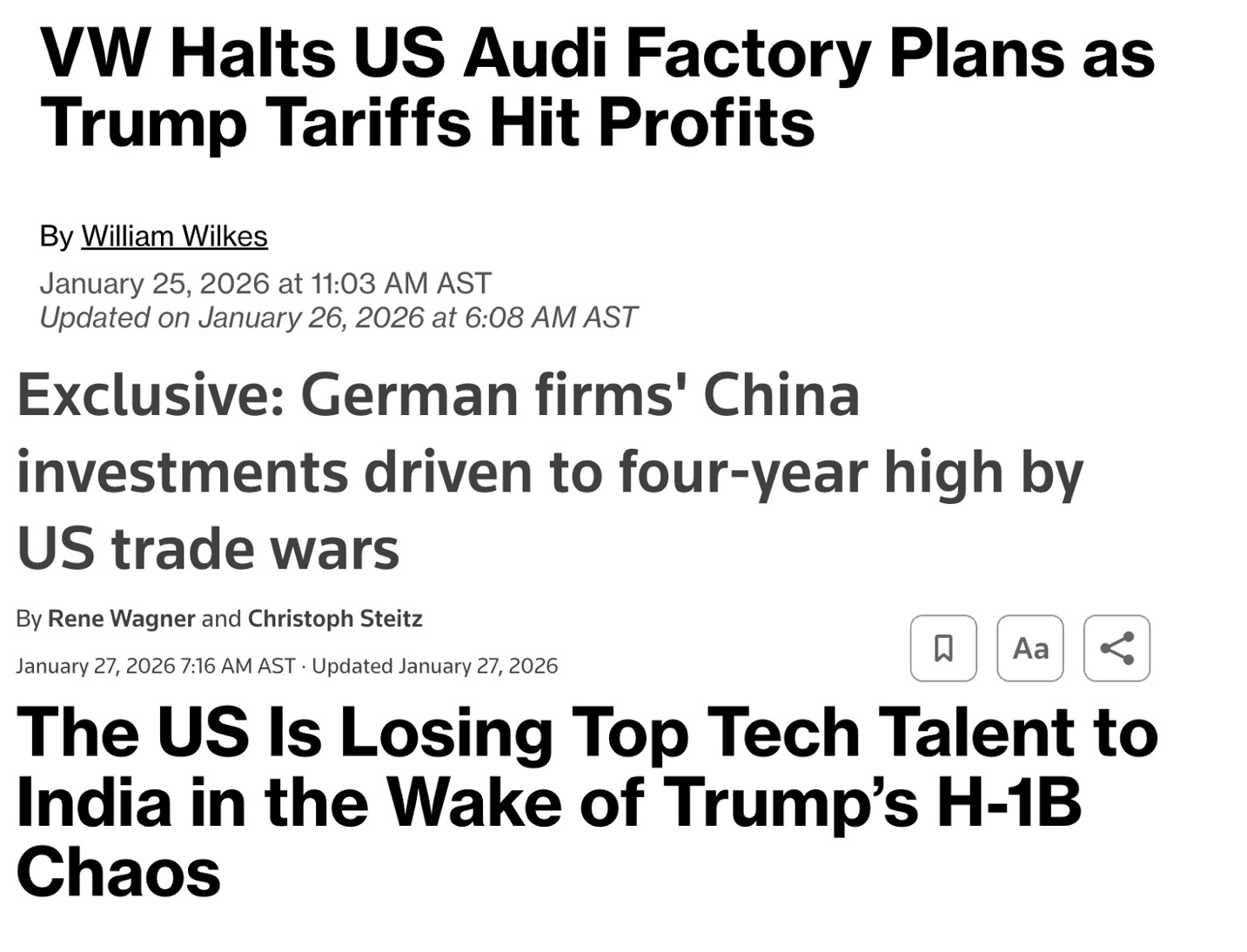
Source: Bloomberg, Reuters
At the time of writing Trump hadn’t reacted to the EU-India deal. Maybe nobody in his administration told him because they are in crisis over the Pretti murder fall-out. At some point, however, I expect him to rage-tweet about it, he did about Canada’s more modest trade deal with China. In general, we can expect Trump to threaten to put tariffs on everyone trying to pivot away from dependence on a nation whose policies are, well, driven by rage tweets.
But more U.S. economic intimidation isn’t going to work, because Trump doesn’t have the cards. Access to the U.S. market just isn’t as important to other countries as he imagines.
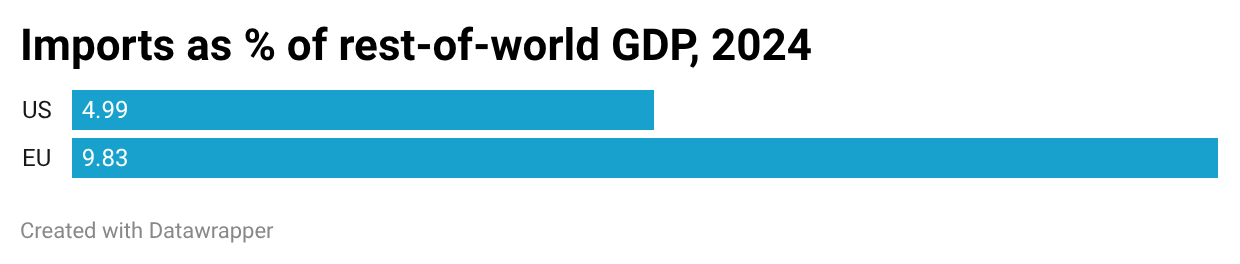
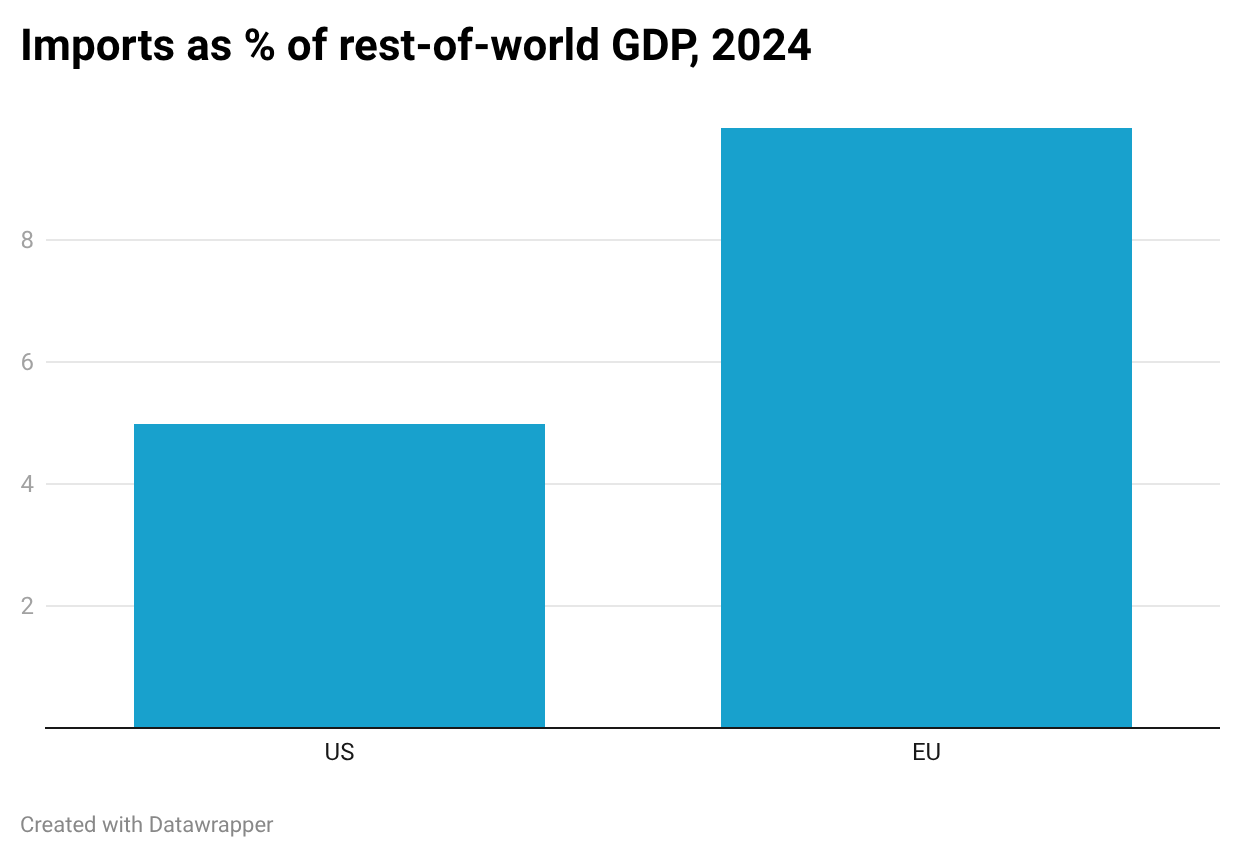
Here’s a number that I think is important: Imports by the United States from the rest of the world, measured as a percentage of the rest of the world’s GDP. This measure tells us how much of other countries’ output they sell to the United States. The answer, on average, is less than 5 percent, and much lower when you exclude Canada and Mexico:
Source: World Bank
Source: World Bank
And as the chart also shows, when you compute the same number for the European Union, it’s almost twice as large. Basically, the world needs access to the EU more than it needs access to the US.
The world trading system as we knew it lasted for three generations after World War II. It was a rules-based system, in which everyone considered the U.S. a reliable, trustworthy partner. But now US economic relations with other nations have turned abusive, and the world is moving toward divorce. And this will make Americans measurably poorer.
MUSICAL CODA