I previously chatted about venture in public markets. This is a related observation.
Take a look at the following pair investments one could have made over the last decade:
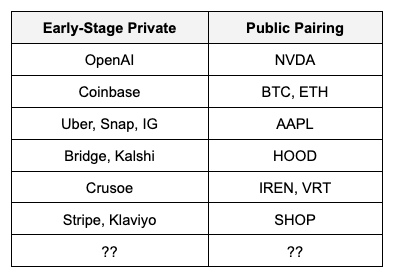
The world doesn’t work in a vacuum – when a new technology or market regime occurs, it affects companies of all sizes. People often talk about the disruption potential of a startup relative to incumbents. Oftentimes, I find the more interesting dynamic occurring when a tailwind ushers in something entirely new. It’s not directly replacing something that already exists. But instead grows up alongside it, and enables a whole new generation of products and experiences to be built.
The technology, market, and culture forces are the common threads. Manifestation takes place in both new company formation, and in the reinvention and re-acceleration of “mature” businesses who understand “it’s always day 1”.
There’s a yin-yang to this loop. Sometimes a startup discovers an opportunity first, and then existing businesses quickly recognize and exploit it too (HOOD). Other times an incumbent funds the r&d, but a new focused startup is best positioned to pursue it (OpenAI). A public proxy might move first before the private ecosystem forms (mobile), or a private grows with the public as a customer (stripe/shop).
Throughout all this, talent becomes a key edge signal. Employees and founders flow between startups and large companies, betting their career on these theses.
To see the full elephant, it’s helpful to have both views. The micro – the small buds and experiments from founders living in the future – and the macro – founder-led “mature” businesses that are still hungry and leaning into new things with their existing advantages.
In this pursuit, reinforcing private-public pairings have and will continue to emerge.