Submitted by

amael-apple
Submitted by
amael-apple
new
Get trending papers in your email inbox once a day!
Get trending papers in your email inbox!
 AK and the research community
Submitted by
amael-apple
Submitted by
amael-apple

Submitted by

hao-li
Agentic coding tools receive goals written in natural language as input, break them down into specific tasks, and write or execute the actual code with minimal human intervention. Central to this process are agent context files ("READMEs for agents") that provide persistent, project-level instructions. In this paper, we conduct the first large-scale empirical study of 2,303 agent context files from 1,925 repositories to characterize their structure, maintenance, and content. We find that these files are not static documentation but complex, difficult-to-read artifacts that evolve like configuration code, maintained through frequent, small additions. Our content analysis of 16 instruction types shows that developers prioritize functional context, such as build and run commands (62.3%), implementation details (69.9%), and architecture (67.7%). We also identify a significant gap: non-functional requirements like security (14.5%) and performance (14.5%) are rarely specified. These findings indicate that while developers use context files to make agents functional, they provide few guardrails to ensure that agent-written code is secure or performant, highlighting the need for improved tooling and practices.
· Published on Nov 17, 2025
Submitted by
hao-li
Agentic coding tools receive goals written in natural language as input, break them down into specific tasks, and write or execute the actual code with minimal human intervention. Central to this process are agent context files ("READMEs for agents") that provide persistent, project-level instructions. In this paper, we conduct the first large-scale empirical study of 2,303 agent context files from 1,925 repositories to characterize their structure, maintenance, and content. We find that these files are not static documentation but complex, difficult-to-read artifacts that evolve like configuration code, maintained through frequent, small additions. Our content analysis of 16 instruction types shows that developers prioritize functional context, such as build and run commands (62.3%), implementation details (69.9%), and architecture (67.7%). We also identify a significant gap: non-functional requirements like security (14.5%) and performance (14.5%) are rarely specified. These findings indicate that while developers use context files to make agents functional, they provide few guardrails to ensure that agent-written code is secure or performant, highlighting the need for improved tooling and practices.
· Nov 17, 2025

Submitted by

unilm
VibeVoice synthesizes long-form multi-speaker speech using next-token diffusion and a highly efficient continuous speech tokenizer, achieving superior performance and fidelity.
Submitted by
unilm
VibeVoice synthesizes long-form multi-speaker speech using next-token diffusion and a highly efficient continuous speech tokenizer, achieving superior performance and fidelity.
Submitted by

andito
Submitted by
andito

Submitted by

Cxxs
Submitted by
Cxxs

Submitted by

Paper99
Submitted by
Paper99

Submitted by

taesiri
DeepCode, a fully autonomous framework, addresses the challenges of document-to-codebase synthesis by optimizing information flow through source compression, structured indexing, knowledge injection, and error correction, achieving state-of-the-art performance and surpassing human experts.
· Published on Dec 8, 2025
Submitted by
taesiri
DeepCode, a fully autonomous framework, addresses the challenges of document-to-codebase synthesis by optimizing information flow through source compression, structured indexing, knowledge injection, and error correction, achieving state-of-the-art performance and surpassing human experts.

Submitted by
taesiri
A self-evolving training pipeline with the Calibrated Step Reward System and GUI-MCP protocol improve GUI automation efficiency, accuracy, and privacy in real-world scenarios.
 StepFun
·
Published on Dec 17, 2025
StepFun
·
Published on Dec 17, 2025
Submitted by
taesiri
A self-evolving training pipeline with the Calibrated Step Reward System and GUI-MCP protocol improve GUI automation efficiency, accuracy, and privacy in real-world scenarios.
Submitted by

akhaliq
Submitted by
akhaliq
Submitted by
akhaliq
Submitted by
akhaliq


Submitted by
taesiri
Segment Anything Model 3 achieves state-of-the-art performance in promptable concept segmentation and tracking by leveraging a unified model architecture with decoupled recognition and localization.
Submitted by
taesiri
Segment Anything Model 3 achieves state-of-the-art performance in promptable concept segmentation and tracking by leveraging a unified model architecture with decoupled recognition and localization.

Submitted by

FrancisRing
Submitted by
FrancisRing

Submitted by
taesiri
This survey provides an updated overview of agent memory research, distinguishing its forms, functions, and dynamics, and highlights emerging research directions.
· Published on Dec 15, 2025
Submitted by
taesiri
This survey provides an updated overview of agent memory research, distinguishing its forms, functions, and dynamics, and highlights emerging research directions.

Submitted by

LiheYoung
Pixio, an enhanced masked autoencoder, demonstrates competitive performance across various downstream tasks using pixel-space self-supervised learning, outperforming latent-space approaches.

· Published on Dec 17, 2025
Submitted by
LiheYoung

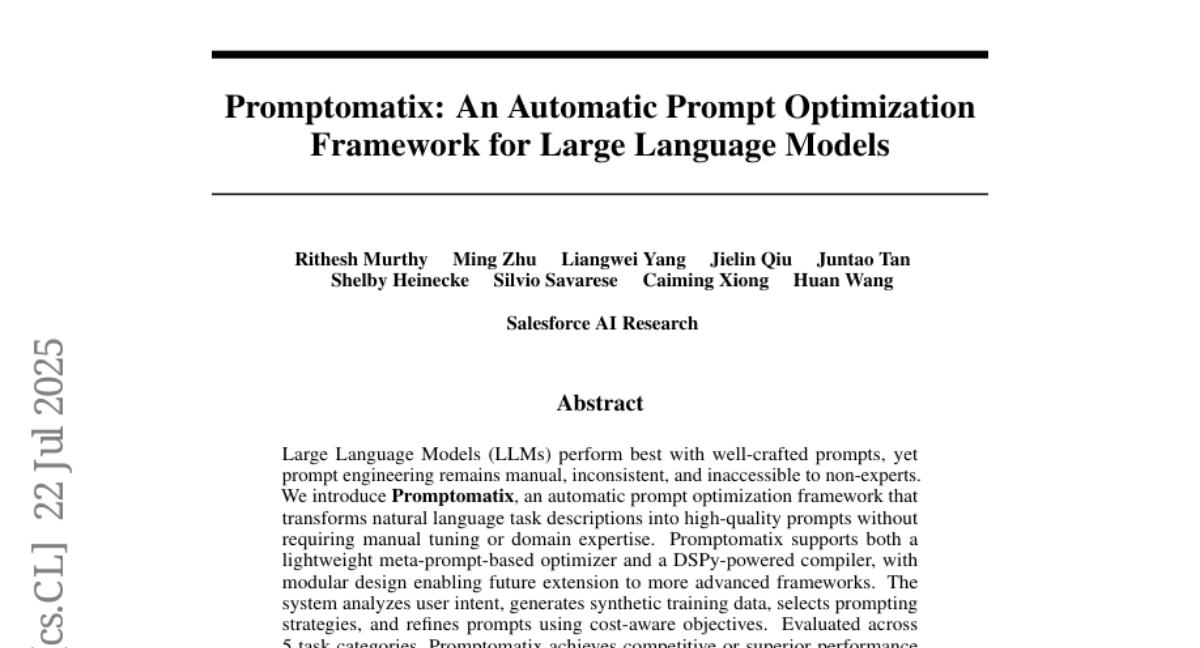
A self-supervised framework optimizes prompts for both closed and open-ended tasks by evaluating LLM outputs without external references, reducing costs and required data.
· Published on Feb 7, 2025
A self-supervised framework optimizes prompts for both closed and open-ended tasks by evaluating LLM outputs without external references, reducing costs and required data.

Submitted by
taesiri
Submitted by
taesiri
Submitted by

rmurthy
Submitted by
rmurthy

Submitted by

wanderkid
Submitted by
wanderkid

Submitted by
taesiri
Submitted by
taesiri
Submitted by
akhaliq
Submitted by
akhaliq

Submitted by

Wayne-King
Submitted by
Wayne-King

Submitted by

MapleF9
A unified visual tokenizer pre-training framework (VTP) improves generative performance by optimizing image-text contrastive, self-supervised, and reconstruction losses, leading to better scaling properties and higher zero-shot accuracy and faster convergence.
 MiniMax
·
Published on Dec 15, 2025
MiniMax
·
Published on Dec 15, 2025
Submitted by
MapleF9
A unified visual tokenizer pre-training framework (VTP) improves generative performance by optimizing image-text contrastive, self-supervised, and reconstruction losses, leading to better scaling properties and higher zero-shot accuracy and faster convergence.

Submitted by

Snyhlxde
Submitted by
Snyhlxde

LightRAG improves Retrieval-Augmented Generation by integrating graph structures for enhanced contextual awareness and efficient information retrieval, achieving better accuracy and response times.
· Published on Oct 8, 2024

Submitted by
akhaliq
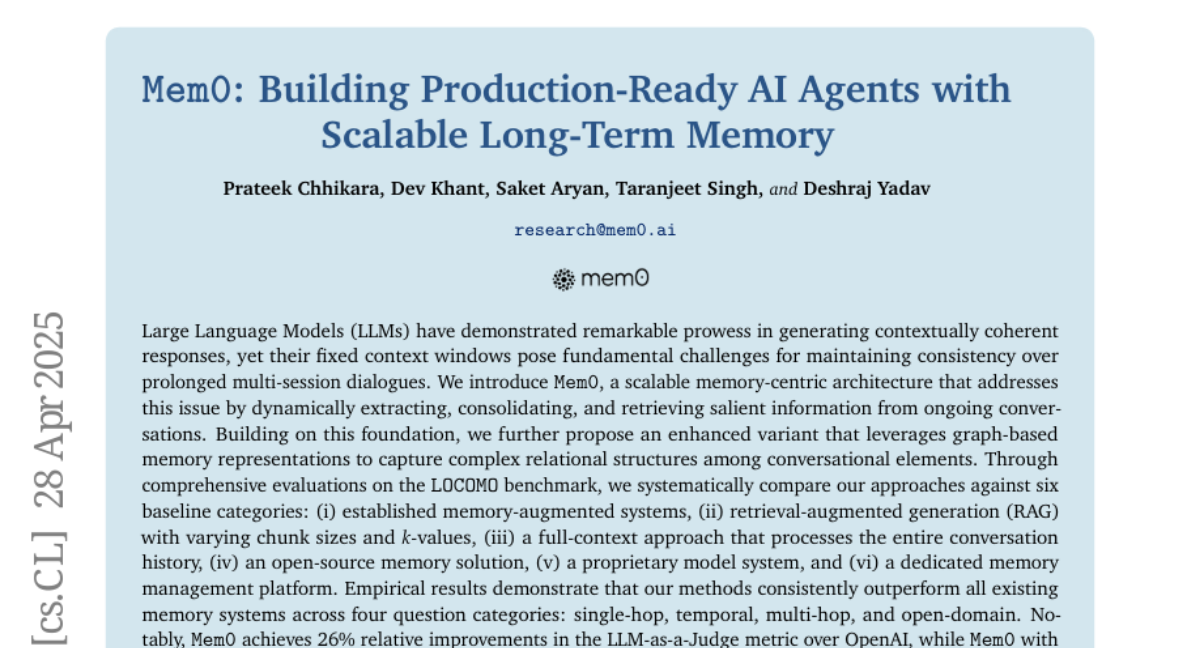
Mem0, a memory-centric architecture with graph-based memory, enhances long-term conversational coherence in LLMs by efficiently extracting, consolidating, and retrieving information, outperforming existing memory systems in terms of accuracy and computational efficiency.
· Published on Apr 28, 2025
Submitted by
akhaliq


Submitted by

Weiyun1025
Submitted by
Weiyun1025
Submitted by

xw-eric
Submitted by
xw-eric

Submitted by
xw-eric
Behavior Best-of-N (bBoN) improves the reliability and success rates of computer-use agents by generating and selecting among multiple rollouts using behavior narratives, achieving state-of-the-art performance on OSWorld and strong generalization to different operating systems.
 Simular
·
Published on Oct 2, 2025
Simular
·
Published on Oct 2, 2025
Submitted by
xw-eric
Behavior Best-of-N (bBoN) improves the reliability and success rates of computer-use agents by generating and selecting among multiple rollouts using behavior narratives, achieving state-of-the-art performance on OSWorld and strong generalization to different operating systems.

Submitted by

zhongwenxu
Single-stream Policy Optimization (SPO) improves policy-gradient training for Large Language Models by eliminating group-based issues and providing a stable, low-variance learning signal, leading to better performance and efficiency.
 Tencent
·
Published on Sep 16, 2025
Tencent
·
Published on Sep 16, 2025
Submitted by
zhongwenxu
Single-stream Policy Optimization (SPO) improves policy-gradient training for Large Language Models by eliminating group-based issues and providing a stable, low-variance learning signal, leading to better performance and efficiency.

Submitted by
taesiri
LongCat-Video, a 13.6B parameter video generation model based on the Diffusion Transformer framework, excels in efficient and high-quality long video generation across multiple tasks using unified architecture, coarse-to-fine generation, and block sparse attention.
 LongCat
·
Published on Oct 25, 2025
LongCat
·
Published on Oct 25, 2025
Submitted by
taesiri
LongCat-Video, a 13.6B parameter video generation model based on the Diffusion Transformer framework, excels in efficient and high-quality long video generation across multiple tasks using unified architecture, coarse-to-fine generation, and block sparse attention.

Submitted by
taesiri
Submitted by
taesiri


Submitted by

Jiasheng1110
Submitted by
Jiasheng1110

Submitted by

mervenoyan
Submitted by
mervenoyan

Submitted by

dyyyyyyyy
Submitted by
dyyyyyyyy


Submitted by

wenbowen
Submitted by
wenbowen

Submitted by

Jeff-Wang
Submitted by
Jeff-Wang

Submitted by

Owen777
Submitted by
Owen777