Despite the overwhelming concern over the use of artificial intelligence, one of the most promising use cases for AI is regulatory reform. Regulatory accumulation — the slow accumulation of rules, related guidance, case law, and specialized knowledge — has created a knowledge base that no human brain could contain, let alone comprehensively analyze. AI, on the other hand, can parse it in minutes.
For example, Pacific Legal Foundation (PLF) recently launched the Nondelegation Project — a database linking every part of the Code of Federal Regulations (CFR) to its underlying statutory authority. With this project, the power of AI has transformed an otherwise incomprehensible, more than 190,000-page behemoth spanning 245 volumes into an interactive website accessible to anyone.
The Nondelegation Project builds upon the long-running QuantGov and RegData projects to answer several “big picture” questions about federal regulations. Which statutes are cited most frequently in the CFR? How often does Congress provide clear, specific directions to agencies when delegating authority, as opposed to broad, general grants of rulemaking power? Which parts of the CFR are the most restrictive? How related is the textual content of the CFR to the statutes they cite as authorities? These types of questions can now be answered with the help of large language models (LLMs).
Behind the Nondelegation Project is a rigorous methodological approach for testing several LLMs, including Gemini, GPT-3.5-turbo, GPT-4, Claude, and Grok. Based on both accuracy measurements and cost-effectiveness, as explained in our working paper, Google’s Gemini 2.0-flash presented the best balance of high accuracy (94%) and low cost. This comparative evaluation demonstrated the critical importance of transparent methodology and rigorous testing in AI-supported legal analysis.
The AI extracts statutory authorities listed in the electronic CFR for each CFR part and lists them individually in a database. In other words, it makes it easy for a person to see the connections between the CFR part and the sections of the U.S. Code (USC) cited for authority.
The primary purpose of the project is to automate and streamline the categorization of statutes into two delegation categories: specific authority and general authority. In other words, coding each congressional delegation of rulemaking authority based on whether it is an explicit statutory directive for precise regulatory tasks (i.e., specific) or a broad, vague grant of regulatory power without detailed specificity (i.e., general).
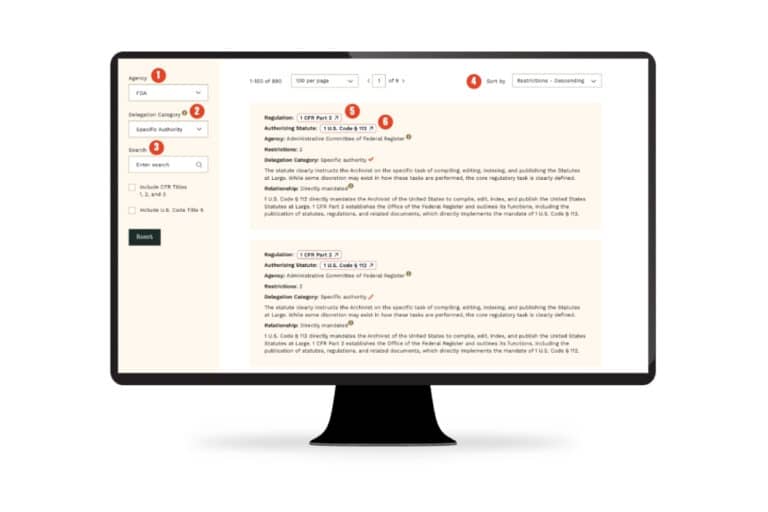
Users can see for themselves what this looks like by visiting the project’s website. The database generates a list of CFR parts that match the user’s search criteria, showing the CFR part, the cited USC authority, whether that authority is general or specific (or, rarely, contains “no delegation”), and the relationship between the regulations and the statutes. The relationship category goes one step further than the delegation category, in that it determines whether the relevant regulation falls into one of four categories: directly mandated, not mandated but authorized, related to but not clearly mandated or authorized, or unrelated to the authorizing statute. The project also generates descriptions explaining the AI’s coding decisions.
From the project (which we note is a “beta release” in part because it does not yet include personal income tax-related regulations from the IRS), we know that 37% of the over 56,000 delegations captured in the database are general (broad, vague, open-ended) grants of authority to regulatory agencies. The most cited general delegation in the CFR is 26 U.S.C. § 7805 (cited 3,775 times), and the most cited specific delegation is 26 U.S.C. § 42 (cited 11,110 times). The Federal Energy Regulatory Commission and the Environmental Protection Agency (EPA) have the highest number of general delegations from Congress — 3,309 and 2,752, respectively — while the Department of Justice and NASA have the highest percentage of general delegations — 72% and 66%, respectively.
The database determines how restrictive each CFR part is based on the number of regulatory restrictions it contains — a method likely familiar to the thousands of users of RegData that involves finding terms such as “shall,” “must,” “may not,” “required,” and “prohibited.” Under that metric, the EPA is far and away the most restrictive agency, with nearly 111,000 regulatory restrictions throughout the database — over 75,000 more than the second-most restrictive agency, the Securities and Exchange Commission (again, we note that the IRS’s data is incomplete).
The Nondelegation Project captures the zeitgeist of the current regulatory reform moment. Not only does it demonstrate the capabilities of AI to capture previously elusive information, but it also shows how this technology can be used to achieve regulatory, specifically deregulatory, reform that has been gaining momentum in the judicial and executive branches.
At the Supreme Court, decisions like West Virginia v. EPA and Loper Bright Enterprises v. Raimondo — which announced the major questions doctrine and overturned judicial deference — have limited agency authority. The seeming eagerness of some members of the Court to revive the nondelegation doctrine — first and last used in 1935 — signals that they “would not wait” to apply it again.
At the White House, the president issued Executive Order 14219, which directs the heads of executive departments and agencies to identify and repeal potentially unlawful regulations. A subsequent memorandum prioritized unlawful regulations under ten Supreme Court decisions. Further, the EPA announced the “biggest deregulatory action in U.S. history.” Even independent agencies, such as the Consumer Product Safety Commission, are seeking information on reducing regulatory burdens.
For all this, the Nondelegation Project can be a resource. It’s a tool to learn more about the contours of the administrative state and its authorities. It’s a tool to identify delegations that are general and/or unrelated to the regulations and therefore may be unconstitutional or illegal. And it’s a tool made possible by the power of AI to bring this information to us in the first place and effect real and lasting regulatory reform.
You can access PLF’s Nondelegation Project at nondelegationproject.org.
This op-ed was originally published in The Yale Journal on Regulation on November 10, 2025.