First, I assert that monospace (fixed-pitch) fonts are hard and unpleasant to read, and that for decades now there has been no good reason to keep inflicting this relic on users. Even if these users are mostly developers. Developers are people and deserve humane treatment.
Further, I assert that terminal emulators—which use these monospace fonts—have grown into an absurd joke regardless, and should have largely disappeared a long time ago—if only we weren’t both completely incompetent as an industry and apathetic as people.
I’m not going to bother supporting these assertions here. If you agree, you agree.[1]
Illustrated
I can push the point across more simply. These are the same thing, only minimally iterated upon:
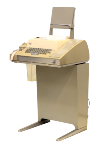
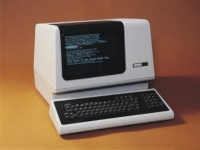
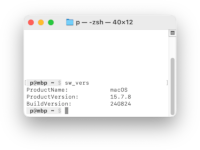
The Teletype Model 33 on the left is from 1963. 60+-year-old technology, in heavy use today, due to getting ossified within UNIX and its derivatives. The fixed character grid is a purely technical limitation carried over.
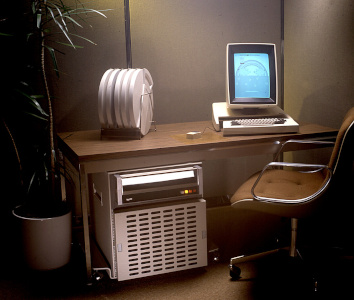
Meanwhile, here is a research computer from 1973. 50+ years old. Fully graphical. You can reprogram the environment from within itself in real time.[2] Its main problem was cost.
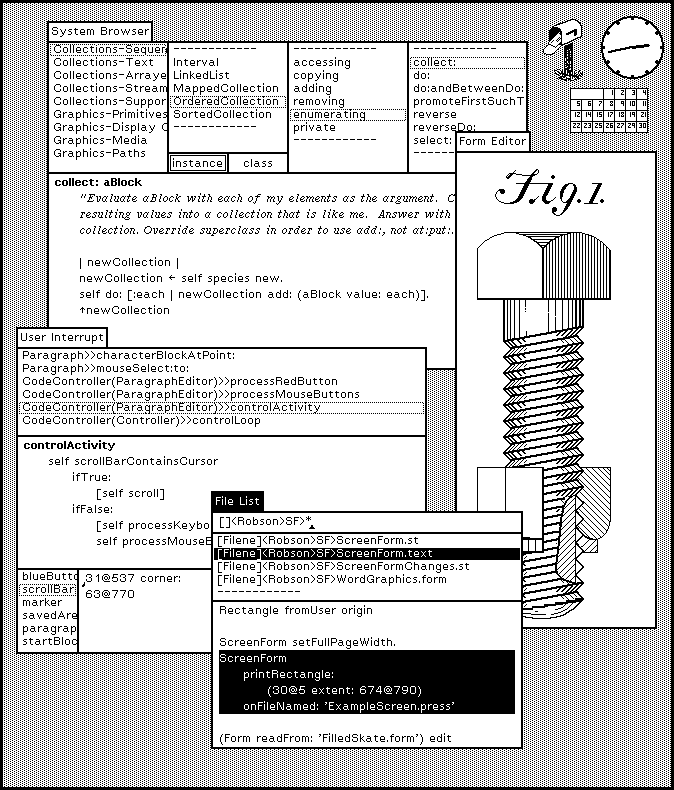
NeXT, Inc. later decided to combine the two concepts—UNIX and Smalltalk—into what’s now called macOS. It’s an automobile towing a horse.[3]
And to Hell with ASCII too
We take ASCII for granted, but we’re stuck with some extremely weird basic glyphs and key meanings for the rest of computing history. For example, the underscore (_) is there purely for formatting, the backtick (`) purely for diacritics (it has no stand-alone sense, yet it’s now an important spacing character), and the hyphen-minus (-) doesn’t know what it is. The backslash (\) is a bizarre invention for approximating ∧ ∨ as /\ \/, funnily shown as ¥ or ₩ in Japanese or Korean Windows instead.[4]
Strong typewriter legacy. Admittedly, the diacritics set ("',^`~) is useful for the compose key mechanism, even if you don’t use a teletype. I need neither a German keyboard layout, nor a Unicode selector to add a few umlauts.[5]
A sigh
I deeply enjoy good typography. I like graphical user interfaces. Yet I punished myself with years of terminal-heavy Linux usage. At the same time, GNOME kept pulling the rug out from under me and made the GUI parts of the system unbearable.[6]
Enough is enough, and I’m on my way to figuring this out.