Every conversation that could happen with a language model – every question, misunderstanding, explanation, and unfinished argument – produces a sequence of internal states.
Could we map that landscape? Would conversations about similar things travel through neighboring regions? Would the same idea, expressed in different languages, arrive somewhere recognizably similar?
My goal was straightforward: take thousands of conversations, feed them into a language model, and actually visualize what they look like inside.
Of course, a neural network has dozens of internal layers you could inspect, so I had to pick a vantage point. I chose the very last layer – the final internal state right before the model converts those numbers back into a predicted token (basically, the next word). If there is a place where the model’s computation crystallizes into its final answer, that is it.
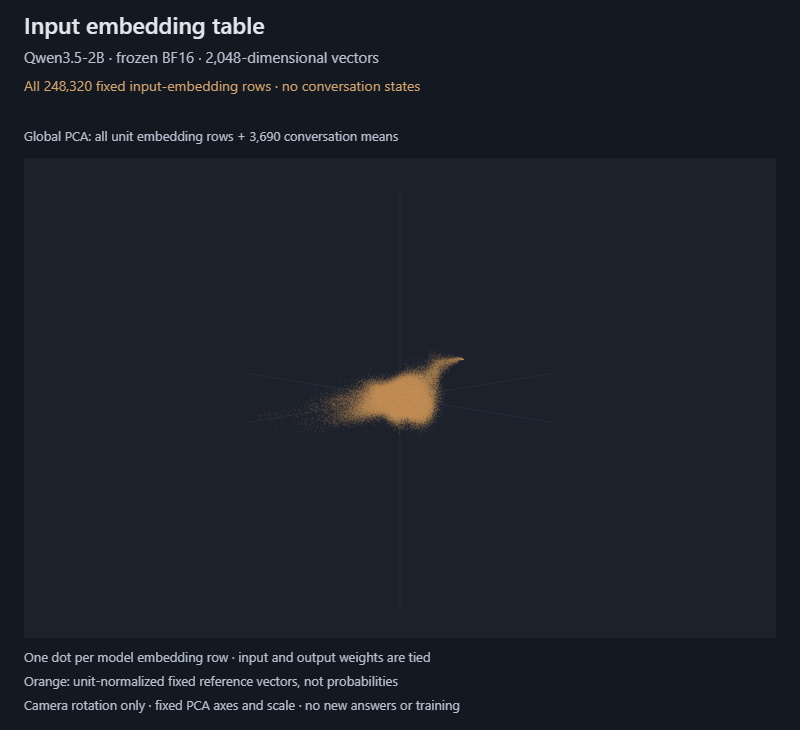
To anchor the map, I started with Qwen3.5-2B and first plotted its entire embedding table – 248,320 learned reference rows, appearing on screen as a static orange cloud of starting points (see photo below). Most rows correspond to tokens; a few padded rows have no tokenizer string. Then, I fed 900 saved English question-and-answer examples through the network, captured the final-layer vectors at every token position, and connected each conversation's steps into a continuous line. The full experiment contains 3,690 saved examples across four languages and Python. The model read these texts; it did not generate new answers or undergo training.
From Input Words to Final States
When you type a prompt, the model breaks your text into tokens – words, pieces of words, or punctuation. Each token begins by looking up its starting row in that orange embedding table: a list of 2,048 numbers.
As the model reads each saved question and reply, those vectors pass through the network's layers, accumulating context from everything that came before. By the time a token reaches the final layer, its 2,048 numbers no longer represent a word in isolation – they represent that exact moment in the conversation, right before the model picks the next word.
In the visualization, the orange dots are those raw starting embeddings sitting still. The colored lines are the conversations: each line connects a token's final-layer state to the next one in reading order, tracing a path across the vocabulary cloud.
Squashing 2,048 Dimensions Into Three
Since human eyes can't inspect a 2,048-dimensional space, I used Principal Component Analysis (PCA) to project those vectors down to three dimensions.
PCA is a way of finding the most informative camera angle for high-dimensional data. It searches for the three perpendicular directions along which the numbers vary the most – like rotating a complex 3D sculpture until its widest, clearest shadow falls onto a wall. To keep every comparison fair, I locked this single 3D camera frame in place and turned different datasets on and off inside it.
900 English Conversations Form a Compact Cloud
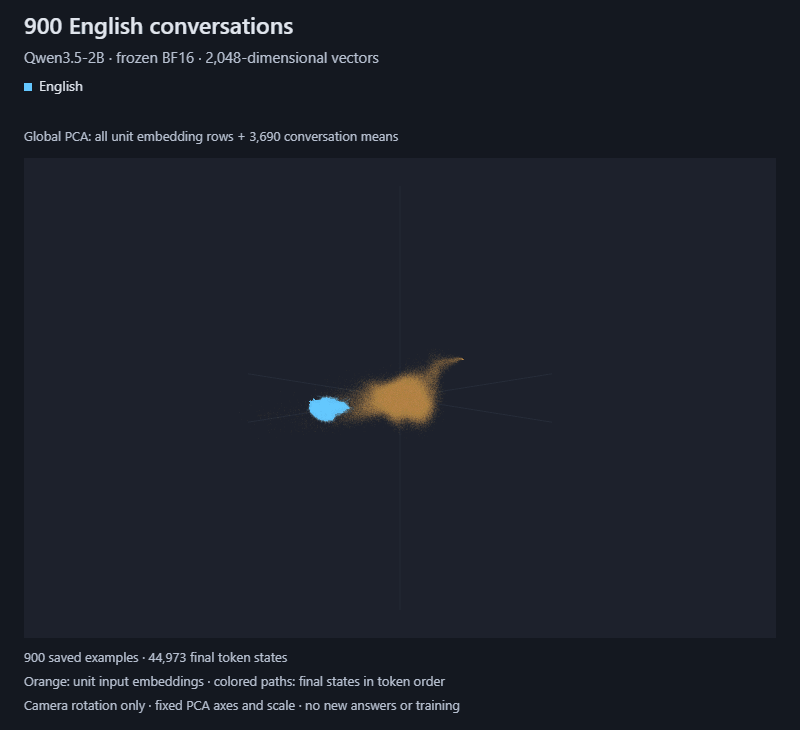
When I lit up the 900 English conversations inside that orange token cloud, a bizarre shape emerged.
The blue conversation lines gathered into a small, dense patch beside the much larger orange cloud. Rotating the camera changed its outline, but the paths stayed tightly packed. It looked as if hundreds of different conversations occupied only a tiny part of the map.
That raised an immediate question: if I feed in the same 100 topics in Chinese, will those lines land in the same patch?
They didn't.
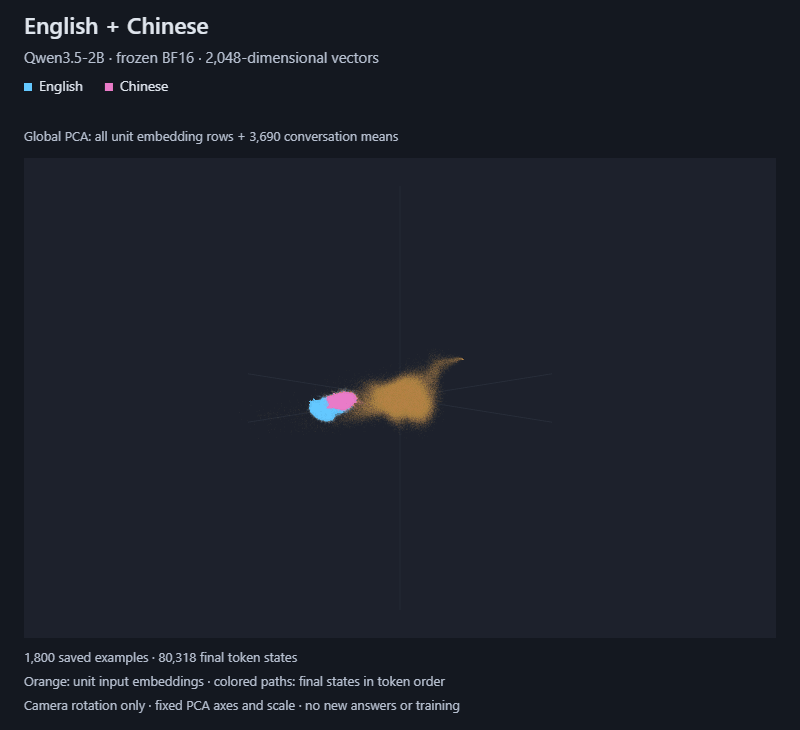
When I toggled on the Chinese conversations, they occupied a nearby, visibly offset region.
Adding German and Croatian brought both straight into the broad English neighborhood, overlapping heavily while Chinese remained off to the side.
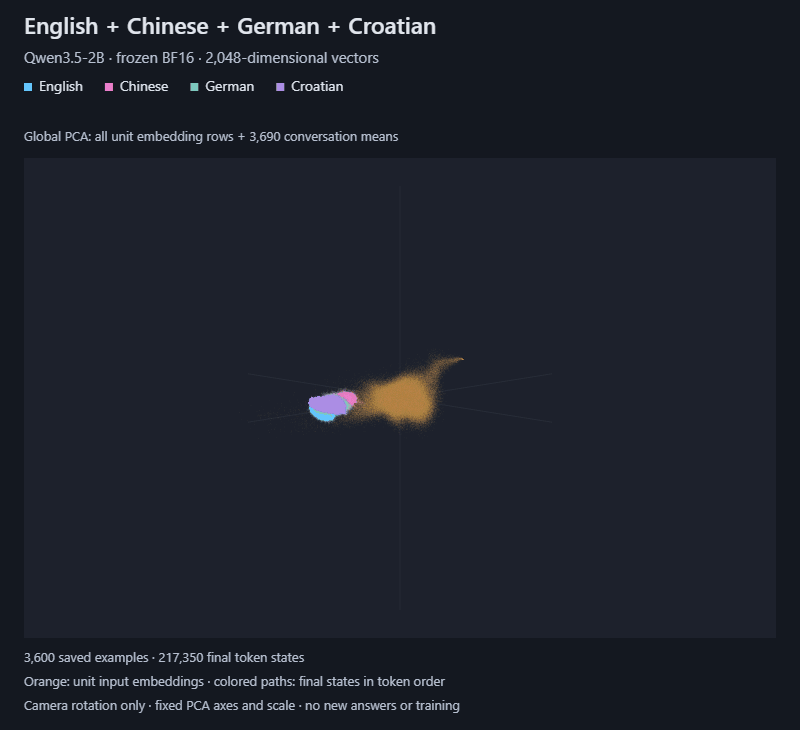
At first glance, it looked like the model was sorting thoughts by writing system – Latin-script languages in one region, Chinese characters in another. Looking closer at the geometry, though, revealed a subtle catch. Croatian responses simply took more Qwen tokens to say the same thing as English. More tokens produce more dots and longer lines – meaning a denser, wider patch on screen reflects how the tokenizer chops up words, not deeper knowledge.
Where Does Python Fit?
If human languages separate like this, where does code go?
I ran 90 Python examples covering sorting, binary search, recursion, graph traversal, and JSON parsing through the same final layer. Code didn't form a separate island at all – it wove right through the same broad neighborhood as English, German, and Croatian.
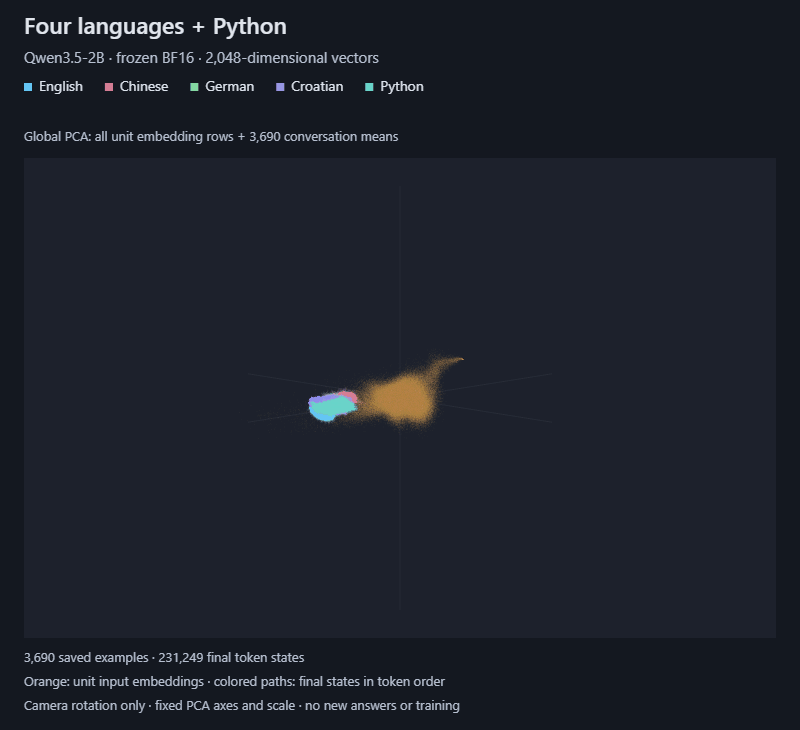
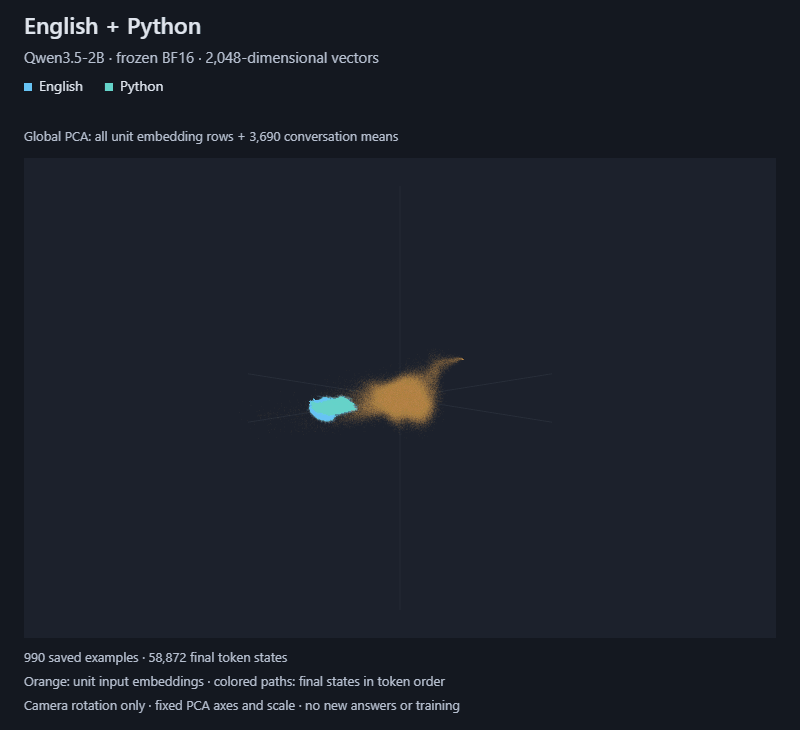
Before reading too much into that, consider what the model is actually seeing. The prompts were written in English, and Python syntax relies heavily on English keywords (def, return, while). That gives code and English plenty of shared tokens. Even so, visual overlap in 3D is not enough to establish which conversations are closest in the full space.
How Much Is the Projection Hiding?
Any 3D shadow of a 2,048-dimensional space leaves most of the room out of frame. To check how much the camera angle itself was shaping the picture, I ran two reality checks:
Re-fitting the camera axes: PCA gives every point an equal vote, so the 248,320 vocabulary rows made up 98.5% of the fitting points and dominated the view. Fitting PCA only on the 3,690 conversation averages opened the geometry into distinct 3D lobes: Chinese extends to one side, German and Croatian form their own wings, and Python overlaps with English. The same states looked much less compressed once the camera was fitted to the conversations themselves.
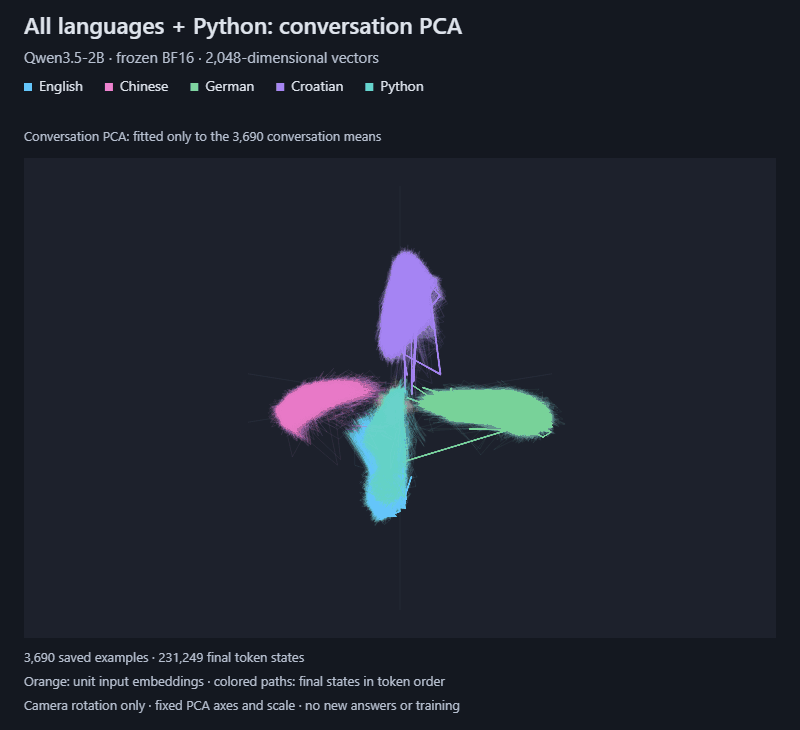
Checking the full 2,048 dimensions: The vocabulary-based Global PCA axes captured just 0.73% of the variation across all 231,249 token states. That tiny cloud hid more than 99% of the variation. Fitting the axes to conversation averages instead captured 24.54% of token-state variation, or 67.87% of variation between the averages themselves. A small patch on screen does not mean the full representations have collapsed.
| Measurement | Result |
|---|---|
| Token positions across the 3,690 saved examples | 231,249 |
| Full token-state variation captured by 3D Global PCA | 0.73% |
| Full token-state variation captured by 3D conversation PCA | 24.54% |
| Conversation-average variation captured by 3D conversation PCA | 67.87% |
Same Meaning, Different Alphabet
To explore how changing the writing system affects the map, I ran a controlled follow-up study using Study PCA (fitting the camera axes purely on the test conversations so each group could form its own cluster). Alongside standard English and Chinese characters, I added three twists:
Pinyin: Mandarin written phonetically in the Latin alphabet (for example, writing "Nǐ hǎo" instead of "你好").
English in Georgian letters: The exact same English sentences, just spelled out using the Georgian alphabet.
Uppercase English: Standard English typed in ALL CAPS.
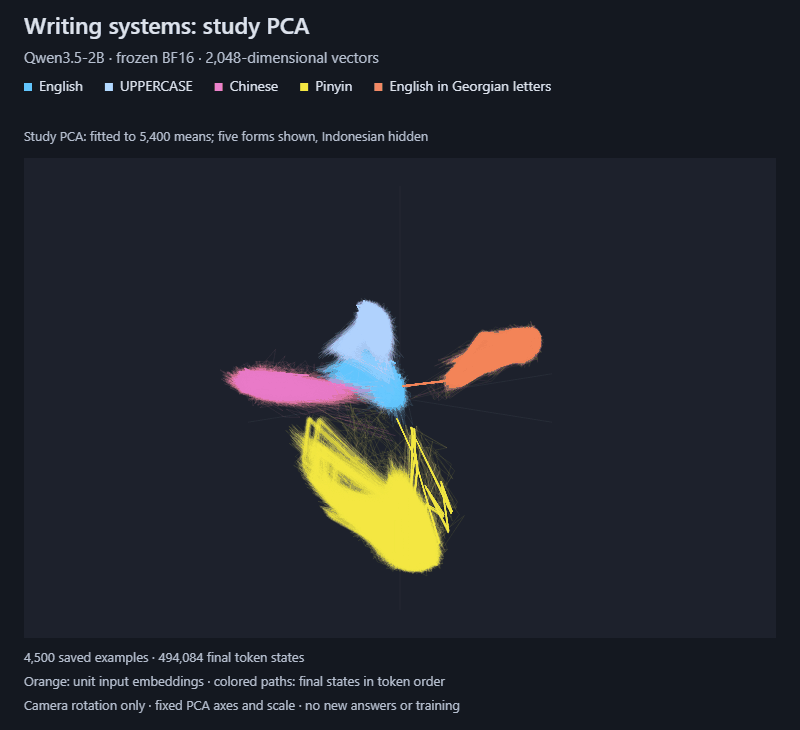
The resulting clusters showed how much the final states could shift when the written form changed.
English transcribed into Georgian letters broke away into its own wing. ALL CAPS English also shifted away from ordinary English, while Pinyin formed a separate, elongated lobe. Changing the written form changes tokenization and sequence length too, so this experiment does not isolate a single cause. But related content clearly does not guarantee overlapping paths in this view.
I also checked whether the matching topics remained identifiable outside the picture. Using the full 2,048-dimensional conversation averages, I subtracted each language's mean and searched for the corresponding English example among 900 candidates. The match was correct for 612 Chinese examples (68.0%), 679 German examples (75.4%), and 459 Croatian examples (51.0%). These reused, constructed examples contain repeated templates, so this is an exploratory matching test. Still, visibly separate language lobes can coexist with cross-language structure in the full space.
Following the Next Token
So far, each line has followed the model's changing internal state as it reads a conversation. What would the path look like if I plotted the next token it predicts at each step instead?
For each saved state, I took the highest-scoring next token and looked up its position in the fixed embedding cloud. In this model, the input and output reference weights are shared: reading a token selects one row, while predicting the next token scores the contextual state against every row. Connecting the selected points gives a different view of how the predictions change as the text unfolds.
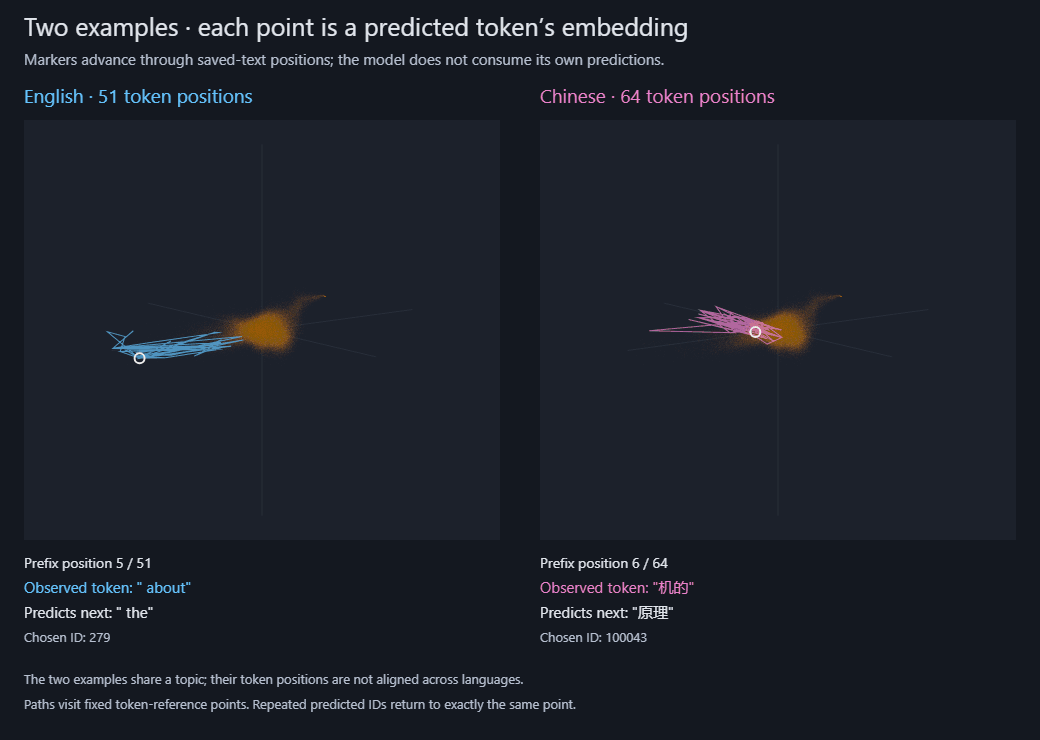
The paths keep returning to familiar points. Across 231,249 predictions, they visited 12,873 distinct token IDs, and the 100 most frequent IDs accounted for 41.0% of all visits. Many busy junctions were punctuation, newlines, and common words such as “the”. Very different conversations repeatedly pass through the same small pieces of language.
Each prediction uses the actual saved text up to that position; the model does not feed its plotted choice back in to continue the conversation. These lines therefore show predictions along an existing conversation. Crossings in the 3D view can also be misleading: the English and Chinese prediction sets shared only 34 token IDs. Two lines can appear to meet without choosing the same token.
If the final layer is this heavily shaped by script, tokenizer mechanics, and getting ready to output specific words, where does pure, language-agnostic meaning live?
Early layers have to decode raw text, and the final layer has to score specific tokens for output. The matching test suggests that some cross-language structure survives even here. I still want to know whether the corresponding conversations become easier to align somewhere in the middle of the network.
I'll be testing that exact hypothesis in the next post by tracking these conversations layer by layer through the model to see where different languages finally meet. If you want to see what emerges, make sure to subscribe to the newsletter and follow me on X so you don't miss it.