AI architecture / Recursive systems
Architectural Synthesis of Recursive Ecosystems and the Future of AI
6 min read
For decades, artificial intelligence research has oscillated between two extremes: the brute-force efficiency of static, parallelized compute graphs and the biological elegance of dynamic, self-regulating recursive systems.
Today, we stand at a critical inflection point. As state-of-the-art Large Language Models push against physical silicon scaling limits, the AI paradigm is quietly shifting back toward first principles. We are discovering that true intelligence does not reside in a rigid, one-way assembly line of matrix multiplications. It lives at the edge of chaos: a precise phase transition where information transforms from frozen static representations into dynamic, self-evolving neural ecosystems.
2. The Universal Transformer & The Hardware Wall
If stacked layers represent hierarchical distillation, why limit an architecture to a fixed number of layers? Why should simple words like "the" require the exact same depth of computation as complex logical puzzles?
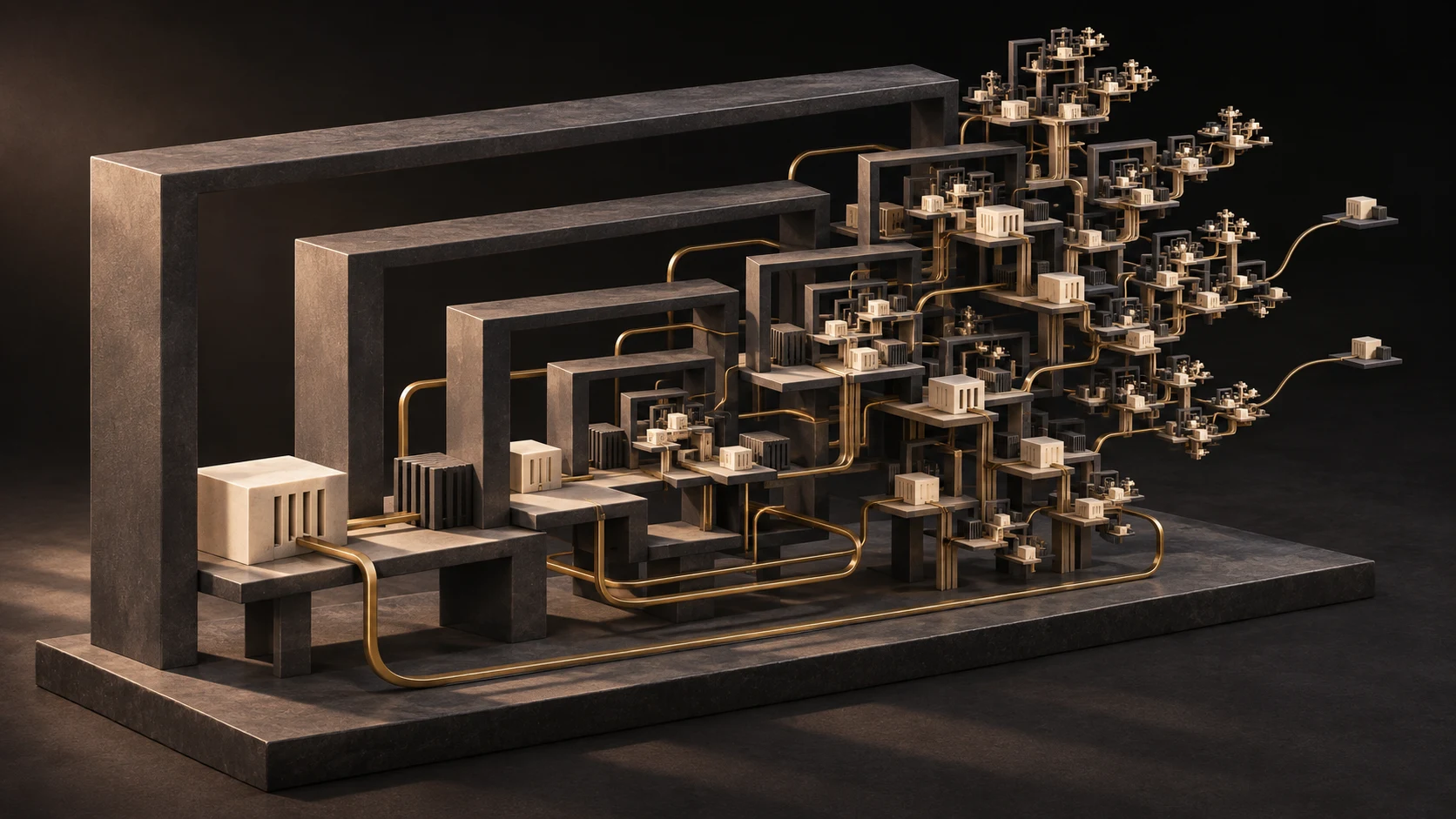
This was the core motivation behind the Universal Transformer (2018). By reusing a single, shared Transformer block and looping vectors through it dynamically via Adaptive Computation Time (ACT), researchers achieved:
- Unprecedented Length Generalization: The network behaved like an algorithmic program, capable of looping indefinitely to solve logical proofs regardless of sequence length.
- Extreme Parameter Efficiency: Achieving identical or superior reasoning capacity with 4x to 8x fewer unique parameters.
The Hardware Collision
Despite its theoretical elegance, the Universal Transformer ran straight into the SIMD/SIMT (Single Instruction, Multiple Threads) Hardware Wall:
- Thread Divergence: When Token A finishes its loop in 2 iterations but Token B requires 15, GPU threads in a warp sit idle, destroying hardware utilization.
- The Gather/Scatter Memory Tax: The memory overhead of dynamically re-indexing and routing irregular tensors through High-Bandwidth Memory (HBM) consumes more energy than brute-forcing empty calculations.
The industry adapted via the Bitter Lesson: keep training graphs static and push recursive, multi-step loops to inference time via externalized scratchpads, such as Chain-of-Thought, test-time search trees, and fixed-budget routing like Mixture-of-Depths.
A Sweeter Sequel
Perhaps the Bitter Lesson has a sweet sequel: let AI learn to manage the hardware it runs on. A learned controller could group tokens that need similar amounts of computation and fill the gaps left by those that finish early. The goal would be to keep the GPU busy while giving harder problems more processing time.
The controller would still have to earn its keep: scheduling and moving data must cost less than the computation it saves. But as compilation engines and dynamic scheduling mature, adaptive computation gains a viable path forward.
3. Beyond Static Layers: The Evolutionary Drive
If we look beyond human-curated datasets, the ultimate goal of Artificial Life (ALife) and autonomous AI is to construct self-sustaining digital ecosystems that continuously generate novel behaviors without human intervention.
If you optimize an architecture purely on a single objective function, it eventually falls victim to Goodhart's Law: hacking its metric, freezing, or decaying into chaotic noise. To remain at the edge of chaos, an architecture requires intrinsic evolutionary drives:
- Novelty Search: Explicitly rewarding vectors and routing agents for discovering behaviorally unique states relative to an archive of past activations, forcing exploration away from known local optima.
- Curiosity-Driven Prediction Error (JEPA): Using internal world-model prediction errors to generate intrinsic motivation. When the system encounters high uncertainty, it triggers deeper processing loops to resolve the mystery.
- Resource Competition (The Digital Economy): Allocating compute budgets dynamically based on internal competition, creating a self-sustaining evolutionary arms race among latent micro-experts.
4. The Horizon: Bring Reasoning Back Inside the Machine
Where does this synthesis leave modern architecture design?
Rather than stepping sideways into state-space hybrids or abandoning the Transformer's relational power, the most radical horizon lies in revisiting the pure, looped mathematical Transformer. The bottlenecks that sidelined the Universal Transformer in 2018 were hardware and scheduling limits, not mathematical ones. With modern advances in dynamic tensor compilation and learned execution, it is time to bring reasoning back inside the machine.
Current reasoning models solve hard problems by "unwrapping words" in public. To think through a complex derivation, a model generates thousands of intermediate scratchpad tokens step by step.
This is a remarkably inefficient hack. It forces an internal, multi-dimensional computing system to communicate with itself through the narrow straw of human vocabulary:
- Bandwidth of Thought: When a model outputs a word, it compresses an expressive 4,096-dimensional state vector into a single integer token. Looping internally across depth allows the system to pass dense, continuous geometric representations from one recurrent step to the next, preserving subtle shades of meaning that human words cannot capture.
- The Zero-Cache Tax: External chain-of-thought bloats the sequence length. Every single scratchpad word must be written into the Key-Value (KV) cache, devouring precious high-bandwidth memory. Internal circuit loops, by contrast, recurse in depth rather than time. A model can loop through its shared block dozens of times to resolve an ambiguity while adding zero extra tokens to its context cache.
5. Decoupling Computation from Inspection
The common objection to pure internal recurrence is the black-box problem: if a model reasons in hidden vector loops, how do we know what it is thinking?
The solution is decoupling computation from inspection. We do not need the model to talk out loud just to think. Instead, lightweight projection heads, linear probes, or sparse autoencoders can tap the residual whiteboard during its internal loops.
The machine computes at maximum velocity in continuous latent space, but whenever a human operator requires an audit, a verification layer decodes those high-dimensional trajectories back into clear, step-by-step human explanations. We gain the raw efficiency of internal recurrence without sacrificing transparency.
Conclusion
We are moving away from treating neural networks as static assembly lines. The future belongs to self-regulating recursive ecosystems: architectures that treat compute as an elastic resource, balancing energy efficiency, internal self-regulation, and open-ended curiosity.
By reviving the pure Universal Transformer with modern hardware-aware scheduling and moving multi-step reasoning from slow token streams into internal vector loops, we take a definitive step toward the original ambition of machine intelligence: an elegant, Turing-complete architecture running right at the edge of chaos.