
Author’s Note: I want to acknowledge and thank my colleagues and friends who have inspired many of the ideas in this manifesto. While confrontational in some ways, the piece attempts to highlight the critical work of leading figures in the regenerative and web3 movements who are already building genuine alternatives to techno-capitalism.
In particular, I am grateful to Patricia Parkinson, Gregory Landua, Samuel Barnes, Darren Zal, Scott Morris, Monty Bryant, Austin Wade Smith, Richard Flyer, Stephen Reid, Jeff Emmett, Jordan Siegel, Kevin Owocki, Ferananda Ibarra, Sheri Herndon, Samantha Power, Joe Brewer, Samantha Sweetwater, Michael James, Michel Bauwens, Charles Eisenstein, Daniel Schmachtenberger, Nora Bateson, and Jem Bendell for being sources of clear-eyed seeing in times of accelerating confusion.
This manifesto is offered freely to the commons under Creative Commons Attribution-ShareAlike 4.0 International Public License.
There is a force moving across our planet, a virus that possesses the mind and urges the body to consume, an insatiable drive to transform atoms into consumer goods that never quite satisfy what we hunger for. This force is not human nature. It is the egregore of capital, a system that metabolizes metals and minerals, plants and bodies into a strange kind of order, perfectly packaged facsimiles of the original object of our desires.
This force, colloquially referred to as ‘capitalism,’ has been analyzed by philosophers for over a century. Gilles Deleuze called its primary operation deterritorialization, the process by which things are torn from their embedded contexts, stripped of their relational meaning, and converted into abstract units of exchangeable value. A farm becomes a line item. A home becomes a rental yield. A community becomes a market segment. Everything that made these things what they were, the relationships, the history, the care, gets sucked out, and what remains is a shell that can be bought and sold.
The extracted value is then reterritorialized, pulled into the financial system, concentrated in the hands of those positioned closest to where money is created. This is why, decade after decade, regardless of which political party holds power, wealth consolidates upward and the US empire topples leaders who stand in the way of global petrodollar supremacy. It’s not a policy failure. It’s the system functioning exactly as its dynamics dictate.
We are now in the late stage of this process. Private equity firms have grown so large that they are hollowing out the basic infrastructure of human life: housing, healthcare, food production.
One small example among a sea of nearly identical scenarios is Vital Farms. They started as something real: pasture-raised hens, a company founded on principles. Then came the Blackrock acquisition. Then the quiet erosion of standards. Now reports of contaminants and slipping quality. The packaging looks the same. The price is higher than ever. But what’s inside the shell has been hollowed out.
This is a small story. But it is also the entire story of the inevitable enshitification at the end of late stage extraction and consolidation.
The abstraction machine has run so long that there is less and less left to abstract. What remains is increasingly the image of things rather than the things themselves.

The theorists who analyzed this process, the postmodern critics, the Marxist cultural analysts, understood something that has largely been lost in the astroturfed 21st century leftist identity politics discourse that followed their 19th and 20th century material critiques. Earlier critics of capitalism saw how the logic of extraction and abstraction doesn’t just affect the economy. It affects the soul.
When everything becomes exchangeable, the person becomes a consumer. When every interaction is mediated by transaction, all relationships become transactional. When attention itself becomes a commodity to be harvested and sold, the inner life gets colonized by the same extractive logic that colonized the land.
Many people today, particularly young people, exist in a kind of bubble, forged from the nihilism that late stage extraction has produced: algorithmically curated, socially isolated, ordering food through apps, scrolling through simulations of connection while the real thing atrophies. This isn’t a failure of their character. This is a failure of our civilization’s ability to produce lives that are meaningful, which is to say lives that are embedded in real relationships. This is what happens when the deterritorializing force runs long enough. The social fabric itself gets fed into the machine. What emerges on the other side is atomization so complete that people no longer remember what they’re missing.
Deleuze saw a potential endpoint in this process. His argument was subtle: the entire operation of capital depends on a premise that is rooted in an existential or ontological contradiction. Capital treats value as something that can be extracted, moved, accumulated, a discrete unit that exists independent of relationship. But value is not actually like that. Value is relational. It emerges from land, from time, from attention, from the web of connections that constitute life. The egg’s worth is not derived from the utility obtained from its protein. The real value has always been the pasture, the hen, the farmer’s care, and the trust between producer and consumer.
When enough of the world has been deterritorialized, when enough of the relational substrate has been converted into abstraction, the system begins eating its own foundation. The contradictions become too great to sustain. The machine, having consumed everything external, begins consuming itself.
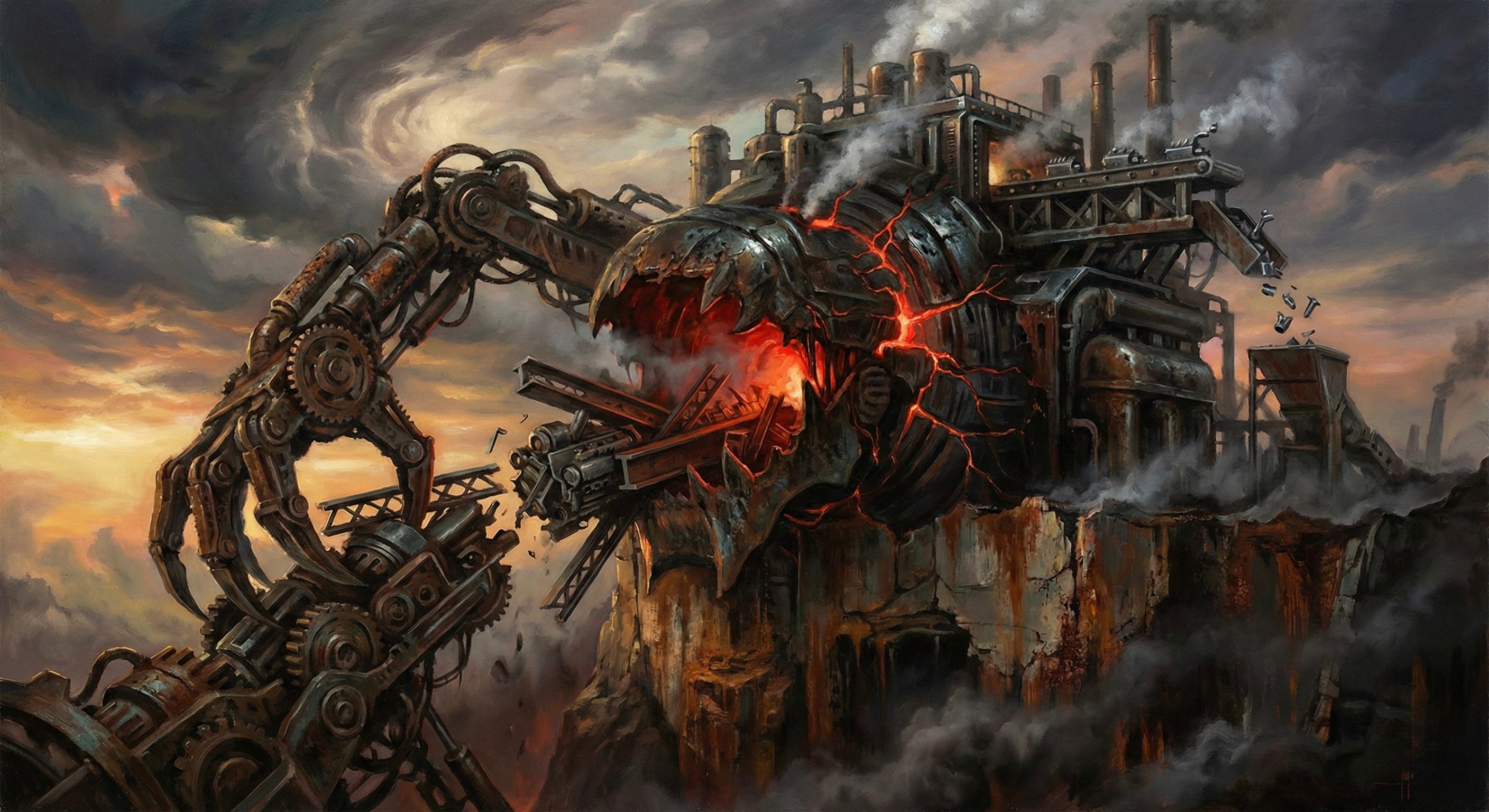
From this analysis came an idea that would later be called accelerationism. If we seek to end the inhuman aspects of capitalism and capitalism is already on an inherently self-destructive trajectory, why try to slow it down? Slowing it down just prolongs the suffering. Perhaps the strategic move is to accelerate, to push the system toward its contradictions faster, get to the breakdown sooner, and build something different from the wreckage.
This was a desperate idea, born from the recognition that reform had failed. Every attempt to make capitalism more humane gets absorbed, metabolized, converted into another domain of extraction. The welfare state became a way to subsidize low wages. Environmental regulation became a compliance industry. The counterculture became a marketing demographic.
This is not because reformers are naive or corrupt. It is because the system has emergent properties that overwhelm individual intentions. Money flows toward whatever generates more money. Attention flows toward whatever captures more attention. Scale advantages compound. Network effects lock in. The game theory is relentless.
Consider carbon markets. The theory was elegant: if we price the externality, the market will optimize for lower emissions. What actually happened? The companies extracting the most value from the earth discovered that carbon credits were simply a cost of doing business. Because they were already so profitable, the cost was trivial compared to what they were extracting. The credits became, in effect, permits to accelerate extraction with a clean conscience. Emissions kept going up, not down.
This pattern repeats everywhere. ESG investing becomes a marketing category while the underlying portfolios barely change. Sustainability certifications become fees paid to continue business as usual. Impact measurement becomes a consulting industry that rarely measures actual impact.
The machine metabolizes its critics. It absorbs opposition and converts it into fuel.
Obama and Trump are mirror images of each other in this regard. While their superficial aesthetics are diametrically opposed, at their core they were both able to capture genuine anger at the late stage of our hyper-capitalist reality and channel it into a political narrative and symbol of transformation while covertly maintaining and accelerating the runaway consolidation of centralized economic actors.
Now, in 2026, we see the sudden emergence of Silicon Valley elites sweeping into the halls of power, ready to usher us as high priests of the Singularity into capitalism’s final act: the transition to technocapitalist authoritarianism. Capitalism’s fundamentally suicidal contradictions are known by even its greatest proponents. They are preparing now to shift the global order again, towards the only form of governance that allows them to perpetuate their oligarchic position while ecological and social systems fracture and break into chaos in the face of irreconcilable contradictions.
These actors saw the same trajectory, the dissolution of traditional society, the rise of machine intelligence, the possible transcendence of biological limitation, and instead of horror, they felt exhilaration. For them, what comes after the acceleration isn’t collapse and rebuilding. It’s the Singularity. It’s merger with artificial intelligence. It’s escape from the prison of flesh and mortality. They don’t want to accelerate into post-capitalist regenerative civilization. They want to accelerate toward a cold, authoritarian, posthuman Singularity.
So, what do those of us who care about people and planet actually do in this landscape?
The first step is perhaps the hardest: stop trying to make capitalism better.
Trying to make capitalism better doesn’t prevent breakdown. It prolongs the time before breakdown while allowing the extraction to continue. Every year of prolongation is another year of lost species, another year of old growth logging, another year of topsoil lost, another year of private equity hollowing out companies and Walmart replacing local businesses.

And now there is AI.
The deterritorialization, the consolidation, the hollowing out, all was accelerating before large language models existed. AI pours gasoline on a fire that was already burning out of control.
We have given every actor in an already-broken system access to tools of unprecedented leverage. Every influencer now has perfect grammar while promoting nearly unlimited dropship products from China. Every tech corporation can automate the extraction of attention at scales previously impossible, filling our social media feeds with somehow ever more endless slop. Every government can surveil and manipulate populations with precision that would have seemed like science fiction a decade ago.
The chaos this introduces makes prediction genuinely difficult. Anyone who claims to know exactly how the next decade unfolds is fooling themselves or trying to fool you. The complexity is too great. The feedback loops are too tangled. Things are going to get weirder and weirder in ways that will surprise everyone.
But we can look at the largest patterns. We can orient ourselves within the complexity even if we can’t control it. This is not abandoning agency. It is locating agency where it can actually operate, not in the fantasy of managing global systems, but in the reality of building alternatives at scales we can actually influence.
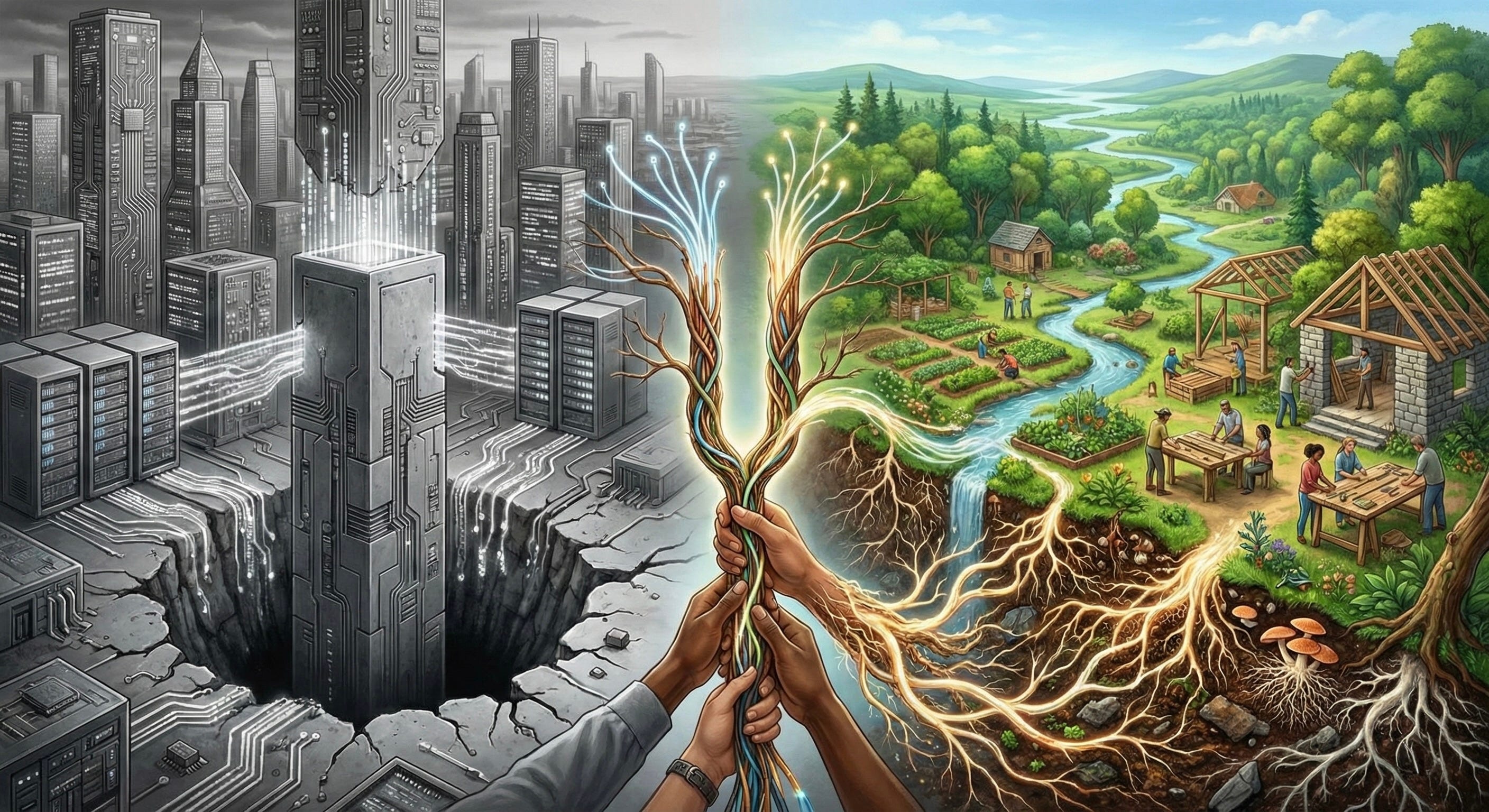
In October 2023, Marc Andreessen published what he called “The Techno-Optimist Manifesto.” It was, on its surface, a defiant celebration of technology as the engine of human flourishing: economic growth, energy abundance, intelligence augmentation.
Critics dismissed it as venture capital propaganda dressed in philosophical clothing. But the manifesto was something even more significant: the public declaration of an esoteric religion that had been gestating in Silicon Valley for decades, now confident enough to speak its own name.
Among the expected references to Friedrich Hayek and Julian Simon appeared a particular citation that offered a crucial tell: “Combine technology and markets and you get what Nick Land has termed the techno-capital machine, the engine of perpetual material creation, growth, and abundance.” Andreessen then adds his own gloss: “We believe the techno-capital machine is not anti-human — in fact, it may be the most pro-human thing there is.”
Nick Land, the amphetamine-prophet of accelerationism, is the philosopher who argues that capital is not a tool humans use but an alien intelligence using humans as its temporary substrate.
The reference is significant. Andreessen wasn’t merely advocating for technology. He was signaling allegiance to a metaphysics in which technological acceleration serves a telos beyond human flourishing, a process that uses our ambitions as raw material for its own emergence. His attempt to recast this telos as pro-human flies in the face of everything Nick Land has publicly stated.
Vitalik Buterin, the creator of Ethereum, recognized what was happening. His response, “My Techno-Optimism,” was not a rejection of acceleration but a reorientation of it. Accept that acceleration is happening and cannot be stopped. The game theory is relatively straightforward. It’s clear to even the most casual observer that the accelerating trajectory of technology is actively reshaping the possibility space of our civilization. But the question still remains open: what should we accelerate into?
Vitalik argued that technologies that were defensive, democratic, decentralized, and differential could subtly but powerfully shift the game-theoretic landscape toward freedom rather than control.
If the technologies we build make surveillance cheap, authoritarianism becomes easier. If they make manipulation scalable, truth becomes harder to establish. But we can also build technologies with different affordances, technologies that protect privacy, enable participation, distribute power, and preserve human agency.
This became d/acc: defensive accelerationism, a framework for influencing civilizational trajectory through the affordances of the tools we build.
D/acc was necessary but insufficient. It knew what it was protecting against: the techno-authoritarian capitalist endgame that Land celebrates and Andreessen carefully obscures, but not what it was building toward. The defensive posture is a holding action, crucial for creating space, but space must be filled with something if it is not to be colonized by what it resists.
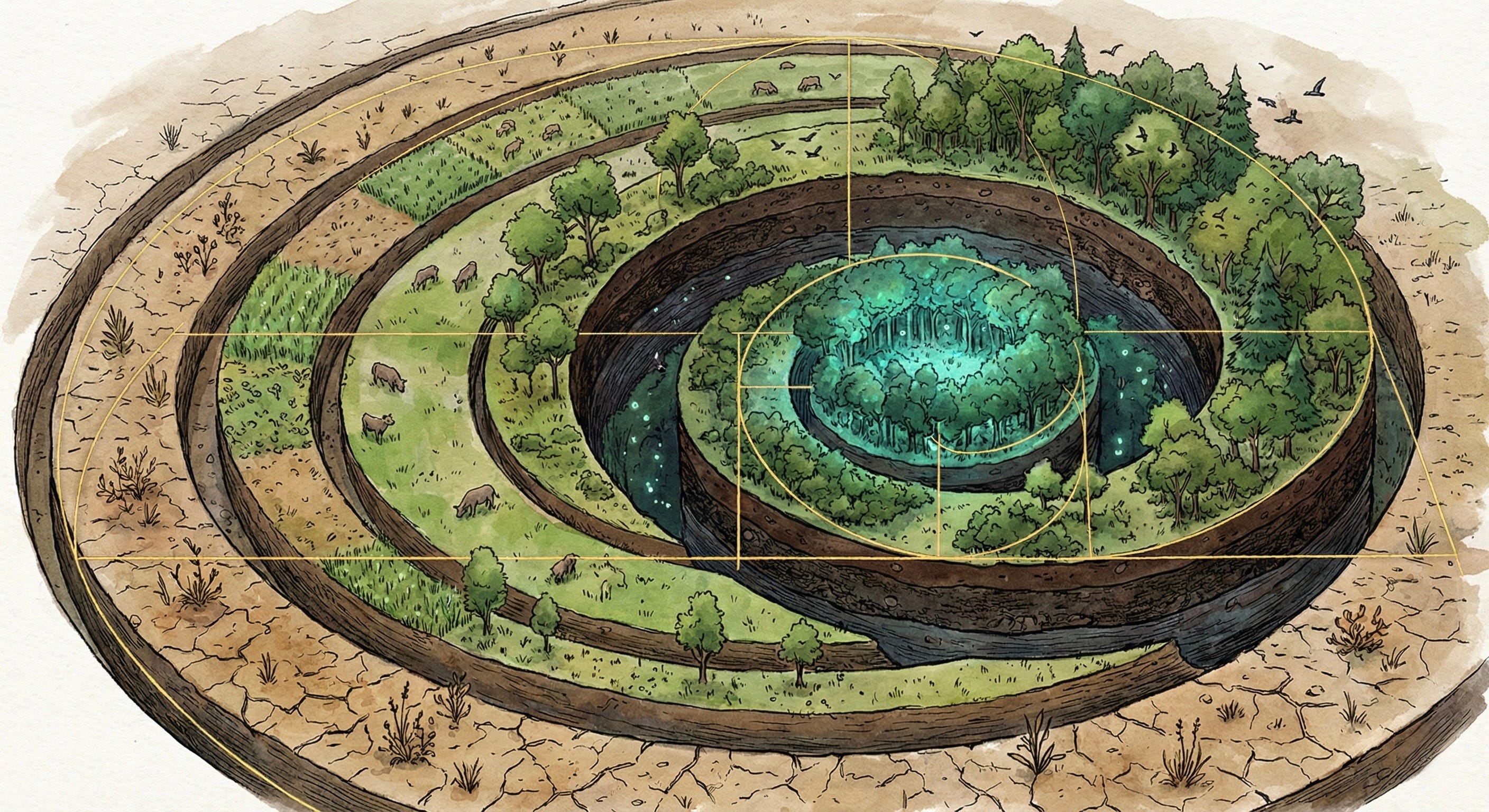
This manifesto proposes regenerative accelerationism, or re/acc, as a complement and completion of Vitalik’s d/acc. Importantly, regenerative accelerationism is distinct from Land’s technocapitalist accelerationism, Andreesen’s techo-optimism, and Thiel’s transhumanist Christian eschatology. Regenerative accelerationism is not the acceleration of capital toward the dissolution of everything human in service of an inhuman Singularity. Neither is it mere resistance against that trajectory.
Regenerative accelerationism accelerates the transition into a regenerative civilization by leaning into capitalism’s runaway feedback loops, not running away from or trying to fix them. Instead of wasting our energy trying to reform the system, we opt out of it while simultaneously re-embedding the tools of capital (currency and computation) to rebuild our own systems that compost energy and resources back into our communities. We fork the source code of society rather than trying to tear it down.
A regenerative civilization is inherently post-capitalist. The contradictions between capitalism’s logic and the wellbeing of living systems cannot be resolved, only composted. We are not going to reform our way to a world that works for all of life. We are going to build alternatives while the old system collapses around us.
Regenerative accelerationism is the practice of building those alternatives with the same self-amplifying dynamics that make capitalism so powerful, but oriented toward life rather than extraction.
Here we must be precise about what distinguishes regenerative accelerationism from regeneration alone. This distinction is not rhetorical but structural. It concerns the system dynamics of the alternatives we build.
Regeneration describes what we do: restoring local ecosystems, rebuilding local economies, healing relationships between humans and the living world. These are essential activities. Plant trees. Restore wetlands. Build community gardens. All of this matters deeply.
But regeneration, when it grows to scales that ultimately threaten the interests of capital, risks being captured by capital. The machine metabolizes regeneration just as it metabolizes everything else.
Regenerative accelerationism is not what we do but how we structure what we do to prevent capture and scale horizontally between peers rather than vertically through the machine. It describes a particular set of system dynamics, self-amplifying feedback loops that compound over time, oriented toward re-embedding value in relational substrates rather than extracting it into abstraction.
Capitalism did not invent recursive dynamics. It captured them.
Life itself evolves through feedback loops. Ecosystems strengthen through mutualistic relationships that compound over time. Cultures develop through shared practices that reinforce each other. What capital did was create a domain of abstraction where these same evolutionary dynamics could operate detached from the living systems that generated them. Capital’s recursion feeds back into itself: money generating more money, accumulation enabling more accumulation. But it does this by severing the connection to actual value creation, parasitizing the relational substrate it can never replenish.
Regenerative recursion feeds back into living systems. Each cycle strengthens the foundation rather than depleting it. The soil becomes more fertile. The community becomes more resilient. The relationships become deeper.
This is the aikido of re/acc: we take the massive energy of the wave that is coming, the acceleration that cannot be stopped, and redirect it into feedback loops that sink and store value back into relational substrates. Not resistance against acceleration, which is futile. Not surrender to the trajectory of techno-capital, which is monstrous. But a redirection of extractive dynamics toward what Karl Polanyi called re-embedding, returning economic activity to its proper place within social and ecological relationships.
The formula is straightforward: through network effects produced by sovereign regenerative technologies, each person who opts out of technocapitalism will make it easier for others to do the same. This is the feedback loop that transforms individualized lifestyle adjustment into the collective action and coordination needed to cut the parasite off from its host. If I plant a garden but the garden doesn’t make it easier for my neighbor to plant one, I’ve done something good but not accelerationist. If I join a local food cooperative and that cooperative provides templates, capital, and supply chains that make the next cooperative easier to form, I’ve participated in a feedback loop that compounds over time.
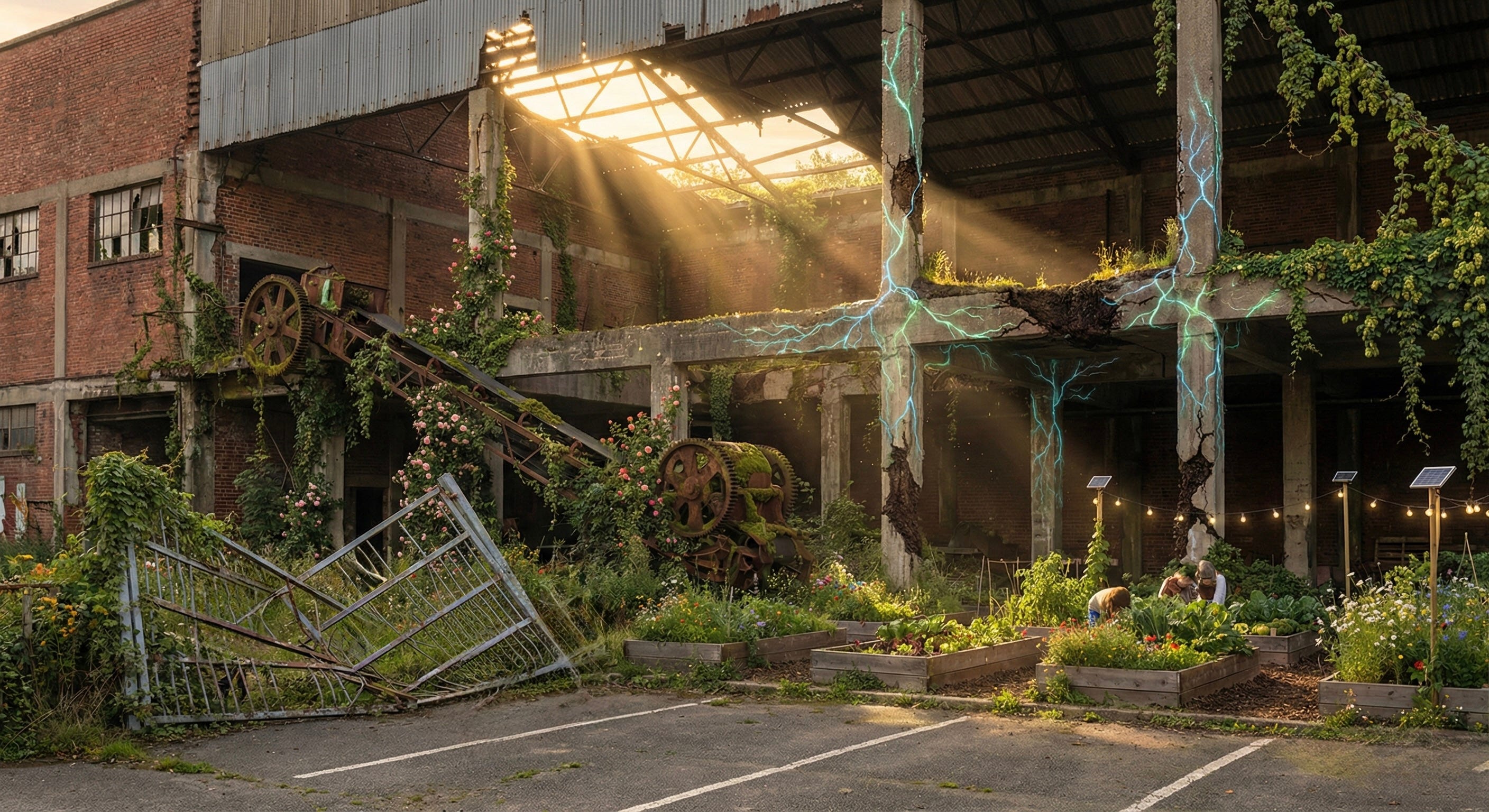
Understanding the system dynamics distinction allows us to specify precisely how we compost capital: how we capture energy and resources currently flowing through extractive systems and re-embed them in relational substrates that resist recapture.
This is not metaphor. It is practical economic architecture. Capital flows can be redirected, decommodified, and locked into structures that compound community wealth rather than extracting it. The specific mechanisms matter.
When you spend dollars, those dollars flow through global financial systems designed to concentrate wealth. A purchase at Walmart extracts value from your community and deposits it in the portfolios of distant shareholders. Even your bank account, sitting in Chase or Bank of America, provides capital that finances extraction elsewhere.
Community currencies create local feedback loops that keep value circulating within place-based economies. Local currencies like the Ithaca HOURS system in New York or the BerkShares in Massachusetts keep purchasing power circulating locally rather than being extracted to financial centers. These are firewalls against systemic shocks.
Local currencies become accelerationist not by artificially inflating their value but by incentivizing and compounding the benefits of increased adoption. A mutual credit network that becomes more useful as more businesses participate. A local currency whose transaction fees fund local public goods that create more demand for local currency. Each cycle strengthens the local economy’s adaptive capacity to meet its own needs, reducing dependency on extractive supply chains.
Blockchain tools, specifically the work of builders within the Ethereum Localism and Regen Commons communities, enable these dynamics at new scales. Tokenized community currencies can maintain local circulation while enabling transparent governance and interoperability between bioregions. Asset-backed tokens can tie money creation directly to regenerative productive activity, carbon sequestration achievements, soil health improvements, watershed quality metrics, rather than financial speculation. This isn’t crypto hype; it’s programmable economics that can be designed for re-embedding rather than extraction.
The financialization of housing perfectly illustrates how capital deterritorializes. When Blackrock purchases single-family homes, it converts what was embedded in community relationships, the place where children grew up, where neighbors knew each other, where roots formed over generations, into an abstract financial asset optimized for rental yield. The home remains physically present, but its relational meaning has been extracted.
Community land trusts reverse this process. By permanently removing land from speculative markets, they decommodify a fundamental asset. The land cannot be extracted because it has been structurally re-embedded in community ownership. Each property acquired by a land trust becomes permanently affordable, permanently outside the dynamics of financialization.
The re/acc dimension: as land trusts grow, they can use existing properties as collateral to acquire more. They develop institutional knowledge that makes the next acquisition easier. They create proof of concept that enables new land trusts to form in other communities. The more land that exits speculative markets, the easier it becomes for more land to exit.
Worker cooperatives apply the same logic to enterprise. When workers own their workplace, the enterprise cannot be hollowed out by private equity. Surplus value stays with those who created it rather than being extracted to distant shareholders. Mondragon, the world’s largest cooperative network, demonstrated this during COVID: while conventional corporations laid off workers to protect shareholder returns, Mondragon cooperatives implemented solidarity measures that maintained employment and community stability.
But Mondragon’s deeper significance is its federative structure. Individual cooperatives are embedded in a network that provides shared banking, education, and mutual support. A struggling cooperative receives support from thriving ones. The network growing stronger as it grows larger.
DAOs, decentralized autonomous organizations, extend these possibilities through programmable governance. Tokenized ownership can separate investment capital from decision-making rights, enabling cooperative structures at scales previously impossible. Different tokens can represent different stakeholder relationships, workers, community members, investors, ecological stewards, each with appropriate governance weight. The legal complexity that historically limited cooperative formation can be encoded in smart contracts that any community can fork and adapt.
Individual cooperatives, land trusts, and local currencies are powerful but isolated. The system dynamics shift when they begin to federate, when alternatives connect into networks that create mutual reinforcement across scales.
A federation of worker cooperatives can achieve supply chain resilience that no individual cooperative could manage. Cooperatives can purchase from each other, creating closed loops that keep value circulating within the solidarity economy. They can share technical resources, training programs, and institutional knowledge. They can develop collective political voice to shape policy environments.
Yellow Barn Farm demonstrates this in practice: a network of worker-owned businesses, a moving company, a compost business, a private membership association for local produce and meat, all embedded in their community’s organizational ecosystem. The cooperatives serve local resilience while providing living-wage employment and ownership stakes to local residents. Each new cooperative strengthens the network; the network makes each new cooperative more viable.
Bioregional financing facilities extend this logic to capital allocation itself. Rather than global capital markets that treat all places as interchangeable sites for extraction, bioregional finance roots investment in specific ecosystems and communities. Returns are measured in ecological and social health alongside financial sustainability. Bioregional finance makes investments that strengthen bioregional resilience rather than extract their resources.
The cosmolocal pattern enables these federations to learn from each other globally while implementing locally. Open-source governance templates spread across bioregions. Financial protocols developed in one watershed can be adapted to another. Knowledge flows freely through global commons while implementation remains grounded in place. This is how viral regeneration works: successful practices spreading through adaptation rather than replication.

Re/acc begins with withdrawal. Not retreat into isolation, the doomer strategy of homesteads and bunkers, but strategic withdrawal of consent, energy, and resources from extractive systems while redirecting them toward the positive sum alternatives described above.
It begins with a genuine accounting: Where in my life am I still dependent on systems that are hostile to what I care about? Where do I still feed energy and resources to entities that see me only as a source of value to extract? Where am I still plugged into the machine?
For most of us, the honest answer is: almost everywhere. We cannot unplug overnight. The system is pervasive, and we are embedded in it. But we can begin. We can notice our dependencies. We can start creating alternatives where possible.
What makes this accelerationism is the recursive dimension:
By building interoperable infrastructure, we create an alternative civilizational stack that grows more powerful as our networks expand. As the infrastructure of alternatives grows, local economies strengthen, mutual aid networks deepen. Each departure from the extractive system adds capacity and energy and value to the regenerative one.
We need network effects. We need bottoms-up, distributed swarms made possible through shared protocols and infrastructure. These are the evolutionary dynamics that capitalism captured and that regenerative systems must reclaim.
This is what I mean by regenerative accelerationism. Not acceleration of technology toward some inhuman singularity. But aligning the acceleration of technology with the feedback loops that strengthen life, community, and the living systems we depend on.
Regenerative accelerationism requires both defense and resilience.
On the defensive side, we must make extraction and authoritarianism harder. This is where d/acc is essential: privacy technologies that prevent data harvesting, decentralized systems that resist capture, tools that give people sovereignty over their own lives.
But there’s another dimension to defense that is not reactive but proactive: extraction becomes harder when people can meet their own needs.
Communities that have strong local economies are less susceptible to extractive development. People who have genuine connection are less vulnerable to platforms that simulate it. When you’re not desperate, you’re harder to exploit.
This resilience has several dimensions. It begins with bioregional organizing, learning to see watersheds and ecosystems as the primary units of organization, building relationships with neighbors and land, understanding that political boundaries are abstractions while ecological boundaries are real. The bioregion is the scale at which genuine self-reliance becomes possible.
It requires third spaces, places where people can gather outside of commercial logic. Community centers, maker spaces, community-owned co-working offices, anywhere that relationship can form without transaction. These spaces are where trust develops, where mutual aid networks form, where the social fabric that makes everything else possible gets woven.
It demands resilience infrastructure, the physical and social systems that allow communities to weather disruption. Local food production, distributed energy, coordination networks that activate in crisis. When the supply chain breaks, when the grid goes down, when the institution fails, sovereign communities continue.
And it includes open civic innovation and co-design, teaching people to use powerful tools and methodologies, including AI, for their own purposes and their community’s needs. Sovereignty requires communal design capacity. The community that can build its own software, adapt its own infrastructure, and design its own governance model is harder to lock into extractive systems and platforms.
This is why strengthening local capacity is itself a form of defense. Re/acc is not just about building a nice alternative. It’s about reducing the leverage that extractive systems have over people’s lives. The landlord who can threaten eviction has physical power. The Amazon warehouse that’s the only employer in town has political power. Removing dependency is removing the ability to coerce.
The same AI that threatens to complete capitalism’s totalitarian endgame contains within it capitalism’s fatal contradiction.
AI drives marginal production costs toward zero across knowledge domains: content creation, software development, analysis, research. This isn’t mere efficiency; it’s fundamental economic transformation. When sophisticated analysis requiring expert teams becomes individually accessible, when complex applications get prototyped in hours not months, when personalized services deliver at near-zero marginal cost, traditional relationships between capital, labor, and value disintegrate.
Open source models, democratized development tools, and distributed AI capabilities create what we might call “digital un-enclosure,” our collective ability to open source the very platforms that have entrapped us like Facebook, Apple, and Google. Historical patterns show technologies initially concentrating power before ultimately distributing it. Printing presses empowered publishers before enabling mass literacy, the internet benefited corporations before spawning countless entrepreneurs and activists. But AI represents qualitatively different democratization because it doesn’t just distribute existing capabilities, it creates entirely new productive capacity.
For the first time in modern history, regular people access the same building blocks of digital power once monopolized by tech giants. Small communities can utilize AI to deploy software rivaling Fortune 500 systems. The forces that wish to enclose our digital commons are only as strong as our lack of participation in creating alternatives. With AI systems like Claude Code, participation in digital systems design is as easy as chatting with ChatGPT.
This is the “vibe coding” revolution: AI assistants translating human intentions into working software. Communities can now build bespoke systems tailored to specific needs, values, and cultural contexts without requiring venture capital or technical expertise. Consider server racks in community centers. Local food cooperatives building their own supply chain management systems. Neighborhoods creating governance tools with rules reflecting local values. Bioregions developing grantmaking platforms that distribute grants according to collective intelligence instead of centralized bureaucracy.
This transcends technological decentralization toward what we might call “technological sovereignty,” community capacity to shape technological environments rather than being shaped by technologies designed elsewhere for other purposes. It could reverse centuries of technological centralization, creating what Murray Bookchin called “libertarian municipalism,” democratic, ecological, human-scale alternatives to both capitalism and state socialism.
But AI alone is insufficient. AI can build tools, but tools need infrastructure. The affordances of blockchain technology provide the substrate on which regenerative systems can run, not out of blind allegiance to blockchain as an ideology, but because its specific technical properties align with what re/acc requires.
Privacy through zero-knowledge proofs. When everything on centralized platforms can be faked, when synthetic content becomes indistinguishable from human creation, we need cryptographic verification of provenance and identity. Zero-knowledge proofs enable verification without surveillance. You can prove you’re a member of a community, that you’ve completed a commitment, that you hold a credential, without revealing the underlying data. This is the technical foundation for coordination without control.
Auditability without centralization. Blockchain creates transparent, tamper-resistant records of commitments and transactions. This enables what traditional institutions promised but couldn’t deliver: accountability and trust. When a community currency’s issuance rules are encoded in a smart contract, no one can secretly inflate the supply. When a cooperative’s governance is on-chain, no faction can quietly change the rules.
Programmability of economic relations. This is perhaps the most profound affordance. Values can be encoded directly into the infrastructure of exchange. A token can be programmed to circulate only within a bioregion. Revenue can automatically flow to ecological restoration with every transaction. Governance rights can be distributed according to contribution rather than capital. The relationships that capitalism strips away can be programmed back into the medium of coordination itself.
Credible neutrality. Open protocols don’t privilege particular actors. Unlike platforms owned by corporations optimizing for extraction, protocols can be designed so that no party has special access or control. This is the technical basis for infrastructure that serves users rather than harvesting them.
We are in a race condition, a competition measured in lines of code written, standards adopted, infrastructure deployed. The outcome depends on whether open source and decentralized technologies outpace re-enclosure attempts. Will democratizing technologies spread faster than authoritarian adaptation?
The window for intervention may be narrow. Once AI systems become sufficiently powerful and entrenched, once centralized identity infrastructure achieves lock-in, the possibility of democratic alternatives may foreclose. But right now, while AI capabilities develop and open source alternatives exist, opportunities remain to shape technological development in more democratic directions.
This is why re/acc must actively harness AI and blockchain, not as ends in themselves, but as means for building the coordination infrastructure that regenerative systems require. Every open source AI model released, every decentralized protocol created, every local community developing technological sovereignty represents small victories against digital feudalism. These seemingly individual decisions aggregate into technological development’s collective trajectory. We are materially creating the future through the algorithms we use, platforms we support, code we write, and communities we build.
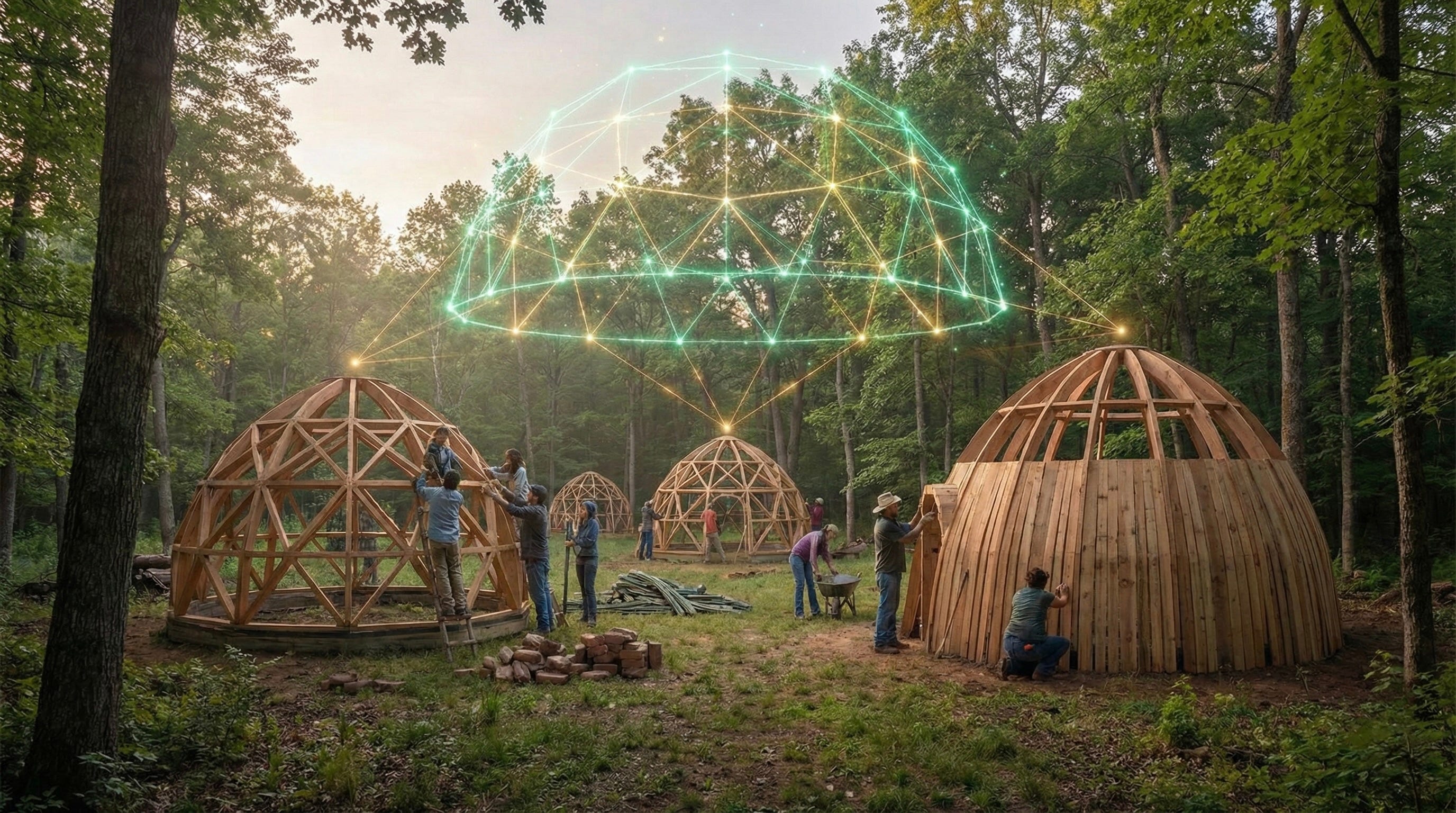
One of the highest-leverage vectors of regenerative acceleration is infrastructure for sharing what works.
Regenerative practitioners are motivated by something deeper than market value. We actually want to share information. We want to learn together. We want the blueprints for resilience and restoration to spread as widely as possible.
This is the opposite of the capitalist instinct to hoard knowledge and extract rents from information. In a regenerative context, sharing is not sacrifice. It’s how the system grows. These are open protocols, patterns that emerge to solve real problems with available resources and relationships.
Here again we find the cosmolocal pattern: knowledge flows globally while implementation stays local. Open-source designs spread across the planet while each community adapts them to their specific context, their particular ecology, their cultural inheritance. And the lessons from each local implementation flow back into the global commons, making the next implementation easier and better.
Open source and open protocol accelerationism are both essential to regenerative accelerationism’s success. This is acceleration through sharing. The more we give away, the faster we all learn. The faster we learn, the more resilient we become.
For regenerative accelerationism to succeed, those of us committed to planetary regeneration must develop shared network protocols to establish a commons for our knowledge and resources. Only once the open protocols, the playbooks for local regenerative systems change, have a medium by which they can be exchanged, documented, remixed, and adapted will we be able to see the feedback loops needed to accelerate bioregional, grassroots, collective action.
And for regenerative accelerationism to succeed, d/acc must succeed. Without defensive technologies that enable this type of secure, private, and permissionless sharing of social and digital protocols, the regenerative acceleration will not survive long enough to begin its first real feedback loops. AI mass surveillance as the ultimate tool of the impending technocapitalist authoritarian regime requires us to come together across our ideologies and backgrounds to support the development of technologies that prevent authoritarian control while enabling regenerative collective action.

We face something vast. It has been building power for centuries. It now commands unprecedented computational resources, capital, and positions of power. It is wielded by people who believe they are building gods, who see humanity as scaffolding for something beyond humanity, who will not voluntarily step back from the trajectory they’re riding.
The honest assessment is that this force is winning. The trajectory, absent intervention, leads somewhere none of us want.
But in that same moment, something else is possible. Not the fantasy of revolution that overthrows everything at once. Not the despair of resignation. But the patient work of building alternatives.
This requires releasing some things we’ve held tightly. The ideological frameworks that keep us fighting each other while the real threat grows. The purity tests that shrink our coalitions. The fantasy that the right election will fix structural dynamics no election can change.
What remains when we let go is simpler and older than modern political categories: the recognition that we share a common fate, that we belong to the places we call home, that we have both obligations and rights to the beauty of this earth.
The work ahead is to build systems that embody these recognitions. To create alternatives that are not merely ethically superior but dynamically superior. Systems that grow stronger through use, that create more capacity than they consume, that invite participation rather than demanding submission.
The regeneration will not be televised. It will be lived. Watershed by watershed, cooperative by cooperative, relationship by relationship. It will spread through sharing. It will adapt to context, and it will accelerate through its own network effects and feedback loops.
The machine that consumes the world has a weakness: it cannot create what it consumes. It can only hollow and extract. Meanwhile, life creates more life. Relationship generates more relationship. Trust builds more trust.
And ultimately, the machine breaks itself. The contradictions are too great. The extraction has gone too far. A system that promises infinite growth on a finite planet will inevitably encounter its limits. It is encountering those limits now.
The question is not whether the old world ends. The question is what grows in its place.
Our work is to compost what it leaves behind and to tend to what’s emerging.
This is not a burden. It is the opposite of a burden. To be alive at a moment of civilizational turning, to have the chance to participate in what comes next, to be among those who get to build rather than merely inherit, this is the thing humans have always wanted. Purpose. Meaning. The sense that our lives are part of a larger circle than our lifespans.
The despair of this moment is real but it is not final. It is the despair of seeing clearly what we face. The other side of that despair is clarity about what is actually ours to do.
We cannot control the trajectory of the machine. We cannot vote it away or reform it from within. But we can withdraw our consent. We can build alternatives. We can connect what has been isolated and share what has been hoarded and protect what is trying to be born.
We are not fighting the machine on its own terms. We are building something else entirely, something the machine cannot replicate because the machine has already severed itself from the source of what nourishes and sustains, the source we must now call upon to see us through this treacherous passage.
That source is still here. It is in the soil, in the water, in the space between people when they actually see each other. It is in the indigenous wisdom that was never fully extinguished. It is in every moment of genuine intimacy, honesty, or connection that somehow persists despite every incentive against it.
It is in you, reading this, recognizing something you already knew.