Jack Dorsey, CEO of Block (the company formerly known as Square), went on X (the company formerly known as Twitter, which he co-founded) and shared a lower-case employee memo, candidly outlining his decision to cut about 4,200 people, just over 40 percent of the company’s staff. The memo was in sharp contrast to the investor letter shared with shareholders, prompting John Gruber to quip on Daring Fireball, “That’s a telling sign about who he respects.”
Wall Street loves nothing more than job cuts. It loves them more than it loves vision. In my jaded eyes, the market wasn’t rewarding his AI narrative. It was rewarding the cut. Block stock surged 22 percent on the news. And frankly, no one is looking at Block for any AI vision.
Either way, the thrust of the memo was AI. In way too many words, what Jack was saying was that AI is here, it is changing how we work, and what it means to be a company. All three points are true. What is also true is that when it comes to technology companies, AI is a convenient narrative that masks a deeper problem.
Operational inefficiencies, over-hiring, and general lack of financial discipline are a common malaise, especially among mid-tier publicly traded tech companies that have lived on the largesse of cloud, mobile, and ZIRP. Block is a poster child, as the data shows.
Ironically, the AI narrative fell apart hours after the news was announced. On X, when challenged about the over-hiring, Dorsey replied, “Yes, we over-hired during COVID because I incorrectly built 2 separate company structures (Square & Cash App) rather than 1.” That is the CEO confessing to a structural mistake while calling the fix an AI transformation.
Here is how I read what Dorsey is saying in his memo and his shareholder letter. This is classic narrative substitution, a tool where you replace one story with another to reframe the situation. Operational balls-up becomes AI transformation. In doing so, you change how people think of the reality with a totally different frame. As an old-timer with decades of experience listening to corporate mumbo-jumbo, I am quick to spot this kind of move.
For example, when Dorsey says,
“AI as destiny,” not “AI as tool”
It frames the layoffs as an operating-model rewrite because “intelligence tools have changed what it means to build and run a company.” What he is not saying is that they found a way to be more efficient. Instead, the message is simply that the world has changed, we are embracing the future, and this is the new way. Dorsey put a number on it. “100 people + AI = 1,000 people.” That is not a business plan. That is a bumper sticker. Or at least a T-shirt.
Culling over 4,000 employees is pure theater, designed for impact. The company has been cutting jobs for quite some time. But this big cut is really a reset of the company. It is also a way to communicate decisiveness to investors and inevitability to employees.
When he argues that a smaller company “has no excuse for being slow” and will “decide faster, ship faster,” he is using speed as a virtue signal. By his own admission, the old organization was just wrong. At an all-hands earlier this month, Dorsey told employees that “a sizable portion of our population have been phoning it in.” That is not an AI story. If a sizable portion of your workforce is unproductive, the CEO who built that workforce is liable for those decisions.
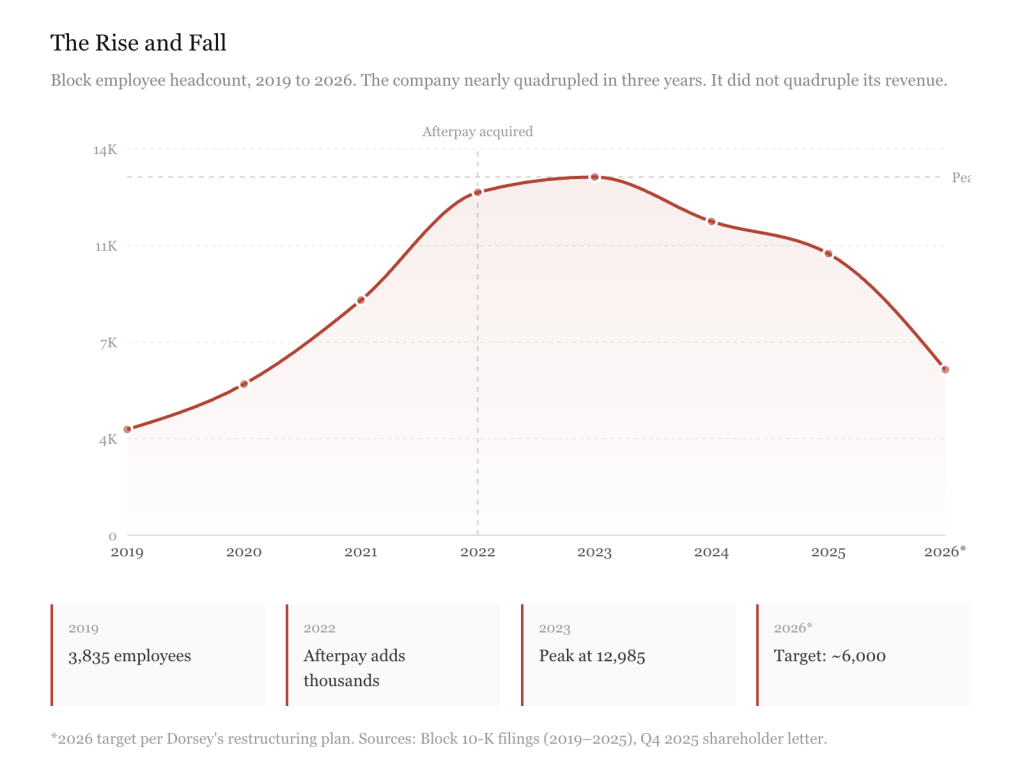
Block had 3,835 employees in 2019. By the end of 2022, it had 12,428. The company nearly quadrupled in three years. It did not quadruple its revenue. A big chunk of that surge came from the $29 billion Afterpay acquisition in January 2022, an acquisition Block is now quietly unwinding.
To be fair, Dorsey is not alone in embracing this “AI-native narrative.” During the ZIRP years, a lot of founders ran their companies on weird auto-hyperdrive, hiring and growing on the assumption that the up-into-the-top-right curve would keep defying gravity. We all know, reality has a way of bringing us all down to our knees. Block is not the first company to use AI as an excuse to cut jobs. And it will not be the last. For now, it is joining the company of Amazon, Google, and Meta in using “AI” as cover to sweep up the sins of unfettered, unchecked, unhinged expansion during the Covid years.
No one is denying that AI is going to be a disruptor, job eater, and overall economic deflator. Certainly not me. I have learned the hard way. The future does what the future wants.
The fundamental truth is that Silicon Valley companies are poorly run. Every time some CEO or founder told me that their headcount had doubled or tripled, I would reach for the migraine pills. Growth in employee base is not the right metric. During the go-go ZIRP years, this growth got even more ridiculous. The logic of the era rationalized it all with the argument that people were a strategic asset. More engineers you have, the more you can do, the more you can experiment, the more you can expand. This allowed companies to sell a better narrative and command higher multiples. What was really happening was that growth masked operational inefficiency and incompetence.
The virus eventually was tamed. Rates normalized. A semblance of reality returned. Amazon called it “right-sizing.” Meta called it the “Year of Efficiency.” Google talked about streamlining. And now the buzz-phrase is “AI-native.” Or AI-first company. I am old enough to remember mobile-native and cloud-first as corporate tropes. An Oxford Economics report in January 2026 found what you would expect. Many of the layoffs CEOs were blaming on AI were corrections for over-hiring. Even Sam Altman called the pattern “AI washing.” When the CEO of OpenAI tells you your AI layoff story does not hold up, the narrative has gotten ahead of the reality. In other words, it is bullshit.
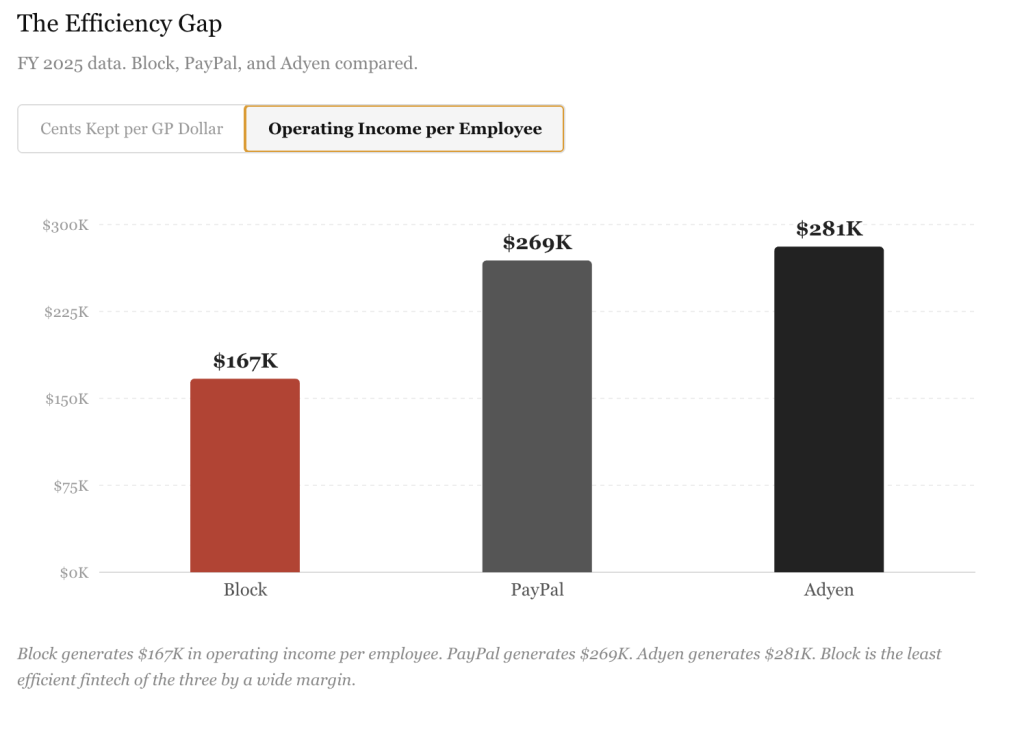
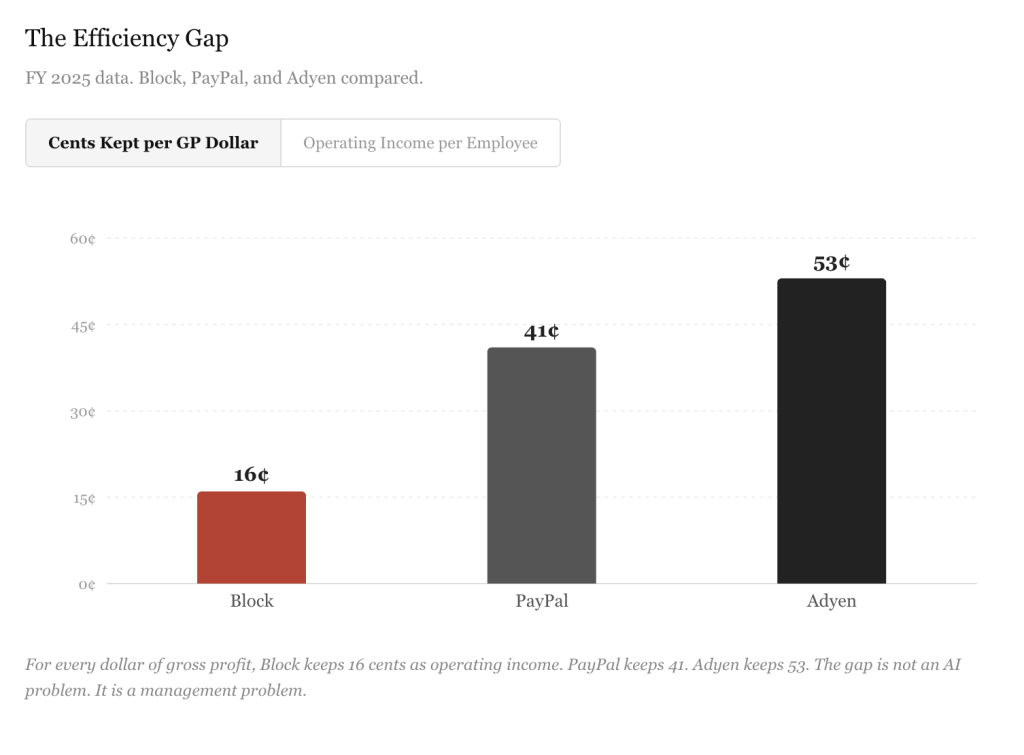
One has to look at Block’s financial filings and compare them to its fintech peers like PayPal and Adyen to see a company in desperate need of a course correction. The indiscipline is right there in the numbers. This is the company that bought an also-ran music-streamer Tidal for no obvious reason. When explaining the deal, I wrote “It’s a bit of a head-scratcher. One could argue that it makes perfect sense — or that it is utter nonsense.” Shame on me, for not being more blunt.
This is the same company that in September 2025, five months before cutting 4,000 people, threw a company-wide party that cost $68.1 million. Jay-Z. T-Pain. Soulja Boy. The bill showed up in their own earnings as a spike in general and administrative expenses. Roughly calculated, $68 million is the annual payroll for about 200 employees.
Block reported FY 2025 gross profit of $10.36 billion and operating income of $1.71 billion and a net income of about $1.3 billion. In comparison, PayPal reported total net revenues of $33.2 billion for FY 2025 and net income of $5.2 billion, with about 23,800 employees. Block had 10,205.
Adyen, the European payments company, had FY 2025 net revenue of €2.36 billion (roughly $2.55 billion), net income of about €1.06 billion (roughly $1.15 billion), and about 4,800 employees. Now do the math that matters. For every dollar of gross profit, Block keeps 16 cents as operating income. PayPal keeps 41 cents. Adyen keeps 53 cents. All that money leaking between gross profit and the operating line is not an AI problem. It is a lack of operational discipline. In per-employee terms, Block generates about $167,000 in operating income per person. PayPal generates $269,000. Adyen generates $281,000.
Block is the least efficient fintech of the three by a wide margin. To me, even these rough back-of-the-envelope calculations show this is more of a management problem. The argument that AI will fix it is narrative substitution in action.
The bigger point is that we have a broader issue in Silicon Valley, one that is not about just one company. Companies need to pair operational discipline with the inevitability of technological progress, not substitute one for the other.
Dorsey’s 2026 guidance implies each remaining employee will produce 2.6 times what they did in 2025. That is a 160 percent productivity jump in a single year. That is a hard pill to swallow. Before this week’s post-layoff bounce, Block stock was down 72 percent over five years. Dorsey spent $68 million on a party five months before cutting 4,000 people. He told employees a “sizable portion” had been “phoning it in.” And then he wrapped the whole thing in AI.
Sadly, this is the new template. Cut half the company. Blame the machines. Watch the stock pop. Move on. And if you are one of the people who just lost their job, well, you are supposed to believe that the future does what the future wants. That is narrative substitution.
Block will not be the last to use this block and tackle template.
February 28, 2026. San Francisco.