Deterministic AI
OLM produces answers from explicitly represented ontological knowledge, reducing the risk of hallucination.
Ontological Language Model (OLM) is a new approach to how machines understand, reason, and control what they communicate.
It is a new language-model/architecture designed to operate independently or alongside LLMs. Instead of relying exclusively on statistical prediction, OLM introduces a deterministic layer built around structured meaning.
The benefits of OLM are grouped in 4 categories as explained below which enable RAG models to be used in high-risk/high-interaction industries.
OLM produces answers from explicitly represented ontological knowledge, reducing the risk of hallucination.
OLM can take over selected reasoning and output functions, reducing dependence on computationally expensive LLM processing.
Enterprises determine what knowledge the system can use and communicate—particularly important for RAG applications.
OLM knowledge structures can be inspected, corrected, expanded, and updated directly.
In a hybrid RAG arrchitecture, the LLM can operate at the natural-language input layer while OLM controls reasoning and output where determinism, traceability, and content control matter most. The operation is as simple as it is depicted in the diagram below.
In the first flow, the administrator (domain expert) is not required to have any experience in coding, prompting, ontological semantics, or AI. He/she sets up the RAG content to be handled by the system automatically.
In the second flow, the user can benefit from the system in a number of ways (called functions) ranging from question answering to knowledge mining. See the functions below.
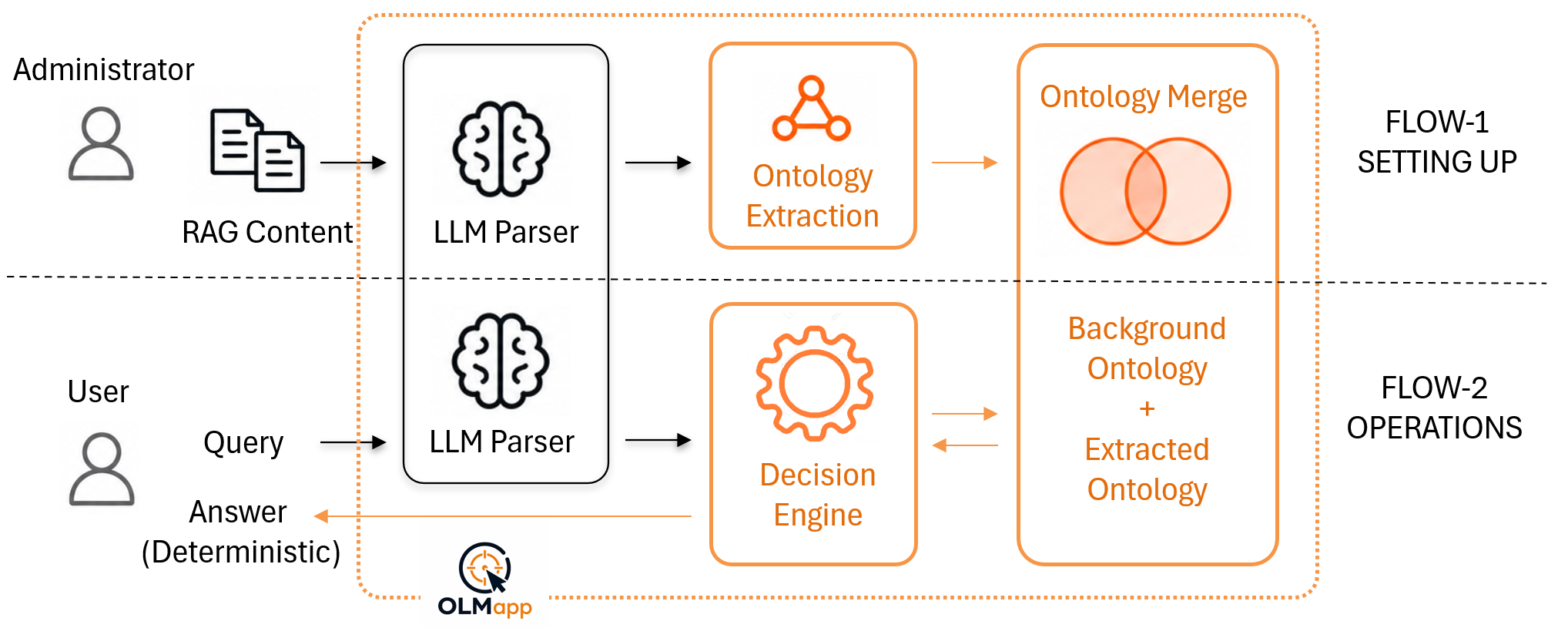
You can try the operation depicted above in our Sandbox. You will be both the administrator and user. As the administrator, you will be asked to copy paste a RAG content. You can use samples or compose your own text not exceeding 1,500 words. After submitting the text, you can ask questions.
OLMapp is the tool to deploy hybrid applications with LLM within a RAG framework. There are 8 main functions of OLMapp as outlined below. They all can be deployed having a human-in-the-loop policy. Some of the functions play a strong role in Agentic AI
Enables counseling dialogue by answering questions from reference sources.
Given the evidence, helps the user in decision making using guidelines.
Summarizes large text without manipulation of the original language.
Discovers unanticipated associations embedded in RAG content.
Generates questions from RAG content ideal for training exercises.
Walks through consent material while answering questions.
Given the situation, warns the user if any regulation was violated using compliance guidelines.
As part of agentic AI, OLMapp can handle the management of automation and robotics.
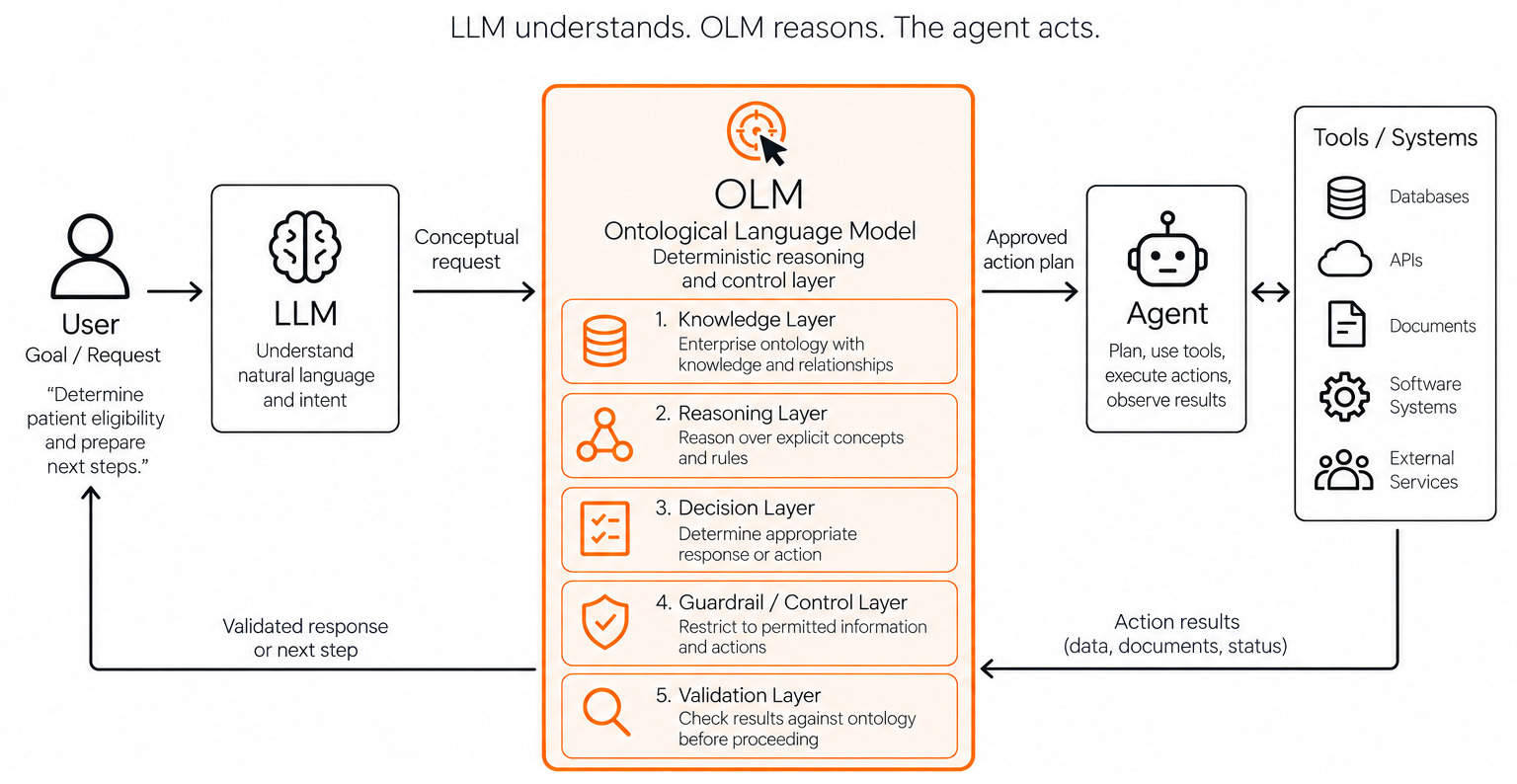
OLM implementation can have a central role in command and control of agentic processes where communication involves natural languages such as giving directives to a robot. The diagram below depicts the 5 potential layers of OLM involvement.
RELEASE 1.1
OLM 1.1 is now ready for Sandbox testing. Released September 5, 2026, Version 1.1 combines a general background ontology with an ingestive, dynamic ontology for selected content.
The OLMapp Sandbox provides a direct view into content ingestion, machine learning, ontology construction, query interpretation, deterministic retrieval, and output generation.
UPCOMING
An upcoming Executive Briefing will educate CEOs, CIOs, CTOs, AI leaders, and enterprise decision makers about OLM, how it differs from LLMs, how the technologies can operate together, and where deterministic language AI can provide advantages in high-risk enterprise applications.
Understand the technology. See the architecture. Explore what comes after purely generative AI.
OLM is the result of more than a decade of R&D in meaning representation, ontologies, deterministic AI, fuzzy logic, and machine reasoning. In 2026, the intellectual property of OLMapp was developed, enabling event-based ontologies to be acquired automatically from content and to be merged with a background ontology. This is the differentiator of our technology among all other ontological methods.
OLM was inspired by a series of historical developments. More than two millennia ago, Aristotle distinguished the symbols of individual languages from the underlying mental concepts and things they represent. OLM follows a modern computational objective: moving beyond linguistic symbols toward an explicit representation of meaning as outlined by the lineage below.
1957
Established an influential classification of events into states, activities, accomplishments, and achievements.
↓
1967
Introduced events as explicit entities in semantic representation, providing a foundation for modern event-centered approaches to meaning.
↓
1980s–1990s
Extended event semantics through richer representations involving event types, temporal structure, tense, aspect, participants, and relationships among events.
↓
1990s–2004
Developed a computational framework for representing natural-language meaning using ontologies, lexicons, fact repositories, and explicit meaning representations.
↓
2006
Demonstrated computational construction of an event ontology from text, connecting event-centered semantic representation with automated ontology construction.
↓
2025–
Event-based meaning representation combined with machine learning for automated ontology construction and merging, enabling deterministic reasoning and controlled output.
LLMs cannot separate "language" from "knowledge". Because their training is exposed to knowledge while learning language (next token probabilities). For example, if the training material was heavily collected from Voo-doo-medicine, LLM's language would capture phrases of witchcraft advice. This is the basic reason of bias. LLMs predict plausible language; they do not inherently verify truth. That gap between Voo-doo medicine and modern medicine is where hallucinations arise.
OLM handles "language" and "knowledge" separately. One is not affected by the other. Event concepts represent knowledge of the world devoid of occurence statistics in any corpus. This results in the 4 categorical advantages listed at the top of the page.
Currently, OLM version 1.1 is being tested vigorously using a RAG framework. Test results are regularly reported via email distribution. Click the button below to contact us for access to all relevant information.
Contact UsOLMapp is founded by technologists from New York City who will soon be listed on this website.