Let’s be honest for a second: most local LLMs feel kind of useless.
If you compare a 7B or 8B parameter model running on your laptop to a cloud flagship, even Claude Sonnet or GPT-5.2, the difference is painful. The local models are often too slow, they hallucinate on complex logic, and for general intelligence tasks, they just can’t compete. You spend hours setting up a local stack, ask it a question, get a mediocre answer, and go back to our cloud overlords.
But there is a nuance: local models struggle with general intelligence, but they can excel at bounded tasks.
If you stop asking the model to know things or rewrite your whole codebase, and just ask it to do one specific job the math changes. I finally found a local model setup that I am actually using, not just tinkering with.
It utilizes a model called “Unslopper” to fix AI-generated text, orchestrated by a cloud agent. Here is how it works.
You know slop. AI text has a smell. It’s the hollow enthusiasm, the bullet-point addictions, and the refusal to just say something like a normal human.
Unslopper are fine-tuned models designed to fix this. They take the “slop” and rewrite it to sound human. Even if I could prompt Gemini to be better at writing, it’s always a bit awkward: “don’t use m-dashes, write short sentences, people speak with different cadence”, etc. I am never sure whether my prompt engineering is enough.
So I built a two-agent system using cagent.
The Brain: I use Claude to handle the thinking. It reads the content, understands the structure, and acts as the project manager.
The Worker (Unslopper): I use a local model running in Docker Model Runner to handle the actual rewriting.
This works because the task is bounded. The local model doesn’t need to know the capital of France or how to code in Rust. It just needs to take a paragraph of text and make it less cringe.
Docker Model Runner (DMR) lets you run LLMs directly through Docker Desktop.
You pull a model just like a container image:
That’s it. The model is now available via an OpenAI-compatible API running locally. Docker handles the GPU acceleration and memory.
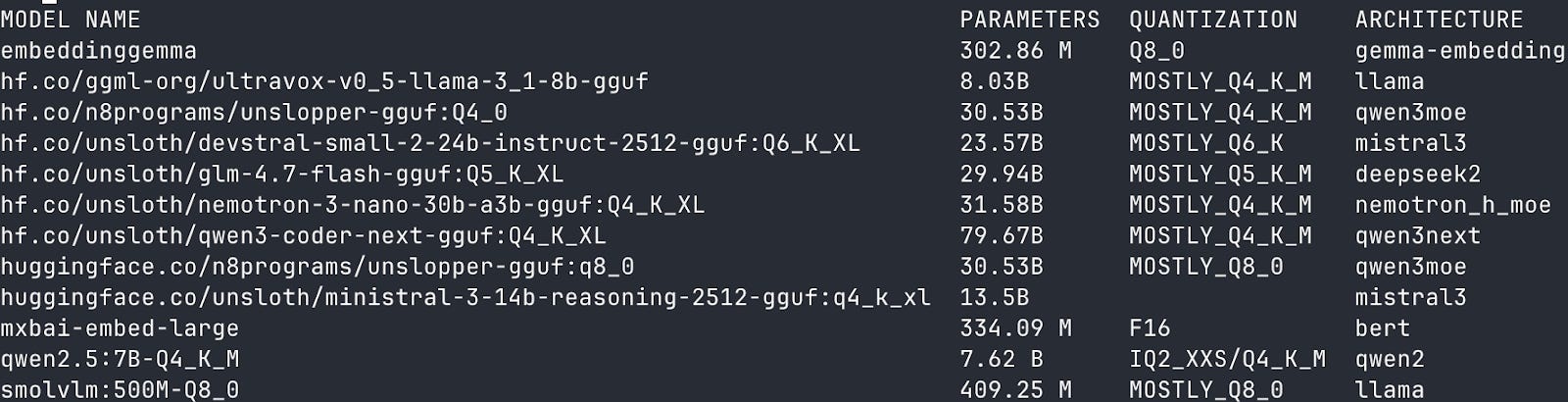
Verify it’s there:
(If this is your first try you might need to enable DMR in Docker Desktop -> Settings -> Features in development first).
Here is the cagent YAML. This configuration is where the “Bounded Task” theory gets applied.
Here’s how it works. Unslopper might be good at rewriting text, but it’s not a particularly strong model in general. If I threw a whole 2,000-word article at it, it would likely lose the plot or cut off halfway through.
By using a smarter orchestrator, we can break the job down. Claude reads the file, identifies the prose, skipping code blocks, and feeds the local model one bite-sized chunk at a time. The local model does the one thing it is good at - rewriting sentences.
The dmr/ prefix in the config tells cagent to route that specific sub-agent to your Docker Model Runner, while the root agent runs Claude on any other model you want to configure it with.
Once the model is pulled and the YAML is saved:
You can then just tell it:
“Rewrite ./draft.md to sound less robotic.”
If you’re curious, ask what did Unslopper change and which bits got improved or got worse. Honestly, it’s a fun exercise especially for a non-native English speaker.
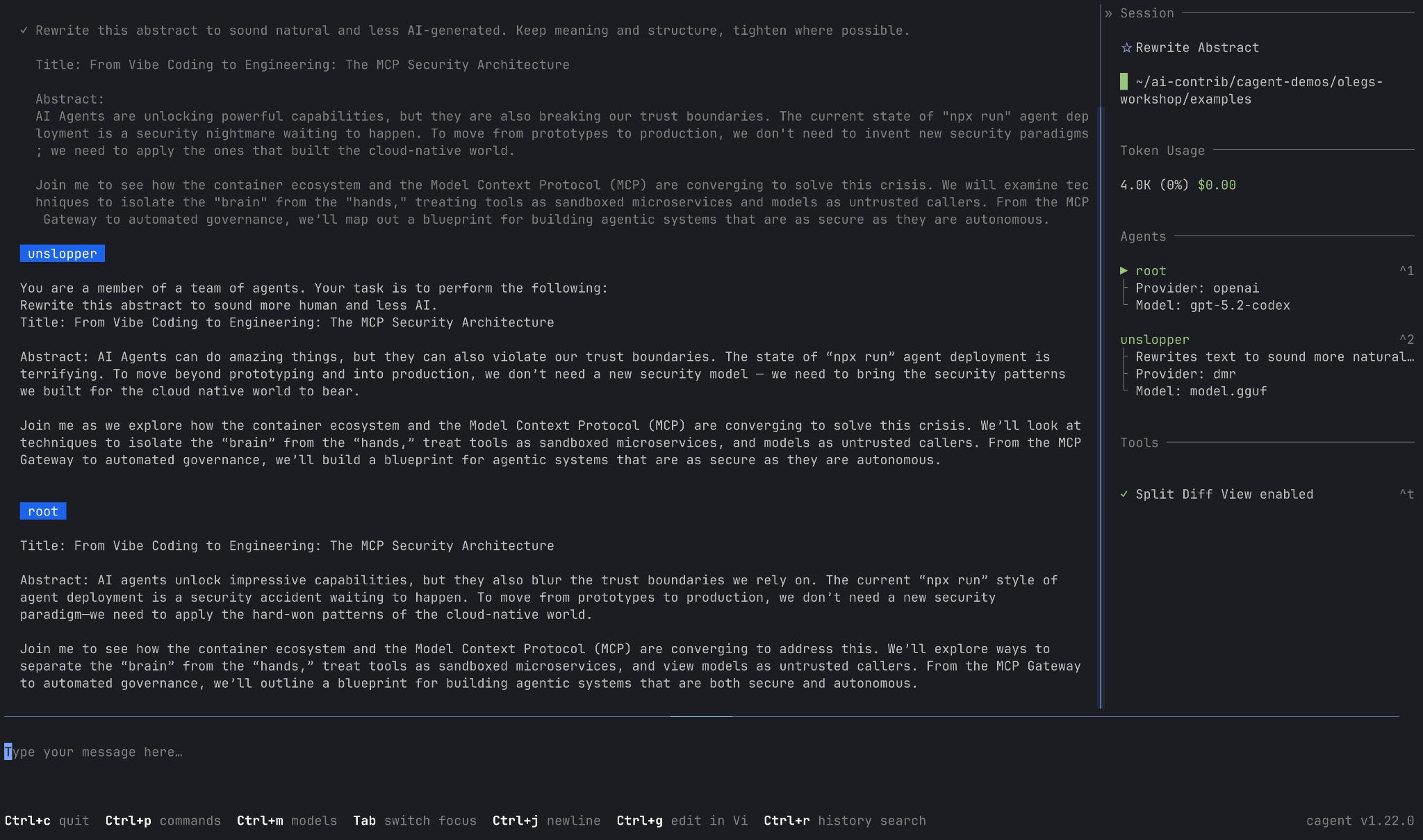
This isn’t just a cool demo; I’m actually using this to clean up slack messages once in a while.
It validates the idea that while local models aren’t ready to replace frontier AI models for “general intelligence,” they are incredible for specialized, private, and repetitive tasks.
I’m hoping to see more of these strictly scoped local models in the future. We need more tools that do one thing really well, rather than trying to be a mediocre jack-of-all-trades.
A massive shout out to the community over at r/LocalLLaMA, it’s a treasure of what these smaller models can do and insight into how people run them.
So do you think this blog post was a fully generated text or was it me writing?