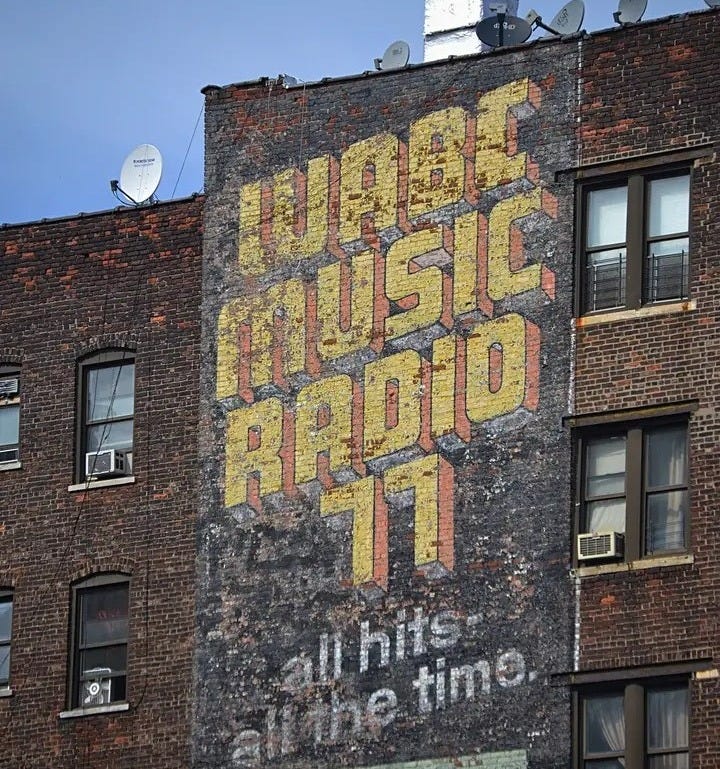
In the years before various devices held personally curated playlists of our favorite songs, listening to music was a communal experience. Whether you enjoyed the songs or not, kids had no choice but to hear the music that their parents liked, adults screamed at their children to “turn down that noise,” and, if you lived in an apartment building as I have for most of my life, you might have been forced to vicariously endure assorted sounds beyond your own taste depending on where you were situated—from salsa to soul, heavy metal to Barbara Streisand singing about people who need people.
Oldster runs on paid subscriptions and pays essayists. You know what to do…
In those days, the communal experience of music was predominant in the mornings, while you might have been getting ready for school, work, or wherever else the AM hours took you. It was a way to start your day, just as important as my Grandma sipping percolated coffee, or me and baby brother eating steaming oatmeal on a chilly day.
That was how, on mornings in the 1960s, I was initially introduced to the so-called American Songbook of classic pop tunes performed by the likes of Billie Holiday, Frank Sinatra, Billy Eckstine, Tony Bennett, and Dinah Washington, a genre I came to greatly appreciate. My mother listened to that music, and she also sang some of it to herself.
There was one maudlin tune Mom used to sing while washing me up called “The Party’s Over.” As she sat on the edge of the bathtub with the soapy wash rag, she vocalized like a torch singer, “The party’s over, it’s time to call it a day/they’ve burst your pretty balloon and taken the moon away…”
In the years before various devices held personally curated playlists of our favorite songs, listening to music was a communal experience—predominantly in the mornings, while you might have been getting ready for school, work, or wherever else the AM hours took you.
Maybe it was just one of her favorite songs, but as a young boy, I heard it as a commentary on the regrets of motherhood, as though being burdened by me, her child, might have been the reason was her life was no longer joyful. I’d later learn that she also sang and hummed it at work.
Only 6 at the time I first heard “The Party’s Over,” I had no idea it was a classic, sung originally by Judy Holiday in the 1956 movie Bells Are Ringing, and later covered by Nat King Cole, Peggy Lee (mom’s favorite version), Lesley Gore, and Sammy Davis Jr. All I knew was that the lyrics were the saddest I’d ever heard.
In those days, there were no bluetooth headphones, or AirPods. Other people’s music choices filled the air, and you just listened. Walking the block-and-a-half through our Harlem hood to school, I’d hear music coming from the open windows of speeding cars and apartment houses, but “The Party’s Over” would still be playing in my head until I entered my classroom.
Mom finally stopped singing that depressing song when, in 1970, my stepfather, who I called Daddy, gifted her a big, brown, wooden radio that sat on a living-room end table next to the crystal candy dish and a replica of the Maltese Falcon.
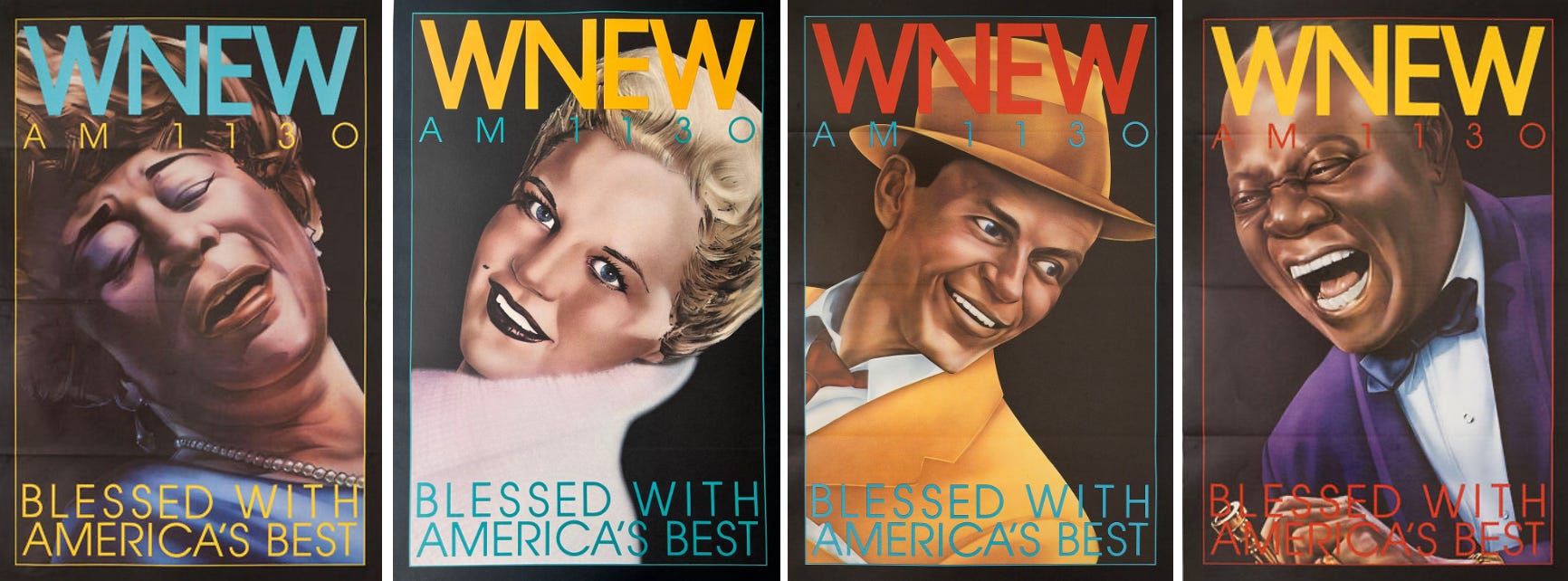
Mom and Daddy were separated, but he still bought her gifts. To me there was something fancy about that radio, a Midcentury Modern rectangular-shaped beauty that looked like you might find it on the office shelf of the bad guy in a noir film. Mom tuned it to WNEW-AM, her favorite station.
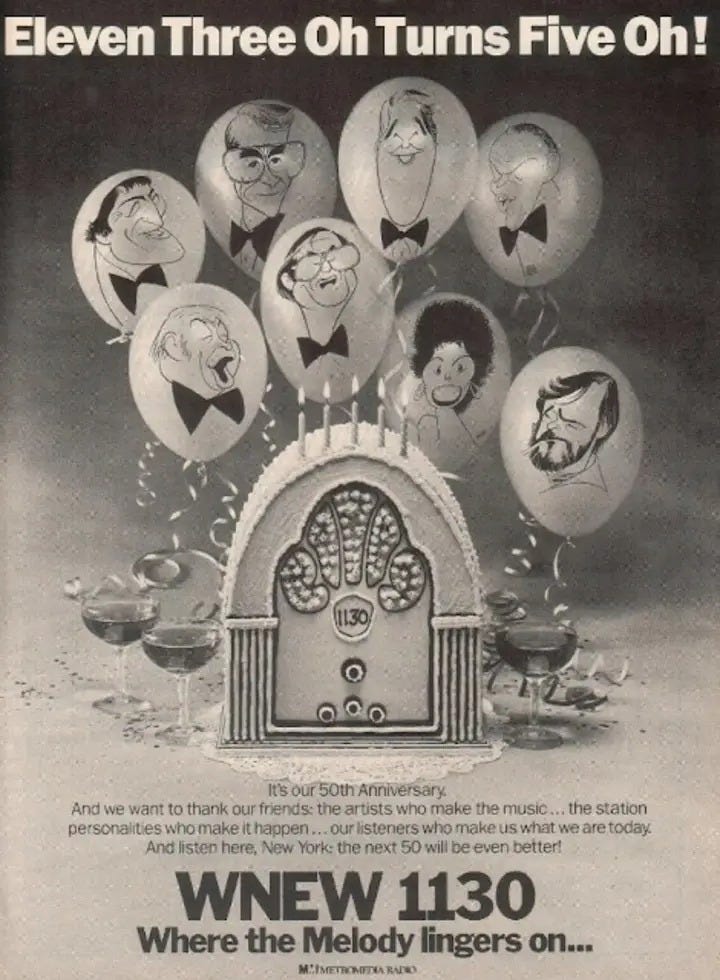
Each morning while eating breakfast, my younger brother and I listened to a lot of her music—songs that were new when Mom was a teenager; still WNEW played current tunes, too. In the heaviest rotation were whatever songwriter Burt Bacharach and lyricist Hal David had produced i.e. “Raindrops Keep Fallin’ On my Head” (performed by B.J. Thomas) and “Close to You” (The Carpenters), as well as Tom Jones’ plastic soul hit “She’s a Lady,” and Sammy Davis’ sugary “The Candy Man.”
I recall becoming obsessed with Dionne Warwick’s ecstatically sad “I’ll Never Fall in Love Again,” another Bacharach and David composition, one that I sang along to and sometimes made up my own silly lyrics for, as I’d learned to do from reading MAD magazine.
At some point in 1970, I convinced Mom to switch over to the more kid-friendly pop and R&B music station, WABC-AM. I’m guessing I learned about the station from subway ads or billboards, but it soon became my favorite. The jock during weekday mornings was smooth but fast-talking Harry Harrison, who spun a variety of hits by The Jackson 5, James Taylor, The Partridge Family, Stevie Wonder, and numerous others.
In those years most pop stations didn’t separate music by the race of the artists, they simply played what was good. One of my favorite songs that year was “Maybe I’m Amazed,” Paul McCartney’s aural valentine to his wife Linda. I discovered years later that the song was never released as a single, but many DJs across the country played the cut from McCartney’s first solo album as though it were.
At 7 I had crushes on two girls in my second-grade class at The Modern School, Zoe Warman, and Toni Landris, who once brought her pet monkey to school for Show & Tell. I thought they both were cutie-pies, real sweethearts who never knew how much I was digging them from across the room. Each time I stared at one or the other, I could hear McCartney in my head singing, “And maybe I’m afraid of the way I love you.” Those first crushes were hardly my last.
I stuck with Harry Harrison and WABC for years, through various artists whose music I embraced, especially The Jackson 5 and Elton John. But, as a lover of short stories who would soon become an aspiring writer, I had an even deeper appreciation for songs that told a tale. I got into Harry Chapin’s haunting “Cat’s in the Cradle,” the weary romanticism of Gladys Knight and the Pips’ “Midnight Train to Georgia,” and Cher’s socio-political “Half-Breed,” but my taste leaned even more towards crime-centered numbers like “The Night Chicago Died (Paper Lace),” “The Night the Lights Went Out in Georgia (Vikki Lawrence),” and “Dark Lady (Cher).”
However, my man forty grand was “Bad Bad Leroy Brown,” who, according to singer/songwriter Jim Croce, was “the baddest man in the whole damn town.” The neighborhood where Leroy operated was “the South Side of Chicago” where he cruised the mean streets in his custom Continental or Eldorado, with a .32 gun in his pocket and a razor in his shoe.
As a kind of shy kid, I always admired the personalities of the deejays who sounded so smooth, smart, and full of life as they talked about music, or interviewed artists on the air. There was one guy on WNEW-AM named William B. Williams who could talk forever about the life and music of Frank Sinatra, while over at WABC my man Harry Harrison sounded like the fun dude who might be your best friend one day.
That song was released in spring of 1973 when I was 10. It was also my first year at a new school, St. Catherine of Genoa, and the first time I ever had to deal with a classroom bully, snot-nosed punk Tom Lowe. From 4th grade to 8th, Tom was one of those boys who wasn’t happy unless he could make everyone else—teachers or students—miserable.
Back then I often fantasized about being the type of guy who could bring down Tom Lowe and make him look “like a jigsaw puzzle with a couple of pieces gone” in the way the “jealous man” in Croce’s song brought down Leroy Brown. Alas, that was not to be. Ultimately nobody, least of all me, dared to stop Tom.
Six months after its release, “Bad Bad Leroy Brown” became Croce’s first number one hit, but sadly he soon died in an airplane accident, just as so many other talented artists (Richie Valens, Buddy Holly, Patsy Cline, and Otis Redding) had before him. Jim’s plane never even took off, but crashed on the runway. It was my first celebrity death and I took it hard. As for Tom Lowe, I never saw him again after graduating in 1977, but 20 years later I ran into an old classmate who told me that he’d gotten blown away while trying to rob a gas station.
Decades later, when Tom’s name came up on my old school’s alumni page, more than a few men chimed in about how he’d made their childhoods hell. “You guys need to get over it and man up,” a female classmate chimed in. “Obviously he had some issues.” Before I thought of a sensible answer, one of the guys replied, “Obviously you were never one of his victims.”
Thinking back, I realize we only listened to the radio in the mornings. After school we watched TV or played records. It was probably because, in between pop tunes, there was the news, and the weather. It felt like a more pleasant way to take in what was happening in the world than listening to a news station, like my grandmother did. Mom shared a bedroom with her. Grandma kept the clock radio on her side of the room, and it was always tuned to the “all-news, all the time” station 1010-WIN, whose motto was, “You give us 22 minutes, we’ll give you the world.”
One summer morning, after flipping over to FM and spinning down the dial, I heard a song that lured me in as to the devil’s lair. Over eight minutes, the song went from soft to hard, and back to soft again, captivating me. When it was finished the DJ announced, “That was Led Zeppelin’s classic ‘Stairway to Heaven,’ and this is Dave Herman at WNEW-FM.”
As a kind of shy kid, I always admired the personalities of the deejays who sounded so smooth, smart, and full of life as they talked about music, or interviewed artists on the air. There was one guy on WNEW-AM named William B. Williams who could talk forever about the life and music of Frank Sinatra, while over at WABC my man Harry Harrison sounded like the fun dude who might be your best friend one day.
My real best friend was a kid from school named Tony Cafiero. He’s who got me into The Beatles when we were in 7th grade. Rock-n-roll wasn’t allowed in his house, so he kept some of his Beatles records at mine—the greatest hits collections with the red (1963-1966) and blue covers (1967-1970). The former captured their earlier, more innocent sound (“Love Me Do,” “Yesterday”), while the latter, my favorite, had the more psychedelic songs (like “Lucy in the Sky with Diamonds” and “Come Together”).
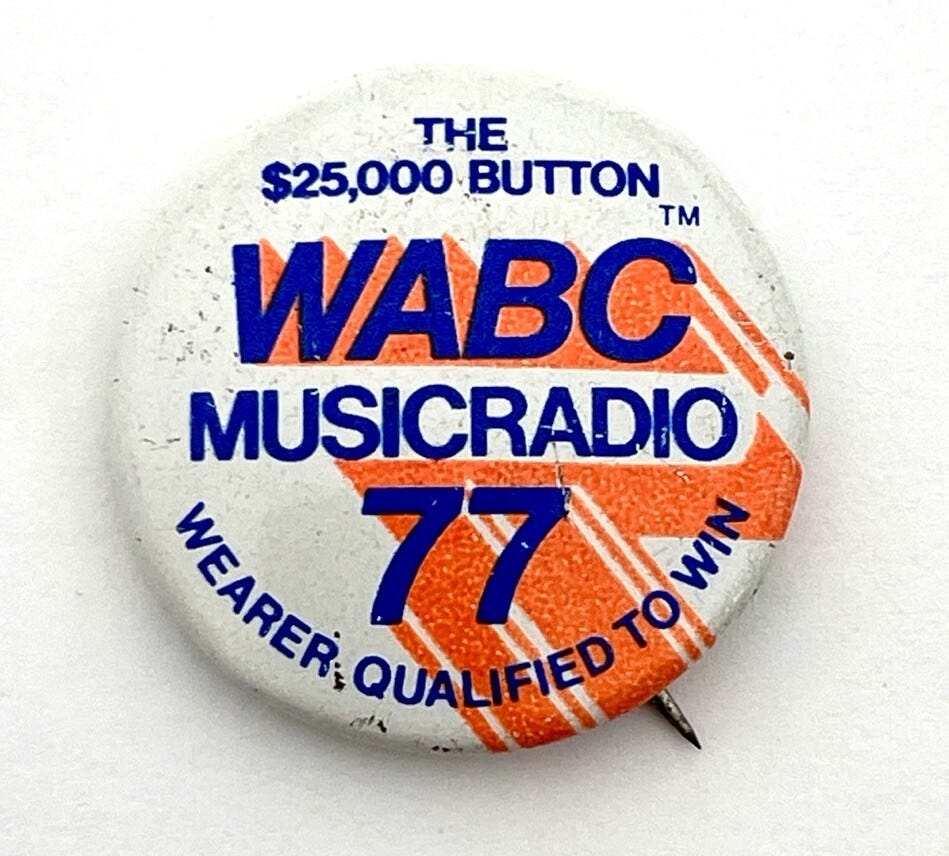
After graduating from 8th grade, but before entering freshman year at the all-boys Rice High on 124th Street and Lenox Avenue, I felt as though I’d outgrown pop music, WABC, and all of their silly contests, which included trying to be spotted wearing their buttons to win $25,000. The buttons were originally orange and blue, then bright purple, and were given away at McDonald’s. At one point I had about 100 buttons on my spring denim jacket, and I still hadn’t been noticed. As a high schooler, I was sure I was now too cool for all that.
One summer morning, after flipping over to FM and spinning down the dial, I heard a song that lured me in as to the devil’s lair. Over eight minutes, the song went from soft to hard, and back to soft again, captivating me. When it was finished the DJ announced, “That was Led Zeppelin’s classic ‘Stairway to Heaven,’ and this is Dave Herman at WNEW-FM.”
I was shocked that Mom’s easy listening station had a rock-n-roll sister on the FM dial. From that moment until we moved out of state the following summer, WNEW-FM became my everything.
Certainly, as a Black teen living in the hood, I was often teased for my musical choices. I liked a lot of funk, R&B and disco music that I heard in the streets or at friends’ apartments, but when I was home, it was all about The Rolling Stones, The Eagles, Thin Lizzy, Bob Seger, Fleetwood Mac and many other rock bands. Even my kid brother, who usually couldn’t care less about what I listened to, began teasing me for playing “white boy music,” as though that would stop me from blaring Queen every time “We Will Rock You” or ”We are the Champions” came on.
***
In the spring of 1978, Mom informed me and Perky that we were moving to Baltimore. There hadn’t been any hint that this major change was coming and it felt as though someone had just pushed me from of a speeding train. Later I chuckled when Mom told me that her co-worker Richard Valdez commented, “Well, I guess the party is really over,” referencing her personal theme song.
At the end of July, Mom rented a small moving truck that her boyfriend Stanley was going to drive to our new place in Maryland. Though we lived on the first floor, there was a small marble staircase outside of our apartment that led to the lobby door.
Certainly, as a Black teen living in the hood, I was often teased for my musical choices. I liked a lot of funk, R&B and disco music that I heard in the streets or at friends’ apartments, but when I was home, it was all about The Rolling Stones, The Eagles, Thin Lizzy, Bob Seger, Fleetwood Mac and many other rock bands.
After Rice let out for summer vacation, I took a job working at a senior residence in the heart of Harlem that was owned by Rachel Robinson, the widow of pioneering baseball player Jackie. While I stayed in New York for a few more weeks until my job was over, I helped to load the truck as Grandma, who wasn’t moving with us, sat on the bed literally twiddling her thumbs and Mom took clothes out of her closet. Like Grandma, I was saddened by the move. I’d grown up in that apartment from the age of 4, had many friends there, and though I would finally get to go to public school in Baltimore, was going to miss Rice High.
Trying to be helpful, I unplugged the radio in the living room, wrapped the cord around it and carried it out the door. I was trying to be careful, but somehow slipped on the stairs and dropped the radio on the marble. Although it happened fast, it felt as though everything was moving in slow motion. I believe the radio keened in an operatic Freddy Mercury voice seconds before it shattered into splintered wood and spilled guts.
Sitting down, I stared at the busted box and began to weep. If an inanimate object can be a part of the family that damn radio surely was. Hell, I loved it more than I did some people. Sticking her head out of the door, Grandma asked, “What happened?”
“Nothing, Grandma,” I mumbled. “Nothing at all.”