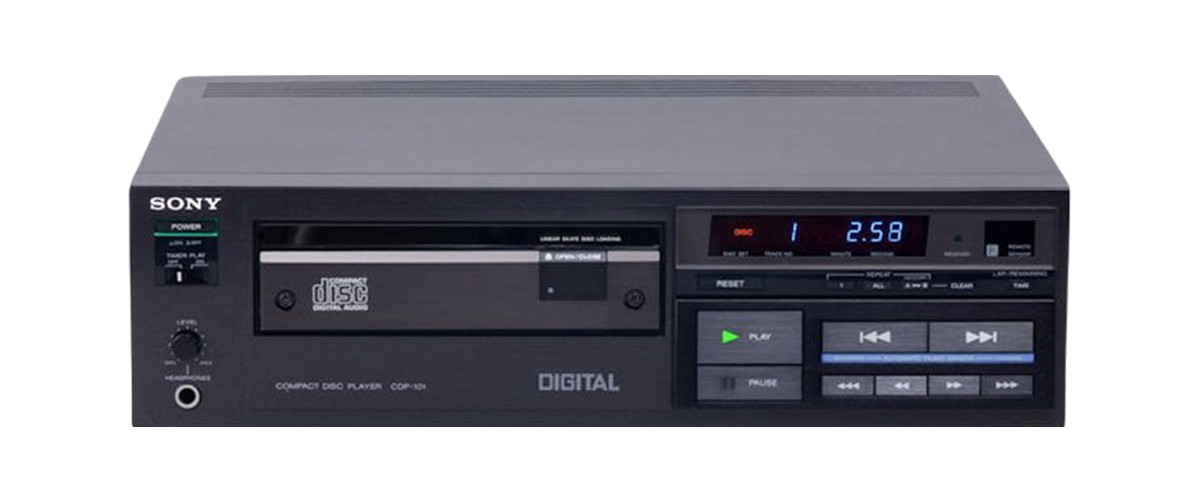
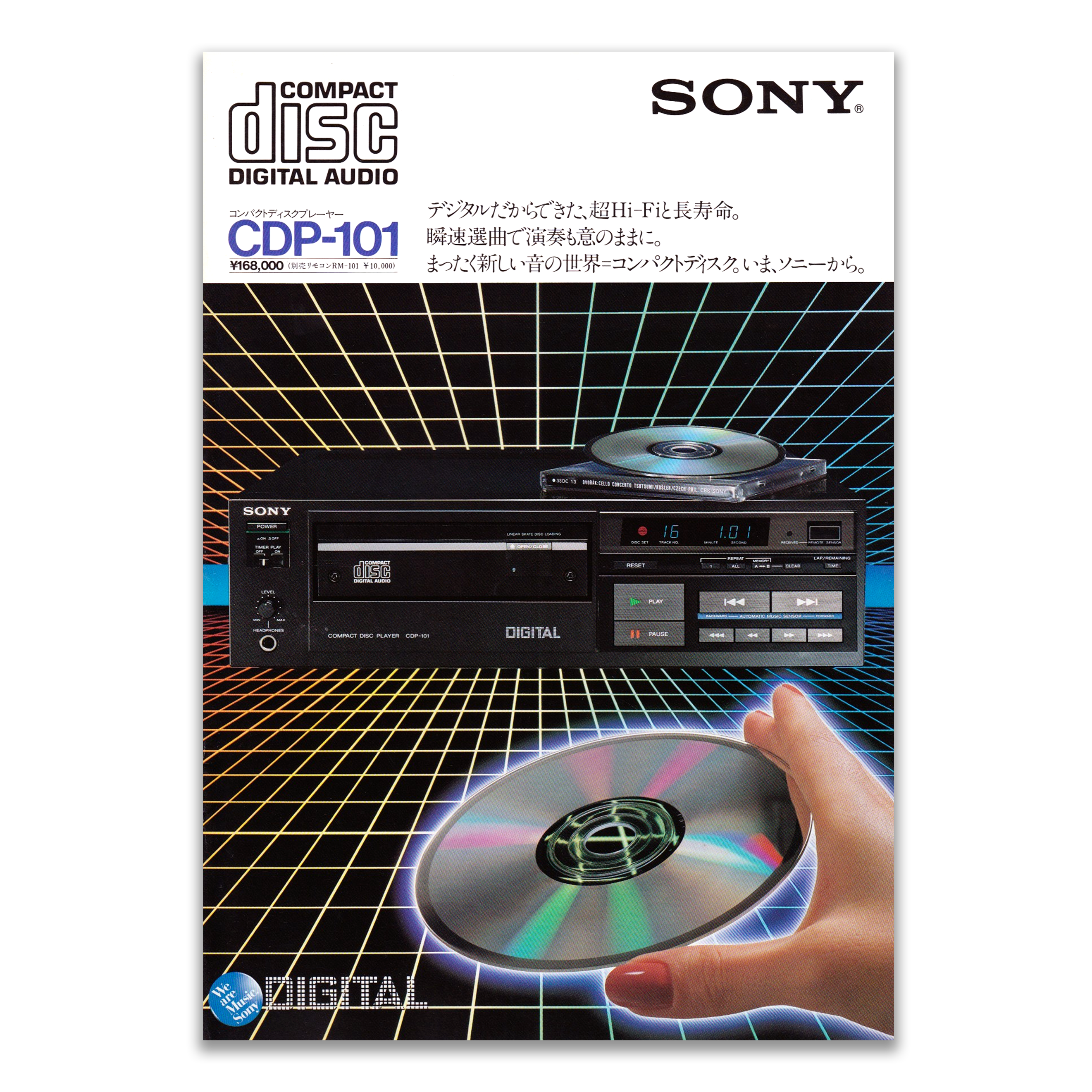
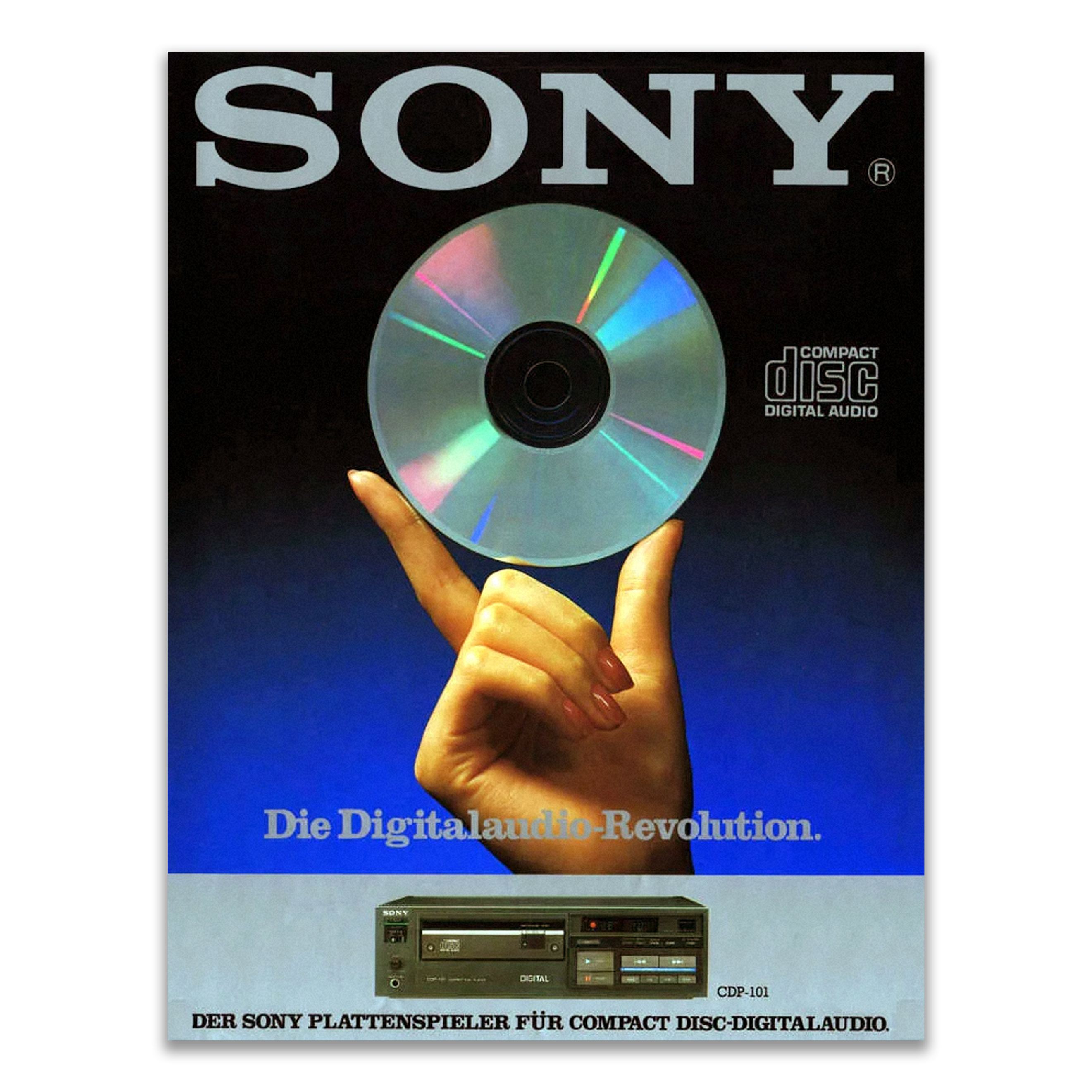
The first compact disc player, and the first CD player ever sold to the public, was the Sony CDP-101. Sony released the machine in Japan on October 1, 1982. It was the first consumer device capable of playing digital music stored on a Compact Disc. With its arrival, digital audio playback entered the home and the commercial era of the compact disc began.
Before that moment, home listening revolved around vinyl records and cassette tapes. Both were analog systems in which sound existed as physical variations in grooves or magnetic coatings. Surface noise, distortion, and gradual wear were accepted parts of playback. The compact disc approached music from a different direction. Instead of storing sound as a physical waveform, it stored digital information encoded on a reflective optical disc. A semiconductor laser scanned the disc and translated that information back into audio.
For the first time, music playback no longer relied on physical contact between the medium and the player. The CDP-101 turned that principle into a working home audio system, replacing the stylus and tape head with a laser and transforming the compact disc from an experimental technology into a practical consumer format.
The story of the first CD player begins with a collaboration between Sony and Philips during the late 1970s. Philips had been researching optical disc technology through projects led by engineer Lou Ottens, who had previously overseen the creation of the compact cassette. At the same time, Sony engineers were experimenting with digital recording systems intended for professional music production.
The two efforts came together when Philips invited Sony chairman Norio Ohga to Eindhoven to examine an early optical audio prototype. Ohga’s background was unusual for a corporate executive. Before joining Sony he had trained as a classical conductor, and that musical training later shaped many of Sony’s decisions in digital audio engineering. When he saw Philips’ prototype optical disc system, he immediately recognized its potential for high-fidelity music reproduction.

Ohga was not the only prominent figure supporting the technology. His close friend, the celebrated conductor Herbert von Karajan, became one of the earliest public champions of the compact disc. At a 1981 press conference in Salzburg demonstrating the emerging format, Karajan famously declared that compared to the digital sound of the compact disc, “all else is gaslight,” a statement that captured both the excitement and the prestige surrounding the technology’s arrival.
Both companies brought different strengths to the project. Philips had extensive experience with optical disc mechanics and laser optics, while Sony had already developed sophisticated digital audio technology used in recording studios. By 1979 the companies formally partnered to create a new digital audio format that later became known as the Compact Disc.
Much of the engineering on Sony’s side was led by Toshitada Doi, who had previously developed the PCM-1600 digital mastering system. At Philips, engineer Kees Schouhamer Immink played a central role in finalizing the Eight-to-Fourteen Modulation coding method and the CIRC error-correction system that made reliable consumer playback possible.
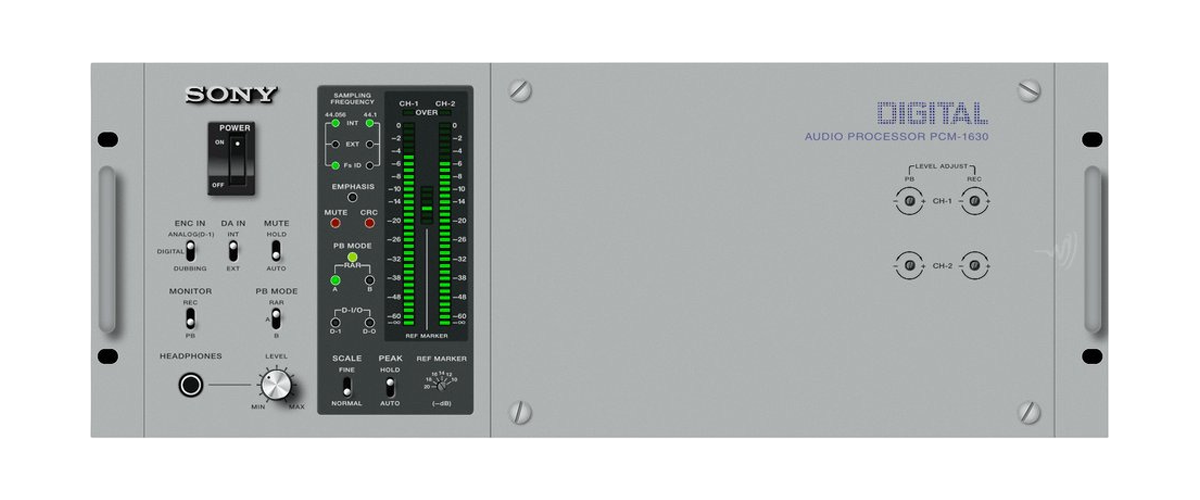
Engineers from both companies began defining the technical structure of the system. The format ultimately adopted sixteen-bit digital audio resolution, a specification strongly promoted by Sony. The sampling rate was set at 44.1 kHz so that the system could remain compatible with the digital mastering equipment already used in studios. That rate was tied directly to Sony’s PCM digital recording systems, which stored audio on U-matic video tape recorders. The 44.1 kHz sampling structure fit neatly within the timing constraints of both NTSC and PAL video signals used by those machines. Engineers also developed a method known as Eight-to-Fourteen Modulation to ensure that digital information could be read reliably from the disc surface, while a complex error-correction system called CIRC allowed the player to reconstruct damaged or missing audio data during playback.

One discussion during development later became famous. Sony chairman Norio Ohga argued that the new format should be capable of holding an entire symphonic performance of Beethoven’s Ninth Symphony without interruption. To meet that goal, engineers expanded the capacity of the disc to roughly seventy-four minutes, a length that later became the standard duration of the compact disc.
These specifications were documented in 1980 in the technical standard known as the Red Book. The finished format used a twelve-centimeter optical disc capable of storing seventy-four minutes of stereo digital audio. Prototype players already existed, and Philips demonstrated an experimental optical audio player in 1979 under the nickname Pinkeltje. However, prototypes alone could not establish a consumer format. The compact disc required an entire ecosystem that included digital mastering systems, manufacturing plants, music distribution, and reliable playback hardware for the home.

Sony entered the compact disc project with an advantage that few companies possessed. During the late 1970s Sony had introduced the PCM-1600 digital audio mastering system, a professional recorder that stored sixteen-bit digital audio on U-matic video tapes. Recording studios used the system to create digital master recordings years before compact discs reached consumers.
Those digital tapes later became the source material for early compact discs. When Sony and Philips finalized the compact disc standard, Sony already had the technical experience required to decode that digital information in a consumer playback device. The CDP-101 therefore represented the final link in a chain that began in recording studios and ended in the living room.
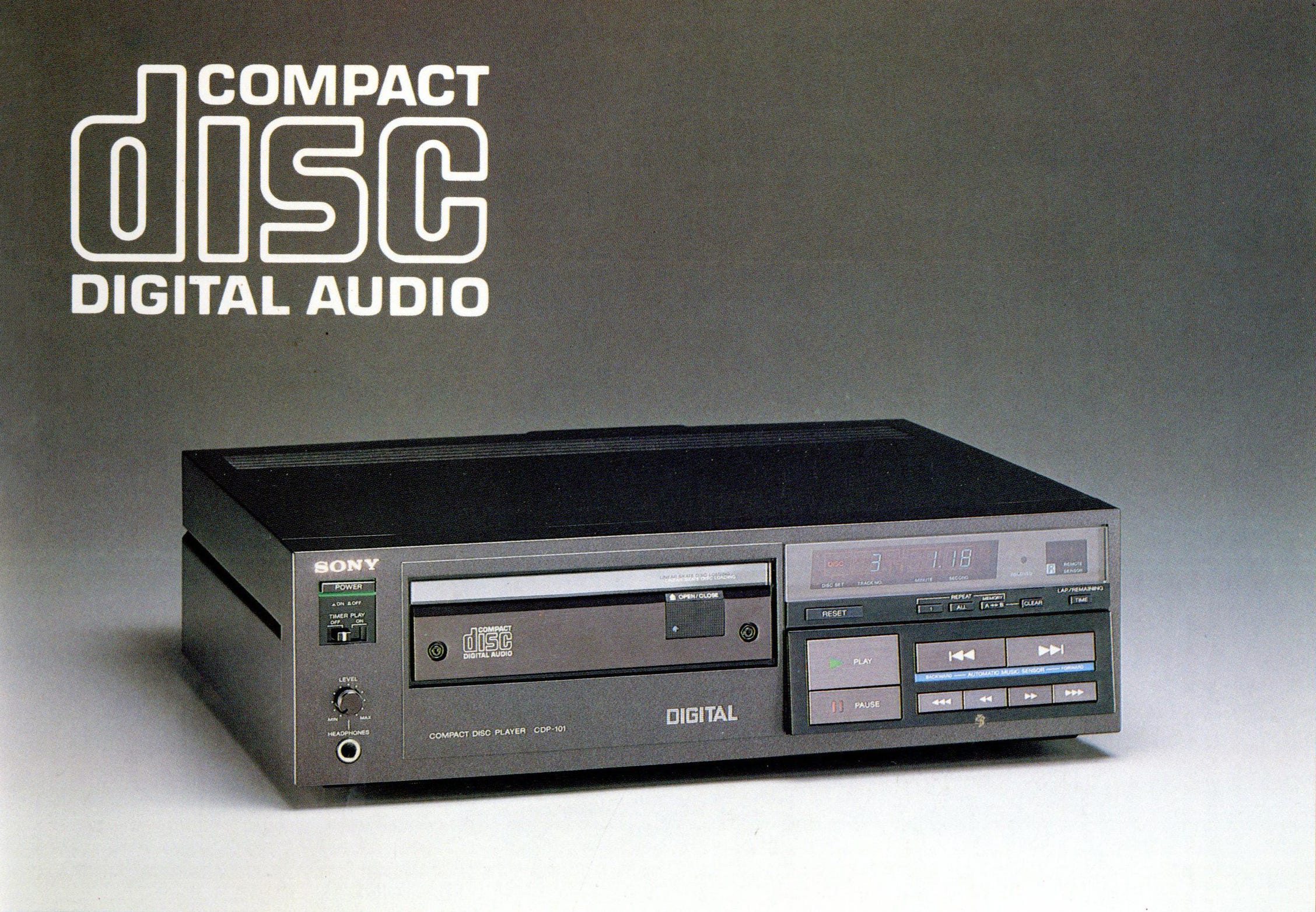
The Sony CDP-101 was designed to translate the compact disc specification into a reliable home audio component. Unlike record players or cassette decks, the CDP-101 used a semiconductor laser to read microscopic pits embedded in the reflective surface of an optical disc. These pits represented encoded digital information, and the player had to read the signal, decode it, correct errors, and convert the data into analog sound in real time.
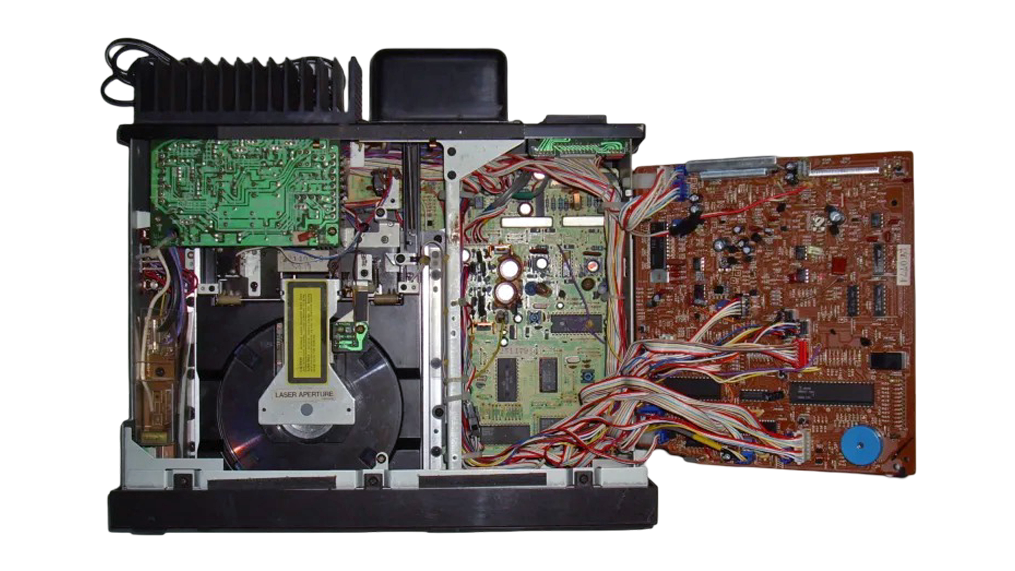
To accomplish this, Sony engineers integrated several complex systems into the player. A precision infrared semiconductor laser pickup read the pits on the disc surface. Digital processors decoded the Eight-to-Fourteen Modulation signal used to encode the data. Dedicated circuitry handled CIRC error correction so that scratches or small defects would not interrupt playback. Finally, a sixteen-bit digital-to-analog converter transformed the digital data stream into the analog electrical signal that powered speakers. The CDP-101 used a single converter that rapidly alternated between the left and right audio channels, a technique known as time multiplexing. This approach simplified the circuitry but introduced a tiny delay of roughly eleven microseconds between channels. The difference was far below the threshold of human hearing, although some early audiophile critics pointed to it as evidence that digital audio still had imperfections.
Because the player used a conventional non-oversampling DAC, it also relied on a very steep analog reconstruction filter to remove ultrasonic frequencies above the audible range. These “brick-wall” filters introduced phase shifts near the top of the audio band, which contributed to early criticism that some first-generation CD players sounded overly sharp compared with vinyl.
The physical design of the player also differed from traditional stereo equipment. Instead of a platter and tonearm, the CDP-101 used a front-loading tray, a configuration that soon became the standard layout for CD players throughout the industry. Early demonstration prototypes briefly experimented with vertical disc loading so that the label remained visible during playback, but Sony ultimately adopted the horizontal tray mechanism for production.
The front panel included a vacuum fluorescent display that showed track numbers and playback time. In the early 1980s the glowing display contributed to the futuristic appearance of the player.
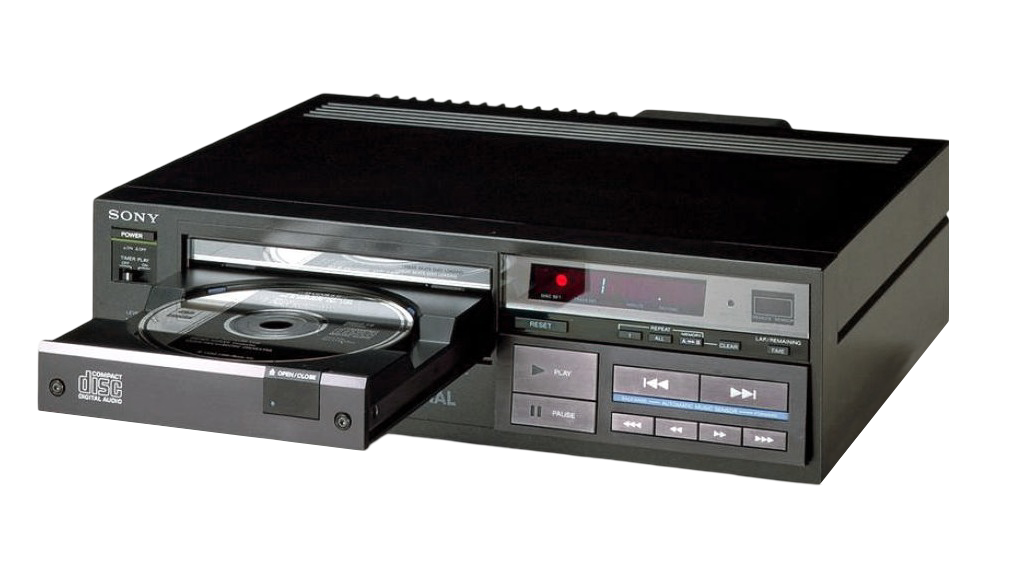
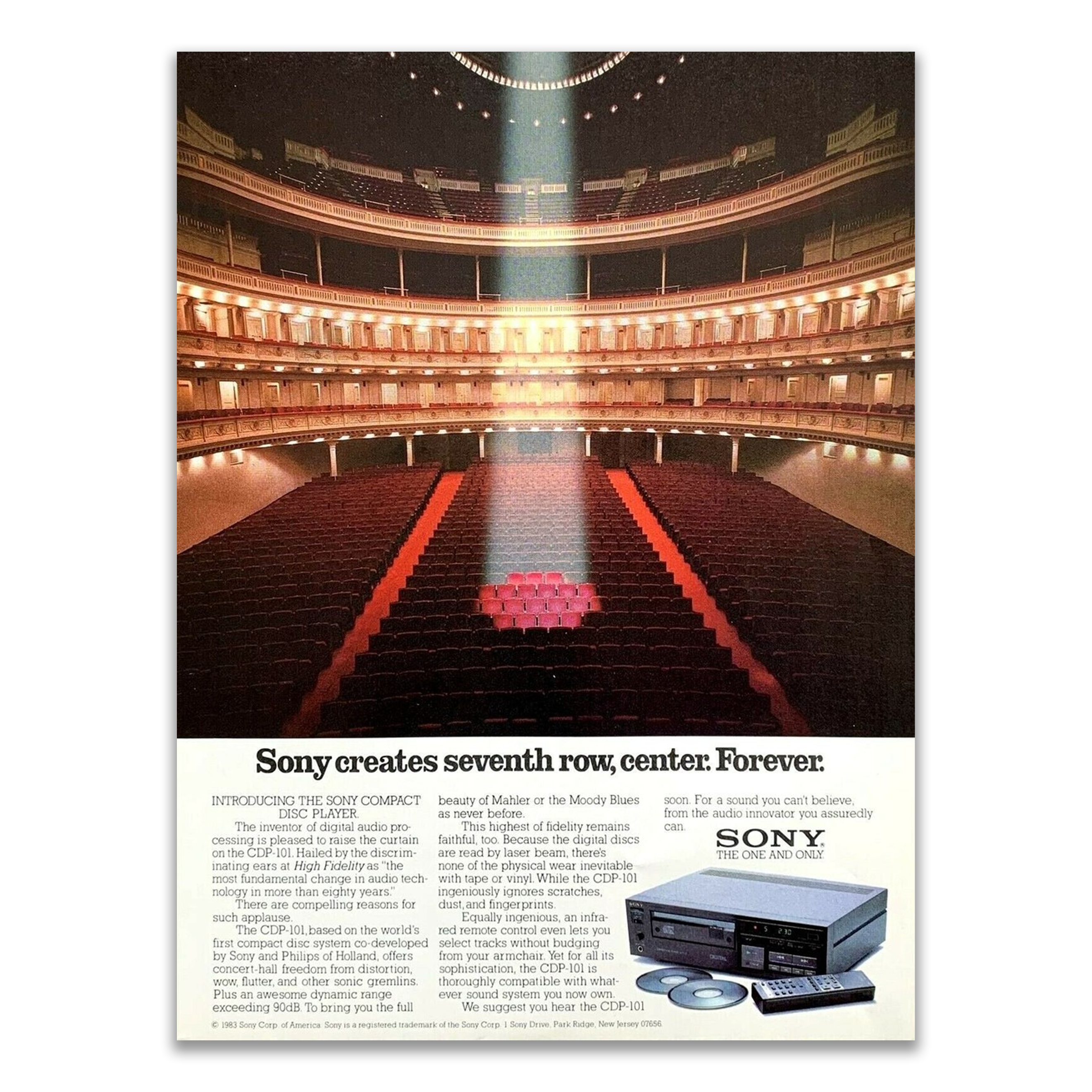
Sony also introduced several features that helped define the CD listening experience. Users could skip directly between tracks using the Automatic Music Sensor system, view precise playback times on the digital display, and control the machine remotely using an infrared controller. In the early 1980s wireless infrared remotes were still rare in home audio equipment, making this feature a surprising convenience for the time. Because remote control technology was new for hi-fi equipment, Sony added an audible confirmation tone that produced a short electronic beep whenever a command was received, and a switch on the rear panel allowed the user to disable the sound if desired. Pressing the open button and watching the motorized tray glide smoothly outward with a mechanical whir felt strikingly futuristic compared with the manual handling of vinyl records.
Compared with the mechanical systems used in turntables and cassette decks, the CDP-101 handled music primarily through electronic processing, marking the moment when music in the home became digital data. The player’s dense collection of early digital integrated circuits generated substantial heat, which is why the CDP-101 included a large finned heatsink mounted on its rear panel. Despite the durability of the discs themselves, the early optical tracking mechanisms were sensitive to vibration, and heavy footsteps or a knock on the audio rack could cause the player to momentarily lose its place and skip.
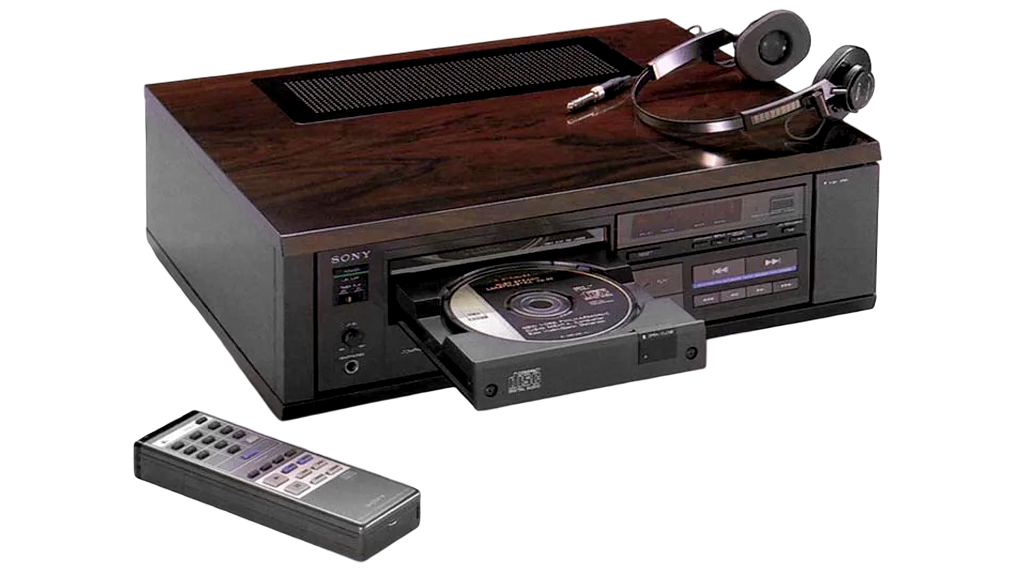
The Sony CDP-101 was introduced on October 1, 1982 in Japan with a launch price of 168,000 yen. The model name also carried a small internal joke. Nobuyuki Idei, who led Sony’s audio division at the time, chose “101” because in binary it equals five. He considered the machine a solid “middle-class” product on a scale from one to ten rather than an ultimate flagship. The player supported the Compact Disc Digital Audio format, reproducing sound at sixteen-bit resolution with a sampling rate of 44.1 kHz. Sony specified a frequency response from five hertz to twenty kilohertz with extremely low distortion and a dynamic range exceeding ninety decibels. Total harmonic distortion measured roughly 0.004 percent at one kilohertz, and the standard line output delivered approximately 2 volts RMS. The integrated headphone amplifier produced around 28 milliwatts into 32-ohm headphones.
The player measured approximately 350 millimeters wide, 105 millimeters high, and 325 millimeters deep, with a power consumption of roughly 23 to 30 watts during operation. It weighed about 7.6 kilograms and used Sony’s early CX-series sixteen-bit digital-to-analog converter integrated circuits.
At launch the price translated to roughly 730 U.S. dollars, placing the CDP-101 firmly in the high-end segment of the home audio market and equivalent to well over two thousand dollars today.
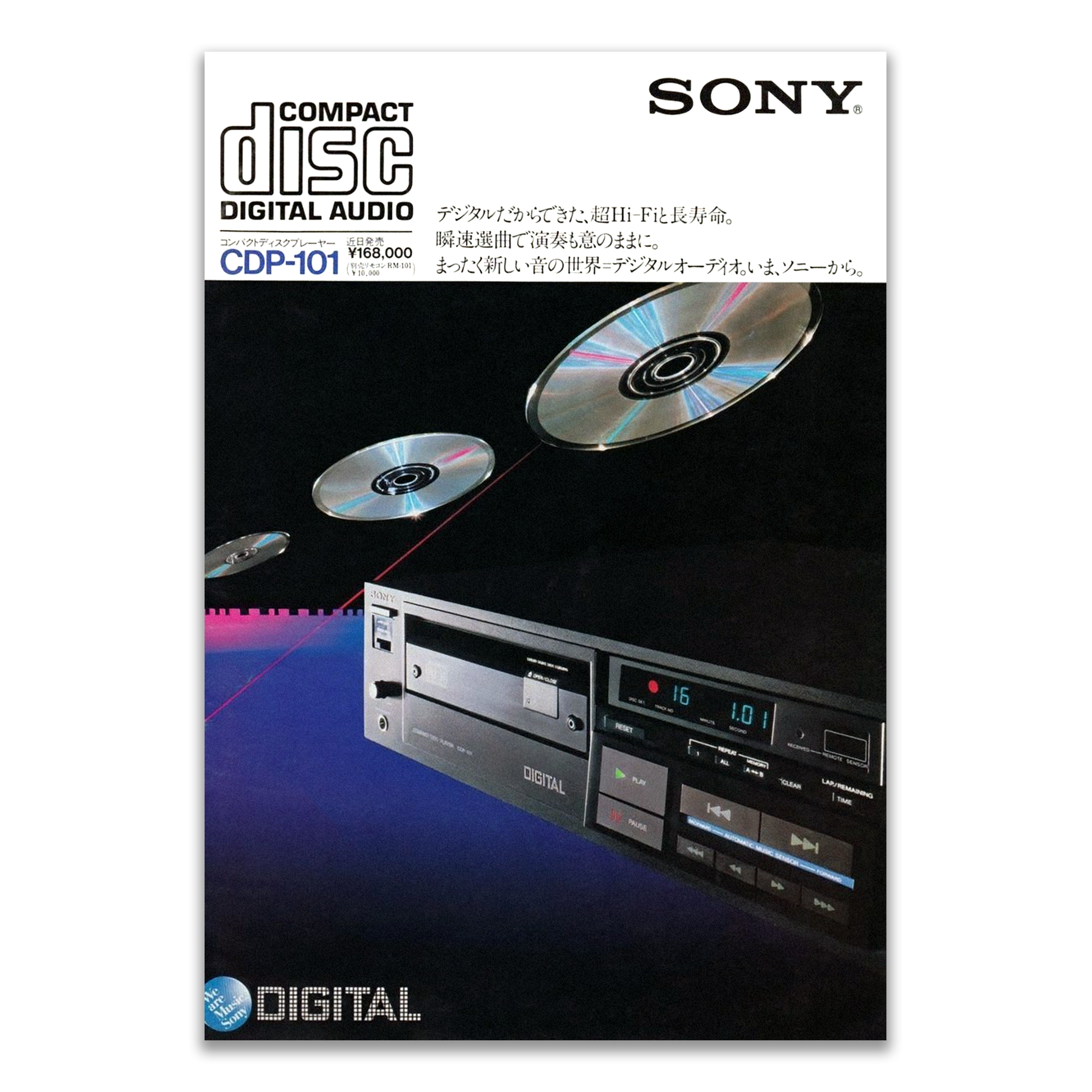
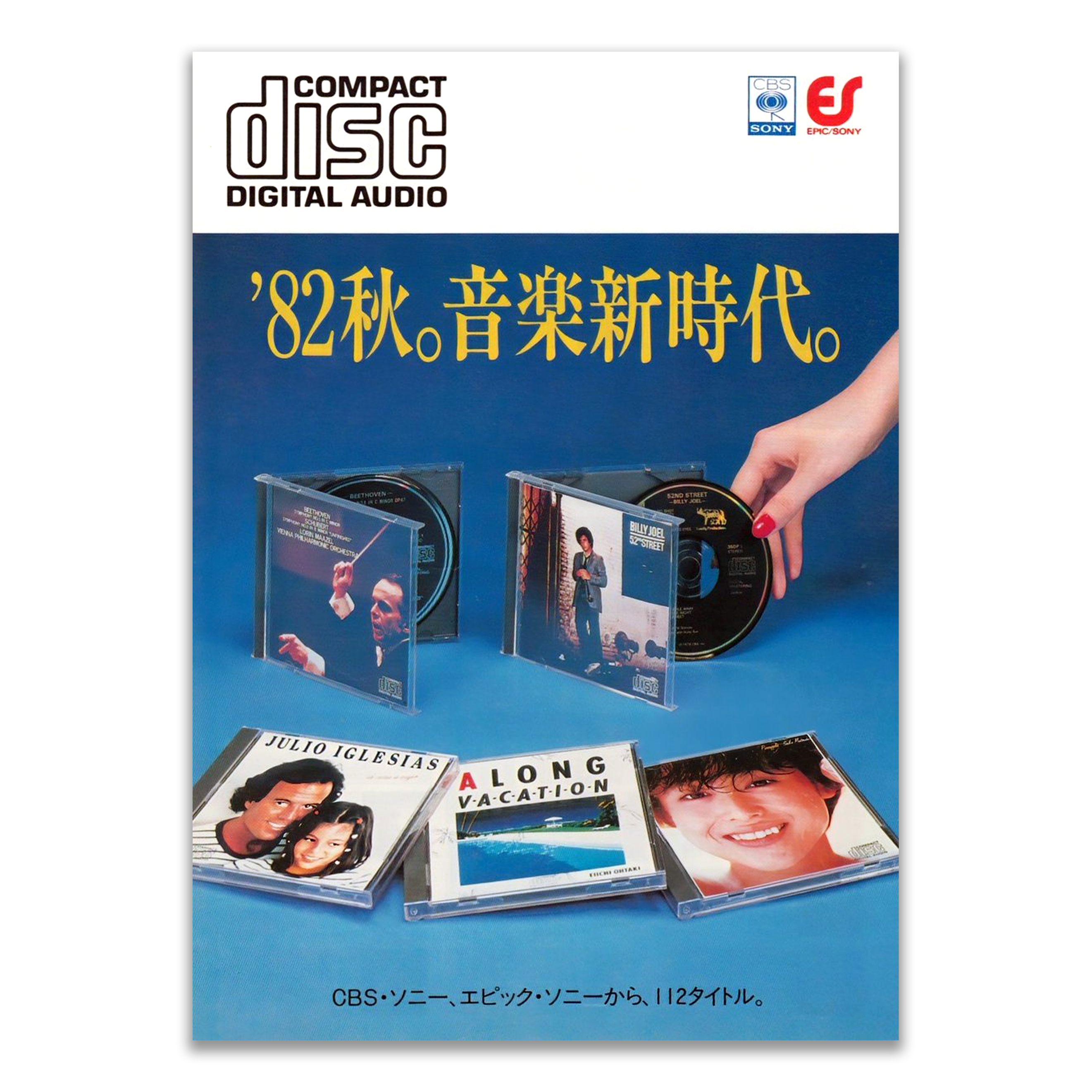
The CDP-101 appeared together with the first commercial catalog of compact discs. On October 1, 1982, Sony and CBS/Sony released roughly fifty CD titles that included classical recordings, Japanese pop albums, jazz releases, and international rock music.
To manufacture these discs, CBS/Sony had already opened a compact disc production facility in Shizuoka Prefecture. The factory became one of the earliest optical disc manufacturing plants in the world. Before discs could be pressed, the music itself had to be converted into digital form.
Early compact discs were mastered using Sony’s PCM-1600 digital recording system. Digital audio was recorded onto U-matic video tapes, which served as the master source for CD production. From those tapes engineers created a glass master, which was then used to stamp microscopic pits into polycarbonate discs during manufacturing.
During the final months before launch engineers encountered a production challenge. Early discs warped slightly during manufacturing, which interfered with laser tracking. The issue was resolved by switching to polycarbonate plastic, the material that later became the universal standard used for compact discs.
By launch day Sony had aligned the essential elements required for the format to succeed. The playback device existed, a catalog of albums was available, and factories were capable of manufacturing discs at scale. At that point the compact disc moved from laboratory research into commercial reality.
In line with the Sony-Philips partnership agreement, the compact disc format expanded internationally the following year. In March 1983 the CDP-101 reached the United States and Europe with a retail price around $900 to $1,000. Philips introduced its own CD100 player in Western markets at roughly the same time. Early catalogs outside Japan were far smaller than the initial Japanese release of about fifty titles, which contributed to a slower adoption of the format in Western markets.
One of the most common questions about compact disc history concerns the first CD release. Many sources point to Billy Joel’s 52nd Street. The album carried catalog number 35DP-1, placing it first in CBS/Sony’s early compact disc catalog series. Sony also used the album in promotional photography for the CDP-101 player, which helped establish its reputation as the “first CD.”
The historical record is more complicated. Compact discs did not debut with a single album. The format launched in Japan on October 1, 1982, the same day the Sony CDP-101 went on sale, with a catalog of roughly fifty titles prepared for the new format.
One of those releases was Eiichi Otaki’s A Long Vacation (35DH-1), often cited as one of the earliest compact discs issued by a Japanese artist.
Disc manufacturing had already begun several weeks earlier. In August 1982, engineers at the PolyGram pressing plant in Langenhagen, West Germany, began producing compact discs while validating the new optical replication process. One of the discs created during these early runs was ABBA’s album The Visitors, frequently cited among the first compact discs manufactured.
At the same time, CBS/Sony’s plant in Shizuoka, Japan, was pressing discs in preparation for the October launch. By the time the CDP-101 reached stores, production lines in both Europe and Japan had already produced inventory for the first catalog.
Because of this overlap, the idea of a single “first compact disc” is misleading. Albums such as The Visitors, 52nd Street, and A Long Vacation appear in the story because they represent different milestones in the early history of the format.
Although Sony introduced the first commercial CD player, the technology spread quickly. Philips, Sony’s partner in developing the compact disc format, released the Philips CD100 in Europe in 1983. Philips approached digital-to-analog conversion differently from Sony, using pairs of fourteen-bit converters with oversampling techniques rather than a single sixteen-bit design. Although Sony’s CDP-101 used a front-loading tray, early CD players experimented with several designs. Philips’ CD100 used a top-loading lid similar to a turntable, while some manufacturers briefly sold vertical-loading players in which the disc stood upright behind a transparent door. Sony’s tray mechanism ultimately became the dominant design because it allowed other stereo components to be stacked on top of the player.
Other manufacturers soon entered the market, including Pioneer, Toshiba, Hitachi, Sharp, Marantz, and Akai. Within a few years CD players began appearing in stereo systems around the world as the compact disc format gained momentum.
Early critical reactions to compact disc playback were mixed. Some reviewers praised the format’s clarity and dynamic range. In one early evaluation, Stereophile founder J. Gordon Holt described certain orchestral recordings played through early CD equipment as “the most realistic reproduction of an orchestra I have heard in my home in 20-odd years.”
Other listeners, however, felt that early digital recordings sounded brittle or clinical compared with vinyl records. Critics often blamed the steep analog filtering used in first-generation players as well as the lack of oversampling. Philips’ CD100 and Sony’s CDP-101 therefore represented two distinct engineering philosophies during the early years of digital audio, and debates between analog and digital enthusiasts quickly became one of the defining arguments of 1980s hi-fi culture.
The CDP-101 demonstrated digital audio in the home, but its high price kept it in the upper tier of the audio market. Sony soon pursued a smaller and more accessible player.
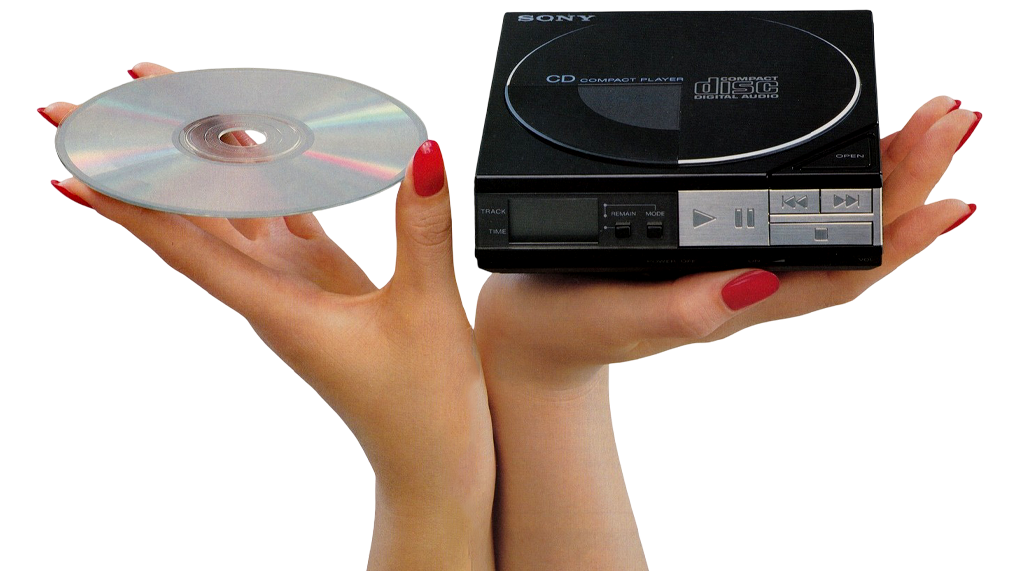
In 1984 the company released the Sony D-50 Discman, the first portable CD player. Engineers condensed the electronics of a full CD player into a device only slightly larger than the disc itself. Sony chairman Akio Morita insisted the machine be priced below fifty thousand yen, even if the company initially lost money on each unit. Morita believed that once people experienced compact disc sound quality for themselves, the format would spread rapidly.
A year later Dire Straits’ Brothers in Arms demonstrated the commercial power of the new format. Released in 1985 and recorded entirely in digital form, the album became one of the first to sell more than a million copies on compact disc.
Once the player, the discs, and the manufacturing infrastructure were in place, the compact disc spread rapidly through the music industry. Within a decade CDs replaced vinyl records and cassette tapes as the dominant music format. Early marketing emphasized durability and promoted the slogan “Perfect Sound Forever,” a phrase used by Sony and Philips to describe the promise of digital audio.
Some early discs were mastered using a technique called pre-emphasis, which boosted high frequencies to reduce noise and relied on a matching de-emphasis circuit inside the player to restore the correct tonal balance during playback. If the mastering or playback chain was imperfect, the result could sound unusually bright, contributing to the first debates between analog enthusiasts and digital adopters.
The CDP-101 remained in production until the mid-1980s. Like many first-generation digital players, it relied on early optical pickup assemblies and controller chips that later designs improved significantly. Surviving working units have therefore become sought-after collectors’ items among vintage audio enthusiasts.
What appeared in 1982 as a single hi-fi component was actually the visible beginning of something much larger. The disc introduced alongside it proved so well defined that nearly fifty years later it still looks essentially the same: twelve centimeters across, a small hole in the center, microscopic pits carrying digital sound. From factories in Japan and Europe the design spread across the world, reproduced hundreds of billions of times and played in hundreds of millions of machines around the world. Few media inventions of the twentieth century fixed their physical form so early and endured at that scale. The CDP-101 was where that object first entered everyday life.