No texts, no Instagram, no subway Slack.
By
,
editor of the Strategist print section, including “The Look Book.”
He was previously a writer at the Strategist covering fitness and outdoor gear.


Photo: Max McKeon
A few months ago, my phone started feeling like too much. Texts from group chats piled up like unread emails, my Instagram feed was mostly sports-betting ads, and even “Do not disturb” mode brought little respite. Then on January 14, there was a nationwide Verizon outage that knocked out cell service for many New Yorkers, including me. For about six hours, I had a taste of the analog life. The next day, I bought a landline and set out to use that for a few weeks — no texts, no FaceTime, no Instagram, no Slack, no nothing.
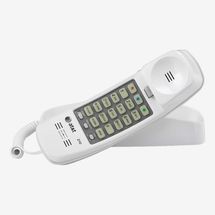
I call Spectrum and tell the representative I’d like to install a landline in my apartment. “This would be for a business account, correct?” he asks. “No, this would be for a home phone,” I say. It’ll be an extra $15 a month, with the first month free, and all I need is the physical phone to plug into my modem. My local hardware store has a corded Trimline in stock. The box is covered in dust, and I buy it for $26.
Want to be emailed about sales and other updates to your saved products? Success! You'll get an email when something you've saved goes on sale.
Yes
New! You can now save this product for later.
I set up the telephone next to some cookbooks on a pantry shelf in my kitchen and connect it to the modem. I follow Spectrum’s instructions on how to set up my voice-mail and answering machine, and I record my greeting in one take. Before turning off my iPhone, I write down the numbers of close friends and family in my planner. The first person I call is my friend Sam, who picks up right away. A couple hours later, I have a voice-mail from my friend Evan. His voice sounds different — it has a grainy crackle to it, as if he called from 1994.
I set my clock to play the radio as the alarm rather than the usual panic-inducing tones of my iPhone, which is turned off and sitting inside my dresser. When I get to the train station and see the 15-minute wait, I wish I had checked the times on my computer. At work, I keep reaching for the spot where my phone would normally be, but I get a lot done and clear my inbox for the first time in months. After work, I get on the stationary bike at the gym. Without music, an hour of pedaling feels like two.
I don’t have a partner, kids, pets, or any big responsibilities other than taking care of myself, and I know this experiment would be incredibly difficult if other people relied on a more consistent level of communication with me. But in reality, most of my friends are texting me about the NBA and Premier League, so I can afford to hit pause on that for a while.
I have six, including one from my friend Max, who said he was feeling sick and couldn’t come over tonight. I catch up with my friend Taylor, who lives in Minneapolis, and we trade life updates from my kitchen. There’s nothing to stare at while I’m talking to him except the ingredients on my pantry shelf.
One reality of not having a phone is it’s hard to change plans on the fly, especially if you’re running late. I planned to meet my friend Matt at a pub to watch soccer in the morning (the matches in England start early over here). The train is delayed so I show up 30 minutes late, and Matt isn’t there. I assume he arrived on time and then left after waiting for me, maybe thinking I slept in. I ask the bartender, Alli, to use the bar’s landline to call Matt to confirm my suspicions. Matt answers — turns out he’s running late too.
I come home to a voice-mail message from my friend: “Hi Jeremy, it’s Sydney. I have someone to set you up with, so you should call me back. Bye!” I call Sydney back and tell her to pass along my number.
Like Tom Hanks in You’ve Got Mail, I have a notepad next to my landline. Since there’s no caller ID and no screen, I have to jot down numbers and messages. This becomes my version of a text exchange: I’ll write a note, then call that person back, and if they don’t answer, I leave a voice-mail. A few friends have asked about the etiquette of calling my landline: “Can I call past 10 p.m.?” “Can you see a missed call if I don’t leave a voice-mail?” (Yes and no.) Before I head out, I write down important addresses and sketch the cross streets on a small notepad that I take with me.
I also have a message from the woman with whom my friend wants to set me up. She suggests email as a better way to schedule a meetup. I’ve never planned a date via email before. We decide to grab wine.
My Trimline phone and trusty notepad for writing down details from voice-mail messages. Photo: Max McKeon
I used to check email and send messages on the train, but that isn’t an option anymore, so I read a few pages of a book. Sometimes I just stare at the floor or read the subway ads. (There are still Seinfeld ads on the F train!) Train delays feel like they’re cutting into the workday. Once I get to my desk, I learn I missed whole conversations between my two editors that were meant to include me, and I react to their messages with a frenzy of thumbs-up emoji. It’s stressful to think of all the little work moments that happen outside the actual office.
Having unplugged, I’m surprised by how out of the loop I feel. I’m starting to miss my family group chat. We have an email thread, but that quickly lost steam because no one checks their emails as often as their texts. I miss seeing pictures of my 6-month-old nephew in particular. This nagging sense of being left out coincides with a voice-mail from my mother: “Hi Jeremy, it’s Mom. Are you still on this phone? So we cannot even text you or anything? Just asking how you are, if you’re okay or not. Give me a call or email me. Love you, bye-bye.”
After work, I head to the wine bar for my date. I write down the cross streets on my notepad and some other spots for backup in case it’s crowded. Before heading in, I realize she doesn’t know what I look like and, more stressful still, that I can’t do my customary booger check without my phone’s front-facing camera. A minute later, she arrives and we find each other easily. At the bar, we chat over wine and then wander around the neighborhood and get burgers and dessert. We walk to the train station and agree to make plans after I get back from my trip to Hawaii — I fly out in a few days.
On the way home, I listen to music on an MP3 player my roommate bought me. I have only ten songs on it, but playing the same songs on repeat is how I listen to music anyway. The best feature: It has FM radio. I put on WNYC.
It’s a bit strange to not send an after-date text when I get home. Calling her close to midnight would feel invasive. But I remember that this is how it used to be, and it’s comforting to sit in that uncertainty. I’ll email her tomorrow.
I land in Hawaii for my friend’s wedding on Kauai. I brought my phone just in case of an emergency, but it’s still turned off. I’ve printed out my boarding passes and MapQuest directions from the airport to the car-rental place and to the Airbnb — and check-in instructions. Thankfully, there are only a few major highways on the island, so it’s relatively easy to get my bearings. I stop at a store and buy two disposable cameras.
59 Actually Useful Tips for Using Your Phone (a Little) Less
In a wild turn of events, I run into my friend Ben on a hike. He and his girlfriend, Callie, are in town for the same wedding, but I didn’t know he’d be coming. We stop and take a picture on my disposable camera.
With my printed MapQuest directions (I cross-reference them with Google Maps on my laptop in the Airbnb beforehand), I drive to the hotel to meet my friends before the wedding. We’ve been coordinating plans via email, and after a few days, I realize I’ve been using my laptop more than I’d like to on vacation.
I momentarily break my no-phone rule. I forgot to print out my boarding passes for the return flights, the security line at the airport starts at the curb, and there is no kiosk to print out my pass, so I have to turn on my phone to access my tickets. I wince at the notifications I expect to buzz on my screen before I remember I turned them all off. Once I scan at the gate and board the plane, I power down my phone again.
After a week of traveling, I expected to come home to a ton of messages on my answering machine. I had three. This was a little disappointing, and I can feel the novelty of the landline wearing off. Some of the film photos from the wedding come back great, and I wish I could share them with my family and friends — almost in an effort to stay relevant in their lives. I have a creeping urge to post pictures of the ceremony in Hawaii to Instagram, which would involve breaking my streak. I spend the day deliberating.
On the way home from work, I decide to stop by the apartment of my friends Sam and Sydney unannounced. I ring the bell, and, after a few seconds that feel like an eternity, they buzz me in. I catch up with them as Sam does dishes and Sydney works on a photography project. After a while, I head home with a piece of cake Sam made, which I interpret as a reward for this monthlong detox.
A month feels like an appropriate time to end the experiment, so I turn my phone on. It’s alive once more, and it feels strange. The screen itself seems foreign and extra bright. (I checked — the brightness was normal.) I open Instagram to a home screen of red notification dots. I post the photos of me and my friend and his wife at their wedding and get a stream of likes and DM-inbox buzzes. At the office, my co-workers want me to check how many unread messages I have. Factoring in ones from group chats, it’s 1,947. Overwhelmed, I turn my phone off again.
- The Strategist Fall 100
- The Best Things Strategist Editors Have Bought This Year (So Far)
- The Strategist Summer 100
- I Replaced My Tretinoin With This $30 Retinal Cream
The Strategist is designed to surface useful, expert recommendations for things to buy across the vast e-commerce landscape. Every product is independently selected by our team of editors, whom you can read about here. We update links when possible, but note that deals can expire and all prices are subject to change.