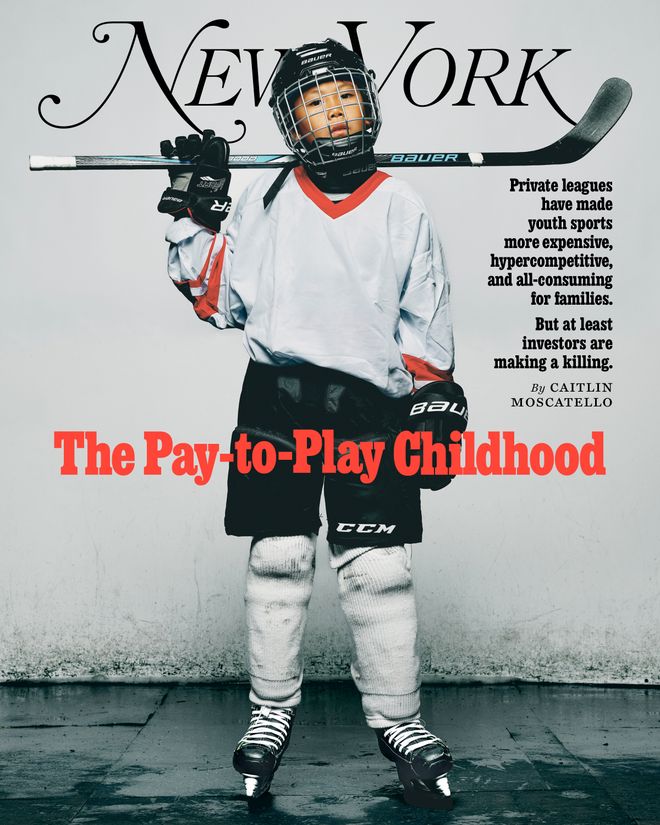
The Pay-to-Play Childhood
Private leagues have made youth sports expensive, hypercompetitive, and all-consuming. Investors are making a killing.
By
,
a contributing writer at New York Magazine.
She covers everything from the expensive college consultant industry to family vloggers.

Photo: Victor Llorente for New York Magazine
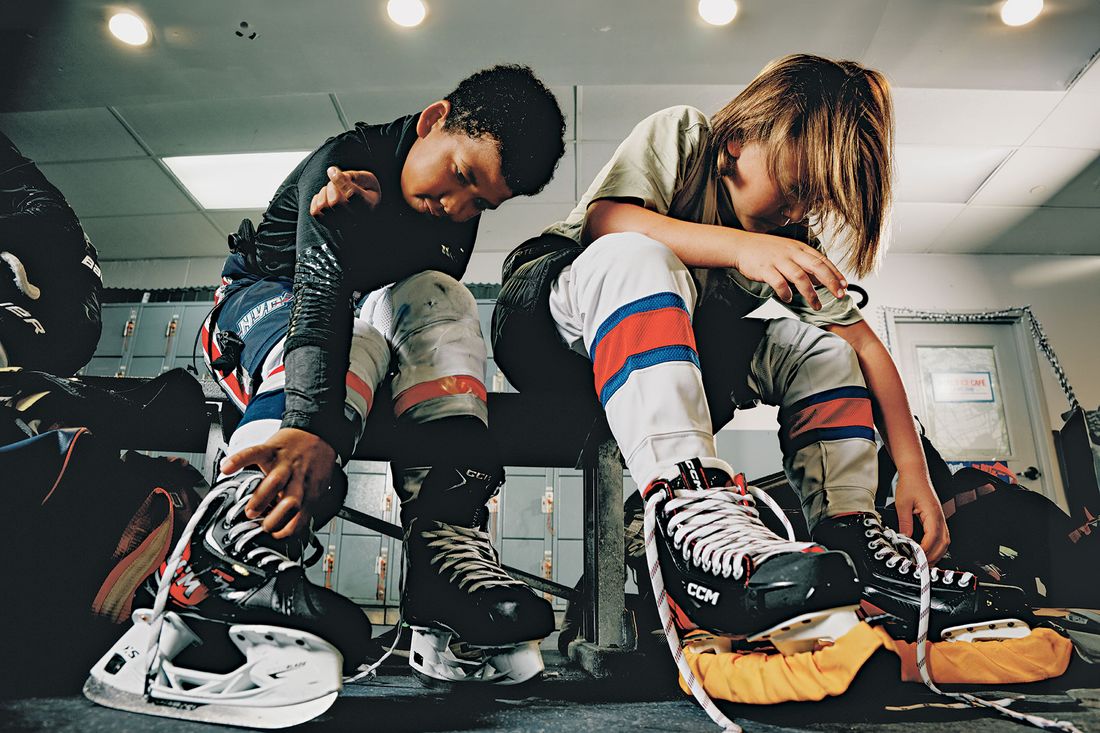
Photo: Victor Llorente for New York Magazine
Photo: Victor Llorente for New York Magazine
This article was featured in New York’s One Great Story newsletter. Sign up here.
Look, the kid is fine at soccer.
At 11, he’s competitive, and he loves the game. But if his mother, Elizabeth, had it her way, he would still be on one of the town’s low-cost teams, where he started at age 6, rather than the $5,000-a-year club program that now dominates their schedule. She looks back on those earlier years fondly: carpooling to games with other families from their suburban public school, cheering on the neighborhood kids from the sidelines. That version of youth soccer resembled her own days on the field in the ’90s, when it was the norm for children — even the most athletically inclined — to play on community-based teams through eighth grade. She had wanted that for her son too. Saturday mornings at the park with friends. Orange slices from the cooler during halftime. Parents clapping for everyone, win or lose, because really, what’s the difference?
Those simpler days were short-lived. By the time her son was 9, at least a third of the children enrolled in his town rec league had left for a travel league, including the pricey clubs offering a mini-version of professional sports — crisp uniforms, hired coaches, games in different states. With fewer players, the town teams became less competitive and gave the remaining boys the impression they were in a second-rate program. Before his 10th birthday, Elizabeth’s son asked if he could try out for one of the clubs, too. “I want to be a social-justice warrior. I didn’t want to flex my privilege muscle,” she said. But her son was getting bored.
In the switch to club, she found herself surrounded by parents with both means and flexibility. Her son did improve, but in her view, it wasn’t because of the coaching or so-called premium facilities; the boys on the club team were simply playing more — four days of practices and games a week, almost year-round. Still, other things troubled her. The time investment made the stakes feel artificially high. There was an enormous focus on winning; at games, she witnessed parents yelling at players, sometimes not even their own, and berating the referees. The coach was red-carded after losing his temper over what he perceived to be a bad call. “Every single time after a loss, the parents blamed the ref,” said Elizabeth. “What does that teach the kids?”
The financial obligations also piled up: There was a tournament 15 minutes from her brother’s house, but everyone on the team was required to book rooms at a designated hotel. Parents were told to buy pink jerseys in addition to the other uniforms; the players wore them only a few times. Elizabeth was shocked when the coach made a surprise announcement that the team was going to compete in scrimmages in Europe that cost $3,500 per player. “They kept saying, ‘Oh, don’t worry. It will only be $3,500 a person because we are going to fundraise for it,’” she said. “And to me, it’s like, Okay, so then I’m going to ask my friends and family to help support my son going to play soccer in Europe? ” To her, the trip didn’t make any sense — this wasn’t an elite team made up of the most competitive kids in the country. “I was thinking, There are plenty of teams we are losing to right here in our state. Why do we need to go lose to teams abroad? ”
The final straw was when the league director lost his temper with a group of boys at a winter clinic. Multiple children came home and told their parents what had happened, and those parents discussed it on the team app, messages she says an administrator then deleted. Next season, a number of the kids aren’t returning, “but that’s not the No. 1 reason,” she said. “The parents are frustrated about the coaching style; they don’t think he’s good enough. They don’t think the practice-field situation was okay because there were too many kids on half a field. It wasn’t that the director of the program was screaming curse words at our children.”
Travel sports, a term that has come to encompass all sorts of private teams, leagues, and clubs, used to be for the truly exceptional young athlete. Now, they’re for anyone willing to pay — an expensive, exhausting commitment that has become popular not necessarily because millions of parents want them for their children but because it can feel like there’s no other choice. Rec programs are underfunded and struggle to compete with for-profit leagues for prime field, rink, and court times. As more children leave rec, so do their parents, creating a void of volunteers. And the level of play is diluted, often very early, as travel teams are incentivized to enroll children at young ages. Some hold tryouts as early as kindergarten.
Parents like Elizabeth are familiar with the stats. They know only around 2 percent of young athletes will compete in Division I college sports and roughly 0.05 percent will play professionally. The vast majority of kids quit organized sports entirely by the time they turn 13. And plenty of parents by now have had it drilled into their minds that the hypercompetitive, highly specialized environment travel sports pushes isn’t developmentally appropriate for young children. For years, the American Academy of Pediatrics has warned that intensely playing one sport from a young age can lead to stress, burnout, and overuse injuries caused by performing a repetitive motion. Experts have long advised that children are best served by playing multiple sports without pressure until they’re in their early teens or even later. But travel teams often lock children into packed practice and game schedules that stretch well beyond a typical season, leaving little opportunity to try other sports. Numerous books on the matter, published across three decades, mostly boil down to: Keep sports fun. Make them child centered. Focus on development, not results.
Still, it can be difficult for parents to resist the travel craze. Children aren’t different from adults in that they look around, see what their friends are doing, and want to be a part of it too. The mother of a first-grader in Manhattan was appalled when, upon her telling him travel baseball would leave no time to play on his school team with his classmates, he said, “I don’t want to be a part of a team that anybody can join. I want to be a part of a team that you have to try out to make.”
Ironically, though, talent and skill no longer act as a barrier to entry. “When I competed, travel was more like you had to be really good. It was intimidating, and most people did not make it,” said Amanda Pennel, a mother of four in Georgia who played travel basketball as a teenager. “Now, it doesn’t matter if you’re the worst basketball player anyone’s ever met; there’s a travel team for you.” Her oldest son started travel basketball in the seventh grade, which she came to learn is considered late nowadays. After her next oldest also joined a travel team, family life torqued around the schedule: Pennel drove an hour to Atlanta multiple days a week for practices, getting home as late as 11 p.m., while weekends were devoted to games and tournaments. Monday was often their only night together as a family. “I was like, What are we supposed to do on Monday? Laundry? ” Worst of all, her children would get back in the car after practices depleted. “They looked like they were wilting,” she said. Her son once missed an annual fishing trip with his father and siblings for a basketball tournament. When the team lost, the coaches yelled and cursed at the players. She looked at her son, shoulders slumped on the bench, and thought, My kid could be on a trout stream right now.
Around 5 million children in the U.S. now compete on travel teams. Parents find themselves trapped. They know the benefits of sports — better health outcomes, higher self-esteem — and want that for their children, yet giving it to them often means buying into a sports ecosystem that’s inherently flawed. As the pay-to-play model increasingly takes hold, so does the idea kids should start competing at younger and younger ages, risking their sense of self along with their shoulders and ACLs. “I think the word isn’t specialize; you are professionalizing your kid early. You are exposing them to everything professionals have to deal with — I’m talking injury, time, schedule, everything,” said John Van Benschoten, a former MLB player who has coached travel baseball in Nashville. It makes one ask: All this for what? And for whom?
Cruz, Quinten, and Brayden play with the NYC Cyclones and NYC Hockey Club. Photo: Victor Llorente for New York Magazine
The modern-day hydra of youth sports can partly be traced to the pandemic. Parks-and-recreation departments, a major provider of rec sports, rely on local tax dollars, but budgets were slashed during COVID, and social-distancing requirements and park closures put many programs on pause. Privately owned sports leagues temporarily stalled during lockdown, but many had the capital to get back up and running soon after; parents who could afford the fees were more than willing to pay if it meant returning their children to some semblance of normalcy. In many ways, it resembled what was happening in education: After public schools shut down, private schools experienced a bump in enrollment.
Investors saw an opportunity and had a model. In 2014, a pair of private-equity firms acquired Varsity Brands, a team-sports-apparel and competitive-cheer company, for $1.5 billion. The deal gave Varsity Brands ubiquity in the youth-sports ecosystem at the national level, from the competitions themselves to the uniforms and training camps. Just four years later, it was bought by another private-equity firm, Bain Capital, for a reported $2.5 billion. In 2024, it sold again to KKR for around $4.5 billion. Travel sports had been growing in popularity since the early aughts, but investments tended to be small and fragmented — a team here, a rink there. The new mentality was bigger and more straightforward: Own it all.
Private investment firms began buying up teams, facilities, software, camps, apparel, and media streaming in a roll-up strategy that allows them to profit from almost every aspect of a family’s participation. “It’s a stay-to-play mentality where you go to a tournament that is owned by the same company that owns the team, that then says you have to book a hotel block that’s owned by the team through a platform also owned by the team. They have rules about taking your own video because they want to sell you their media package, and you have to pay to park because they own that too,” said a former club-lacrosse coach in New Jersey who has three children on travel teams. “Before you know it, you’re paying a lot of money for the privilege of your kid playing a team from one town over, several states away from where you all live.” Private equity didn’t create all these practices, but in some cases it accelerated them, said Tom Farrey, founder and director of the Aspen Institute’s Sports & Society Program.
Since the initial Varsity Brands sale, multiple deals have anointed different sports with their own financial overlords. 3Step Sports, backed by private-equity firm Juggernaut Capital Partners, rules club lacrosse; Black Bear Sports Group, owned by a set of private investors, including a minority investment from Blackstreet Capital Holdings, a company founded by Black Bear’s ex-CEO Murry Gunty, is a dominant force in youth ice hockey.
A common investment tactic is to purchase smaller teams and leagues, put them under one national umbrella, and give them a corporate sheen to resemble the pros. Some of this is aesthetic: Children receive high-quality uniforms and play in state-of-the-art venues. Other parts seem devised to ratchet up the pressure. Apps feed parents and young athletes live stats and standings. There are contracts with terms that make it difficult for players to switch teams. Some leagues make “exploding offers,” giving families a short window, often 24-to-48 hours, to accept or decline a spot before it goes to someone else. Competitive programs with brand appeal add B and C squads, charging those parents the same amount of money for a more junior program with less-experienced coaches. Words like elite and select are thrown into team and league titles as bait. Leagues tell parents, subtly or not, that their child is special: This summer, a private-equity-backed youth baseball program in New York City with children as young as 7 sent parents an email that read, in part, “Players on our Travel Teams represent the top 5% of all players in our program” and reminded them that “travel baseball here isn’t something that players and families choose to ‘do’ but something that requires a high level of desire, commitment, and competitiveness.”
Parents so far have shown a willingness to pay. Overall, families spent 46 percent more on a primary youth sport in 2024 than they did just five years prior, according to Project Play, an initiative of the Aspen Institute. It estimated that youth sports generate up to $40 billion in annual revenue — nearly twice as much as the NFL. It isn’t just the ultrarich doing the spending, either. An AP-Ipsos survey published this month found that less affluent parents spent about the same on their children’s sports as ones whose household income was at least $100,000. The children most left out of organized sports are from homes with incomes under $25,000, according to the Aspen Institute, and that gap is widening. Meanwhile, profits for investors in youth-sports companies are growing significantly.
Firms are now in a race for less-tapped markets, including who gets to own flag football, a former backyard game that private capital has helped mold into a competitive sport booming among young athletes. Participation in tackle football is down amid fears about the dangers of concussions, and flag football is also more accessible to girls. It’s only in the past five years that flag has truly taken off. This year, the girls’ high-school flag-football championship aired to an audience averaging more than a million viewers. In 2028, the sport will make its Olympic debut at the Summer Games in L.A., and NFL-affiliated professional leagues are scheduled to launch next year.
The investment playbook is similar to those of other sports: Hook families while their kids are very young. Brand Velocity Group, a private equity firm where Eli Manning is a partner, recently acquired the operating partner for the NFL’s youth flag-football program, which starts at age 4. Unrivaled Sports, also backed by private capital, acquired a majority stake in Under the Lights, a national flag-football program that begins before kindergarten. It could be a strategic choice for parents, too. The women’s game is emerging as a D-I sport and is far less saturated than sports like soccer, offering a fresh pipeline to playing in college and beyond. In interviews, parents tend to say they’re not delusional about their children’s athletic futures, but in an anonymous survey, 11 percent said they believe their child could one day go pro. In another poll, 44 percent said the potential for NIL (name, image, and likeness) money played a role in their decision to sign up their child for sports. Never mind that highly lucrative NIL deals are rare, even among the minute percentage of athletes who go on to play in college.
Flag football has already eclipsed lacrosse and could very well come to rival youth soccer, said Scott Lancaster, a youth-sports adviser and program architect who has consulted for investors interested in the sports sector. He developed the NFL’s initial youth flag-football program in the ’90s, which was mostly created as a marketing tool. Lancaster predicts investors will buy up field houses that leagues and clubs can rent for tournaments, then develop local and regional youth leagues as they have in other sports. “Private equity loves investing in facilities where they can be the anchor tenant of the sport they also invest in. Then they go back and buy others and bring them into a conglomerate,” he said. “They want to take every angle and monetize it.”
One reason parents accept these conditions is they are anxious about what will happen if they don’t. In a time of justified concern for children’s mental health and unease about the future, parents have latched on to sports as a lifeline — a kid throwing a ball around is a kid not scrolling YouTube. No parent wants their child to feel left out, and more and more, parents may worry that a travel league is the only way to set their child up to play beyond grade school. Some school districts across the country have cut freshman and junior-varsity teams from their budget, increasing competition for fewer spots, said Farrey of the Aspen Institute. He experienced it himself as a parent. “You look at the high-school team, and all those kids played club starting from a fairly early age, and just to preserve the opportunity that my kid could play in high school, I’m like, Well, I might as well go with it,” he said. “And the next thing you know, it’s Mother’s Day and you’re in Poughkeepsie at some Drury Inn.”
This fear — that if they don’t get their child in on the ground floor of travel teams, the elevator will go up without them — can lead families to commit to one sport and one sport alone. Eric Marvin, a former D-I and minor-league hockey player in Michigan, has four children who play on travel hockey teams, which collectively cost around $35,000 a year. He wishes they had time to try other activities. Children who are highly specialized in one sport report more fatigue and mood issues than those who play multiple sports. But there’s a sense that if they skip a hockey camp or aren’t playing year-round to accumulate ice time, they won’t advance. These days, if they don’t start young enough, it’s possible for a child to get left out of the pipeline by third grade; Marvin said the coaches of the most competitive teams for children ages 10 and under often want athletes from the most competitive teams for children ages 8 and under.
“I used to think, I’ll never be that mom,” said Liz Marmer, a parent of two on Long Island. She signed her son up for ice-skating lessons when he was 4 after a family trip to Boston, where he’d had a blast puttering around a pond. Three years later, her son, now 7, plays on a competitive travel ice-hockey team; in the spring, he plays on two. The sport has become a central part of their family life, and some weeks, she finds herself spending as much as ten hours chauffeuring him to and from the rink. Each year, the team holds tryouts in which even current players must fight to keep their positions. “Now that he’s on a better team, he has a lot more to risk,” she said.
It’s not really about hockey. “Being a kid these days is not what it was when we were kids. The expectations come so much earlier in life that it’s almost like they have to figure out what they want to do at such a young age,” Marmer said. “I was willing to let my kids get into travel sports at such a young age because they need to figure out now if that’s what they love.” As a mother of three soccer players in North Carolina told me, “I never want my kids to look back and say I didn’t do everything I could to help them live their dreams.” She’s hired professional photographers to take action shots for her 12- and 13-year-olds’ Instagram accounts — the social-media platform has become a recruiting tool — and they’ve both asked her to pay for personal trainers to work with them.
In their pursuit of a competitive edge for their children, parents can inadvertently take the positive effects of sports and turn them inside out. Perhaps nobody knows this better than Travis Snider, a child baseball prodigy turned first-round MLB draft pick who ultimately struggled in his professional career until he retired in 2022. Snider remembers what it was like to be the child on the field; his sense of self-worth was so closely linked to how well he played — every inning felt like his life depended on it.
Now a father of three, he’s the co-founder of 3A Athletics, a company that educates adults on a healthier way to interact with young athletes. He’s trying to reach parents and coaches of children ages 6 to 18 who are what he calls the “80 percent middle.”“You have 10 percent of parents who are just insane — they’re the ones who are screaming at their kids, they’re yelling at umpires and getting kicked out of games. Then there’s the 10 percent of enlightened, yoga, tea-sipping parents who are just like, ‘Hey, we’re here to have fun! This is great!’ And then you have the 80 percent of us in the middle who are kind of mildly crazy,” he said. “There’s a lot of damage that’s done by this 80 percent unknowingly without the intention of ever wanting to create these traps for our kids.”
If an 8-year-old starts talking about how much she wants to compete in college, he urges parents to recognize it could be because a dream is taking root but also because she’s seeing if saying that gets her more love and attention. “Kids are taking the cue from us: How serious is this?” he said. Even the best-intentioned parents could feel resentful after spending thousands of dollars and countless hours in the car for their child to compete on a travel team, only for their child to tell them one day that they don’t want to play anymore. Many do want some form of return on their investment, he said, even if they can’t articulate that, and the more they put in, the more they expect. In the best-case scenario, that return is their child having a positive experience. Too often, though, it comes down to results.
“Despite their awareness that kids should be learning and winning doesn’t matter at younger ages, that gets thrown out the window because parents want to win,” said the lacrosse coach, who admits he can sometimes be that parent himself. “They want to be a part of a program that’s going to take their kid to the promised land.” Coaches and parents both know there’s always another team for families to jump to; on the field, coaches are in charge, but that doesn’t change the reality that it’s the parents who are the paying customers.
As travel sports get more commercial, parents are mimicking trends and behaviors they see in college and professional sports. In baseball, it’s become popular for parents to play walk-up music when each child goes to bat, just like in the pros, which extends an already slow game. (One of the most popular songs is DJ Khaled’s “All I Do Is Win.”) Social media is awash with parents’ images of staged contract signings for children as young as 5, complete with balloons and hats in their team colors, their small hands holding pens. Some tournaments require them to buy tickets to see their kids play — perhaps why there’s a subset of adults who show up with an expectation of being entertained; parents shared stories of seeing other parents mixing screwdrivers from a cooler or sipping wine from Yeti tumblers at 8 a.m., which can lead to bad sideline behavior. At a lacrosse tournament in Rhode Island for second- and third-graders in July, a sign staked into the ground addressed adult attendees: PLEASE REMEMEBER, THIS IS A GAME, THESE ARE KIDS, REFS ARE HUMAN.
The coaches, they have to win. In the travel-ball world, that’s how it is,” said Van Benschoten, the former MLB player and travel-baseball coach. One practice that has become commonplace is recruiting “guest players,” athletes not on the team who act as hired guns for games. “Coaches are constantly working the phones; they are constantly asking people to play with them,” he said.
It was two years ago, when his son was 11, that Van Benschoten first saw parents letting their children guest-play for other teams. He became concerned when he learned that one boy on his team, a pitcher, had thrown in a game for a different team on Thursday when he was scheduled to pitch for their team that Saturday. The boy’s father assured Van Benschoten he’d thrown only 25 pitches, but a parent at the Thursday game told him that number was closer to 60. Another game would have been too much for the boy’s shoulder. “The parent was actively lying about this, and if we just took his word for it, we could have put the kid in danger,” he said. “A lot of coaches don’t care, and they love the fact that they can use this kid as a chess piece and win with him.” Pennel, the basketball mother in Georgia, says it happens frequently; the unintended message is that children are, at best, valuable only if they can perform to expectations and, at worst, dispensable. “Imagine being a kid and you’re like, Oh, I’ve been to all the practices and now I’m sitting because they called this other boy just to help the team win.”
By the time she was 13, London, a 16-year-old soccer player from Kentucky, was guest-playing for three additional travel teams. The extra playing time helped strengthen her skills, and she liked competing with different people. But London was already playing soccer seven days a week all year. The extra playing time put additional stress on her still-developing body. Yet it was difficult to turn down opportunities. “I know a lot of people who don’t get asked to guest-play,” she said.
London had started on the local rec team when she was 6 but joined a travel team at age 9, when she and her father decided it was time to get serious about soccer. “I was waking up real early in the morning, going to the gym, practicing before school,” she said. “Every day, it was soccer, soccer, soccer.” There was more pressure to perform well in the travel league, and anxiety attacks became a regular occurrence — not every game or tournament but often enough that London began “having anxiety about having anxiety.” She worried about what her coaches were going to think, what her father was going to think. “It could be so bad that I would start playing soccer and then start hyperventilating and have to sit down. I was so scared that I wasn’t doing good,” she said. The coach’s daughter was also a striker, and they competed for playing time. London felt there was no room for error. Sometimes, as she sat crying, the coach would give her a pat on the back and then walk away.
Initially, London’s anxiety didn’t seem so out of the ordinary to her mother, Rachel West. It was a competitive team, and expectations were high. There was yelling. Children cried. “I feel like when these kids are doing club and travel sports during puberty, there’s a lot of emotion,” West said.
London was guest-playing for another travel team in November 2024 when she heard a pop and fell to the field, pain radiating up and down her left leg. It was a full ACL tear and would require surgery; the recovery could take up to 12 months. West reassured her that she had plenty of time. It was only her freshman year. College coaches couldn’t contact her until she was a junior. London would get the surgery, do physical therapy, and find herself back on the field when it really mattered. Still, another player would need to temporarily replace her. She thought, What if they take my place? What if I don’t get to play that position anymore? She started to second-guess if she had played well enough that season and worry about what it meant to be stuck on the sidelines. West took her to a surgeon one state over who performed fertilized ACL surgery, in which bone-marrow stem cells are mixed into the bone graft during reconstruction, and told them she could return to playing in six months.
London returned to the soccer field in June 2025, just as her doctor had promised. Her first season back, she was constantly worried about reinjuring her leg. But she soon regained her physical strength, and with that, her fears of getting hurt again began to dissipate. It was ten minutes into a game this May when she felt something snap in what had been her healthy leg. She was again guest-playing in a tournament, this time for a rival team — they’re selective; it was flattering to be asked. Immediately, London knew it was her ACL. Days later, an MRI confirmed it.
At Boston Children’s Hospital, young athletes being treated for an injury are sometimes referred to its sports-behavioral-health clinic for help with the psychological toll. The average age of patients at this clinic is 16, and currently, the youngest is 8. ACL injuries are common. So are chronic pain, bone-stress injuries, and post-concussion headaches. After an injury, “there’s a lot of anxiety about this happening again, fear of not being able to get back to where they were, fear of falling behind,” said Taryn Brandt, a psychologist at the clinic. “There’s anxiety about losing opportunities. I think certainly there are times when it’s I don’t want to disappoint family or coaches.” Recently, I spoke with a 14-year-old lacrosse player in Maryland named Carrington who not long ago underwent her second ACL surgery on the same leg. She had her first operation in the seventh grade, when her growth plates — areas of cartilage near the ends of long bones in children — may not have closed yet. Carrington and her parents opted for a more limited surgery, one that would repair the area using hamstring tendons but not bone plugs; the latter are more stabilizing but can lead to irregular bone growth in children who are still developing. Even as she recovers from her second surgery, Carrington’s priority is getting to play again.
Matthew Sacco, a sport-and-performance and health psychologist at the Cleveland Clinic, placed a minimum age of 12 on his practice because otherwise he found himself dealing more with parents than patients. “I’m getting many, many, many, many more asks for younger kids than I’ve ever had,” he said. Sometimes parents bring a child in, sharing with him some version of “I just want to make sure that we’re doing everything we can do to support them. We want to give them every resource.” Other times, they view their child as broken and are hoping for a straightforward solution. Sacco is wary of those parents. “At a certain age, it’s quite an indictment to bring somebody to see the psychologist because I need to fix something to make them a better athlete,” he said. Most often, parents are concerned that their child is more irritable than usual and is suddenly complaining about going to practice. Sessions with young patients always start with the parents in the room; when Sacco speaks with the child alone for the first time, that’s when they tell him that they’re not having fun anymore, that their body is constantly sore, that it’s been injury after injury. On rare occasions, he closes the door and they say outright, “I’m over this. I’m done. I don’t want to play anymore.”
Sacco blames the year-round schedule many travel programs encourage for much of the burnout he sees in young patients. “The travel or elite sports programs, they’re built around a competitive calendar. It’s not a developmental one,” he said. “A 9-year-old’s brain is not built for these tactical, high-stakes, decision-making competitions.” There’s no magic number, but experts generally recommend waiting to focus on one sport until at least the early teen years. When a patient is experiencing burnout, he typically first suggests stepping back, rather than stepping away from the sport entirely. “But a lot of people aren’t okay with that. It’s like if they step back, then they’re not going to be progressing. They’re missing these opportunities, and the window is so small,” he said.
There’s an identity loss for athletes who are unable to compete for a period of time, who quit their sport, or who want to keep playing but don’t advance to the next level. The latter can be particularly painful, but Brandt equates all of these experiences with grieving. Young athletes grapple with regret, focusing on where they could have made a different decision or taken another opportunity.
Hali Campbell’s son, Hudson, is in many ways a success story: He started playing hockey at 6, and nearly a decade later, he’s a defenseman for a team that’s at the highest level for his age. The family spends $25,000 a year for Hudson to play hockey. At this point, the skates are $1,200, and “he has a hockey bag that is the cost of a trip to Disney,” she said. Combined, Campbell and her ex-husband make $150,000 a year. She’s a marketing director for a small skin-care company and pet-sits on the side for extra income. Most weeks, she spends about 30 hours at the rink or driving to and from it.
For a long time, the sacrifice seemed like it would pay off; Hudson had all the makings of an athlete who had a real shot at playing for a D-I college one day. Campbell saw herself as a parent committed to her child’s dreams and allowed academics to take a back seat. Late nights at practice followed by 90-minute drives home leave little time for studying.
She’s starting to worry, though, that they’ve put too much on one side of the scale. As Hudson approaches the end of high school, he finds himself competing against athletes whose families can afford private coaches or who attend the prep schools that serve as feeders to the big D-I programs. College recruiters also pull talent from junior leagues and from Canada, where almost a third of NCAA hockey players hail from. Hudson isn’t interested in playing college hockey if he can’t get a scholarship, but Campbell believes without hockey, he might not get in at all. “I feel like it’s all about the money,” Campbell said. She sees hockey players her son’s age burning out physically and mentally trying to keep pace with a system that increasingly favors those who can afford more. Even travel hockey, expensive and time-consuming as it is, may not be enough anymore; another level is seemingly always being built above young players’ heads.
It doesn’t have to be this way. In Minnesota, a network of 250 public rinks serves as the foundation for a nonprofit youth ice-hockey program with more than 60,000 athletes across the state. The entry cost for Minnesota Hockey is low: Most families pay $200 to $400 per season, and in some parts of the state, there’s no fee at all for a player’s first one and equipment is provided for free. The idea is to keep ice hockey accessible and community based; the organization is broken out into 13 districts, and athletes play where they live. Jeremy Reed, the executive director, says organizing the program geographically is crucial: “The majority of the players in Minnesota grow up playing for that name on the front of their jersey. That’s their community.”
Starting at age 13, athletes can try out for Minnesota Hockey’s Tier I team, which competes with the private clubs at nationals, but nobody is cut from the program altogether. Instead, athletes are grouped by ability, which keeps the game competitive for the more skilled athletes and fun for everyone else. The price increases at the highest level — top players pay up to $1,400 for one season, including equipment — but that’s trivial compared to the $25,000 some families pay elsewhere.
Reed says they’re able to keep down costs by relying on volunteer coaches, who are required to complete a training course with USA Hockey, the sport’s governing body, to ensure quality. Much of the funding comes from charitable gambling machines called pull tabs, or what some Minnesotans refer to as “cardboard crack,” found in bars across the state. Families who can’t afford the registration fees can also pay with their time; in Roseau, Minnesota, players and their parents receive a discount if they volunteer at the local fair. It’s a setup that separates Minnesota from the rest of the country and that Reed seeks to preserve. He’s seen other hockey powerhouses with which they used to go head-to-head, including Michigan and Massachusetts, lose their public leagues and rinks to the private sector. Minnesota Hockey’s model works because nobody is trying to profit from selling families ice time. In most of the country, however, rinks are commercial enterprises trying to make as much money as possible. “When you own the rink, it gets more into the business side of things,” said Reed, watching his words with a midwestern politeness. “You need that rink to be filled.”
The results speak for themselves: Minnesota produces more D-I men’s and women’s ice-hockey players than any other state, and it’s not a stand-alone case. In Norway, a country that medaled more than any other at the recent Winter Olympics and made it to the quarterfinals of the FIFA World Cup this summer, youth teams are subsidized by the government so that every child can play regardless of their family’s income, and they’re not allowed to publish scores or rankings until age 11 or compete for national championships until age 12. For comparison, the U.S. was knocked out of the World Cup in the Round of 16 despite the massive amounts of money spent on youth sports. Critics blame a landscape that has become less about merit than it is about money. In other countries, the best athletes are plucked from the largest possible pool of subsidized youth teams and then developed under the sponsorship of professional leagues. Here, children whose parents can’t afford for them to play may never get the chance. And even if they do, prioritizing winning over skill development may make them weaker team players later on. Last season, roughly a quarter of NBA players were from outside the U.S., many of them from Europe, where there’s a strong focus on team play and fundamentals.
The fight to remove private capital from youth sports has made its way to Congress, where the Let Kids Play Act, a Democrat-led bill that seeks to curb what it calls “vulture practices” in the sector, was introduced this spring. The bill calls out private-equity firms specifically but, if passed, would require any investors in youth-sport companies with below-board tactics — junk fees and binding contracts, for instance — to divest over a two-year period. “We basically say, ‘If you were engaged in these practices, then we are essentially deeming you an illegitimate owner of a youth-sports organization,’” said Senator Chris Murphy, a lead sponsor of the bill and the father of a hockey player. He argues that elementary and middle-school sports should be covered by nonprofits as well as local and state governments, akin to the way high-school sports have been funded for decades, with some support from the federal government, too.
In a subcommittee hearing this summer, Black Bear Sports Group, the privately owned hockey company that’s been buying rinks across the Midwest and Northeast, was specifically named following a USA Today report accusing the company of driving out nonprofit teams to prioritize private ones, among other practices. (The company declined to be interviewed for this story but denied the report’s allegation in an emailed response.) Black Bear argues that it is purchasing rinks that would likely shut down otherwise. New compressors alone, which are necessary to cool the ice, can cost $2 million, and energy prices are rising. Evan Nierman, a company spokesperson, points out that the repairs on just one of its 47 ice rinks, the Jersey Shore Arena in Wall Township, New Jersey, cost almost $3 million. “We feel strongly that private ownership is not the real threat to youth sports, and youth hockey specifically,” Nierman wrote in an email.
Murphy calls that argument persuasive only because we’ve gotten used to private ownership in youth sports. He’s arguing for more public investment in an ecosystem that millions of children and families want to participate in. Private capital “wants you to think that their investment is free. It’s not. You’re paying for it. Plus, you know, a vig for their investors,” said Murphy. “So it’s a question of, How do you want to pay for youth sports?” The bill is unlikely to move forward before the midterms and faces an uncertain future after, but Republicans recently joined Democrats to pass legislation limiting private-equity investment in single-family homes, giving Murphy some hope for momentum.
Real change would also require a cultural shift. Lancaster, the youth-sports adviser, is a co-founder of Whole Child Sports, an organization that aims to improve children’s experiences in athletics. He’s currently testing a flag-football program modeled on free-play games like pickup basketball to keep the sport fun and accessible. The idea is young athletes will register as individuals and play with different kids on multiple teams throughout the course of one day, each accumulating points, and at the end there’s no winning team. It may not appeal to parents seeking a more competitive atmosphere for their children, Lancaster said, but he hopes it could provide an alternative to club mania. With flag football, he sees a rare opportunity to build a better sports ecosystem from the ground up before families once again find themselves giving in to onerous scheduling and financial demands. “I’m concerned because money can change everything,” he said.
A return to the sports paradigm of the ’90s is likely out of reach. But there are companies experimenting with a sort of hybrid future. RCX Sports, one of the companies backed by Brand Velocity Group, creates plug-and-play sports packages for low-cost town teams, providing uniforms, equipment, and operational support. Most of its programs cost as little as $25 to $40 per child, keeping it accessible for families, although its mission isn’t entirely altruistic. RCX is an official licensing partner for professional leagues’ youth programs, including the NFL’s, and research shows children who play a sport are significantly more likely to become a fan. “They want consumers for life of their media, merchandise, and other products,” said Farrey of the Aspen Institute. It’s too early to know if RCX is a success story, “but at the very least, it’s an opening to bring back local rec leagues with some level of quality.”
For some families, it’s too late. This year, despite her reservations, Elizabeth’s son will play for a different soccer club; it doesn’t feel like a real option to return to the town team, not when she knows there are so few kids left, much less ones who play at his level. She doesn’t see soccer as a path to college for him — “The end goal is not a scholarship,” she said — but she does want him to continue to love the game.
Elizabeth recognizes her family is complicit in a broken system. When her son first joined a club, he left behind one of his closest friends on the town team. That boy was just as athletic; the only difference was his parents couldn’t afford the costs of a private league. Since Elizabeth’s son left, that child’s mother has told her he’s lost interest in soccer. His family loves the game, but he doesn’t want to play anymore. “There are enough kids in our town that if they all played rec, my son would have had a great experience,” Elizabeth said. His friend could have, too. “It’s a collective-action problem.”