The ultrarich divulge how money bent their reality (and whether they even noticed).
By
,
a features writer for New York Magazine.
He was previously the magazine’s culture editor and one of the original editors of Vulture.
Illustration: Zohar Lazar
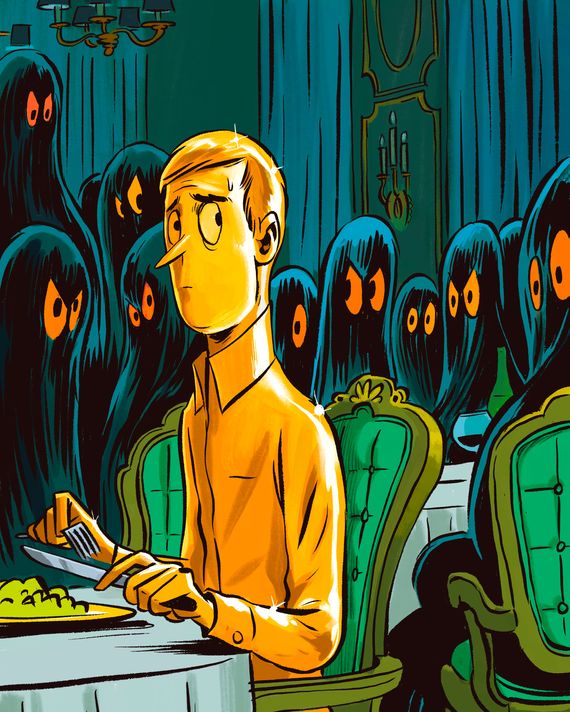
Illustration: Zohar Lazar
Illustration: Zohar Lazar
This article was featured in New York’s One Great Story newsletter. Sign up here.
A former CEO with a high eight-figure net worth spent a recent morning searching online for cheap flights. He drives a sensible car. He wears $140 shoes, and he winces whenever he flips over the price tag on a Prada sweater. He owns a mere two houses. He knows exactly how much money he has — he can check his bank balance anytime — but it never quite feels like his. “I’m still not acclimated to being rich,” he told me. “I find even saying these words to you now a bit disturbing. It’s just not part of my identity.”
For two months, I interviewed people with extreme wealth, asking them how money had changed the way they think — how their view of the world shifted once financial constraints disappeared. How did becoming rich alter their perceptions of status, friendship, obligation, and maybe even reality itself?
I sent many requests, offering anonymity. Many said “no.” (“We’re going to pass this time,” said a rep for a well-known hedge-funder. “Not my jam,” replied a famous entrepreneur.) Even more just ignored me.
But some said “yes.” One founded a large company. Another had made millions on his own and then married into hundreds of millions more. Another multiplied his family inheritance many times over by buying into the investment firm where he worked. Another was Mark Cuban.
At first, few of them would tell me outright that wealth had changed their thinking. But almost none could say it hadn’t, either. They deflected and hedged and resorted to hypotheticals. The former CEO said his perspective “hasn’t shifted that much” but then admitted “I might be deluding myself.” An acquaintance of mine who married into old money joked that “other people I know might regale you with the various ways I have dramatically and reprehensibly transformed,” but he couldn’t name one.
Meanwhile, ask pretty much anyone without money what wealth does to people and the answer is usually more straightforward: It makes them worse. Resentment of the rich now powers politics both left and right for slightly different reasons but with the same math: A tiny few control staggering amounts of wealth while ordinary people struggle to pay for rent and groceries. The number of billionaires has tripled since 2010, and the most visible among them are often the most obnoxious, many of them building the very AI companies that threaten to automate everyone else out of a job and into a permanent underclass. Hollywood has received the memo; every prestige-TV show now seems to be about affluent people who are either evil or dumb or both and who seldom make it through an episode without cheating on a spouse, defrauding a business partner, or murdering a poor person with their bare hands. Then, in January, into this already charged atmosphere dropped 3 million pages of Epstein files, exposing hidden depths of our elites’ depravity and also how often they have dinner with Woody Allen. The reputation of the rich has rarely been lower.
But the people I spoke to didn’t seem evil or dumb. None of them had emailed with Jeffrey Epstein. These weren’t the billionaires building bunkers in New Zealand or trying to buy the U.S. Constitution. Anyone willing to have this conversation is, by definition, self-selecting and probably an unrepresentative sample. All were willing to engage with my occasionally awkward questions and to struggle, in good faith, toward some kind of honest self-accounting.
However reluctant they were to draw conclusions about themselves, the people who agreed to talk often had plenty to say. In several cases, I asked for a short phone call or Zoom and they went for an hour, sometimes two. What surprised me most was how many of them, despite undergoing one of the most dramatic life changes possible, told me they were discussing this topic for the very first time. “I’ve actually never talked about this with anybody,” one said. “And it feels strange to do it with you.” Said another, “These are things I haven’t really thought about. I probably should.”
Not everything they told me was a revelation. A lot of their thoughts were tentative, the kind of things a person comes up with when they’re working it out as they speak. People contradicted themselves, changed the subject, and started stories they couldn’t finish. A question about money would turn into an answer about marriage, then into a long silence. Only some of it resolved into clean, quotable points. Still, in the accumulation of half-formed ideas and accidental admissions, a portrait took shape.
Early on, one source warned me that writing this story may be difficult because there is no universal experience of wealth. “I know a lot of very wealthy people,” he told me, “and you see some who are just epicurean hedonists. You see some who try to pretend that they don’t have it and feel quite guilty about it. Then you find some who either find a balance or keep working because they want more.” And yet, he said, just as studies have shown that poverty creates a scarcity mind-set — shaping how people think about things like risk and time — there must be something like an inverse effect. “There are probably some behavioral trends that can be pulled out.”
What emerged was less a unified theory than a cluster of variations. Wealth seemed to work differently on different people, depending on who they were and how the money arrived. A software developer whose start-up sold to a tech giant for nine figures — making him very rich, if not quite ultrawealthy — told me that when he got his payday, his first emotion wasn’t happiness but something closer to vindication. “It felt like things were finally as they should be,” he said. He’d grown up with ADHD and struggled in school. The money wasn’t just about money. “It was about showing the world — and my high-school English teacher who didn’t like me very much.” His fortune felt like a kind of scale-balancing, as if the universe had belatedly recognized who he was and compensated him accordingly.
I heard stories like this mostly from the self-made. Inheritors tended to describe their money as a source of gratitude, guilt, or embarrassment but rarely a solution to cosmic injustice. The self-made often believed they could rebuild their fortunes from scratch if they had to. “If you lose all your money today and wake up on the streets tomorrow having nothing but the clothes you’re wearing,” said a European entrepreneur who is both self-made and the son-in-law of a centimillionaire, “knowing that you can yourself build the life that you have is a vastly different feeling than basically having everything thrown into your lap.” He compared it to driving a race car. The self-made person has earned his spot on the team and “can control every tiny movement in that car if anything happens. But if you’re just placed in this fast machine with no training, that’s scary.”
David Roberts was born into money. His maternal grandfather, he told me, made a fortune in oil in the 1930s. As an adult, Roberts grew his inheritance by using part of it to buy an ownership stake in the firm where he worked, which sold for $2.7 billion in 2023. Still, he puts himself in the inheritor camp. “The drive forged in self-made people,” he told me, “is of a different caliber” from his own. The sacrifices someone born to wealth is willing to make, he said, are rarely as challenging. “There’s a resilience you probably only get from confronting scarcity and defeating it.” He was candid about what he saw as his own limitations. “I don’t think I ever had the confidence and risk tolerance” to be an entrepreneur, he said. Even so, he had his own version of striving. As a young father, he remembers worrying about whether he would “ever make enough money to mimic the lifestyle I had been brought up in.”
Ed McCaffery, a tax-law professor at USC who advises wealthy families, told me that among inheritors, the psychology isn’t uniform. In his experience, it splits along gender lines. Female heirs, he said, more often treat the money as something to protect. Male heirs are more likely to invest inherited money in risky ways — active trading, crypto, hedge funds, some aggressive bet that lets them feel they’ve transformed the wealth into something earned. “The son wants to feel like it’s his money, so he’s going to do something with it to make it feel earned,” McCaffery said. “Take the money, put it in bitcoin, claim that you made a fortune in bitcoin.”
For all those differences, certain effects seemed to recur. One of the most common was isolation. For some, it set in almost immediately. The European entrepreneur remembers the exact moment. As a university student, he’d launched a business on his own, and one afternoon he sat in his dorm room refreshing his laptop screen as hundreds of thousands of dollars flooded his bank account. He would go on to make much, much more, but that first infusion was the most destabilizing. “I was like, Fuck, what do I do now?” he says. That night, he went to dinner with schoolmates and said nothing. “My friends would’ve called me a prick.” He also couldn’t tell his parents, who are hippie anti-capitalists. “I couldn’t say, ‘Hey, I made more money in literally one second than you do in years.’ I got what I wanted, but in that moment, I felt totally isolated.”
It became a pattern for him, especially after he married a woman who came from a much wealthier family. He noticed his wife talked less about herself with others than anybody he knew. “You don’t tell your friends in high school about all the exotic places you’re jetting off to because they’re going to be jealous. They’re going to tell stories about you,” he said.
For anyone already inclined toward solitude, money can make it easier to withdraw further. “I’m naturally very introverted, and I don’t like being around a lot of people,” said the software developer who sold his company to the tech giant. “Wealth allows me to just be a little more insulated and less dependent on other people,” which perhaps indicates he recognized that this was not entirely a good thing. “As you move up in terms of luxury and comfort, experiences are always going to be more private,” noted the European entrepreneur. “When you get a bigger house, your neighbors are further away. In a nice hotel, the people that service you are going to be more polite and less personal. And you don’t meet anyone in a private jet.”
Without honest company, even people who suspected that wealth had changed them didn’t always trust themselves to say how, likely because our brains are built to normalize whatever life throws at us. The European entrepreneur had studied psychology and knew the term for this phenomenon: hedonic adaptation, or the human tendency to adjust to new circumstances quickly no matter how drastic the change. “Our senses don’t work objectively,” he said. “We can only see light compared to dark. We can only hear loud sounds compared to quieter ones.” Happiness works the same way. It’s not a fixed target but the gap between what you expected and what you got. He understood all this in theory. Then his expectations rose anyway.
Most of my sources said that buying nice stuff gets old fast. “Having your new car — the anticipation of which model, which style, which color — it really got me excited,” said the European entrepreneur. “But after the first couple of drives, you don’t use any of the features. It is just like your old car, a way to get from point A to point B.” The software developer described something similar. Before he could afford them, he would occasionally splurge on $500 sneakers. “Now I buy myself those same $500 sneakers and I don’t get the same pleasure,” he says. It turned out the pleasure wasn’t in the shoes themselves but in the irresponsibility of the purchase. He said he recently invested a million dollars in OpenAI — and that did the trick.
Not everybody I talked to believed that money changes people in such complicated ways. I sent Mark Cuban a cold email on a Tuesday afternoon, and by that evening he was calling me from his car in Dallas.
Cuban grew up in a working-class family in Pittsburgh — neither parent had graduated from college, and his father never made more than $40,000 a year — and once slept on the floor of an apartment he shared with five roommates. Then, at 40, during the dot-com boom, he sold his company Broadcast.com to Yahoo for $5.7 billion. I asked whether becoming rich changed him, and he said “not really.” “It was an enabler, but not really a change factor,” he said. “If you were happy when you were broke, like I thought I was, you’re going to be insanely happy when you’re rich. And if you were miserable, that doesn’t change.”
So maybe wealth isn’t transformative; it’s an amplifier. It turns up the volume on whoever you already are. When you don’t have money, your personality runs up against friction all day long. You might be generous, but your generosity has a ceiling when you’re living on a fixed income. You might be anxious, but ordinary life forces you to confront your stressors often enough to keep them manageable. Money removes that friction, and whatever it was holding in check is free to run. The generous person can give amounts that change other people’s lives. The anxious person can design a life without any of their old triggers and then fall apart when the smallest thing goes wrong because their coping muscles have atrophied. This might sound reassuring — You’re still you! — but how many people really know who they are when there’s nothing pushing back on them? Plenty of billionaires probably seemed normal when their eccentricities were still bound by everyday constraints.
Cuban said he still thinks the way he always has but his money has allowed him to act on that thinking at a larger scale. He told me about going to the Dallas Mavericks’ 1999 season opener and finding the arena half-empty. “I said, ‘I could do a better job than this,’ just the entrepreneur in me talking out loud. And then I realized I could put my money where my mouth is.” He bought the team. Later, he found himself similarly irritated by the health-care system, especially the layers of markup built into prescription drugs. His answer was Cost Plus Drugs, a company that routes around middlemen to sell medicines at lower prices. “I’m trying to fuck up the health-care industry to the benefit of everybody else in the country,” he told me. “And once I’m through with that, I can go after education.”
He maintained he still dresses like a slob. “I worked my whole life so nobody can tell me what to wear.” He credited luck as much as talent for his fortune. And he had remained close with his old friends. “My high-school buddies, my college buddies, my roommates when I moved to Dallas, we’re all still friends,” he told me. “When Indiana went on its run in the college-football playoffs, we all went together. Now, that was on my plane and I picked up the tab. But my relationships haven’t changed all that much.”
Even if money doesn’t change a person in major ways, it still introduces new asymmetries into everyday life. In many of my interviews, the conversation found its way to the same topic, usually before I could bring it up myself: the restaurant check. It might be the thing that makes the abstract strangeness of being wealthy feel most concrete. It’s a tiny war over status, pride, and generosity that happens every time the rich and non-rich sit down to eat together.
Here’s the situation: You’re a deep-pocketed person out to dinner with shallower-pocketed friends. The meal winds down. The check arrives. You could easily pay the whole thing and never think about it again. But paying might send a message you didn’t intend — that you think you’re better than everybody else at the table, or that you want to be thanked, or that you’re keeping score. Not paying, or splitting the bill, sends a message too — that you’re cheap or clueless or pretending to be modest. Every option sucks.
A founder of a large company told me he always gets the check and has learned to make peace with the awkwardness. “I think I should always pay,” he said. His close friends push back. “They’re like, ‘No, I need to pay some because I’m not here to mooch on you.’ And I’ll say, ‘I know you’re not here to mooch on me.’ And they’re like, ‘Yeah, but I still need to pay some.’” Over time, he said, you develop codes. When he and friends go on vacation, he’ll cover the hotels and meals; they’ll pay for their own flights. “Usually people always need to protest once, but then when you go out twice, they’ll just let you pay,” he said. “But then sometimes you do wonder how much people are wanting to hang out with you because you’re paying the bill and you actually have no idea.”
The European entrepreneur told me that when he’s out with friends and the check arrives, “in implicit ways it’s suggested that I take the bill because I can. It’s super-subtle but clearly noticeable.” He doesn’t mind paying, but he’s uneasy about the expectation. “There’s a power dynamic that’s not equal.” He’d felt the imbalance from the other side, too, when his in-laws flew the family somewhere by private jet. “I want to say thanks as I would to anyone making a nice gesture. But again it feels like the dynamic is a bit skewed.”
The restaurant check represents a miniature argument about obligation. What do you owe the people sitting across from you? The tax code is the same argument but bigger.
At a certain level of wealth, the tax system doesn’t just influence a person’s decisions; it makes them. Where to put your money, when to cash out, where to live — all of it gets filtered through the goal of minimizing the bill. According to McCaffery, the USC tax-law professor, the system favors one strategy above all others. He coined the phrase “Buy, borrow, die” to describe the method by which the very wealthy avoid taxes on their money almost completely: Buy appreciating assets — blue-chip stocks, Manhattan real estate, Hockneys — borrow against them instead of selling, since a sale would trigger capital-gains taxes, then hold them until death, when the tax basis resets and heirs inherit the assets with the gains effectively erased. “If you depend on wages,” McCaffery told me, “you face inescapable taxes. But if you already have capital, you’re paying no taxes. Zero taxes.”
McCaffery came up with “Buy, borrow, die” in the 1990s thinking it was an act of exposure. His idea was that if he could name the strategy plainly enough, lawmakers would be forced to close the loophole. He presented the idea at academic conferences. Nobody cared. “They thought it was too simple,” he told me. “People would say, ‘You don’t have any data.’ I would say, ‘It’s not a data thing. If I can show you how you could be rich and pay no tax, why wouldn’t rich people do that?’” He started consulting for billionaires, who understood it right away. “I can explain it to them in 15 minutes,” he said. “Then they send me nice Christmas presents.” Later, McCaffery’s framework became a movement among crypto investors on Reddit — “at which point I said, ‘Fuck it, I’m going to do it myself.’” He started investing his own savings according to the formula he’d spent decades explaining to everyone else. “I came up with ‘Buy, borrow, die’ to make the world better,” he told me. “And now the only thing I’ve done is make millions for myself.”
To be fair, nobody likes paying more than they have to. Having more money doesn’t change that feeling. If anything, wealth creates more opportunities for it. The European entrepreneur told me that being rich can feel a little like being a western tourist in a developing country but all the time. He said, “When other people see that you’re rich, why would they not charge you double for everything?” So you haggle even over insignificant amounts. “Who wants to be overcharged? It might not matter to you financially, but you still don’t want to be fucked.”
In 2021, ProPublica estimated that the 25 richest Americans paid an average effective federal income-tax rate of about 3.4 percent, which prompted calls for their heads along with various structural overhauls. Cuban told me he’s skeptical of most proposed solutions, including Elizabeth Warren’s Ultra-Millionaire Tax Act. “The politicians who talk about wealth taxes haven’t thought it through,” he told me. His objection wasn’t to the idea that the wealthy should contribute more but to the practical problem of turning net worth into tax revenue. “If it’s a 5 percent tax, what happens when they sell all those assets to try to create that cash?” His preferred fix is preventative rather than punitive. Instead of taxing wealth after it’s been made, he argues for distributing ownership earlier. “If a company’s CEO gets stock options, the janitor should get them at the same ratio,” he said. “It’s far more incumbent upon the wealthy to try to figure these things out, because if we don’t, you’re going to see people protest, and it could go horribly, horribly wrong.”
Lately, TV shows, movies, and books have become obsessed with the wealthy, maybe because they’re one of the few groups that can be portrayed negatively without provoking a backlash. Some of the people I spoke to were annoyed by this, not because they thought the portrayals were wholly unfair but because of their sameness. Rich characters usually come in just two varieties — depraved or ridiculous — without much shading in between.
Now retired from finance, David Roberts writes a Substack newsletter about wealth and the psychology of it. One reason he started it, he told me, was his frustration with the one-note way culture depicts people like him. “It tends to skew really negatively,” he said. “So I wanted to give people a sense that the personalities of wealthy people run the gamut. I know a lot of them who are really normal.”
Roberts recently read Emma Cline’s novel The Guest, which he thought captured Hamptons types accurately. (He has a place in East Hampton.) “But then I was thinking, There are no good rich people in that particular book,” he said. “And then I was thinking, well, have I read any modern books or seen movies where I could say there’s an actual nuanced good rich person? I had to go back to Dickens.”
He understands the fixation. “People love a story of a wealthy person brought low by their own bad behavior. On TV, the rich are always having affairs and making parenting mistakes galore. And I think it’s a sort of balancing” — a way for audiences to feel that they wouldn’t really want to trade places. Even his favorite show is guilty. “No one’s ever written incoherent dialogue better than on Succession,” he said. “Logan Roy builds this big empire, but he hates his kids and his kids hate him, and he hits his grandson.”
Even the people who found those TV caricatures flattening understood where they came from. They’ve seen enough ugly conduct from fellow wealthy people to know that there’s a ring of truth to them. The acquaintance who married into wealth said that the fancy places he’d traveled with his wife’s family “are just stacked with assholes. I’ve certainly felt bad for a lot of kids whose parents I’ve seen behaving badly.”
Ask anyone who works with wealthy people and you’re likely to hear stories like this. An executive assistant who has served an affluent family for decades told me that when she started, her employers, who both came from working-class backgrounds, were more grounded. Over time, she said, “a sense of entitlement has grown a hundred percent.” When something small breaks, “they don’t know how to cope. It’s like, ‘Call 9-1-1 and get somebody to fix this right now.’ They can’t survive.” And then there are their adult children. “They’re horrible,” she said. “They’ve never worked, and they walk into the house and tell me to make them a pot of coffee.” The waste bothers her most. Food is ordered, plans change, and it’s thrown away. A friend who cooks for another wealthy family, at a level the assistant compares to the French Laundry, watches pristine meals scraped directly into garbage bags.
Carelessness and helplessness are two ways entitlement can manifest itself. Another is the need to stage it in public. Jaclyn India, the founder of Sienna Charles, a luxury travel agency that serves the ultrawealthy, said that what some of her clients want most is recognition — not just good service but to be noisily fussed over, especially in front of other rich people. “They want that everywhere,” she said. One client insisted on being checked in from her SUV before she arrived at her hotel. “She wanted the staff to walk her to her room like she was a president.”
This isn’t just ego, India said, so much as survival inside a hierarchy that’s steeper than outsiders can probably imagine. A person worth $50 million is “a nobody.” That’s an awkward place to be, she said, “because it’s an enormous amount of wealth but you still have to push your way around to get great service.” Someone worth $100 million is only marginally better off. “You still can’t just call and get a table at Carbone or Polo Bar. There are still thousands of people richer than you. So you’re basically a loser.”
So how can a person go from tossing out fancy food and pretending to be the president on vacation to something even darker? How does ordinary entitlement curdle into moral rot?
For many people, the latest batch of Epstein files simply confirmed what they had already suspected about the effects of wealth. For some of the people I spoke to, it stirred more intimate questions: How close have I been to someone like this without realizing it? Under the wrong circumstances, could I have become one of them?
David Roberts told me he knew people who turned up in the Epstein files. He was surprised to see some of those particular names, though not especially shocked by the files’ overall contents. “At all levels of socioeconomic status, men abuse women,” he said. What struck him more was the number of people who drifted into Epstein’s orbit without thinking about what it would cost them. He mentioned Howard Lutnick, the U.S. Commerce secretary. “Why did he visit Epstein’s island? Probably because he thought it would make him look powerful,” Roberts said. “I think it was impulsive. A lot of wealthy people don’t really think about what legacy means. They think it means having a building named after you. They don’t think about the more important part: Are you remembered as a good person?”
Roberts recently wrote about the Epstein files on his Substack and in the process found himself asking whether a younger version of himself might’ve looked the other way for the chance to have dinner with someone like Bill Gates. “I think I would have,” he said. “But I do think I would’ve gotten that ick feeling or my wife would’ve told me ‘no.’”
I asked Dr. Paul Hokemeyer, a psychotherapist who treats high-net-worth patients and is the author of Fragile Power: Why Having Everything Is Never Enough, if he could sketch out something like a road map, a sequence of psychological shifts that could transform an ordinary wealthy person into a monster. He gave me eight steps.
It starts with (1) a shift in how the person sees themselves. Wealth changes not just what a person can buy but what they feel entitled to want. Then comes (2) isolation: private clubs, private schools, private planes, private neighborhoods, private versions of reality. Soon (3) an echo chamber forms and the wealthy person is surrounded by people whose status and income depend on keeping them happy. Bad news stops arriving. As a result, (4) tribal instincts take over and outsiders are viewed with suspicion and contempt. Then come (5) psychological defenses. The wealthy person begins to deny the humanity and needs of others. They rationalize that if they made their money, anyone can, and those who didn’t are lazy or immoral. Eventually (6) they become isolated from consequences. They can hire other people — lawyers, publicists — to deal with the ramifications of what they do. From there (7) a feedback loop takes hold: Bad behavior is rewarded with more power, more wealth, more status, which only reinforces the conviction that one is right and others are wrong. The final stage is (8) moral distortion. “The person of wealth rationalizes their actions as appropriate because the world in which they live rewards those who live like they do,” Hokemeyer explained. “While their behaviors from the outside appear predatory, they view their actions as completely justified, normal, and in fact celebrated by their tribe.”
When I described the eight steps to Roberts, he nodded along. He thought of Tom and Daisy Buchanan in The Great Gatsby — “careless people who break things and let other people clean up the mess. They’re the literary paradigm of that whole trend.” He says he’s seen it in real life too. “There’s a lot of infidelity among wealthy people because the men just feel entitled to a newer model of their first wife. And they don’t think about how it might affect their children.”
None of the people I spoke to seemed to have traveled very far down Hokemeyer’s flowchart. But most seemed aware, at least faintly, that such a fall was possible. And nearly all of them, when asked how wealth had changed them, eventually offered the same proof that it hadn’t: They were still cheap.
One source recently bought a $6.53 Americano and was so annoyed by the price that he vowed never to return to that coffee shop. The acquaintance who married into old money insisted that he never pays the nickel for a bag at the grocery store, even if it means carrying a half-dozen cans of beans home in his coat pocket. “I will absolutely save that five cents there — and then contemplate some major purchase that is orders of magnitude and then some beyond that,” he said.
Hokemeyer told me this kind of thinking is normal among the wealthy and is usually a good sign. Thrift, he says, serves as a kind of psychological guardrail. “It assures them that they are not becoming too soft, spoiled, entitled, or a host of other negative stereotypes that we associate with the Über-rich.”
Maybe they’re not really saving money so much as saving an idea of themselves. A version untouched by money or at least not wholly remade by it. Even Mark Cuban told me he shops on Amazon for everything from food to clothes. “I still get pissed off when things cost too much,” he said. “Milk is $4.80 a gallon. When did that happen?” Becoming a billionaire, he said, “doesn’t suddenly make it easy to send a wire transfer for a million dollars. I just upgraded my plane. I got a used one.”
- Sam Bankman-Fried’s Prison Experiment
- Wall Street’s Eyes on the Strait
- What Do You Do and What Do You Make?